A2A vs MCP Protocol: How Agent-to-Agent Communication Fills the Gap Tool Calling Can't
A2A vs MCP protocol explained: learn how agent-to-agent communication handles cross-vendor orchestration where tool calling falls short.

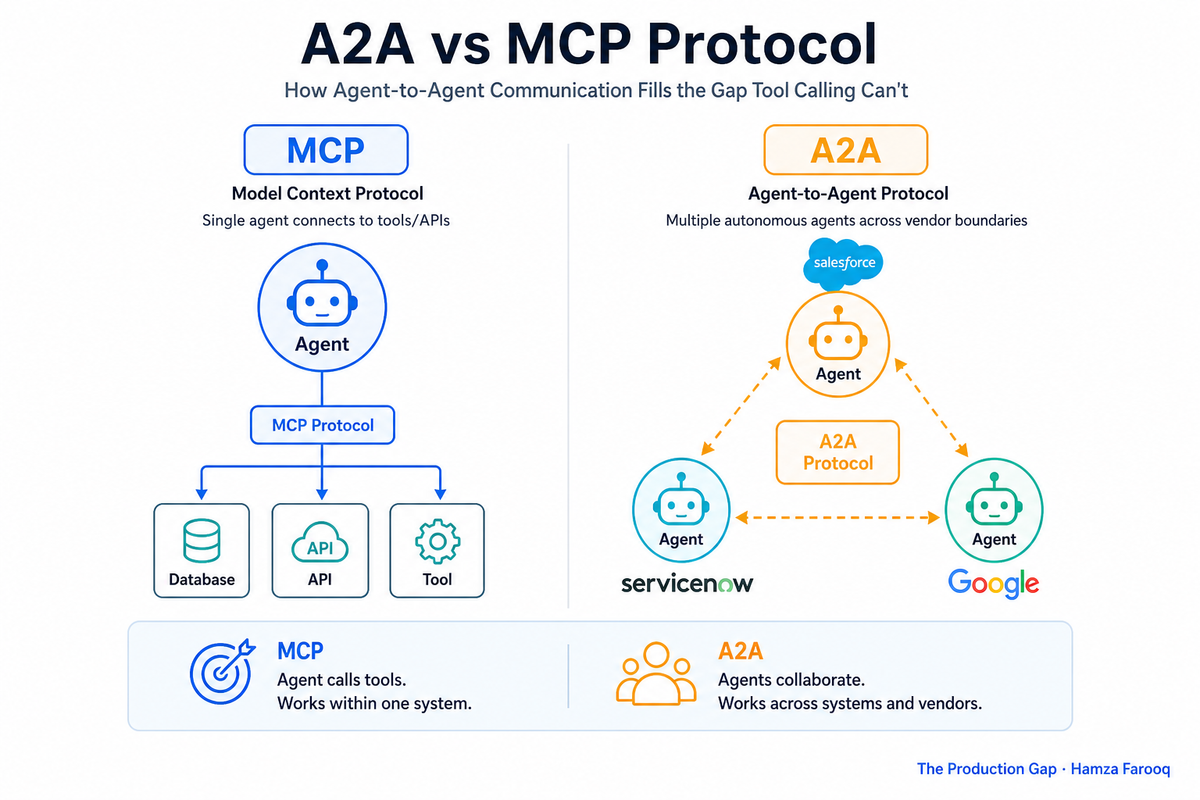
TL;DR: MCP connects agents to tools and data sources; A2A handles peer communication between autonomous agents. MCP has no mechanism for delegating tasks between independent agents across vendor boundaries. Use both together: MCP for tool access, A2A for agent-to-agent orchestration. They operate at different layers and are designed to compose.
Key Takeaways
- MCP handles tools, not agents: Built for a single agent calling tools and retrieving data, not coordinating autonomous peers.
- A2A fills the cross-agent gap: Gives independent agents a standard way to delegate tasks, share status, and return results across vendor boundaries.
- Agent Cards enable capability discovery: Each A2A agent publishes a machine-readable card so orchestrators can find and route to specialists without hardcoded integrations.
- A2A and MCP compose at different layers: MCP connects an agent to its tools; A2A connects agents to each other. The architectural question is not which to pick but where cross-agent delegation begins in your stack.
Introduction
MCP is the default wiring for agent-to-tool communication. It works well until deployments stretch past single-vendor boundaries: one agent in Salesforce, another in ServiceNow, a third on a custom LLM stack. At that point, MCP's tool-calling model hits a structural limit, because it was never designed to coordinate autonomous peers.
A2A was. Cisco's engineering team documented this split directly: MCP adoption has been rapid while A2A's has been a slower burn. That gap is why teams reach the coordination problem before they anticipate it.
Both protocols are under active development. The comparisons throughout this guide reflect the state of each protocol as of July 2026.
What does MCP actually do, and where does its tool-calling model break down?
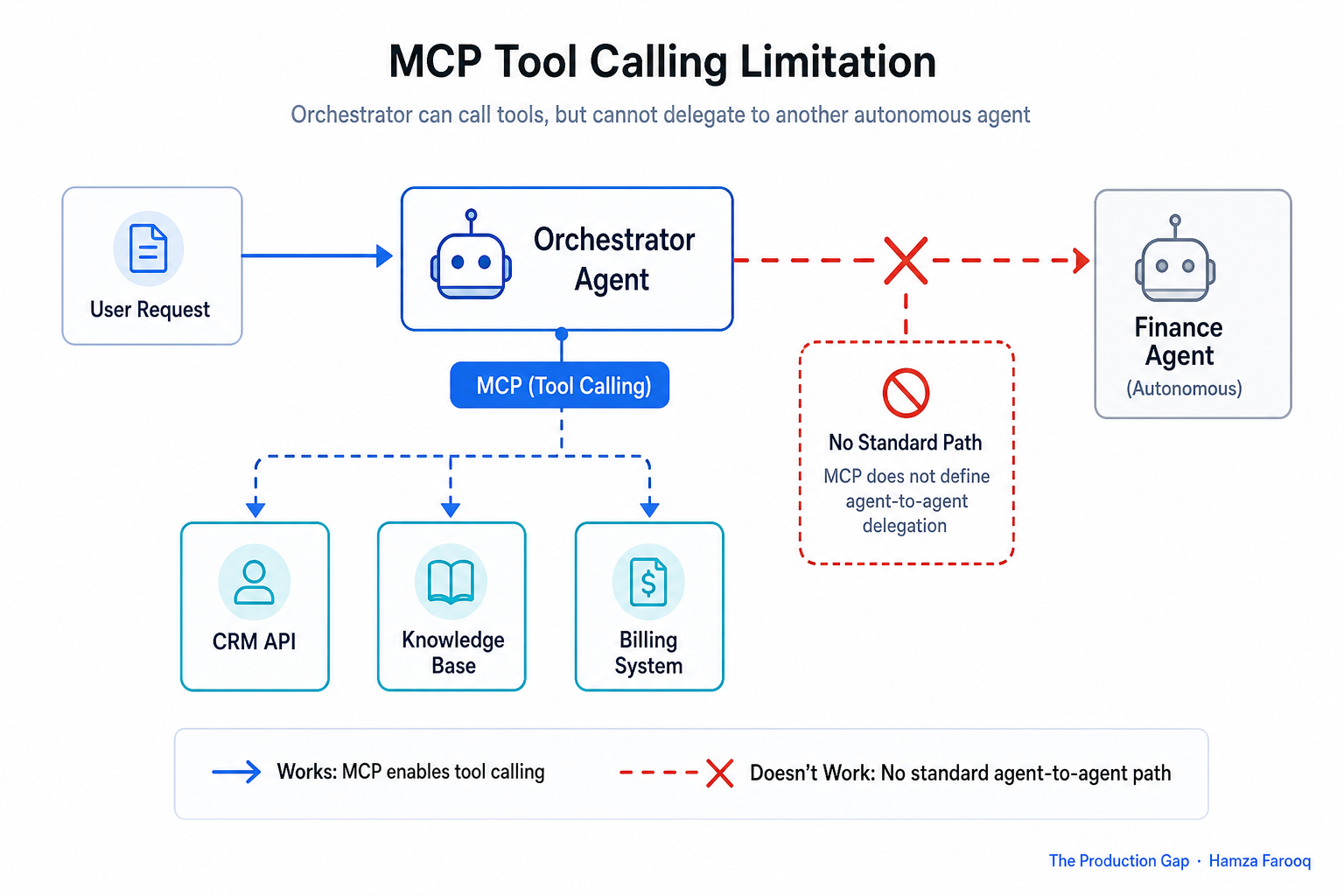
MCP is a structured protocol that lets a single AI agent invoke tools, query APIs, and retrieve external data, but it has no mechanism for delegating tasks to another autonomous agent.
Auth0 confirms: MCP is designed for LLM-to-data-source integration, not agent-to-agent interoperability. A customer-support orchestrator can use MCP to pull ticket history from Zendesk and check entitlements from a billing API. When it needs to hand off a complex refund analysis to a specialist finance agent on a different vendor stack, MCP has no defined mechanism for that handoff.
Merge.dev draws this line precisely: MCP facilitates LLM-to-data-source integration; A2A supports agent-to-agent interoperability, two distinct coordination problems. Every MCP tool call assumes the orchestrator stays in control and the tool is subordinate. MCP's limitation is not a bug; it is a scope boundary.
How does A2A's Agent Card mechanism change cross-vendor capability discovery?
A2A's Agent Card is a machine-readable specification each agent publishes, declaring its capabilities, supported task types, and endpoints, so orchestrators can discover and route to specialists without hardcoded integrations.
An unbiased protocol comparison confirms: A2A uses Agent Cards while MCP lacks any standardized discovery mechanism. In practical terms, the unit of registration shifts from an API endpoint to an autonomous agent with declared skills. As a practical rule of thumb used in this guide, that distinction matters most for platform teams managing growing fleets of specialist agents across vendor boundaries.
Table 1: MCP vs A2A Capability Matrix
| Capability | MCP | A2A |
|---|---|---|
| Tool invocation | Standardized | Not in scope |
| Agent delegation | Not in scope | Standardized |
| Capability discovery | No standard mechanism | Agent Cards |
| Cross-vendor routing | Not in scope | Protocol-native |
| Task status and async results | Not defined | Built-in |
How do A2A and MCP compose together in a production stack?
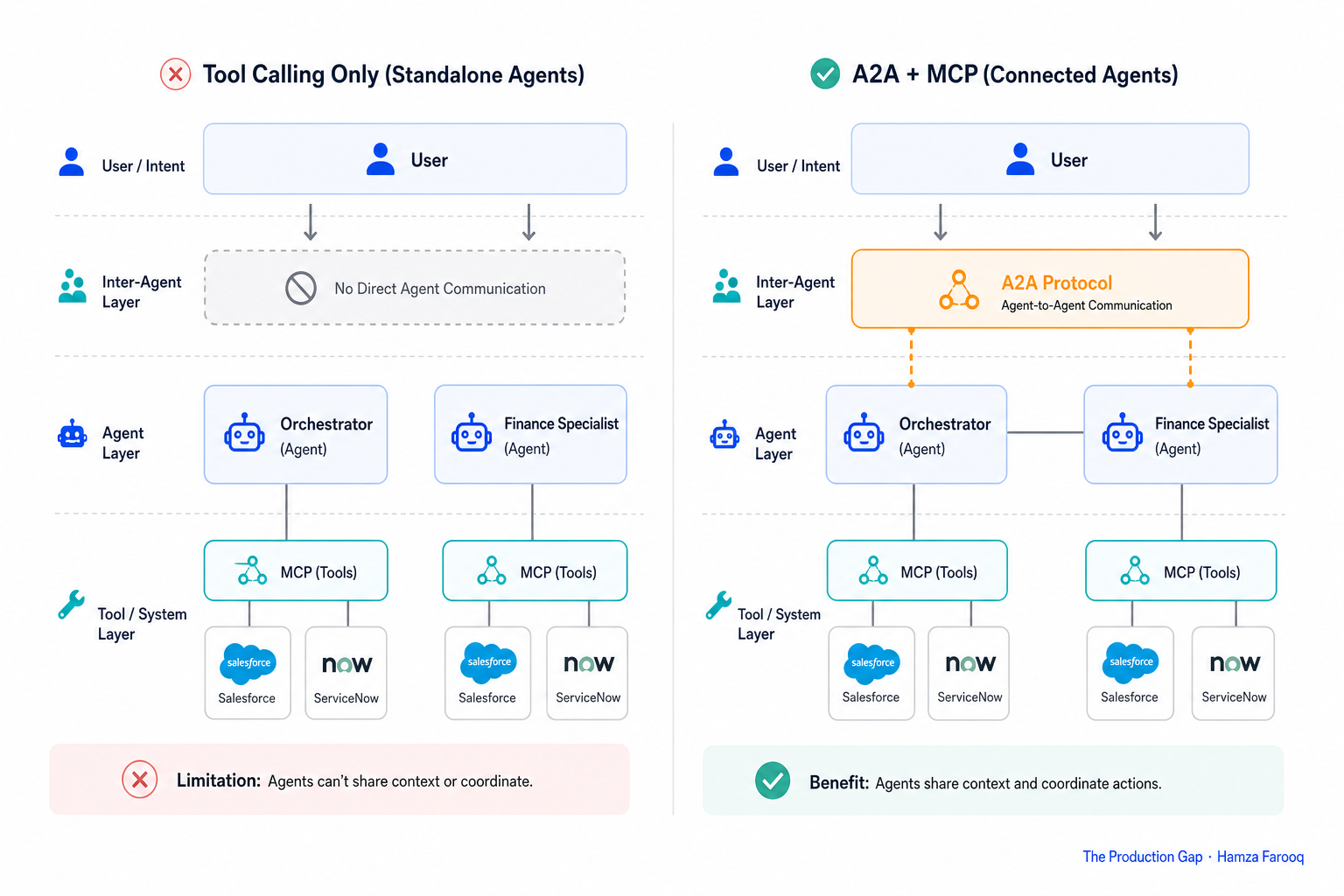
In a production multi-agent stack, MCP connects an individual agent to its tools while A2A connects that agent to other autonomous agents; the two protocols operate at different layers and are designed to run together.
A2A has the capability to be layered with MCP, meaning both can compose in a single stack. The following walkthrough, used as the framework in this guide, illustrates how this plays out in a customer complaint resolution scenario:
- Orchestrator receives a user request.
- Orchestrator uses MCP to pull order history from a Salesforce MCP server.
- Orchestrator uses A2A to delegate refund eligibility analysis to a specialist finance agent discovered via Agent Card.
- Finance agent uses its own MCP connections to query billing and entitlement APIs, then returns a structured result via A2A.
- Orchestrator synthesizes the result and responds to the user.
Both agents are MCP-native internally; A2A bridges them at the inter-agent layer. Cisco captures this directly: both protocols are complementary, serving distinct roles in agentic AI architecture. The architectural decision is not A2A vs. MCP. It is identifying where cross-agent delegation begins, then applying A2A at that boundary.
Frequently asked questions
When should an engineering team adopt A2A instead of relying solely on MCP?
Adopt A2A when your agents need to delegate tasks to other autonomous agents, especially across vendor boundaries. MCP supports LLM-to-data-source integration but not agent-to-agent interoperability. Once your architecture requires the latter, A2A is the relevant layer. A practical trigger: if routing logic between agents is currently handled by custom glue code, A2A is the protocol that standardizes that boundary.
How do Agent Cards in A2A enable capability discovery across heterogeneous agent systems?
Each A2A-compliant agent publishes an Agent Card declaring its capabilities, task types, and invocation endpoints. MCP has no equivalent standardized discovery mechanism. This means an orchestrator using A2A can resolve which specialist agent handles a given task type at runtime, without manual configuration or hardcoded routing tables.
Can MCP and A2A be used together in the same agent architecture?
Yes, and they are designed to. MCP handles internal agent-to-tool wiring; A2A handles external agent-to-agent wiring at a different abstraction layer. The two protocols address distinct coordination problems and do not overlap in scope.
Adding A2A to an MCP stack requires publishing Agent Cards for each specialist agent and updating the orchestrator's routing logic to resolve capabilities at the agent level rather than the API-endpoint level. The practical effect is that capability discovery moves from tool-level API calls to agent-level declarations, which changes how platform teams register and route to specialist agents. The internal MCP wiring of each agent remains unchanged.
Conclusion
MCP solved tool calling but left a gap at the coordination layer. A2A addresses that gap directly, giving autonomous agents a standard way to delegate tasks and share results across vendor boundaries.
The core decision is identifying where tool-calling ends and agent-to-agent delegation begins. Cisco's framing holds: these protocols are not competing, they are complementary, and they serve different jobs in the same stack.
Your next step: Audit your stack for routing logic sitting between agents. Publish Agent Cards for your two most-used specialist agents and validate that an orchestrator can discover them at runtime without manual configuration.
The teams who get this right will not have chosen A2A over MCP. They will have identified exactly where one ends and the other begins.
Learn from me

Agent Engineering Bootcamp: Developers Edition, my Maven cohort. Advanced agentic RAG, multi-agent orchestration, memory, evals, and guardrails. Take agents from prototype to production. Join the next cohort →
Hire us
Traversaal.ai. We're a team of forward deployed engineers solving the toughest AI problems for Fortune 100 companies: document intelligence, agentic data platforms, and real-time web intelligence, deployed in production. Work with our team to deploy your next agentic ecosystem. Talk to Traversaal.ai →
Join us
Want to solve these problems with us? We're always looking for forward deployed engineers who want to ship production AI. jobs@traversaal.ai