Agentic AI RAN Architecture in 2026: What Ericsson's and Nokia's Announcements Change for Always-On Network Agents
Agentic AI RAN architecture is now an engineering problem. See how Ericsson's rApp agents and the AI-RAN Alliance blueprint reshape autonomous network design.

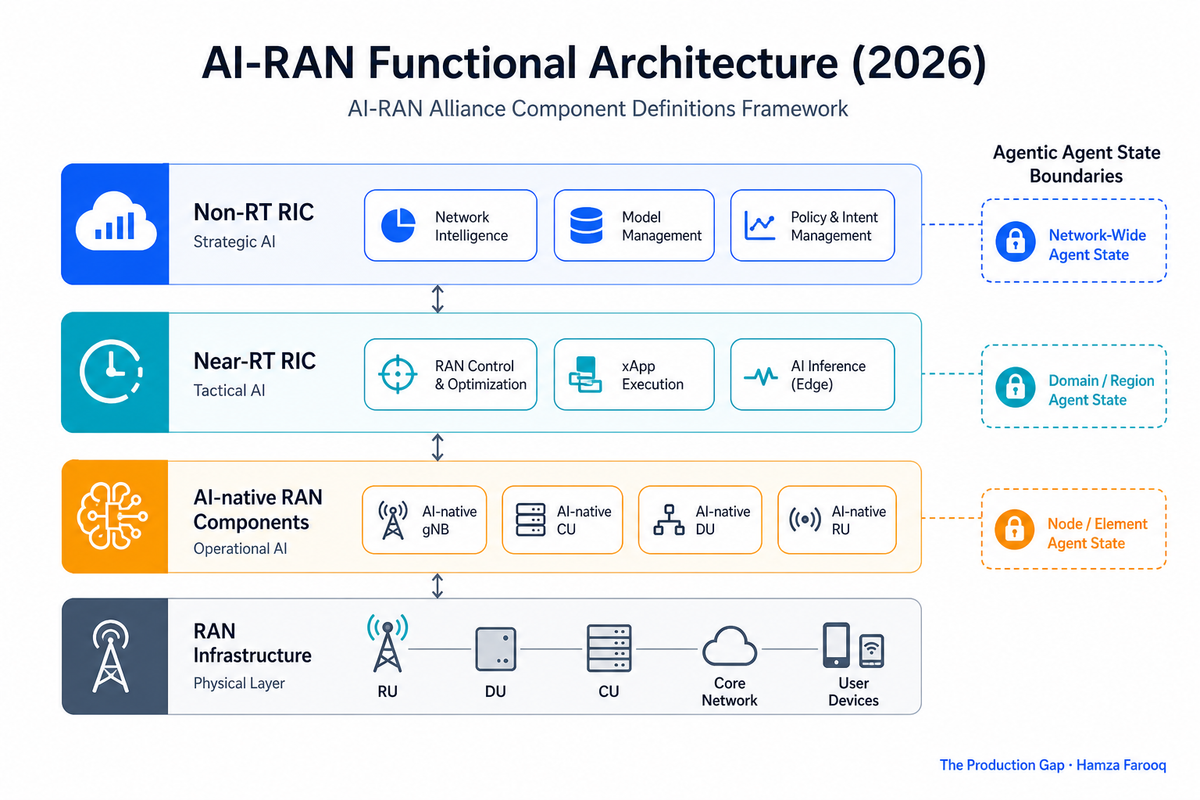
TL;DR: As of 2026, Ericsson's commitment to AI-powered rApp agents within the Non-RT RIC, combined with the AI-RAN Alliance's first industry-consensus architecture blueprint, shifts agentic AI RAN architecture from a research concept into an active engineering problem. The central unresolved challenge is persistent agent state management across RIC boundaries, no current O-RAN standard addresses this, and architectural decisions made now will directly shape 6G's foundation.
Key Takeaways
- Agentic RAN is now an engineering problem, not a planning one.
- The AI-RAN Alliance blueprint is the first shared functional reference to replace competing proprietary definitions.
- No current O-RAN standard specifies where agent state persists across Near-RT and Non-RT RIC boundaries, this is the central unresolved problem in agentic RAN architecture as of 2026.
- Ericsson's rApp agents create a structured path to Level 5 autonomy without discarding O-RAN, but introduce statefulness requirements the rApp model was never built for.
- The gap between AgentRAN's lab results and operator deployments remains open; treat claimed timelines with skepticism until production references appear.
- Architectural decisions made in 2026 will directly shape 6G's foundation.
Introduction
As of 2026, the O-RAN xApp/rApp model has delivered disaggregation, clean interface contracts, and separation between Near-RT and Non-RT control loops. That model was built for stateless, episodic automation. When Ericsson embedded agentic logic into rApps and the AI-RAN Alliance published its formal Architecture Overview, the industry's first shared functional blueprint for AI-native RAN, the debate stopped being theoretical. It now has a specification to argue against.
The central problem: always-on network agents require persistent memory across decision cycles, and the rApp model was built for the opposite. The real contest in 2026 is not inference at the edge. It is where agent state lives.
What did the AI-RAN Alliance's architecture framework actually define, and what did it leave unresolved?
The AI-RAN Alliance's Architecture Overview established the first industry-consensus functional blueprint for AI-native RAN, but deliberately deferred persistent agent state management, making it a necessary foundation rather than a finished answer.
The framework established functional separation of AI-native RAN components, inference engine roles at each layer, and how AI workloads relate to traditional RAN workloads. A stateless inference engine optimizing beamforming from a single snapshot fits cleanly inside that picture. An agent that tracks interference patterns across multiple handover events and replans continuously does not. The Alliance's component definitions do not prescribe how that agent's context gets stored, replicated, or recovered after a node failure. This gap is not a flaw in the Alliance's intent; it is the problem the industry needs to solve next.
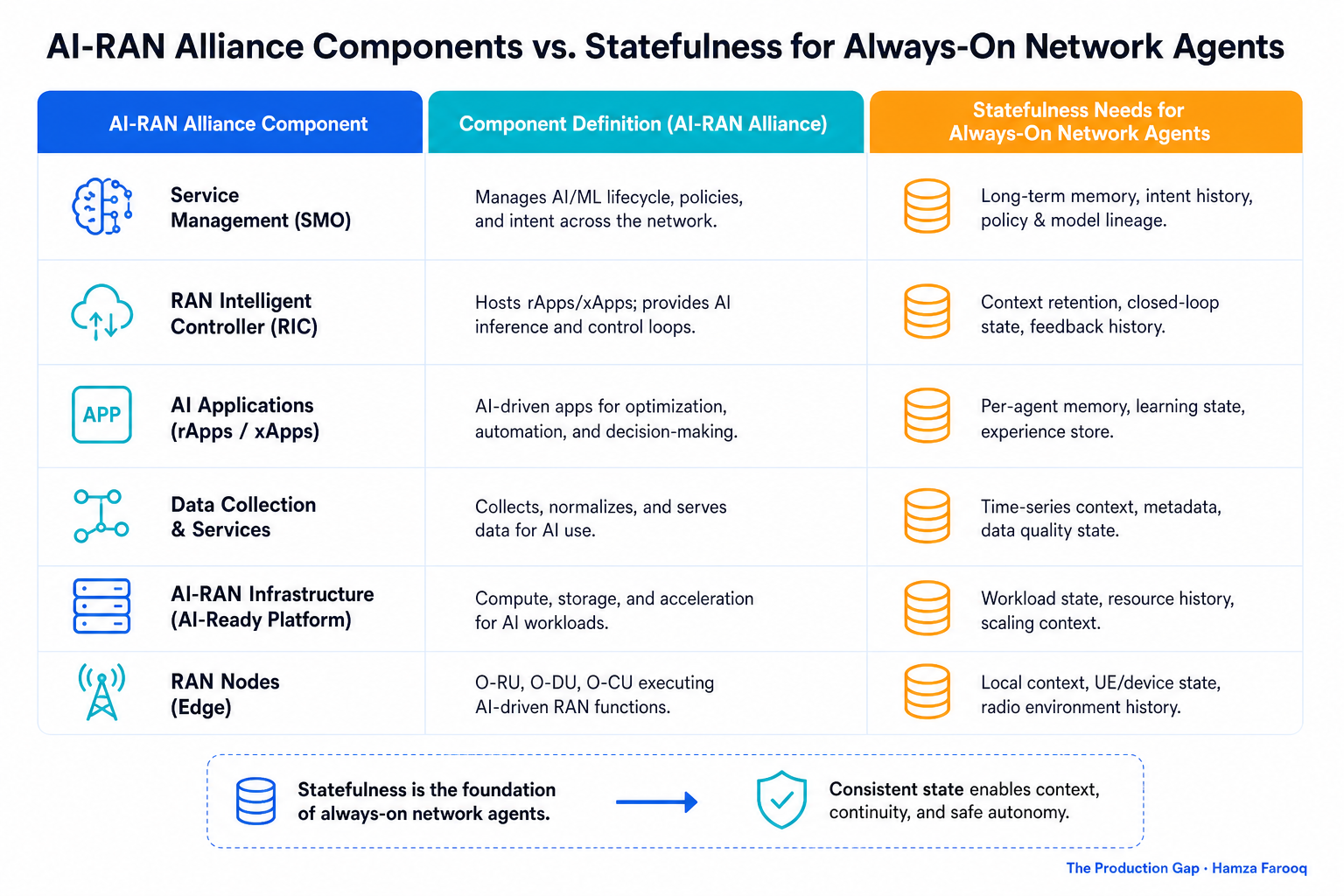
Table 1: AI-RAN Alliance Component Gaps for Always-On Agents, Author Analysis, 2026
| AI-RAN Alliance Component | Defined Interface? | Stateless/Stateful Assumption | Gap for Always-On Agents |
|---|---|---|---|
| AI Inference Engine | Yes | Stateless (episodic inference) | No persistent context across cycles |
| AI Model Repository | Yes | Stateless (model store) | Not designed for agent memory |
| AI Data Pipeline | Partial | Stateless (stream-based) | No session continuity across RIC boundaries |
| RIC to Agent Coordination | No | Undefined | Entire orchestration layer is unspecified |
How does Ericsson's rApp-based agentic architecture actually work, and where does it break from the O-RAN model?
Ericsson's position is precise: a traditional rApp receives a policy recommendation, executes it, and terminates. An agentic rApp holds multi-step goals, tracks progress across execution cycles, retains prior network states, and replans when conditions change. That is a fundamentally different execution model sitting on an A1/R1 interface designed for the former.
The deeper problem surfaces at the Near-RT RIC boundary. When an agentic rApp's goal spans both the Near-RT and Non-RT control windows, the agent's context must bridge that boundary. The O-RAN specification does not provide a native mechanism for this. Using this framework as the basis for analysis, vendors that resolve this gap with proprietary state stores risk quietly recreating the vendor lock-in that Open RAN's disaggregation model was designed to prevent. This is an author assessment, not a published vendor position.
What does AgentRAN add, and how close is it to O-RAN-compliant production?
AgentRAN's core contribution is distributing agents across RAN nodes rather than centralizing control (IEEE proceedings; arXiv preprint). This directly addresses the single-point-of-control risk that Ericsson's rApp-layer approach quietly introduces. Its distributed-fabric model implies local context with coordination protocols between agents, closer to gossip-style state synchronization than a central state store, and more aligned with Open RAN's founding principle of no single controlling entity.
The IEEE CAI 2026 tutorial track confirms this remains active research, not a shipped product. Verify production readiness against operator reference deployments before building program plans around it.
What does 6G pre-standardization signal about where agentic RAN architecture is heading?
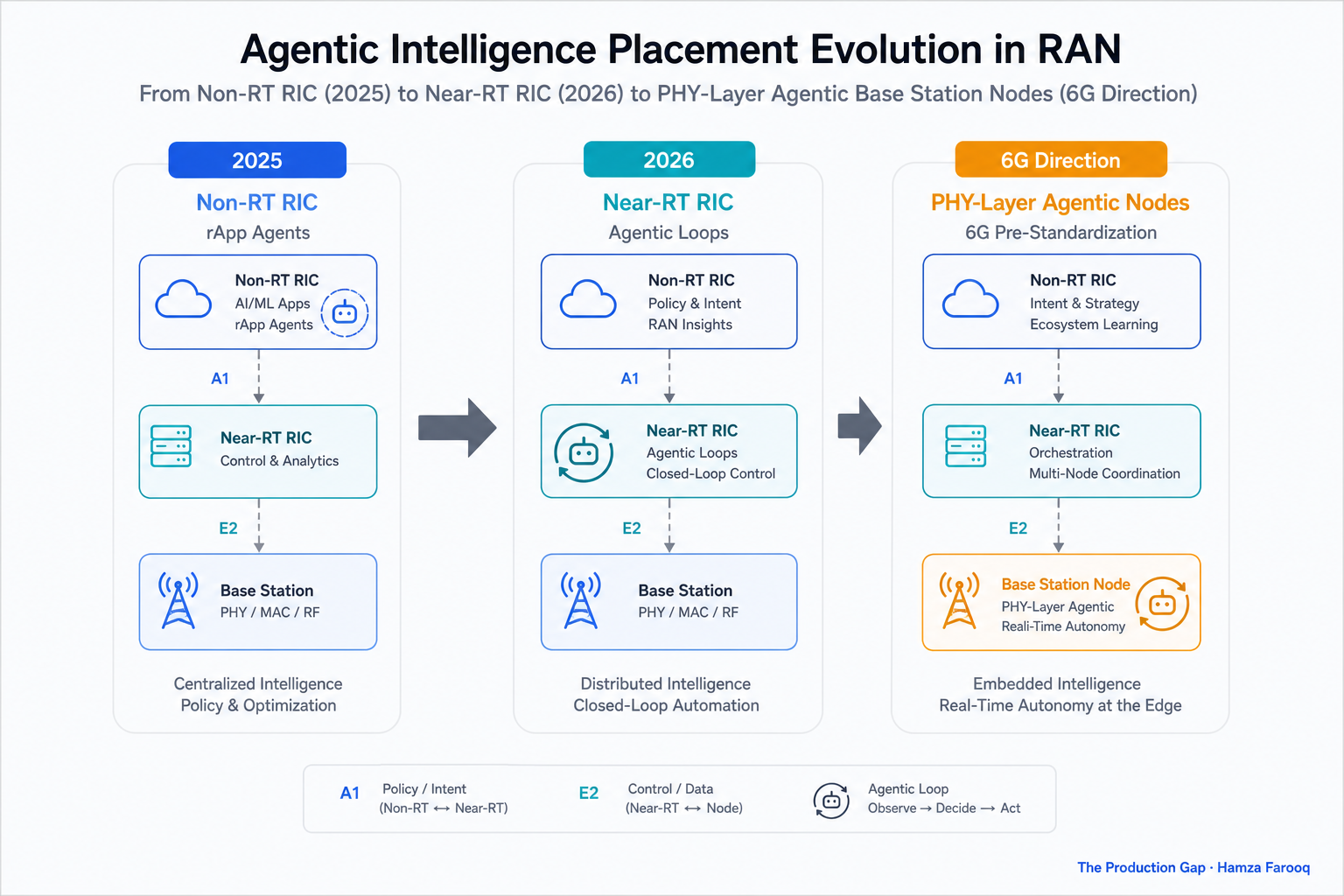
Research directions in 6G incorporate agentic intelligence at the base station level, meaning 2026 architectural choices may directly constrain or enable 6G evolution.
Published 6G research explores placing agentic intelligence at the PHY layer, as examined in analysis of the case for agentic base stations in 6G RAN. This direction would shift the primary AI decision point away from the RIC and into the base station itself. As author synthesis based on the sources reviewed here: this trajectory makes RIC-layer-agnostic agent design the lower-regret option for practitioners building agentic systems today.
The practitioner question worth asking now is concrete: does your current agentic RAN design isolate agent logic so it survives a future where the base station, not the RIC, is the primary AI decision point?
Frequently Asked Questions
What is the AI-RAN Alliance's architecture framework and why does it matter in 2026?
The AI-RAN Alliance's Architecture Overview is the first industry-consensus functional framework for AI-native RAN, defining components, interaction interfaces, and AI workload roles at each layer. It gives operators and vendors a shared baseline to build against. Persistent agent state management is not yet specified within that framework, which is the most consequential open item for teams designing always-on agents today.
Where does agent state persist across Near-RT and Non-RT RIC boundaries?
No O-RAN standard currently specifies where agent state persists across Near-RT and Non-RT RIC boundaries, this is the central unresolved problem in agentic RAN architecture as of 2026. Ericsson's rApp approach manages state within the Non-RT RIC using its own mechanisms; AgentRAN's distributed-fabric model offers a research alternative that has not yet reached production scale.
How do Ericsson's agentic rApps differ from earlier closed-loop automation?
Ericsson's agentic rApps replace stateless, event-driven automation with goal-directed planning systems running on the same interface. Traditional rApps are stateless and event-driven: one policy recommendation per cycle, then termination. Ericsson's agentic rApps embed multi-step goal pursuit, cross-cycle memory, and adaptive replanning, a fundamentally different execution model that the underlying A1/R1 interface was not originally designed to support.
Will agentic base station research in 6G make the current RIC-centric architecture obsolete?
Agentic base station research will not immediately obsolete the RIC-centric architecture, but it introduces a credible long-term pressure on the RIC's coordination role. Published 6G research places agentic intelligence at the PHY layer, as covered in analysis of agentic base stations, which could reduce the scope of decisions currently routed through the Near-RT RIC. Designing 2026 agent logic to be RIC-layer-agnostic is, in the author's assessment, the lower-regret option given that trajectory.
Conclusion
The harder questions are operational. Where does agent memory live when a node fails? Who owns that state in a multi-vendor deployment? What happens to an optimization campaign when a handover crosses two agents on different vendor stacks? None of these have standard answers yet, and the agentic base station direction in 6G research suggests the architecture underneath them will keep moving.
Next step: Audit your current rApp and xApp deployment against the AI-RAN Alliance Component Definitions, mapping where persistent state must live for each use case you plan to make agentic. That gap analysis, structured against Table 1 above, is the most useful artifact you can produce before your next architecture review.
Learn from me
Agentic AI for Product Managers, my Maven cohort. Learn how to design, evaluate, and ship reliable AI systems: the technical fluency PMs need to lead agentic products, no engineering background required. Join the next cohort →
Hire us
Traversaal.ai. We're a team of forward deployed engineers solving the toughest AI problems for Fortune 100 companies: document intelligence, agentic data platforms, and real-time web intelligence, deployed in production. Work with our team to deploy your next agentic ecosystem. Talk to Traversaal.ai →
Join us
Want to solve these problems with us? We're always looking for forward deployed engineers who want to ship production AI. jobs@traversaal.ai