Agentic RAG Architecture Explained: Query Decomposition, Hybrid Retrieval, Re-Ranking, and Iterative Loops vs. Naive RAG
Agentic RAG architecture beats naive RAG with hybrid retrieval, re-ranking, and iterative loops. Learn how each layer improves answer accuracy.

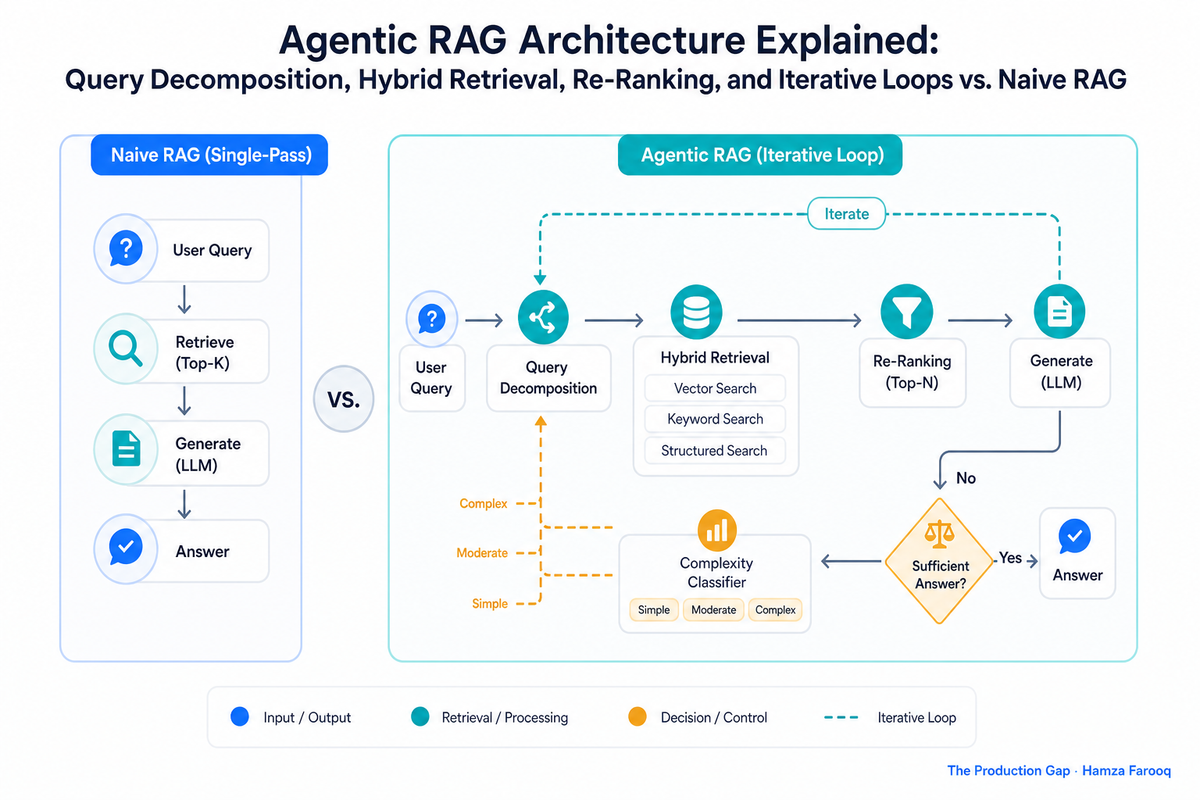
TL;DR: Agentic RAG architecture extends naive RAG by adding five coordinated mechanisms (query decomposition, self-querying, hybrid retrieval, re-ranking, and iterative retrieval loops) that let the system plan, search, evaluate, and refine answers autonomously rather than executing a single static lookup. Naive RAG embeds a question, fetches the top-k chunks, and generates; agentic RAG decides how to search, checks whether results are sufficient, and loops until they are.
Key Takeaways
- Query decomposition unlocks complex answers: Breaking a hard question into sub-queries retrieves precise evidence for each part instead of gambling on one broad search.
- Hybrid retrieval beats either method alone: BM25 plus dense vector search catches exact-term matches and conceptually similar results that neither method finds alone.
- Re-ranking fixes retrieval order: A cross-encoder re-scores chunks in context of the query, promoting genuinely useful passages ranked too low by initial retrieval.
- Iterative loops enable self-correction: An agentic pipeline checks evidence sufficiency and retrieves again only when needed.
- Naive RAG wins on speed: For single-topic factual queries, agentic machinery adds latency without improving answers.
- Agentic RAG is an architectural choice: Build it based on actual query complexity and latency tolerance, not engineering ambition.
Introduction
A naive RAG pipeline (single embedding lookup, top-k retrieval, LLM generation) handles straightforward queries reliably. Multi-part questions, cross-document synthesis, and exact-term lookups expose its limits, returning wrong or incomplete answers. That gap is what agentic RAG is designed to close.
Agentic RAG broadens RAG from static single-turn interactions to multi-step, reasoning-driven context gathering, as documented in comparative analyses from both Meilisearch and DigitalOcean. The decision to adopt it is architectural. The real risk is deploying it indiscriminately on workloads where it quietly degrades performance rather than improving it.
What are the five agentic RAG mechanisms and which failure modes do they fix?
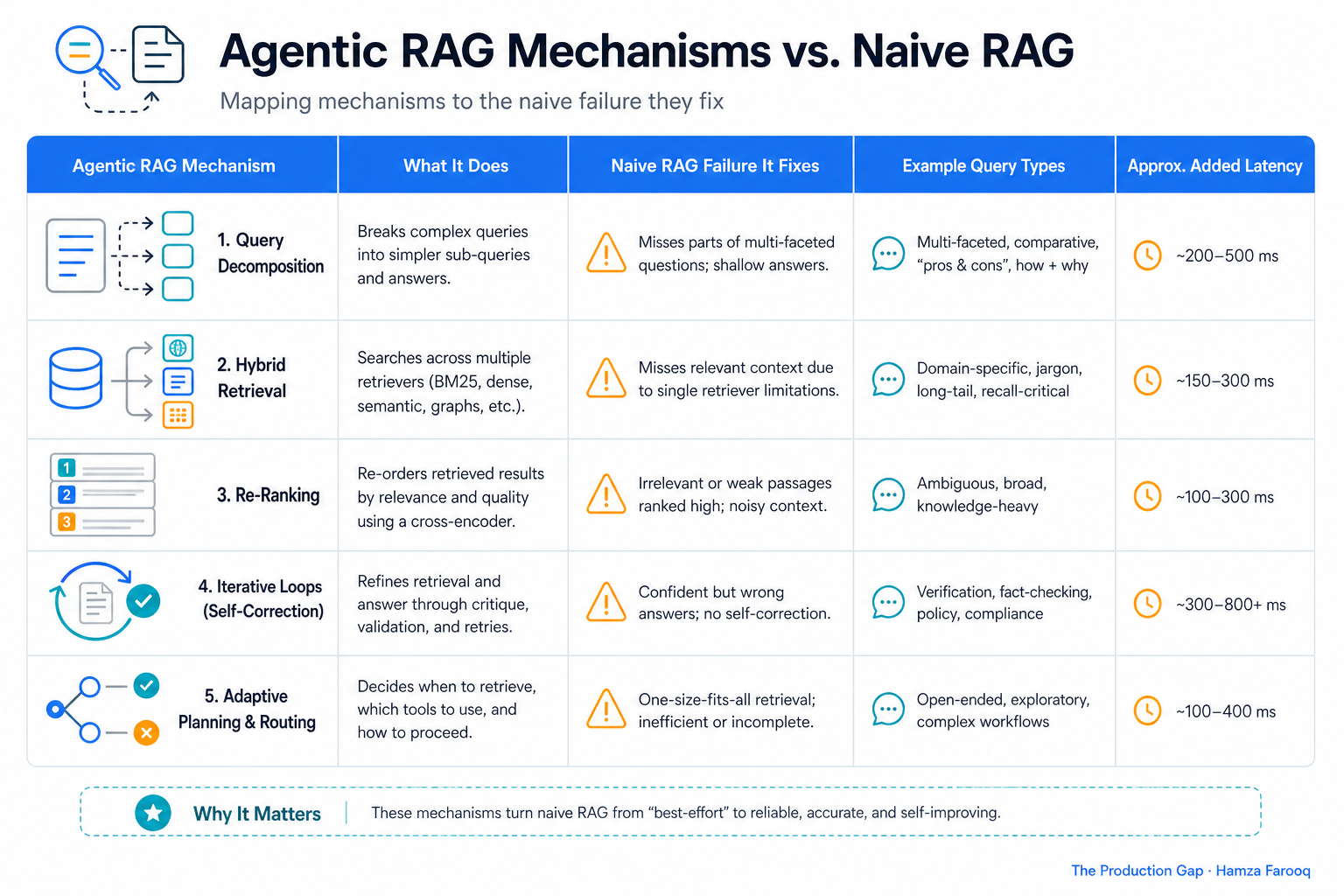
Agentic RAG addresses five specific failure modes in naive RAG through five coordinated mechanisms: query decomposition, self-querying, hybrid retrieval, re-ranking, and iterative loops. Each mechanism targets a distinct weakness. The following subsections describe each one using the framework applied throughout this guide.
Query decomposition
Query decomposition is a mechanism that uses an LLM call to split a complex question into targeted sub-queries, each of which receives its own independent retrieval pass, with results aggregating before final generation. For example, "Compare Vendor A and Vendor B across data residency and breach notification clauses" becomes two precise sub-queries rather than one blended embedding. This prevents a single broad embedding from averaging over multiple distinct information needs.
def decompose(query: str) -> list[str]:
 response = openai.chat.completions.create(
 model="gpt-4o",
 messages=[{"role": "user", "content": f"Decompose into sub-queries: {query}"}],
 functions=[{"name": "output", "parameters": {
 "type": "object",
 "properties": {"sub_queries": {"type": "array", "items": {"type": "string"}}}
 }}]
 )
 return response.choices[0].message.function_call.arguments["sub_queries"]
Self-querying with metadata filters
Self-querying is a mechanism that extracts structured predicates from the user query and applies them as hard filters before semantic search runs, cutting noise from irrelevant chunks before any embedding comparison happens. For instance, a query about breach notification clauses for Vendor A produces a structured filter such as {"vendor": "Vendor A", "clause_type": "breach_notification"} that scopes retrieval precisely. Naive RAG applies such filters only when a developer hardcodes them; agentic RAG derives them dynamically from each query.
Hybrid retrieval
def rrf_merge(bm25_results, dense_results, k=60):
 scores = {}
 for rank, doc in enumerate(bm25_results + dense_results):
 scores[doc.id] = scores.get(doc.id, 0) + 1 / (k + rank + 1)
 return sorted(scores, key=scores.get, reverse=True)
Iterative loops
Iterative loops are the mechanism by which an agentic pipeline evaluates retrieved evidence against a sufficiency criterion and triggers additional retrieval passes when evidence is inadequate, repeating until results meet a threshold or a termination condition fires. This mechanism, detailed further in the next section, is what distinguishes agentic RAG most sharply from naive RAG and from simpler RAG router patterns.
How does the complexity classifier gate control loop entry and termination?
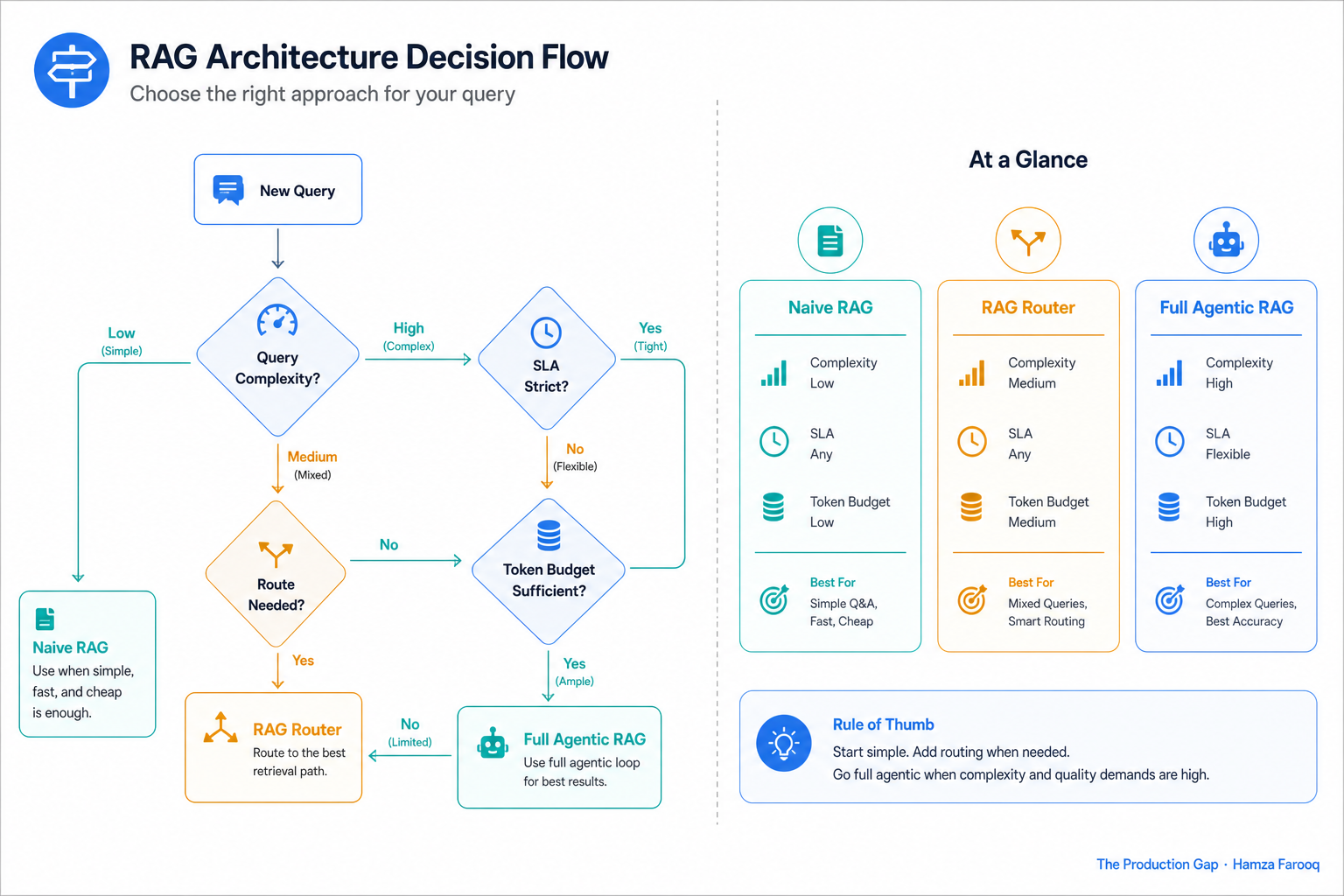
A complexity classifier gate is a lightweight routing component that inspects each incoming query and directs it either to a fast-path naive RAG pipeline or to the full agentic loop, preventing the expensive loop from running on queries that do not need it. This is a practical rule of thumb from the framework used in this guide, not an externally benchmarked standard. The gate operates on signals such as token count, entity count, and conjunction density.
def classify_complexity(query: str) -> str:
 score = (
 len(query.split()) * 0.1 +
 count_entities(query) * 1.5 +
 query.lower().count(" and ") * 2.0 +
 query.lower().count(" compare") * 3.0
 )
 return "complex" if score > 8.0 else "simple"
- Simple, single-entity queries route to fast-path naive RAG.
- Multi-entity, comparative, or multi-hop queries route to the full agentic loop.
Iterative loops also require explicit exit logic: a hard cap on iterations, a sufficiency score threshold, or a diminishing-returns check where high overlap with the previous pass triggers a stop. Without termination conditions, loops accumulate latency across multiple passes before generation even begins, which can breach latency budgets on time-sensitive workloads. Instrument loop latency, iteration counts, and sufficiency scores before shipping; the right cap depends on your latency budget and query distribution.
When does agentic RAG win and when does naive RAG win?
Naive RAG wins on speed and simplicity for single-topic factual queries, while agentic RAG wins on quality for multi-hop, comparative, or evidence-synthesis tasks. Your actual query complexity distribution should drive the decision, not architectural preference.
Table 1: Naive RAG vs. Agentic RAG Architecture Decision Matrix
| Dimension | Naive RAG | Agentic RAG |
|---|---|---|
| Retrieval passes | 1 (fixed) | 1 to N (dynamic) |
| Query decomposition | No | Yes |
| Metadata self-querying | No (manual filter) | Yes (agent-driven) |
| Hybrid retrieval | Optional | Standard |
| Re-ranking | Optional | Standard |
| Best query type | Single-topic, factual | Multi-hop, comparative |
| Operational complexity | Low | High |
| Token cost per query | Low | Higher |
| Recommended for tight latency SLAs | Yes | No (without routing gate) |
A RAG router sits between these two options: it dynamically selects the right tool or data source and executes one retrieval pass without committing to a full iterative loop. Routers are more capable than naive RAG for mixed-source queries and less expensive than a full agentic loop for queries that do not require iterative evidence gathering.
Frequently Asked Questions
How does query decomposition work in a RAG pipeline? Query decomposition works by using an LLM call to break a complex question into targeted sub-queries, each run as an independent retrieval pass, with results aggregating before final generation. This prevents a single broad embedding from averaging over multiple distinct information needs and is most valuable for comparative or multi-part questions.
When does agentic RAG's added latency outweigh its accuracy benefits? Agentic RAG's added latency outweighs its accuracy benefits when most queries are single-topic or when your latency budget is tight, because each retrieval loop accumulates cost before generation even begins. A complexity classifier routing gate addresses this problem for mixed-complexity traffic by directing only genuinely complex queries into the agentic loop.
What is the difference between a RAG router and a full agentic RAG loop? A RAG router selects the right tool or data source and executes one retrieval pass, while a full agentic RAG loop retrieves evidence, checks sufficiency, and repeats until evidence is adequate or a termination condition fires. Routers carry lower latency and suit queries with clear source-routing needs; full loops handle genuinely multi-hop tasks that require iterative evidence gathering.
Which re-ranking strategy works best inside iterative agentic RAG loops? Cross-encoders generally offer strong precision relative to their latency cost because they score query and document together rather than separately. As a practical rule of thumb from the framework used in this guide, reserving LLM-based rerankers for the final retrieval pass only can limit per-loop latency accumulation, though the right choice depends on your specific latency budget and quality requirements.
Conclusion
Agentic RAG architecture is five distinct mechanisms (query decomposition, self-querying, hybrid retrieval, re-ranking, and iterative loops), each solving a specific naive RAG failure mode and each adding real latency and cost in exchange for higher answer quality on complex queries. The common mistake is not implementing these mechanisms incorrectly, but deploying them on queries that never needed them, producing higher latency and cost-per-query with no quality gain.
Classify a representative sample of your queries by complexity and measure what share is genuinely multi-hop or comparative. If that share is low, build the routing gate first and validate that the agentic path earns its cost on the subset that enters it. If that share is high, the full agentic architecture is justified. Let your query distribution make the call.
Learn from me
Agent Engineering Bootcamp: Developers Edition, my Maven cohort. Advanced agentic RAG, multi-agent orchestration, memory, evals, and guardrails. Take agents from prototype to production. Join the next cohort →
Hire us
Traversaal.ai. We're a team of forward deployed engineers solving the toughest AI problems for Fortune 100 companies: document intelligence, agentic data platforms, and real-time web intelligence, deployed in production. Work with our team to deploy your next agentic ecosystem. Talk to Traversaal.ai →
Join us
Want to solve these problems with us? We're always looking for forward deployed engineers who want to ship production AI. jobs@traversaal.ai