AGENTS.md Joins the Linux Foundation: Which Coding Agents Have Adopted the Standard (and How to Bridge the Gap Today)
AGENTS.md Linux Foundation adoption is official. See which coding agents comply, why Claude Code doesn't, and how to bridge the gap with one simple fix.

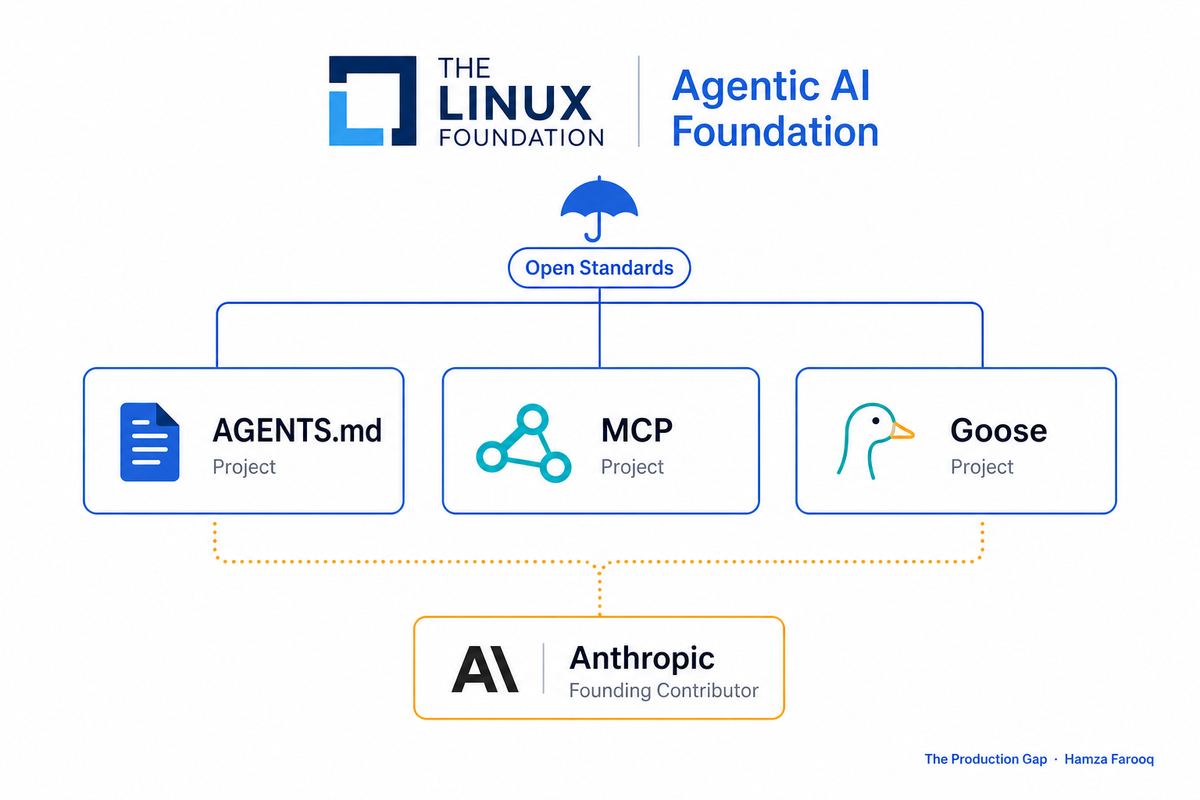
TL;DR: AGENTS.md Linux Foundation adoption is now official, with OpenAI Codex, Windsurf, and several other major coding agents already honoring the standard, while Claude Code remains the notable holdout, reading only CLAUDE.md per Anthropic's own documentation. Teams can bridge the gap today by maintaining one canonical file and symlinking or copying it so every tool finds the filename it expects.
Key Takeaways
- AGENTS.md is now an open standard: The Linux Foundation's Agentic AI Foundation formally governs AGENTS.md alongside MCP and Goose.
- Claude Code is the notable holdout: According to Anthropic's Claude Code documentation, the tool reads CLAUDE.md, not AGENTS.md, creating silent instruction drift in mixed-agent pipelines.
- A symlink or CI-sync bridges the gap today: One canonical file, zero drift.
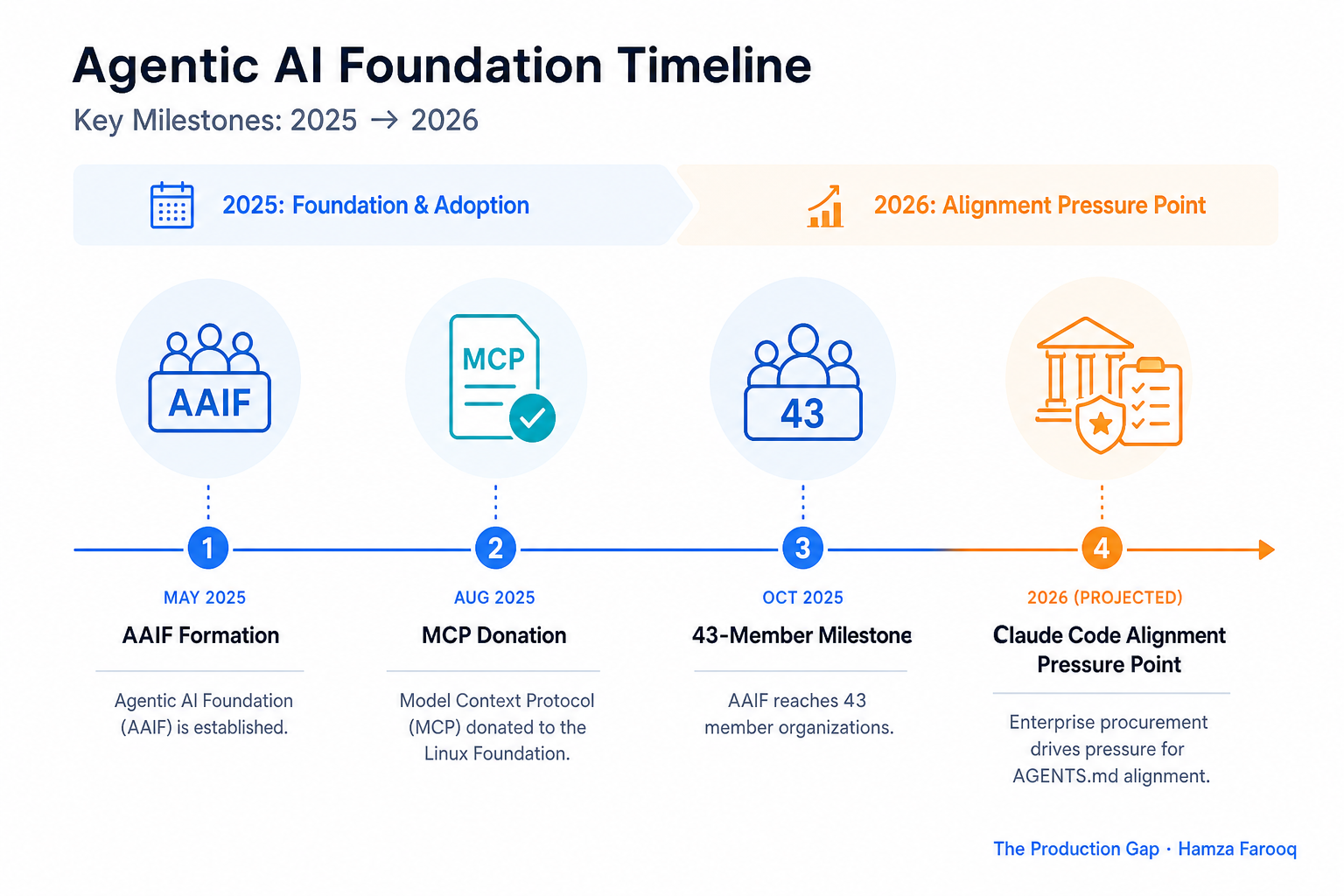
- Enterprise procurement is catching up: The AAIF added 43 new enterprise and government members, pushing AGENTS.md compliance toward a formal procurement requirement.
- Monorepos need per-directory files: Both formats support subdirectory scoping for precise agent context.
Agent-instruction files are load-bearing infrastructure. They are Markdown files that tell coding agents how to behave in a repo, encoding style rules, test commands, security constraints, and workflow conventions that agents follow autonomously inside CI/CD pipelines. AGENTS.md is now governed by the Linux Foundation's Agentic AI Foundation (AAIF) and active across more than 60,000 open-source projects. But Claude Code reads CLAUDE.md, not AGENTS.md, as documented in Anthropic's official Claude Code memory documentation. For teams running Cursor, Codex, and Claude Code simultaneously, that gap costs time today and risks compliance tomorrow.
What Is the Agentic AI Foundation and Why Does It Make AGENTS.md Matter More Than It Did a Year Ago?
The AAIF is the Linux Foundation body that formally governs AGENTS.md, MCP, and Goose as open agent standards, giving AGENTS.md the same institutional backing that turned Kubernetes into a procurement requirement. Before the foundation existed, AGENTS.md was a useful but informal convention. Governance changes the calculus. The AAIF's addition of 43 new enterprise and government members signals that informal adoption is giving way to formal compliance expectations, the same transition that turned OpenAPI from a community preference into a procurement checkbox.
Which Coding Agents Natively Read AGENTS.md Today, and Where Does Claude Code Stand?
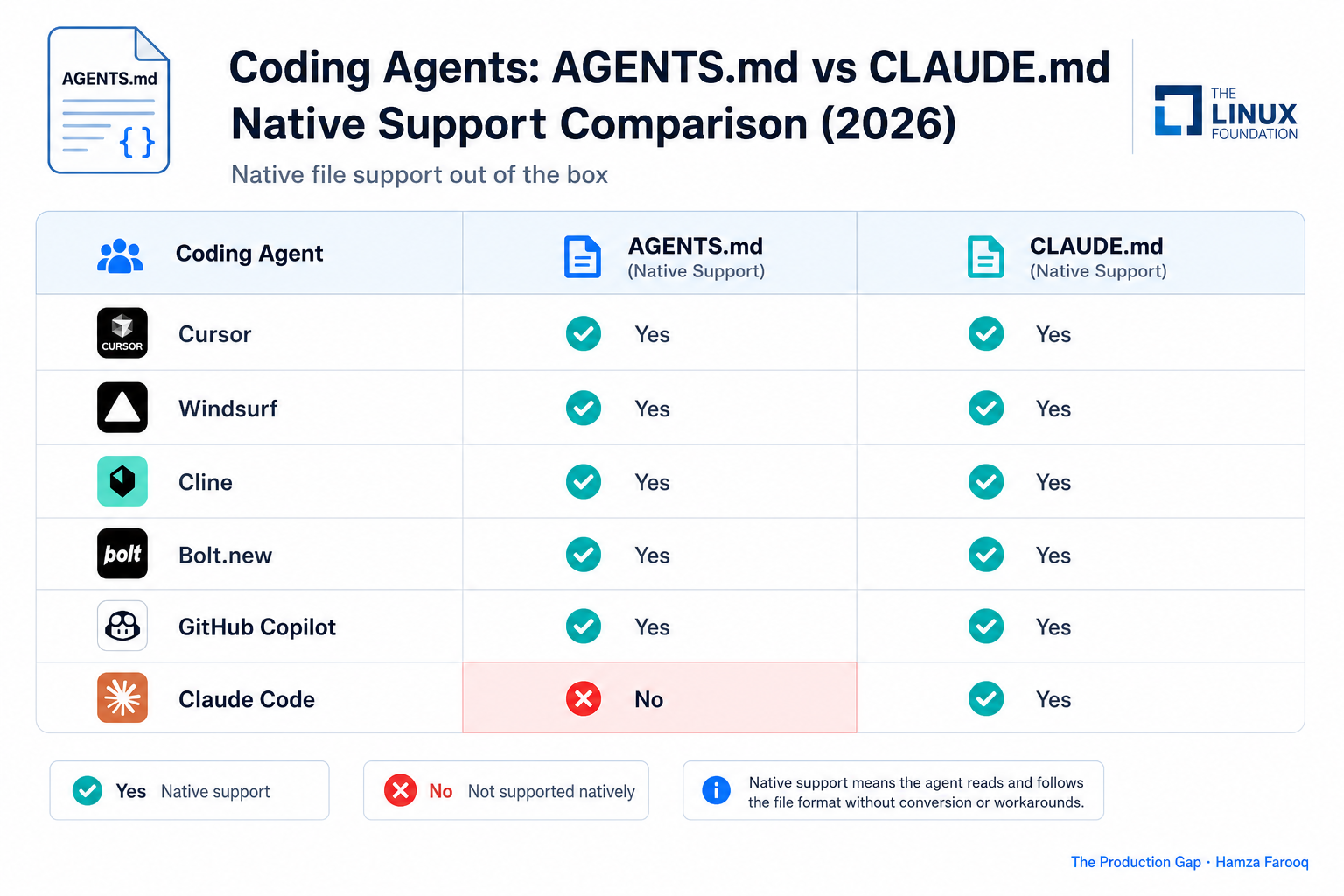
As of July 2025, based on the Linux Foundation AAIF announcement and Anthropic's Claude Code memory documentation:
| Coding Agent | Reads AGENTS.md natively? | Reads CLAUDE.md? |
|---|---|---|
| Amp | Yes | No |
| Codex (OpenAI) | Yes | No |
| Cursor | Yes | No |
| Devin (Cognition) | Yes | No |
| Factory | Yes | No |
| Claude Code (Anthropic) | No | Yes |
Anthropic donated MCP to the AAIF, the same foundation that stewards AGENTS.md, yet their flagship coding agent is the most prominent non-conforming tool in the ecosystem. This looks like product-cycle lag rather than philosophical rejection, which matters: it means alignment is plausible, and a practical bridge exists now.
How Do You Maintain One Source of Truth for Agent Instructions Across Claude Code, Cursor, and Codex Today?
Keep AGENTS.md as your canonical file and bridge it to Claude Code via symlink or CI sync, one file, zero drift.
Pattern 1, Symlink (local dev and small teams):
ln -s AGENTS.md CLAUDE.md
Git tracks the symlink, so the relationship is version-controlled. One caveat: some CI environments do not preserve symlinks reliably, so test before treating this as solved.
Pattern 2, CI-sync script (enterprise and monorepos):
cp AGENTS.md CLAUDE.md
git add CLAUDE.md
Add this as a pre-commit hook or pipeline step. AGENTS.md stays as the source of truth; CLAUDE.md becomes a generated artifact. Document this in your README, otherwise a contributor may edit CLAUDE.md directly and introduce silent drift.
Monorepo scoping applies the same bridge at each directory level:
/services/payments/AGENTS.md symlinked to CLAUDE.md in same dir
/services/auth/AGENTS.md symlinked to CLAUDE.md in same dir
Both formats support subdirectory placement, so you can scope instructions per service without bloating the root file.
The Single-Source Agent Instruction Pattern
The author synthesis behind both patterns above is named here as the Single-Source Agent Instruction Pattern: treat AGENTS.md as the manifest and CLAUDE.md as the generated lock file, the same way package managers produce lock files from a single source of truth. This label is unique to this guide and is offered as a practical framework, not an externally standardized term.
Will Claude Code Ever Read AGENTS.md Natively, and What Should Enterprise Teams Do in the Meantime?
Enterprise teams should not wait for Claude Code to align natively, three concrete steps address the gap today.
Claude Code shipped its CLAUDE.md convention before the AAIF formalized AGENTS.md as an open standard. Anthropic's MCP donation to the AAIF makes eventual alignment plausible, but that is a forward-looking observation, not a confirmed roadmap commitment. The bridging pattern is a practical necessity for mixed-agent teams now.
- Audit today. Run
find . -name "CLAUDE.md" -o -name "AGENTS.md"across your repos. Any repo with CLAUDE.md and no corresponding AGENTS.md is a drift risk the moment you add a second agent to that pipeline. - Implement the bridge. Apply the symlink or CI-sync pattern to every repo where Claude Code runs alongside Cursor, Codex, or Devin, before a production incident surfaces the gap.
- Add AAIF compliance to your vendor checklist. Include native AGENTS.md support as a procurement criterion for any new coding-agent tool. This creates pressure on holdout vendors and prevents repeating the dual-file problem with the next agent you adopt.
Frequently Asked Questions
Which coding agents natively support AGENTS.md? Amp, Codex, Cursor, Devin, and Factory all natively read AGENTS.md per the Linux Foundation press release. Claude Code is the notable exception, reading only CLAUDE.md per Anthropic's documentation. Confirmed adopters are listed at aaif.io.
Why does Claude Code use CLAUDE.md instead of AGENTS.md? Claude Code shipped its convention before the AAIF formalized AGENTS.md as an open standard. As documented by Anthropic, the tool looks for CLAUDE.md specifically. Anthropic's MCP donation to the AAIF makes eventual alignment plausible, but the bridging pattern described in this guide is the practical solution for mixed-agent teams now.
How do you write one agent-instruction file that works across Claude Code, Cursor, and Codex? Keep AGENTS.md as your canonical source, then symlink (ln -s AGENTS.md CLAUDE.md) or copy via CI (cp AGENTS.md CLAUDE.md). Both agents then read identical content with no drift. This is the Single-Source Agent Instruction Pattern described in this guide.
Does AGENTS.md placement matter in a monorepo? Yes. Both formats support subdirectory scoping. Apply the symlink bridge at each directory level independently so all agents receive the same scoped instructions throughout the codebase, without overloading the root file with service-specific context.
Conclusion
Audit for drift, implement the bridge, and add AAIF compliance to your vendor checklist.
Start now: run find . -name "CLAUDE.md" -o -name "AGENTS.md" across your repos and you will know exactly where your gaps are before they become incidents.
Learn from me
Claude Code in Practice, my Maven cohort. Master Claude Code from fundamentals to advanced orchestration: skills, subagents, hooks, MCP, and production automation. Join the next cohort →
Hire us
Traversaal.ai. We're a team of forward deployed engineers solving the toughest AI problems for Fortune 100 companies: document intelligence, agentic data platforms, and real-time web intelligence, deployed in production. Work with our team to deploy your next agentic ecosystem. Talk to Traversaal.ai →
Join us
Want to solve these problems with us? We're always looking for forward deployed engineers who want to ship production AI. jobs@traversaal.ai