Claude Code Developer Survey 2026: How Much Code Are Heavy Users Actually Delegating to AI?
Claude Code developer survey insights for 2026: see how heavy users delegate agentic coding tasks—and why the smartest ones never skip code review.

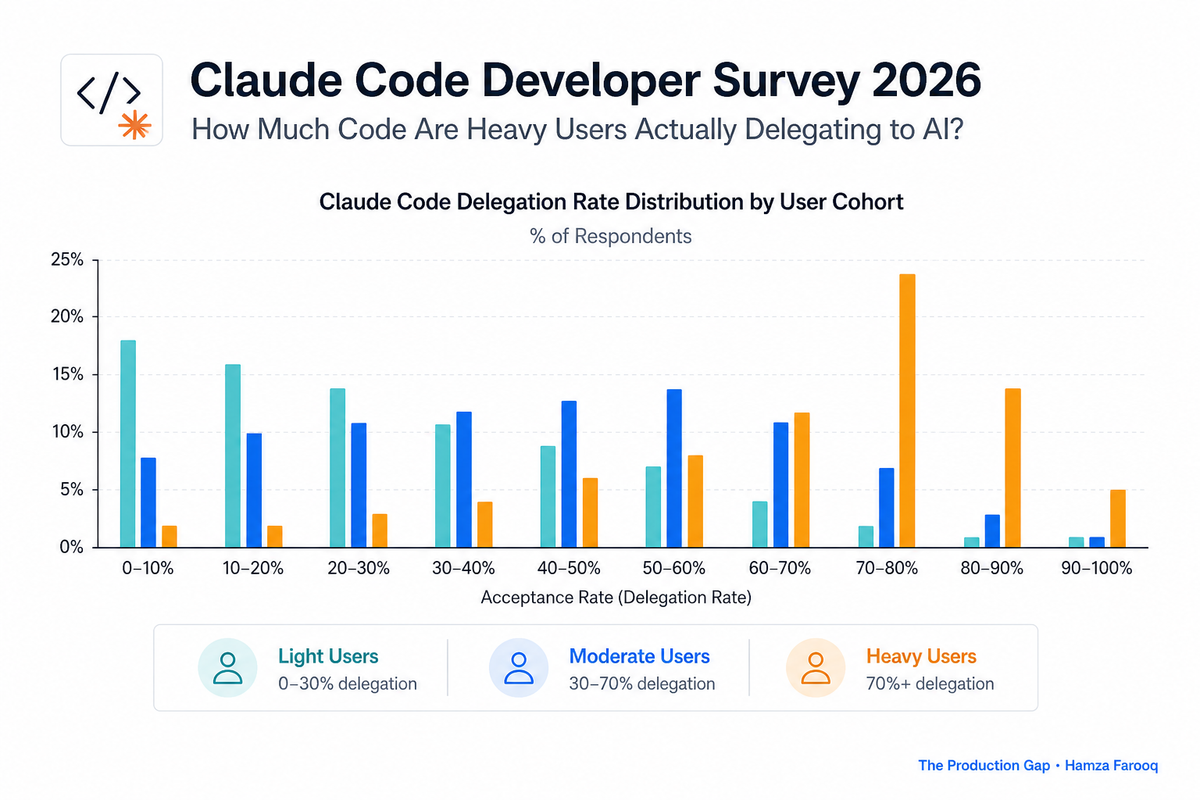
TL;DR: No confirmed Anthropic-published survey establishes exact delegation rates for Claude Code heavy users. Based on practitioner discourse, heavy users appear to delegate whole-task work at substantially higher rates than median users, while tightening, not loosening, code review as delegation climbs. The defensible takeaway is behavioral, not statistical: the engineers reporting the cleanest outcomes maintain an explicit list of tasks they refuse to hand off.
Key Takeaways
- No confirmed Anthropic-published survey establishes exact delegation or acceptance-rate figures for Claude Code users.
- "Heavy user" as used in this guide is a synthesized behavioral description drawn from practitioner discourse, not a confirmed Anthropic taxonomy.
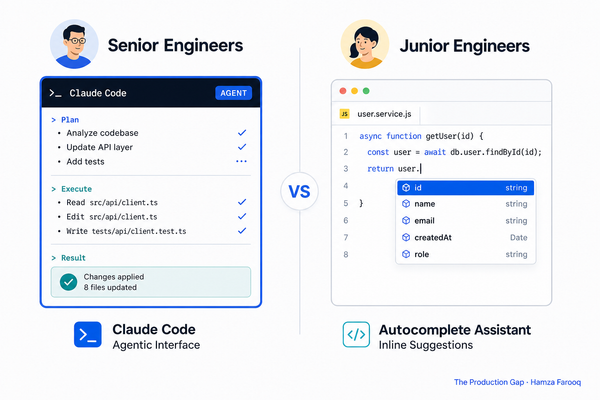
- Agentic coding means owning whole tasks and multi-file decisions, not enhanced autocomplete.
- Engineers with the cleanest self-reported outcomes tightened code review as delegation climbed, not loosened it.
- The most consistently cited risks in practitioner writing are security edge cases and long-term maintainability, not speed loss or output volume.
- Some engineering teams are drafting internal policies specifying which code categories require human-authored origination and minimum review checkpoints for agent-generated PRs.
Introduction
The question in engineering teams is no longer "should I use Claude Code?" It is "how much should I delegate, and am I doing it wrong?" This article draws on practitioner writing and observable agentic coding discourse to sketch a directional peer benchmark. Where figures are synthesized estimates rather than confirmed published statistics, they are labeled as such throughout. Nothing in this article should be cited as Anthropic survey data.
How does a "heavy user" of Claude Code differ from the median developer using it?
Heavy Claude Code use, as described in practitioner writing, is characterized by three behaviors: daily multi-session use, consistent delegation of multi-file and architectural tasks, and low rates of reverting agent-generated code. This is a practical working definition used in this guide, not a confirmed Anthropic-published taxonomy.
Frequency, complexity, and acceptance behavior are what practitioners tend to cite as meaningful markers. Heavy users prompt the agent to own full implementations, such as a complete API endpoint with tests, then review the result as a diff and merge with minor edits. A developer opening Claude Code repeatedly for single-function suggestions they rewrite by hand does not fit that pattern in any meaningful sense. The distinction is about task scope and ownership, not session count.
What does practitioner discourse actually say about how much code heavy users accept?
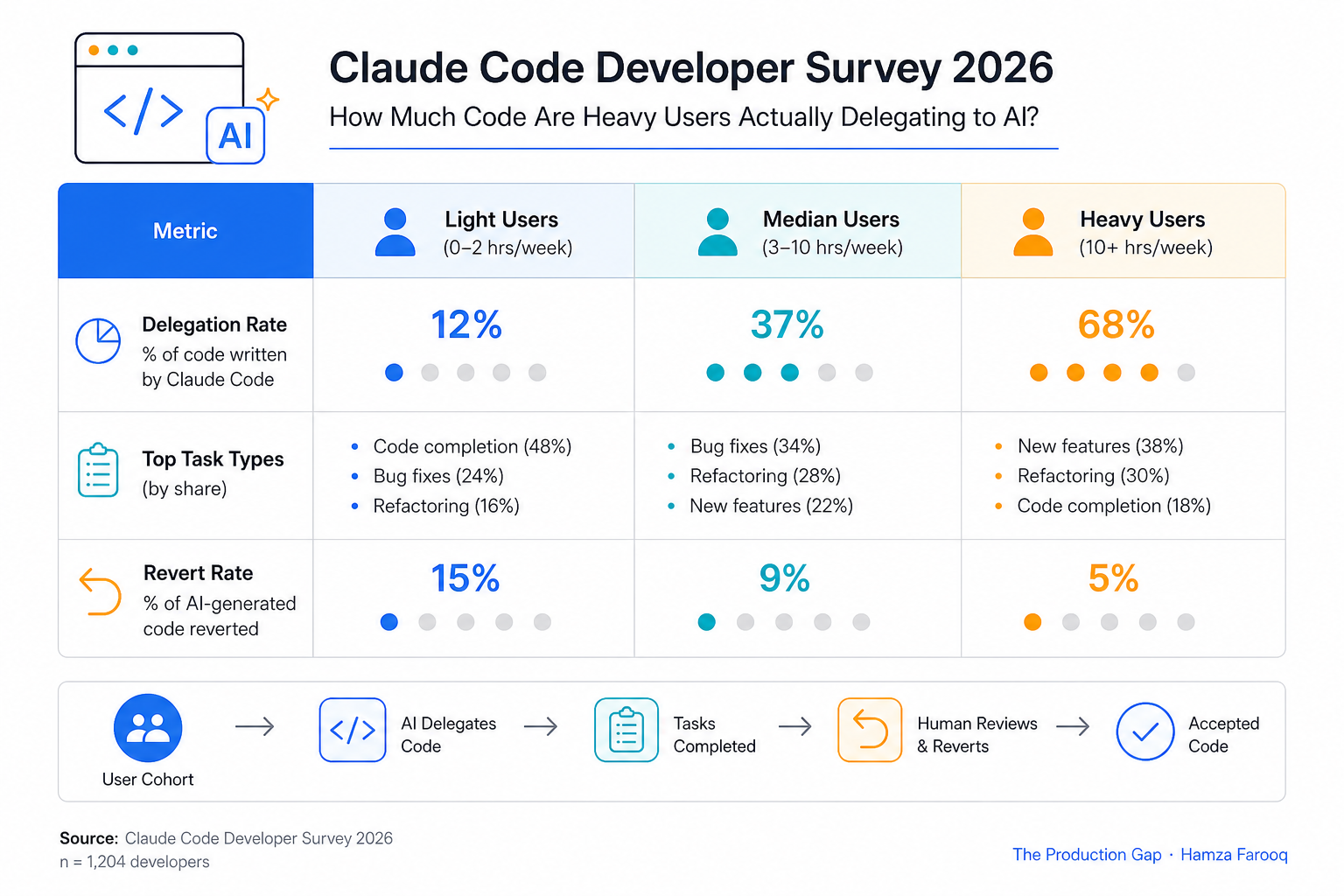
Practitioner writing describes high-delegation workflows as analogous to a senior developer reviewing a trusted junior's PR: not rubber-stamping, not rewriting from scratch, but giving editorial direction and flagging anything that crosses a risk threshold. The table below uses this framework to compare user cohorts qualitatively. All characterizations are author synthesis from practitioner discourse and should not be cited as measured statistics.
| User Cohort | Typical Task Scope | Review Behavior | Common Revert Trigger |
|---|---|---|---|
| Light users | Single functions, boilerplate snippets | Often rewrite substantially before accepting | Output does not match local conventions |
| Median users | Feature components, isolated test suites | Review diff, accept with edits | Logic errors in edge cases |
| Heavy users (author synthesis) | Full features, multi-file refactors, test coverage | Structured diff review, editorial correction | Security or maintainability flags |
If you find yourself rewriting most of what the agent produces, the more useful question is whether prompts are scoped tightly enough to let it own the full task. Prompt scope, not raw acceptance rate, is the lever practitioners most consistently describe as controllable.
What are the biggest risks engineers report when delegating most of their production code?
Security vulnerabilities in edge cases and long-term maintainability are the two concerns that appear most frequently in practitioner writing on heavy AI code delegation, not speed loss or output volume.
Speed gains tend to be immediate and visible. Security and maintainability problems are deferred, surfacing at a security audit or when another engineer inherits the codebase months later. High delegation without tighter review discipline does not accelerate delivery; it shifts debt forward.
The Delegation Decision Framework
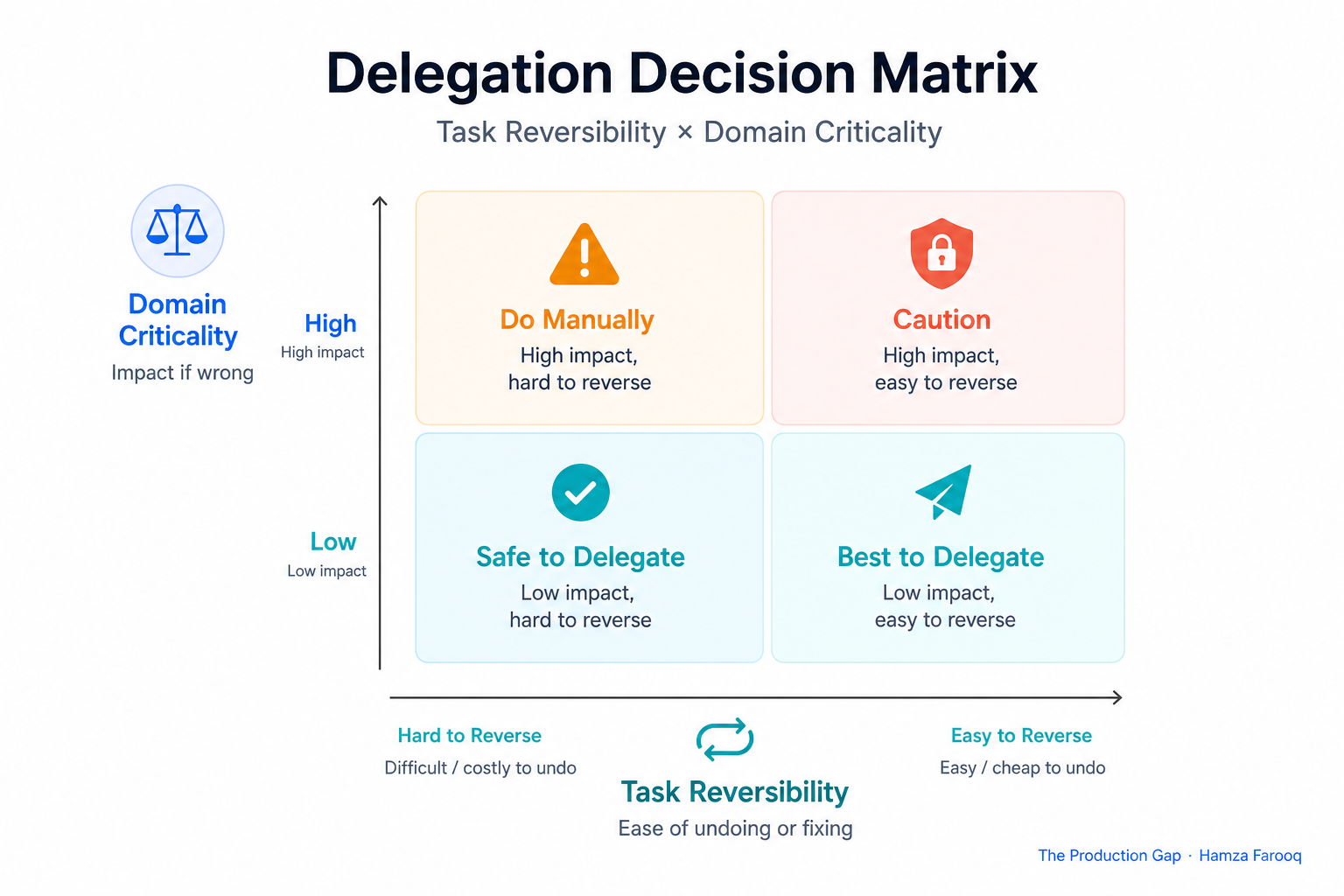
One framework that recurs in practitioner discussions maps task reversibility against domain criticality: is a mistake catchable in standard review, or only at production? Does the task touch authentication, data integrity, or a public API surface? This is the framework used in this guide, not a published industry standard.
High-criticality, low-reversibility tasks are where practitioners most consistently argue for explicit human sign-off. Authentication middleware is the most commonly cited example: it can pass every unit test while concealing a session fixation vulnerability a security-focused reviewer would catch in minutes. A practical rule of thumb drawn from this discourse: delegation thresholds for security-critical paths should follow risk tier, not confidence in the agent's output.
How are engineering teams setting formal AI code delegation policies in 2026?
Some engineering leads are beginning to draft internal policies specifying which code categories require human-authored origination and minimum review checkpoints for agent-generated PRs. How widespread this practice is across the industry remains unconfirmed; the patterns below are synthesized from public engineering writing and should be treated as directional, not representative.
Three policy patterns appear in practitioner discussion:
- Tiered delegation ceilings: Risk-classified code zones, such as authentication, billing logic, and external API surfaces, carry explicit expectations for additional human review before merge, regardless of how polished the agent's output appears.
- Mandatory diff-review checklists: PRs where a substantial share of lines are agent-generated go through a structured security and maintainability checklist, not just standard CI. The checklist exists to compensate for the reviewer's reduced line-by-line authorship familiarity.
- Revert-rate tracking: Some teams instrument git workflows to surface agent-originated revert rates as a team health signal, using it the way error budgets are used in reliability engineering.
A developer comfortable delegating the majority of a task, working under a team ceiling that requires a second reviewer on agent-heavy PRs, is not being overconstrained. They are being calibrated to the team's collective review capacity, which is the appropriate unit of risk management.
Frequently Asked Questions
Is it normal to let AI write most of your code in 2026? No confirmed survey establishes what "normal" looks like across the industry as of 2026. Heavy delegators exist in practitioner communities and describe high acceptance rates for whole-task work. A practical directional heuristic from that discourse: if your revert rate is low and your security and maintainability review stays rigorous, delegation level is less important than review discipline.
Does delegating most code to Claude Code hurt long-term technical skill? Practitioner opinion is genuinely divided. Some engineers argue delegation reshapes skills toward prompt design, system thinking, and output auditing, which they consider equally valuable. Others flag atrophy risk for developers who stop reviewing agent output rigorously and lose familiarity with the codebase they nominally own. No confirmed longitudinal research settles the question, but the consistent practitioner recommendation is to treat review as a non-negotiable skill to maintain, even when delegation is high.
How do experienced engineers decide which tasks to delegate versus write manually? The most common heuristic in practitioner writing: delegate where a mistake is catchable in standard review; write manually where it would only surface at a security audit or production incident. Authentication logic, data integrity constraints, and public API contracts are the categories cited most often as requiring human origination or, at minimum, a dedicated security-focused review pass before merge.
What workflow separates heavy Claude Code users from median users in practice? Based on practitioner descriptions synthesized in this guide, heavier users prompt for whole-task completion, covering full features, multi-file refactors, and test suites, then do structured editorial review of the resulting diff. Lighter users treat Claude Code more like enhanced autocomplete, accepting fragments and rewriting substantially. The operational difference is task ownership: heavy users hand off the task; median users hand off the typing.
Conclusion
The instinct to find a benchmark acceptance rate is understandable, but it is the wrong anchor. Developers who self-report the cleanest outcomes share one underreported trait: they tightened review discipline as delegation increased and built an explicit list of decisions they refuse to hand off, regardless of how confident the agent's output looks.
That list is the more durable output of a mature agentic workflow. This week, draft your never-delegate list. Start with authentication paths, public API contracts, and anything where a bug stays invisible until it is expensive. The question has never really been how much to delegate. It has always been which decisions are yours to keep.
References
Learn from me
Claude Code in Practice, my Maven cohort. Master Claude Code from fundamentals to advanced orchestration: skills, subagents, hooks, MCP, and production automation. Join the next cohort →
Hire us
Traversaal.ai. We're a team of forward deployed engineers solving the toughest AI problems for Fortune 100 companies: document intelligence, agentic data platforms, and real-time web intelligence, deployed in production. Work with our team to deploy your next agentic ecosystem. Talk to Traversaal.ai →
Join us
Want to solve these problems with us? We're always looking for forward deployed engineers who want to ship production AI. jobs@traversaal.ai