Claude Sonnet 4.5 retirement checklist: moving to Sonnet 5.5 before the tentative November 30 date
Anthropic lists a tentative November 30 retirement for Claude Sonnet 4.5. See the Sonnet 5.5 migration steps, expected 400 errors, and Claude Code pins.

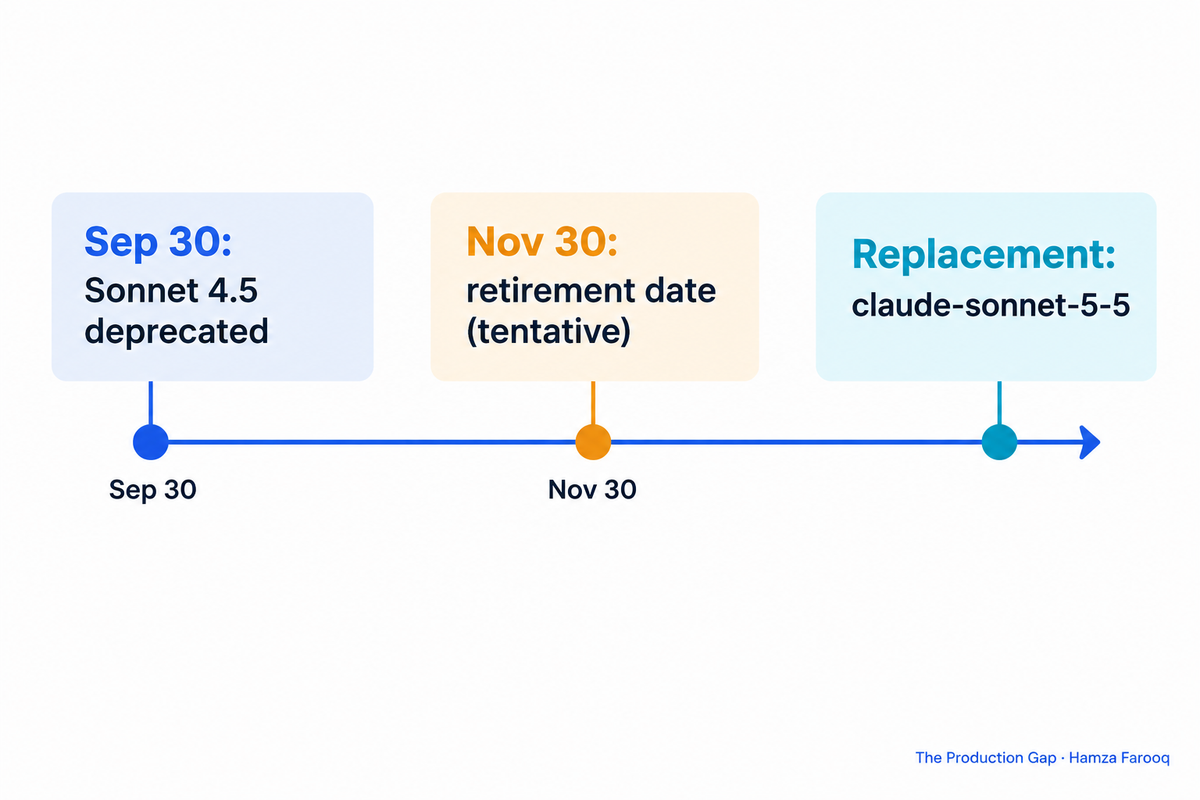
Anthropic's model deprecations page lists Claude Sonnet 4.5 as deprecated on September 30, with a tentative retirement date of November 30 and claude-sonnet-5-5 as the recommended replacement. The same page says requests to models past their retirement date will fail. Swapping the model ID is the easy part: the Sonnet 5.5 migration guide lists request settings that return 400 errors on the new model.
TL;DR: Anthropic lists Claude Sonnet 4.5 as retiring on a tentative date of November 30, with claude-sonnet-5-5 as the replacement, and says requests to retired models fail. Moving means changing the model ID and also removing thinking budgets, sampling parameters and assistant prefills, which return 400 errors on Sonnet 5.5. List prices are lower, but the same text produces about 30 percent more tokens so retest cost and limits.
Key Takeaways
- Deadline: the deprecations page gives November 30 under a column headed "Tentative retirement date".
- Replacement: the page names
claude-sonnet-5-5as the recommended replacement. - Breaking changes: thinking budgets, sampling parameters, assistant prefill, forced tool choice and
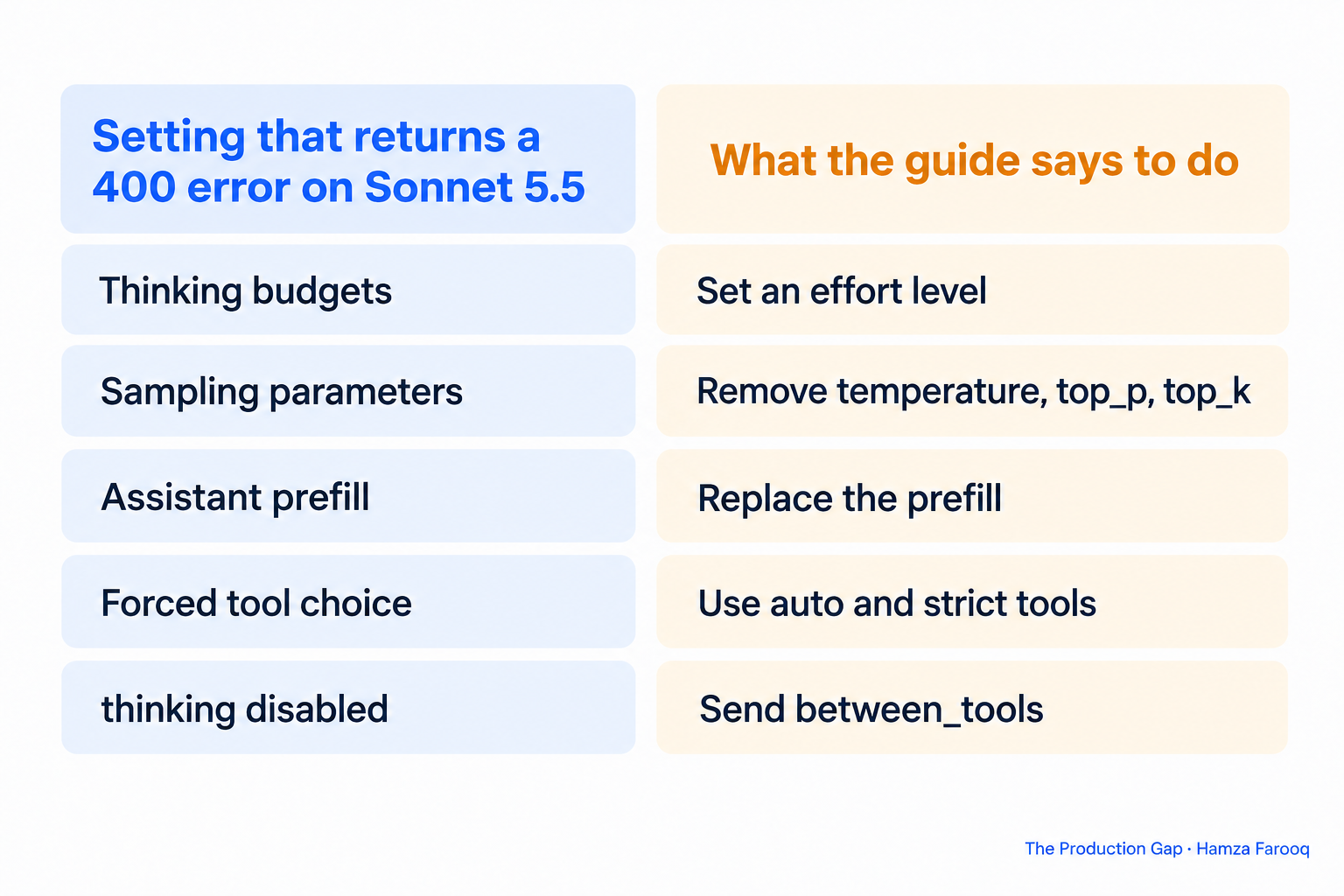
thinking: {"type": "disabled"}return 400 errors on Sonnet 5.5. - Cost: Sonnet 5.5 lists at $2 and $10 per million tokens against $3 and $15, but the same text produces about 30 percent more tokens.
- Claude Code: aliases move forward over time, while a full model name or an environment variable pins a version.
When does Claude Sonnet 4.5 retire, and what replaces it?
Claude Sonnet 4.5 is listed as Deprecated since September 30, with a tentative retirement date of November 30, on the model deprecations page. The deprecation history on that page names claude-sonnet-5-5 as the replacement. The page defines a retired model as one that is no longer available for use, and says requests to retired models fail.
The status table labels the date column "Tentative retirement date". The pages I read do not explain how it could change, so plan around the tentative November 30 date.
Check which platform serves your calls. The dates apply to the Claude API, Claude Platform on AWS, Claude Models on Google Cloud (Anthropic managed) and Microsoft Foundry. Amazon Bedrock and Claude Models on Google Cloud (Google managed) set their own retirement schedules.
What breaks when you point Sonnet 4.5 code at Sonnet 5.5?
Several request settings return a 400 error on Sonnet 5.5, and the Sonnet 5.5 migration guide names five: thinking budgets, sampling parameters, assistant prefill, forced tool choice and thinking: {"type": "disabled"}.
Thinking also behaves differently. On Sonnet 5.5 a request with no thinking field runs with adaptive thinking, while Sonnet 4.5 ran without it. A response can start with thinking blocks, so code that reads content[0].text breaks. The guide says max_tokens covers thinking plus text, that thinking tokens are billed as output tokens, and that Sonnet 4.5 has no effort parameter, so you should set an effort level explicitly.
How do Sonnet 4.5 and Sonnet 5.5 compare?
Sonnet 5.5 has lower list prices, a larger context window and a higher output limit than Sonnet 4.5, but it counts more tokens for the same text. The page linked in each row carries that row's figures.
| Item | Sonnet 4.5 | Sonnet 5.5 | Source |
|---|---|---|---|
| Lifecycle state | Deprecated September 30, tentative retirement November 30 | Active, retirement not sooner than September 28, 2027 | Model deprecations |
| Price per million tokens (input / output) | $3 / $15 | $2 / $10 | Models overview |
| Context window / max output | 200K / 64K tokens | 1M / 128K tokens | Models overview |
Request with no thinking field |
Runs without thinking | Runs with adaptive thinking | Sonnet 5.5 migration guide |
| Prefilled last assistant turn | Accepted | 400 error | Sonnet 5.5 migration guide |
| Tokens for the same text | Baseline | About 30 percent more, depending on content | Sonnet 5.5 migration guide |
I would not assume the lower list price saves money until you recount tokens on your own prompts.
Where do pinned Sonnet 4.5 model IDs hide, including in Claude Code?
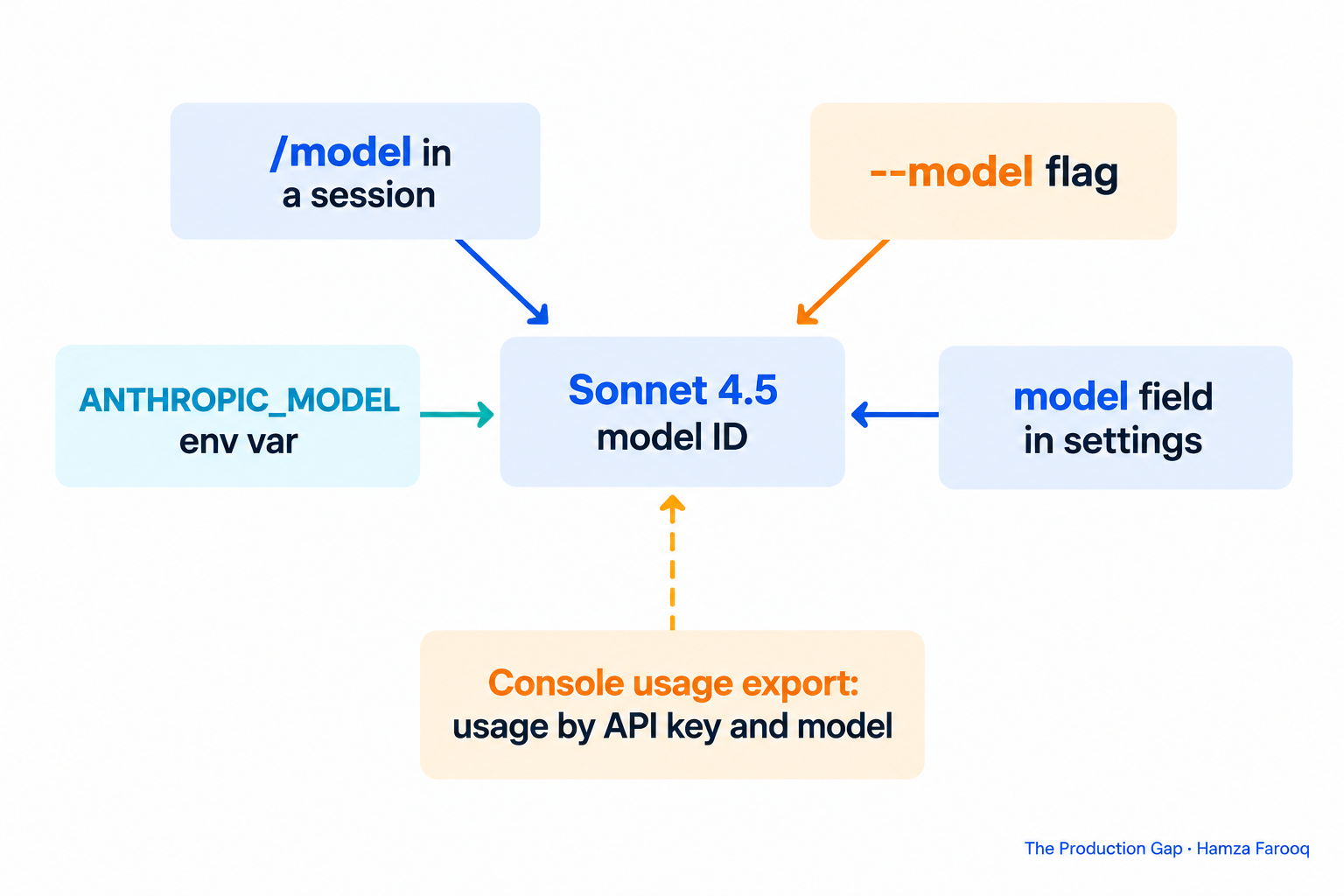
A pinned ID can sit in any of the places that the Claude Code model configuration page lists for setting a model: /model in a session, the --model flag, the ANTHROPIC_MODEL environment variable, the model field in a settings file, and ANTHROPIC_DEFAULT_MODEL.
The same page says aliases such as sonnet update over time, and that you pin a version with a full model name or an environment variable like ANTHROPIC_DEFAULT_SONNET_MODEL. It gives Amazon Bedrock as an example where sonnet resolves to Sonnet 4.5. Its managed settings example pins claude-sonnet-4-5, so a team that copied that example would carry the pin. The page also says Claude Code warns, naming the requested model, when that model has a scheduled retirement date.
For API usage, the deprecations page describes an audit: open the Usage page in Claude Console, click Export, and read the CSV of usage by API key and model.
What is the migration checklist from Sonnet 4.5 to Sonnet 5.5?
The steps below come from the deprecations page and the Sonnet 5.5 migration guide. The order is mine.
- Export your Console usage to find API keys and models still on Sonnet 4.5.
- Change the model ID to
claude-sonnet-5-5. - Read content blocks by
type, and passthinkingblocks back unchanged. - Replace thinking budgets with an effort level, and set
output_config.effortexplicitly. - Remove
temperature,top_pandtop_k. - Replace assistant prefills, and replace forced tool use with
autoand strict tools. - Remove any context-window beta header, and move
output_formattooutput_config.format. - Recount tokens, revisit
max_tokensand cost, and test well before the retirement date.
My own suggestion, not from either page: search your repositories, CI configuration and Claude Code settings files for the Sonnet 4.5 model name before step 2.
Frequently Asked Questions
Will my Sonnet 4.5 calls keep working after the tentative November 30 date?
The deprecations page says requests to models past the retirement date will fail. I did not find an error message for retired models on the pages I read, so test the failure path in your own code.
Is Sonnet 5.5 cheaper than Sonnet 4.5?
Its list prices are lower: $2 and $10 per million tokens against $3 and $15. The migration guide says the same text produces about 30 percent more tokens, and that thinking tokens are billed as output tokens. Measure your own traffic before forecasting savings.
Does the tentative November 30 date apply on Amazon Bedrock?
Not necessarily. The deprecations page says Amazon Bedrock and Claude Models on Google Cloud (Google managed) set their own retirement schedules, so a model's dates can differ there.
How do I keep Claude Code on a specific model?
Use a full model name or an environment variable such as ANTHROPIC_DEFAULT_SONNET_MODEL, according to the Claude Code model configuration page. Aliases update over time.
Conclusion
Plan around the tentative November 30 retirement date for Sonnet 4.5 and start by finding where the model name appears. Then work through the migration guide's changes, and budget time for the 400 errors and the token increase, not just the model ID.
Learn from me

Claude Code in Practice, my Maven cohort. Master Claude Code from fundamentals to advanced orchestration: skills, subagents, hooks, MCP, and production automation. Join the next cohort →
Hire us
Traversaal.ai. We're a team of forward deployed engineers solving the toughest AI problems for Fortune 100 companies: document intelligence, agentic data platforms, and real-time web intelligence, deployed in production. Work with our team to deploy your next agentic ecosystem. Talk to Traversaal.ai →
Join us
Want to solve these problems with us? We're always looking for forward deployed engineers who want to ship production AI. jobs@traversaal.ai