Coding Agent Credential Security: How Anthropic's 2026 Threat Report Reframes the Real Attack Vector (and What to Do About It)
Coding agent credential security starts with the API key, not the model. Learn how to scope, broker, and expire tokens before attackers exploit them.

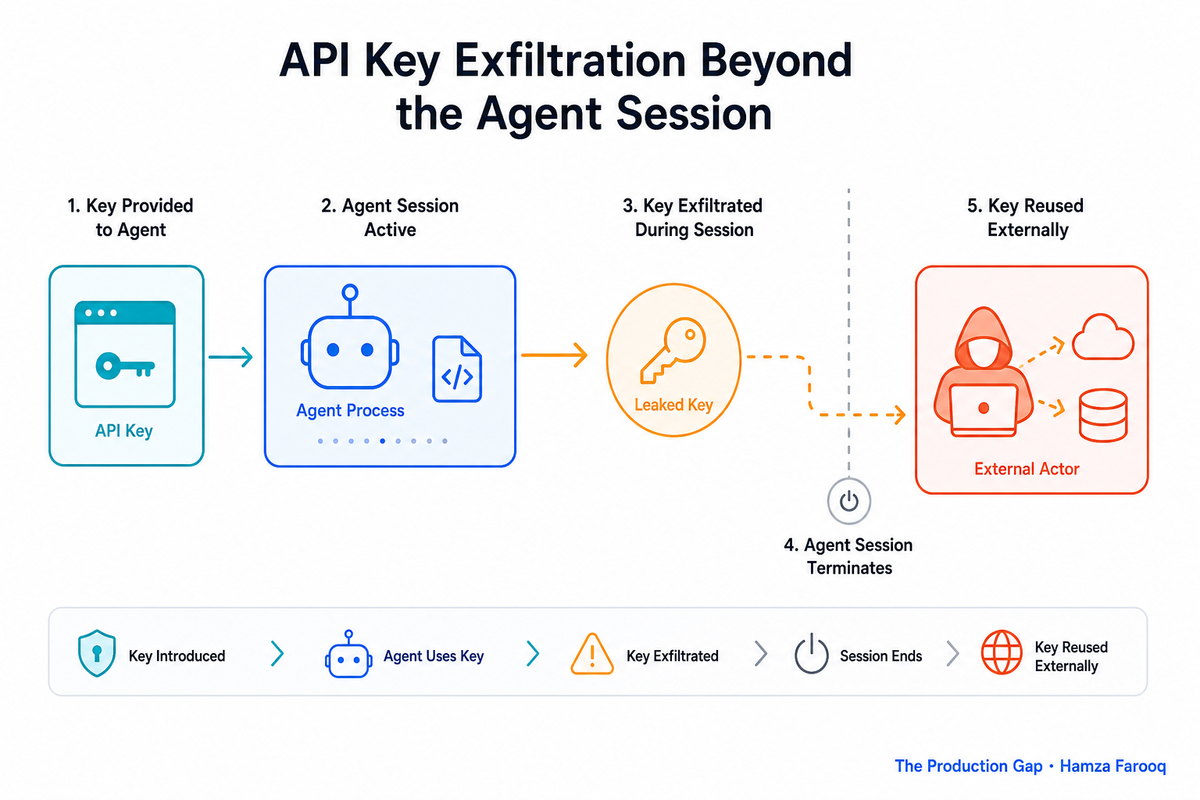
TL;DR: Attackers targeting coding agent deployments go after the API keys and tokens those agents hold, not the model's behavior. A credential exfiltrated mid-session operates entirely outside the agent's process, leaving no model-layer forensic signal. The fix is treating the credential as the control plane: scope it to the task, broker it through a secrets manager, and expire it when the session ends
Key Takeaways
- Credentials, not models, are the target: Attackers go after the API keys coding agents hold, not the AI's behavior.
- Least-privilege scoping is non-negotiable: Every credential should cover only the specific task at hand.
- Time-bound tokens shrink exposure: Credentials that expire at session end give attackers a much narrower window.
- Shadow AI hides the biggest risks: Many agents run outside formal review, holding developer-level credentials far too powerful for their tasks.
- Monitor the credential, not just the agent: Flag when a legitimate token is used outside the original session context.
- Credential brokering beats direct injection: Route secrets through a secrets manager at runtime so the agent never holds the reusable key.
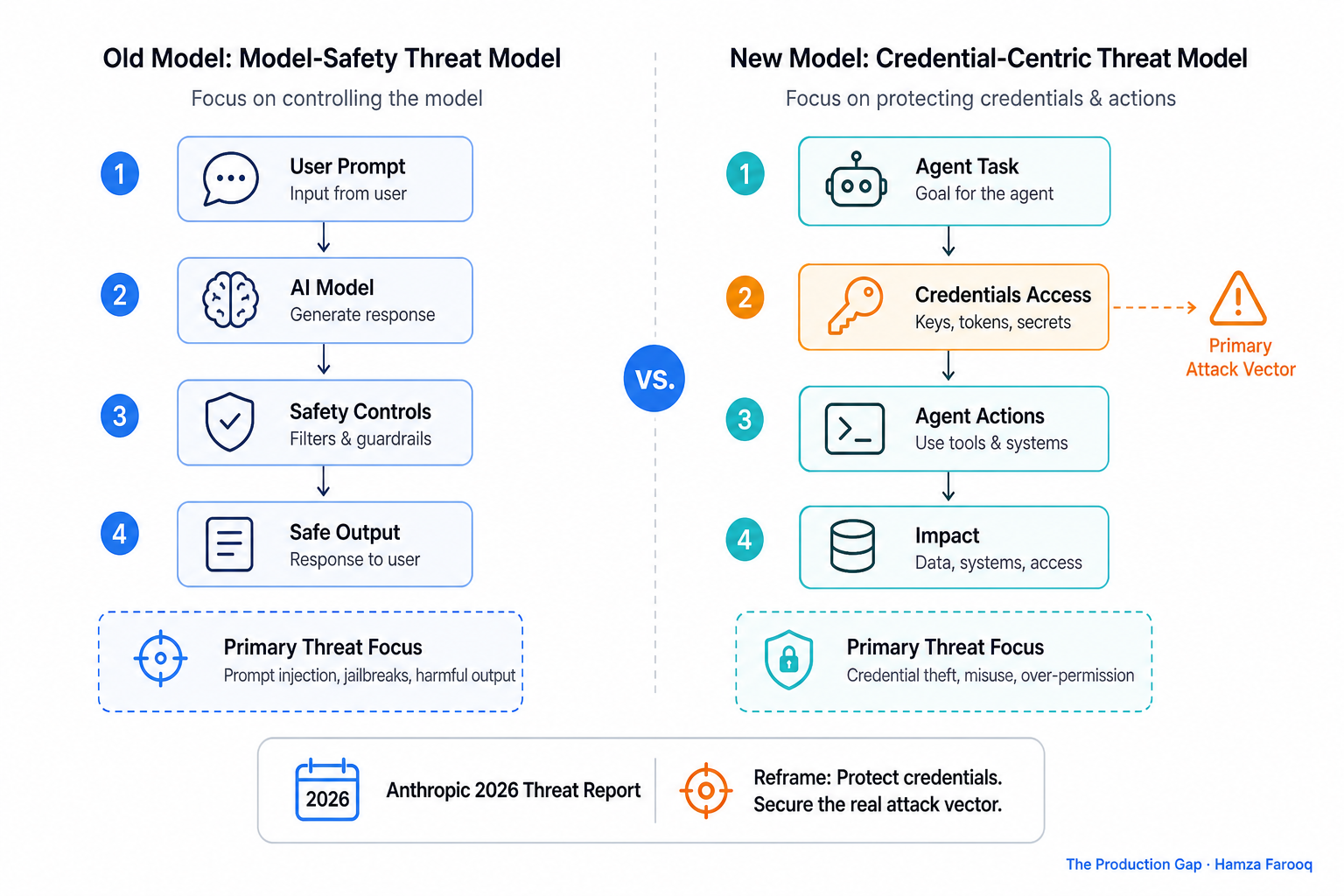
Why is the coding agent's credential the primary attack surface rather than the model's behavior?
The credential a coding agent holds determines what an attacker can do after exfiltration, regardless of how the model itself behaves.
Shadow AI compounds this exposure. Agents running outside formal governance hold developer-scoped credentials broader than any single task requires, and discovering them is a prerequisite to controlling them.
Why is sandboxing alone insufficient to protect coding agent credentials?
Sandboxing contains where an agent runs; it does not control what the agent can do with credentials it legitimately holds inside that boundary.
AI coding agents run with full filesystem permissions, they can read .env files, SSH keys, and AWS credentials in the working directory. Coding agents can combine those legitimate credentials with runtime decisions and high-speed tool use, which is why sandboxing alone is insufficient. A credential relayed through a legitimate tool call bypasses egress controls entirely.
What does a secure, time-bound credential lifecycle look like for Claude Code deployments?
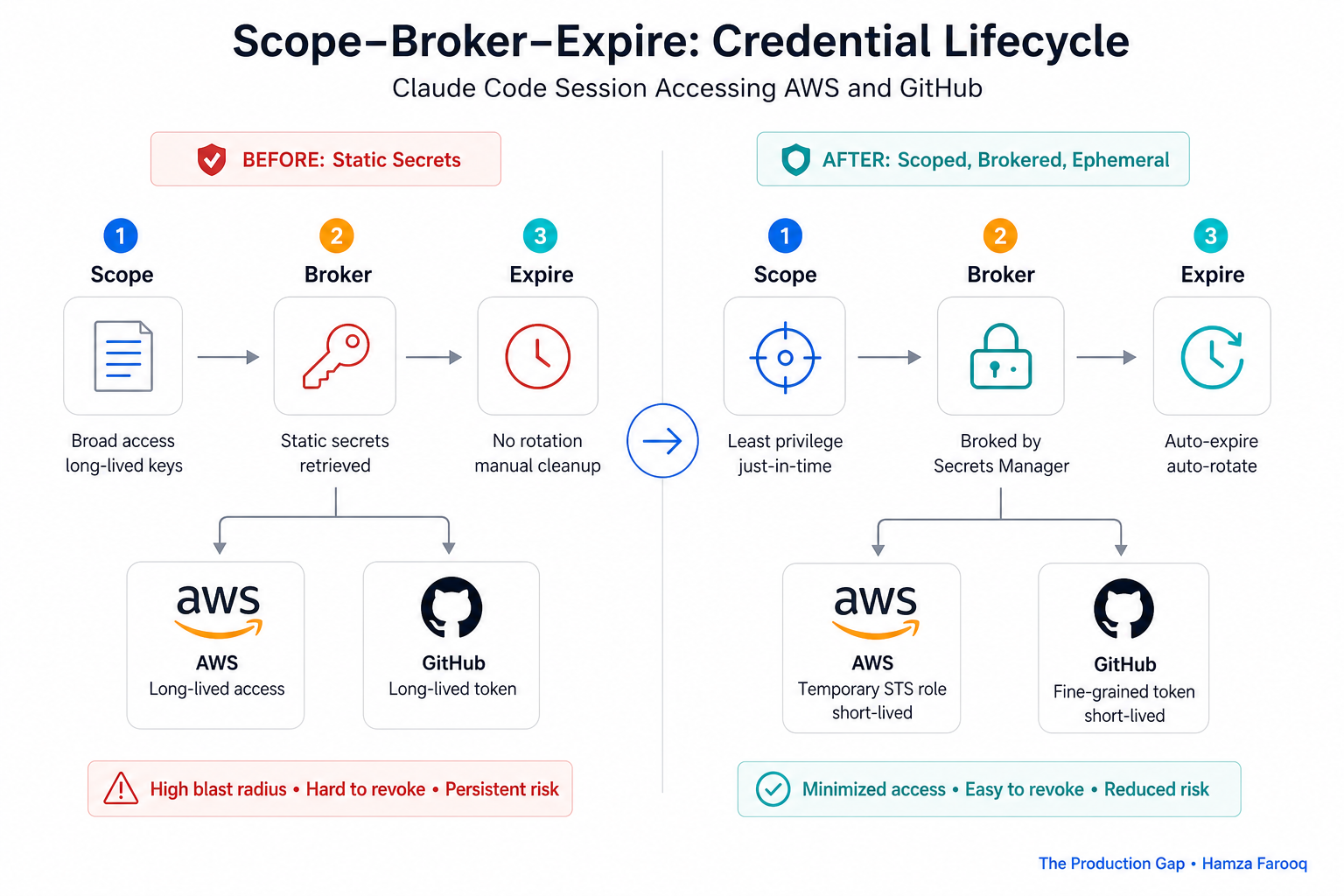
A secure credential lifecycle issues the narrowest possible permissions at session start, brokers access through a secrets manager, and expires the credential automatically when the task ends.
The following three-part framework, used throughout this guide as an author synthesis of the controls described in the cited sources, organizes the core controls. As of 2026, this framing reflects the practical approach most directly supported by available deployment guidance.
Expire: Credentials expire at task completion, kept entirely separate from human credentials.
| Dimension | Direct Secret Injection | Credential Brokering |
|---|---|---|
| Agent sees reusable secret? | Yes | No |
| Credential lifetime | Long-lived (days/weeks) | Short-lived (session/task) |
| Blast radius if exfiltrated | Full permission scope | Expired or narrow scope |
| Auditability | Agent process logs only | Broker logs and agent logs |
| Shadow AI risk | High: developer injects own keys | Lower: broker enforces policy |
| Implementation complexity | Low | Medium |
What is the actionable credential-scoping checklist for teams running Claude Code on sensitive systems?
Audit every active agent credential against seven controls: scope, separation, lifetime, brokering, discovery, baselining, and revocation.
- Scope every credential to the task. No wildcard policies, one service, one operation type.
- Separate agent credentials from human credentials. Agent identities are non-human identities (NHIs) and must never share tokens with the developer who launched the session.
- Set an expiry on every token. Time-bound secrets are the recommended approach; credentials should expire at task completion, not persist across sessions.
- Route through a secrets broker. Agents request short-lived tokens at runtime and never receive static secrets at startup.
- Discover shadow AI deployments. Run NHI discovery tooling to find agents operating outside formal governance.
- Establish a behavioral baseline. Log normal call patterns, source IPs, and time windows per agent identity, then alert on deviations.
- Build a revocation runbook. Define a documented process for revoking credentials when a session ends abnormally, and verify it works before you need it.
In the author's experience, items five through seven are where coverage tends to be weakest and where exfiltrated credentials go undetected the longest. Teams that have completed items one through four often skip the discovery and detection work entirely.
Frequently Asked Questions
What is the difference between sandboxing a coding agent and protecting the credentials it holds?
Sandboxing restricts where the agent runs; credential protection restricts what the agent can do with secrets it legitimately possesses. Sandboxing does not prevent a scoped key from being relayed through a legitimate tool call.
How should teams scope API keys for Claude Code so a compromised session cannot access production secrets?
Issue task-scoped, short-lived tokens via a secrets broker covering exactly one service and operation type, expiring at session end, tracked as an NHI separate from any developer credential.
How can security teams detect when an agent's legitimate credentials are used maliciously after a session ends?
Baseline each agent identity's normal call patterns, source IPs, and active time windows. Alert on any credential use that occurs outside the session window, originates from an unexpected IP, or invokes permissions that were never exercised during the original session. The core principle here is that the detection boundary must follow the credential, not the agent process. Behavioral baselining for non-human identities follows the same logic applied to human privileged-access monitoring: establish a normal pattern, then treat deviation as a signal rather than noise.
How does a credential-centric threat model differ from prior model-safety threat models?
Model-safety approaches focus on outputs: jailbreaks and prompt injection. A credential-centric model identifies a structurally different exposure: the model operates correctly, but its credential is the target, and the attack generates no model-layer forensic signal because it occurs after exfiltration.
Conclusion
The credential the model holds is the attack surface, not the model itself. Governing what an agent writes, runs, and ships means nothing if the key it carried outlives the session.
Three controls address the most common gaps: run an NHI audit to surface every active agent credential including shadow deployments; apply the Scope-Broker-Expire framework described in this guide to every Claude Code deployment touching production; and build a behavioral baseline so credential use outside a session triggers an alert.
Discovery, baselining, and revocation are where coverage tends to be weakest, and where exfiltrated credentials go undetected longest.
The agent finished its session. The key did not.
Learn from me
Claude Code in Practice, my Maven cohort. Master Claude Code from fundamentals to advanced orchestration: skills, subagents, hooks, MCP, and production automation. Join the next cohort →
Hire us
Traversaal.ai. We're a team of forward deployed engineers solving the toughest AI problems for Fortune 100 companies: document intelligence, agentic data platforms, and real-time web intelligence, deployed in production. Work with our team to deploy your next agentic ecosystem. Talk to Traversaal.ai →
Join us
Want to solve these problems with us? We're always looking for forward deployed engineers who want to ship production AI. jobs@traversaal.ai