The Forward Deployed Engineer Model That Actually Works: Why Enterprises Are Copying Palantir's Pod Structure, Not Just Hiring More FDEs
Forward deployed engineer model decoded: learn why Palantir's triadic pod structure beats solo FDE hires for enterprise AI implementation in 2026.

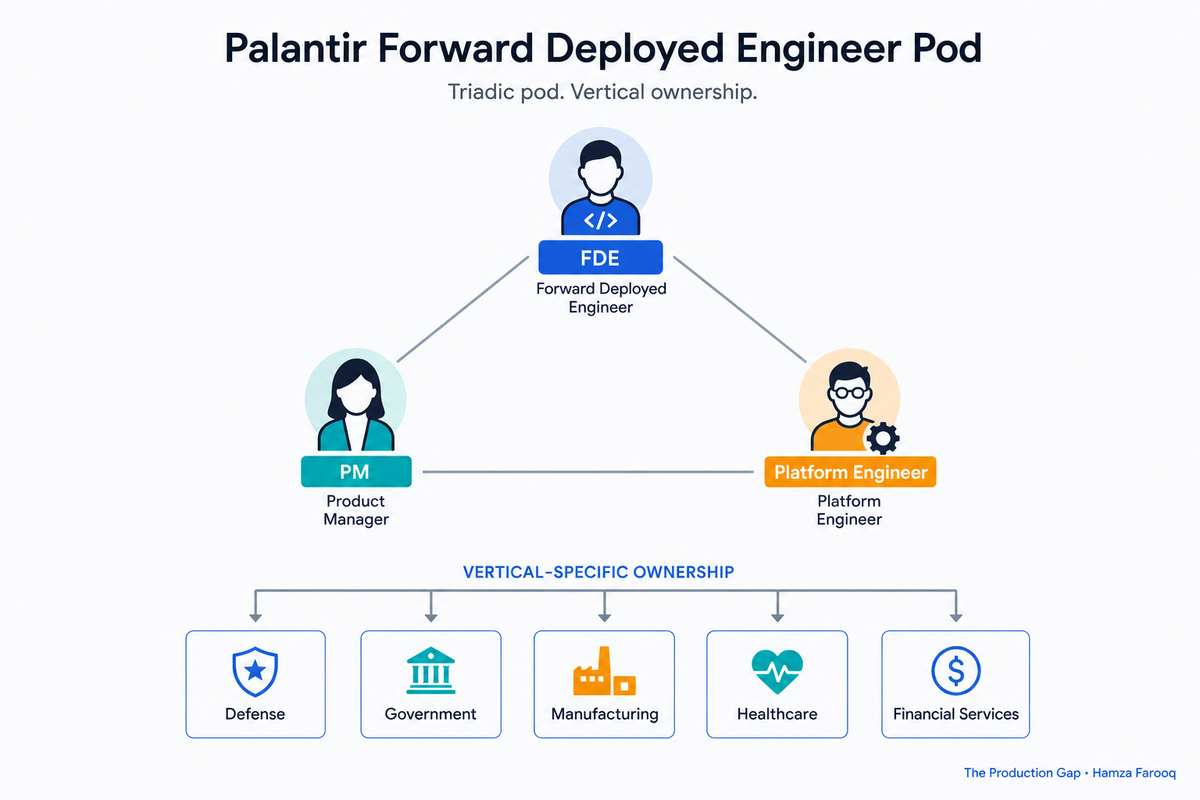
TL;DR: As of 2026, The forward deployed engineer model is not a hiring strategy, it is a three-role pod structure (FDE, PM, and platform engineer) borrowed from Palantir and now replicated by enterprise teams. Each role owns one distinct loop: problem framing, building, and stability. Enterprises that copy only the FDE job title without restructuring around the triadic pod place all three loops on one person, and each function degrades the others. The pod is the actual innovation.
Key Takeaways
- The pod is the unit, not the person: Palantir's results come from deploying a three-role team (FDE, PM, and platform engineer) not from hiring more individual engineers.
- Auftragstaktik drives FDE autonomy: Each pod operates under mission-command doctrine, making field decisions without waiting for centralized approval.
- Enterprises are copying the model internally: Companies are redesigning internal teams around pod structure to accelerate adoption beyond what any vendor team can do for them.
- Vendor-built pods carry ownership risks: When an outside FDE pod builds inside your environment, the resulting workflows and IP may create lock-in no standard software license was designed to address.
Introduction
The enterprise AI bottleneck right now is not model capability, it is implementation bandwidth. Vendors including Palantir are running variants of the forward deployed engineer model to close this gap.
What exactly is the forward deployed engineer model, and what does it actually include?
The forward deployed engineer model embeds empowered engineers directly inside a client's environment to build under real constraints, not abstracted product cycles. But that describes one node in a three-node system.
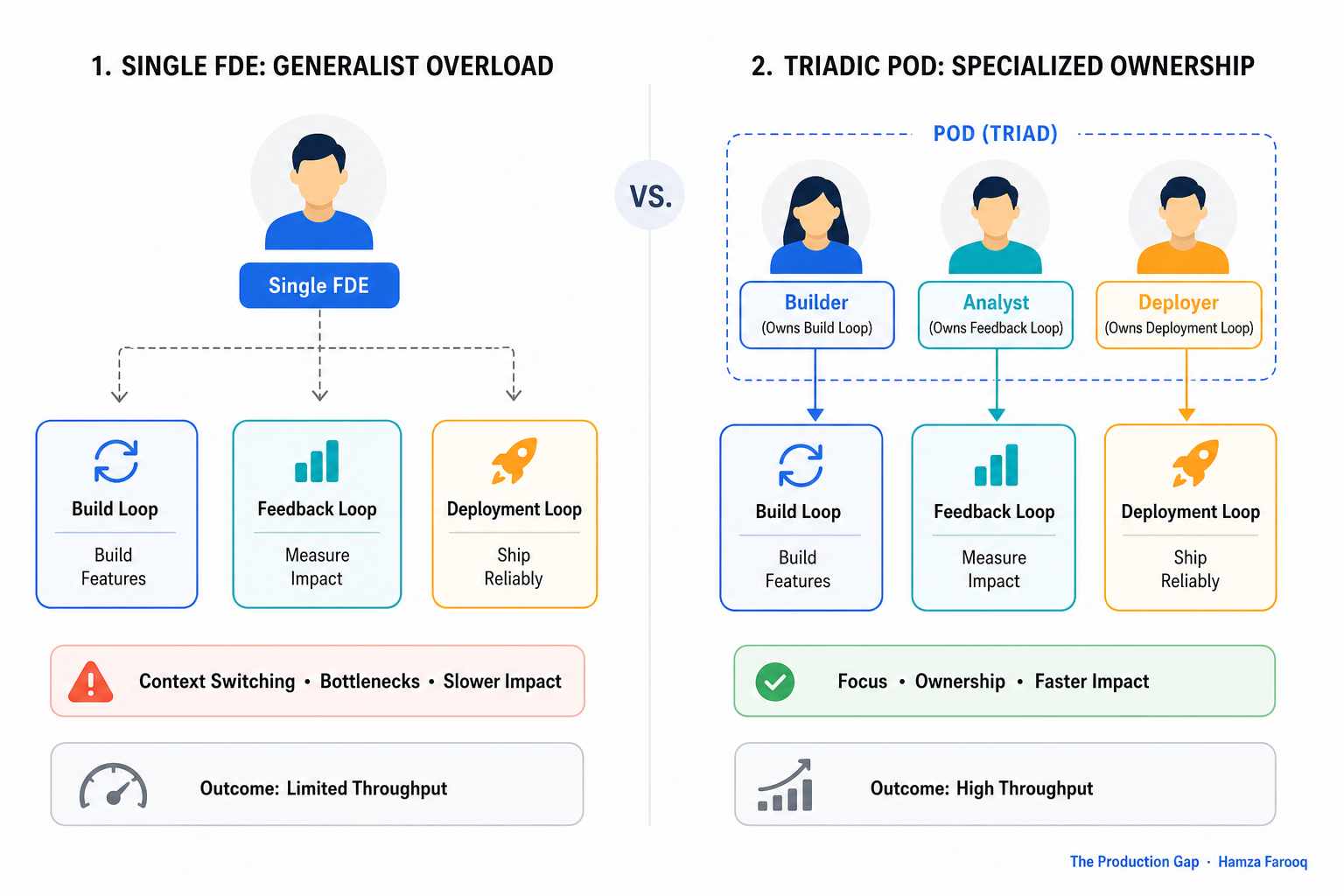
The Palantir FDE pod structure deploys a triadic unit per vertical:
- The FDE builds under real customer constraints, the build loop.
- The PM owns problem framing, stakeholder translation, and outcome definition, the problem loop.
- The platform engineer maintains integration layers, data pipelines, and environment stability, the stability loop.
Each role owns a distinct loop. SVPG frames the model as deploying "empowered engineers and other product creators", plural, not singular. Hiring one node without the system is, in my view, the core mistake enterprises make.
Why doesn't simply hiring more FDEs or solutions engineers scale customer outcomes?
Hiring more FDEs without restructuring around a triadic pod model fails to scale because each solo engineer must carry the problem, build, and stability loops simultaneously, and each function degrades the others. A forward deployed engineer playbook is not a hiring guide, it is the operating model that turns embedded engineering into shipped product.
A forward deployed engineer builds iteratively inside the customer's environment with product-level autonomy, which is a structurally different role from one focused on scoping or delivering to a fixed specification. In my view, assigning someone the FDE title without changing their operating model produces no structural change. The pod exists precisely to distribute those loops across specialized roles so each can function properly.
How does the Auftragstaktik doctrine run inside an FDE pod, and why does it matter?
Auftragstaktik, the military mission-command doctrine Palantir imports into its FDE model, lets a pod make consequential product decisions in the field without waiting for centralized approval. Senior leaders set objectives; the pod determines execution.
Without this doctrine, the pod is just a staffing arrangement, three people who still need sign-off before shipping anything. The doctrine is what transforms the triadic structure into a genuinely accelerated delivery loop, rather than a traditional professional services engagement operating under scope-change constraints.
What this means practically is that the pod is not just implementing, it is running a compressed product development cycle at the customer site. Enterprises considering vendor FDE engagements should think carefully about what that implies for ownership of the outputs produced inside their walls.
What are the risks enterprises miss when a vendor FDE pod builds inside their environment?
When a vendor FDE pod builds inside your environment under mission-command autonomy, the resulting workflows, integrations, and institutional knowledge can create vendor dependency that a standard software license was never designed to address.
What gets built is not just software, it is institutional logic encoded in workflows, data schemas, and integrations. In my view, enterprises should consider whether their legal and procurement review processes are equipped to address IP ownership, data residency, and portability before an FDE engagement begins, not after.
How should an enterprise build its own internal FDE pod to reduce that risk?
One approach worth evaluating is building an internal mirror team simultaneously, composed of an embedded engineer, an internal PM, and an internal platform engineer, to shadow the vendor's work and own capability transfer over time.
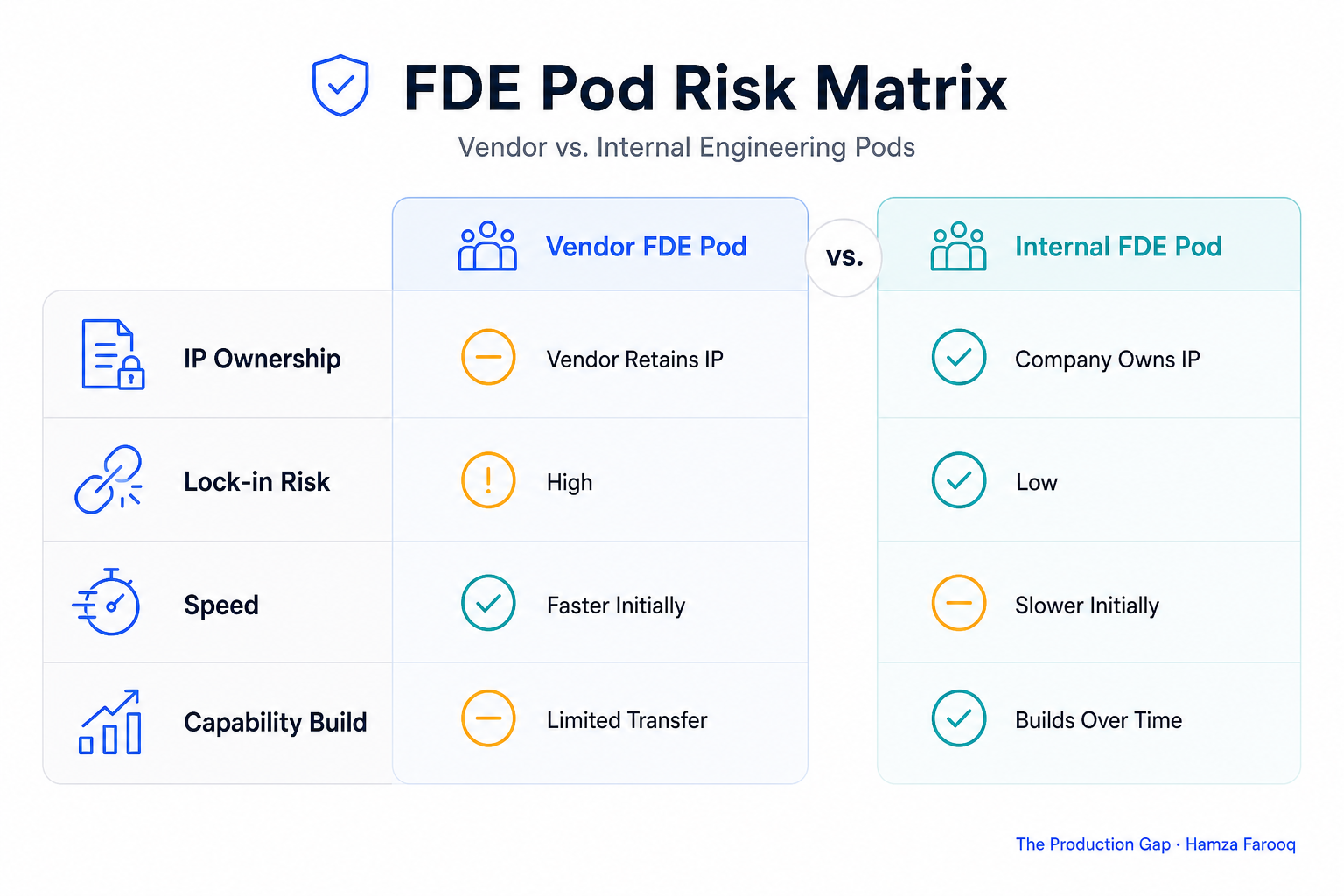
| Dimension | Vendor FDE Pod | Internal FDE Pod |
|---|---|---|
| Speed to first delivery | Typically faster | Typically slower initially |
| IP ownership clarity | Requires explicit contractual attention | Generally clearer |
| Vendor lock-in risk | Higher without mitigation | Lower |
| Internal capability build | Limited | Primary benefit |
| Long-term cost | Depends on contract structure | Depends on team scaling |
Frequently Asked Questions
How does a forward deployed engineer differ from a solutions engineer? A forward deployed engineer builds iteratively inside the customer's environment with product-level autonomy and no fixed specification ceiling. That is a structurally different operating model from roles focused primarily on scoping or delivering against a predefined spec, and the distinction matters when evaluating whether a team is genuinely running the FDE model.
Why do AI platform vendors use FDE-style models if they are not professional services firms? AI companies need embedded engineers to build the application layer for each customer vertical. The FDE model lets them develop real-world deployment experience without building every vertical product themselves.
How should an enterprise protect IP when a vendor FDE pod builds inside its environment? Standard service contracts may not address workflow logic, data schema ownership, or embedded institutional knowledge. Before any FDE engagement begins, it is worth consulting legal counsel to confirm that work-for-hire provisions, IP assignment clauses, and data portability terms are explicitly covered.
What is a practical minimum pod structure for an enterprise starting an internal FDE function? As a practical rule of thumb used in this guide, starting with one triadic pod (one embedded engineer, one PM, one platform engineer) assigned to a single high-value internal deployment gives you a contained environment to test whether the structure works before scaling. The first pod's goal is validating the model, not maximizing output.
Conclusion
When you let a vendor FDE pod build inside your environment, that vendor is effectively running a product development loop inside your walls. Whether your procurement and legal teams have reviewed the IP implications is worth confirming before the engagement starts, not after.
Your next step: Audit your current AI implementation engagements and identify which have a real triadic pod structure (FDE, PM, and platform engineer) and which have a single embedded engineer carrying all three loops at once. That audit is where the structural fix begins.
Learn from me
Forward Deployed Engineering Bootcamp for Full-Stack Developers, my Maven cohort. Build and ship complete AI products end to end, from React and Node.js frontends to deployed models with caching and observability. Join the next cohort →
Hire us
Traversaal.ai. We're a team of forward deployed engineers solving the toughest AI problems for Fortune 100 companies: document intelligence, agentic data platforms, and real-time web intelligence, deployed in production. Work with our team to deploy your next agentic ecosystem. Talk to Traversaal.ai →
Join us
Want to solve these problems with us? We're always looking for forward deployed engineers who want to ship production AI. jobs@traversaal.ai