GSA LLM Contract Clause 552.239-7001: What Vendors Need to Know About Federal AI Safeguarding Requirements
GSA LLM contract clause 552.239-7001 explained: scope, carve-outs, FedRAMP requirements, and AI safeguarding rules federal vendors must understand now.

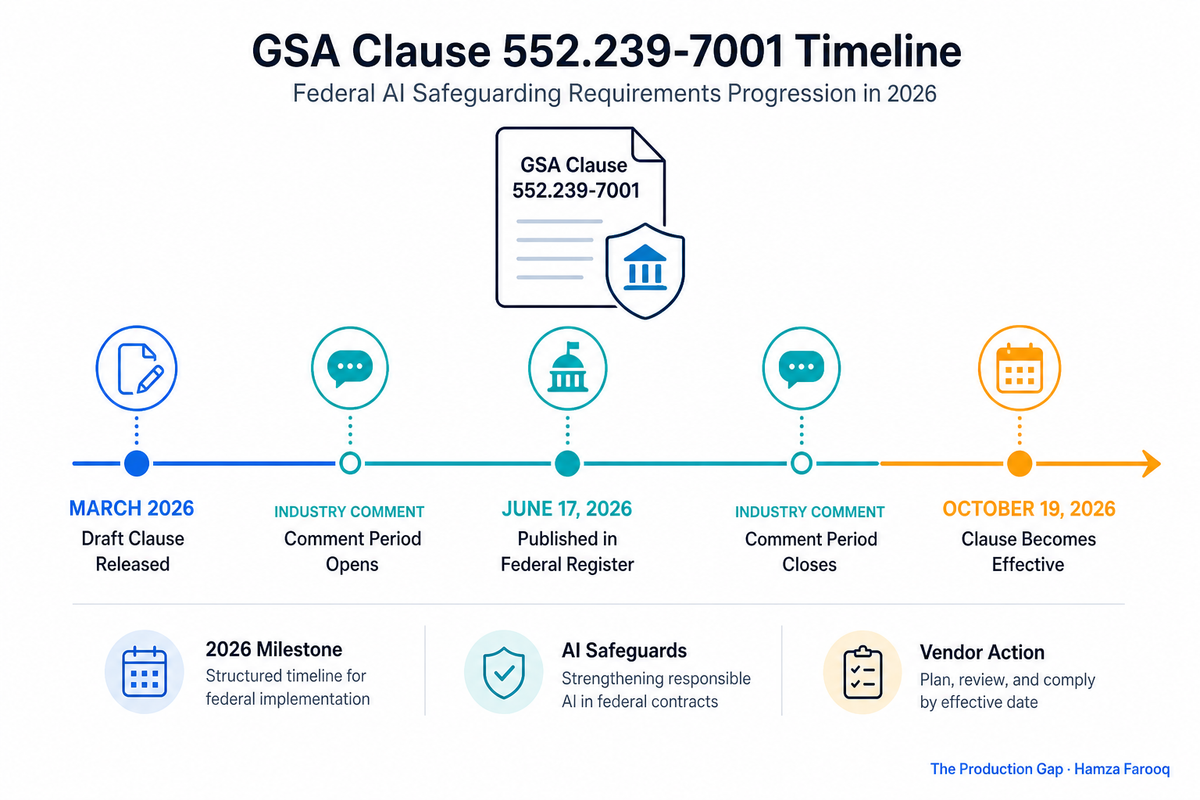
TL;DR: GSA proposed clause 552.239-7001 (Federal Register, June 17, 2026) requires vendors supplying LLM capabilities to federal agencies to meet AI safeguarding standards covering model risk classification, incident reporting, IP protections, and decommissioning cost limits. Key exposure points: the material-feature test triggering renegotiation rights, FedRAMP-aligned incident reporting, mandatory NIST AI RMF flow-downs to subcontractors, and a government suspension right for non-compliant updates.
Key Takeaways
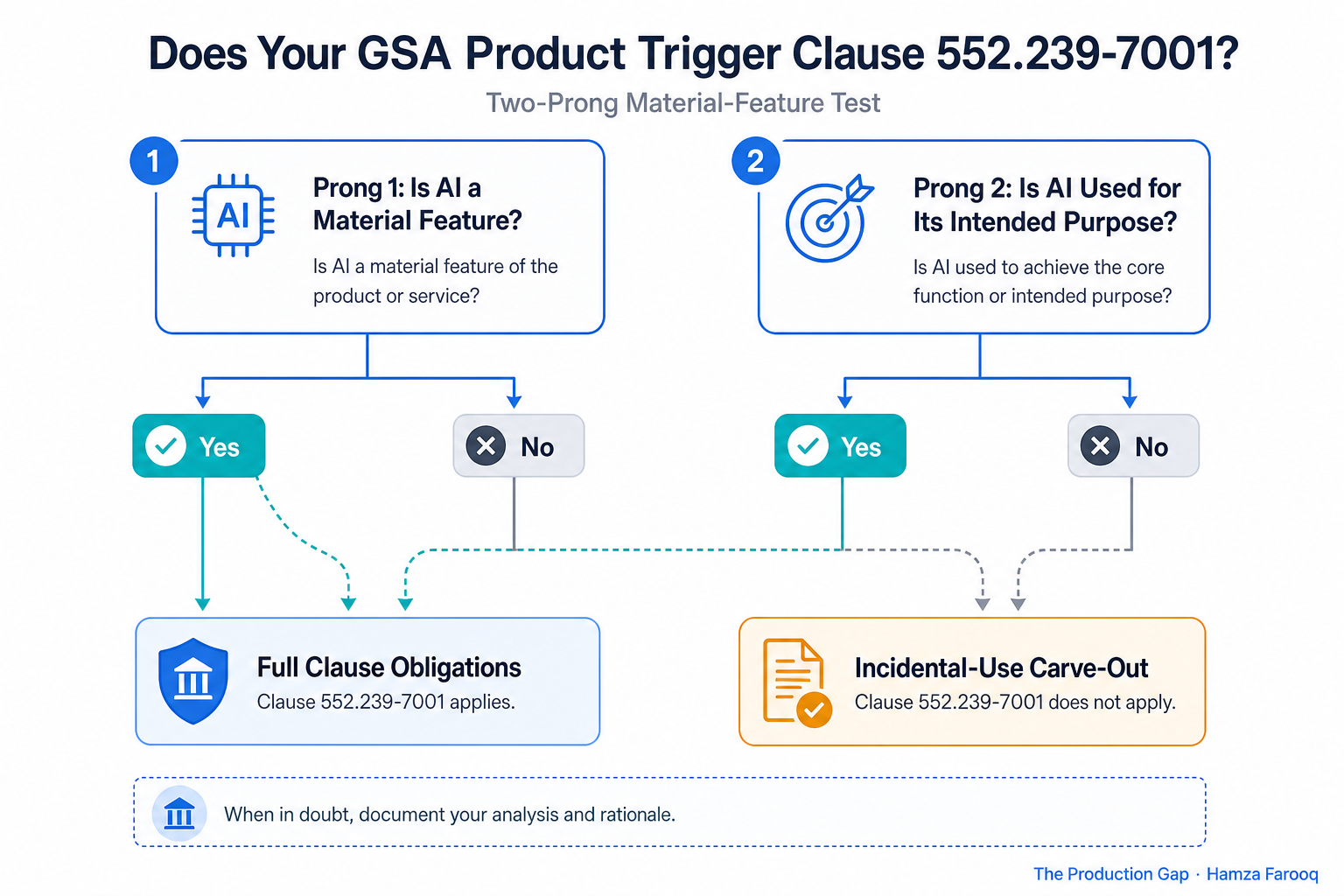
- The incidental-use carve-out has two conditions that must both be met.
- Suspension rights let the government halt LLM features without a formal breach finding.
- FedRAMP safe harbor may require active AI-specific logging; FISMA-only routing may not qualify.
- Model weights and training data IP obligations are addressed explicitly.
- Flow-down rules are intended to reach subcontractors and API providers; commercial API terms may not suffice.
Introduction
GSA proposed clause 552.239-7001 via a June 17, 2026 Federal Register proposed rule to establish comprehensive safeguarding requirements for government data within LLM AI systems. The proposal followed an earlier draft critics called "governance by sledgehammer." GSA delayed rollout and extended the comment period twice.
Does GSA clause 552.239-7001 actually apply to your product? The scope and carve-outs explained
The first carve-out covers LLM functionality that is "incidental" to the contract, meaning the contract does not require delivery of an AI-enabled capability. The second excludes LLMs used for "internal business, back-office, operational, or performance-support systems" not delivered to or accessed by the government. Neither carve-out is self-applying.
Vendors selling commercial platforms with bundled AI features (collaboration tools, CRM, ERP) must assess whether those features fall outside both carve-outs. If an AI feature is referenced in the statement of work or accessible in a government tenant, it warrants a compliance review. BSA's public comment argued the clause should apply only to vendors designing, building, deploying, and operating custom LLM systems for the government. How GSA resolves that in the final rule will significantly affect COTS vendors with embedded AI.
Practical rule of thumb: Audit every active task order's statement of work against the proposed scope definitions now, not at renewal.
What are the government's suspension rights, the FedRAMP safe harbor, and the IP provisions, and what do they mean for vendors?
The proposed clause creates real service and IP risk: it mandates that AI systems "must not" engage in specified behaviors, converts previously agency-specific demands into standard contract terms, and gives the government the right to suspend LLM features without a formal breach finding.
The clause addresses real gaps (inadequate transparency, weak exit rights, insufficient testing authority) but critics note the mechanism is blunt. Audit and testing rights operate alongside, not instead of, the IP protections. Any SLA built around continuous AI-feature availability carries performance risk. Suspension contingency planning, incident response classification, and IP schedule review are three distinct workstreams requiring separate attention.
Table 1: Clause 552.239-7001 Key Provisions at a Glance
| Provision | Clause requirement | Vendor consideration | Suggested action |
|---|---|---|---|
| Data protection and ethical AI | Comprehensive requirements when LLMs are used | Applies broadly, not only to purpose-built AI tools | Map all LLM touchpoints in your delivery chain |
| AI behavioral mandates | AI systems "must not" engage in specified behaviors | Standard term across all AI vendors | Review prohibited-behavior list against your model's outputs |
| IP and data protections | Explicit IP and data protection requirements | Scope of government rights in model behavior vs. weights | Obtain legal review of IP provisions before next option |
| Suspension rights | Government may halt LLM features | SLA risk if AI features are unavailable | Design a service-delivery contingency without AI dependency |
| FedRAMP incident reporting | AI-event disclosure obligations | Legacy FISMA-only programs may not satisfy the standard | Assess whether AI events are classified and reported separately |
How do NIST AI RMF flow-down obligations and the decommissioning cost cap create potential tail liability?
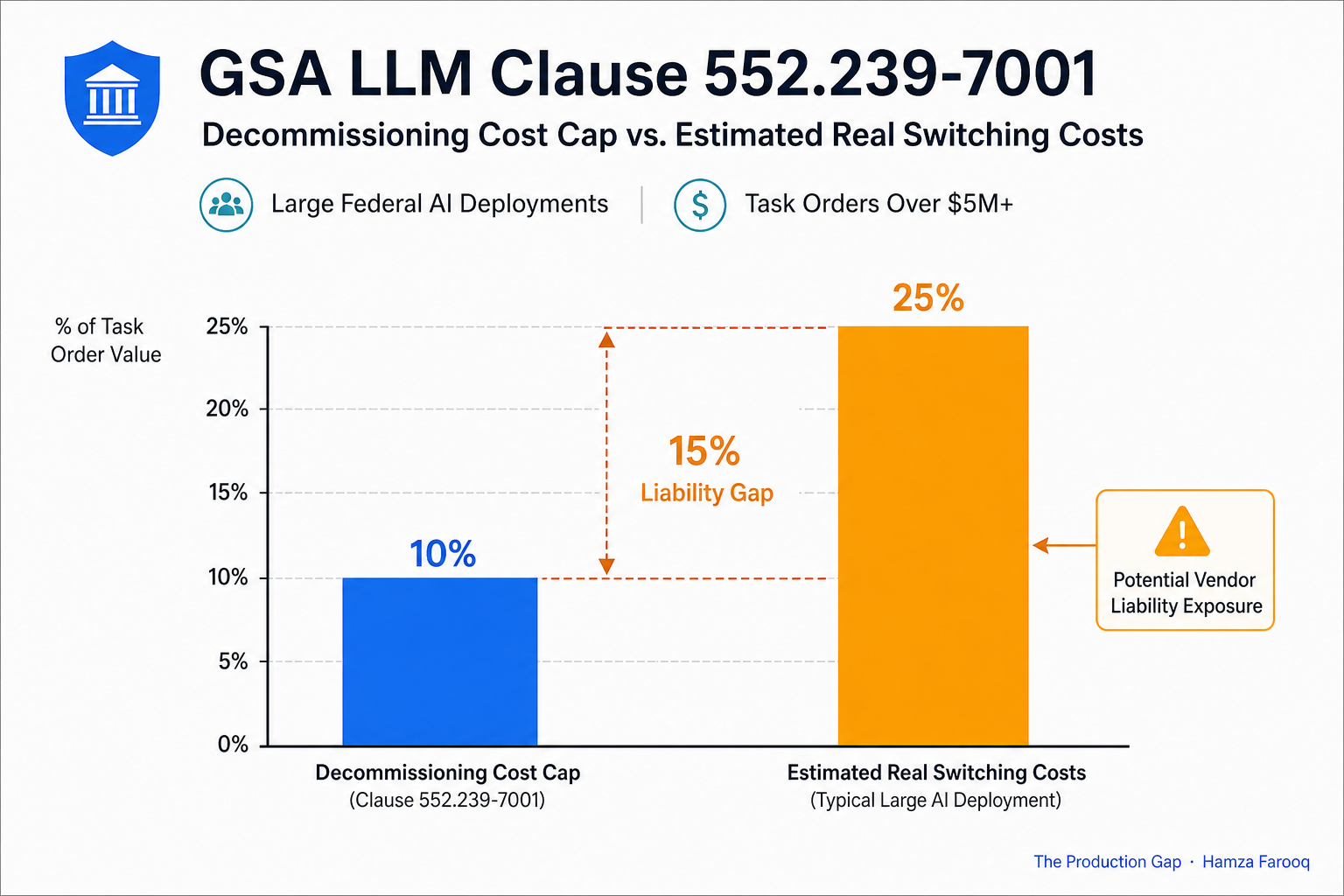
The decommissioning cost cap and NIST AI RMF flow-down obligations are the clause's most consequential financial provisions, each creating distinct tail liability if not addressed before contract execution.
Practical rule of thumb: Model realistic decommissioning scenarios at contract inception, not at option exercise, and explore supplemental provisions where the contracting vehicle allows.
Table 2: Flow-Down and Decommissioning Vendor Considerations
| Provision | Clause requirement | Vendor exposure | Mitigation action |
|---|---|---|---|
| NIST AI RMF flow-down | Primes bear responsibility for subcontractor and API provider compliance | Liability for third-party non-compliance | Audit all model API agreements; add flow-down language to subcontracts |
| Decommissioning cost cap | Recovery may be capped by clause terms | Unhedged switching costs on large multi-year orders | Model switching costs at inception; negotiate supplemental provisions |
| Suspension right | Government may halt LLM features without a standard modification | SLA performance risk | Design service delivery with an AI-off contingency mode |
| FedRAMP safe harbor | May require active AI-specific incident logging | Legacy FISMA-only programs may not qualify | Update incident response plans to classify AI events separately |
Frequently Asked Questions
Does clause 552.239-7001 apply if my GSA Schedule product bundles an LLM feature rather than sells it separately?
Bundled LLM features may trigger the clause depending on how they are described in the statement of work and whether either carve-out applies. Neither exclusion is self-applying; review specific task order language before assuming coverage.
What does the government's right to suspend LLM use mean for service continuity obligations?
The suspension right operates as a standard contract term (no formal breach finding required) so vendors must not build SLA commitments around AI-feature availability without an AI-off contingency mode.
Which subcontractors and model API providers must comply with the NIST AI RMF flow-down, and how should prime contractors document it?
Any provider whose LLM capabilities are part of the delivered government solution is in scope. Primes should obtain written documentation of each provider's NIST AI RMF compliance posture rather than relying on standard commercial terms.
How should vendors handle task orders where decommissioning costs may exceed the clause's cap on recovery?
The cap limits recovery, not actual costs; large multi-year orders carry the greatest exposure. Model realistic switching costs at inception and negotiate supplemental decommissioning provisions before option exercises, not at the point of transition.
Conclusion
Clause 552.239-7001 is still proposed, but vendors with bundled AI features in federal markets should be assessing exposure now. The incidental-use and back-office carve-outs are not self-applying, and the flow-down, suspension, and decommissioning provisions each carry distinct compliance workstreams. Three actions form the core framework: audit every active GSA Schedule task order against the clause's scope language; confirm your incident response program classifies AI events separately; and model realistic decommissioning costs before pricing your next renewal.
Download your firm's clause 552.239-7001 task-order audit checklist, or schedule a contract risk review with your GovCon counsel before your next option exercise.
Learn from me

Agentic AI for Product Managers, my Maven cohort. Learn how to design, evaluate, and ship reliable AI systems: the technical fluency PMs need to lead agentic products, no engineering background required. Join the next cohort →
Hire us
Traversaal.ai. We're a team of forward deployed engineers solving the toughest AI problems for Fortune 100 companies: document intelligence, agentic data platforms, and real-time web intelligence, deployed in production. Work with our team to deploy your next agentic ecosystem. Talk to Traversaal.ai →
Join us
Want to solve these problems with us? We're always looking for forward deployed engineers who want to ship production AI. jobs@traversaal.ai