LLM Agent Decision Routing: A Concrete Framework for When to Replace an LLM Call with a Typed, Non-Autoregressive Model
LLM agent decision routing done right: learn when typed classifiers beat LLMs on cost, latency, and accuracy in production agent pipelines.

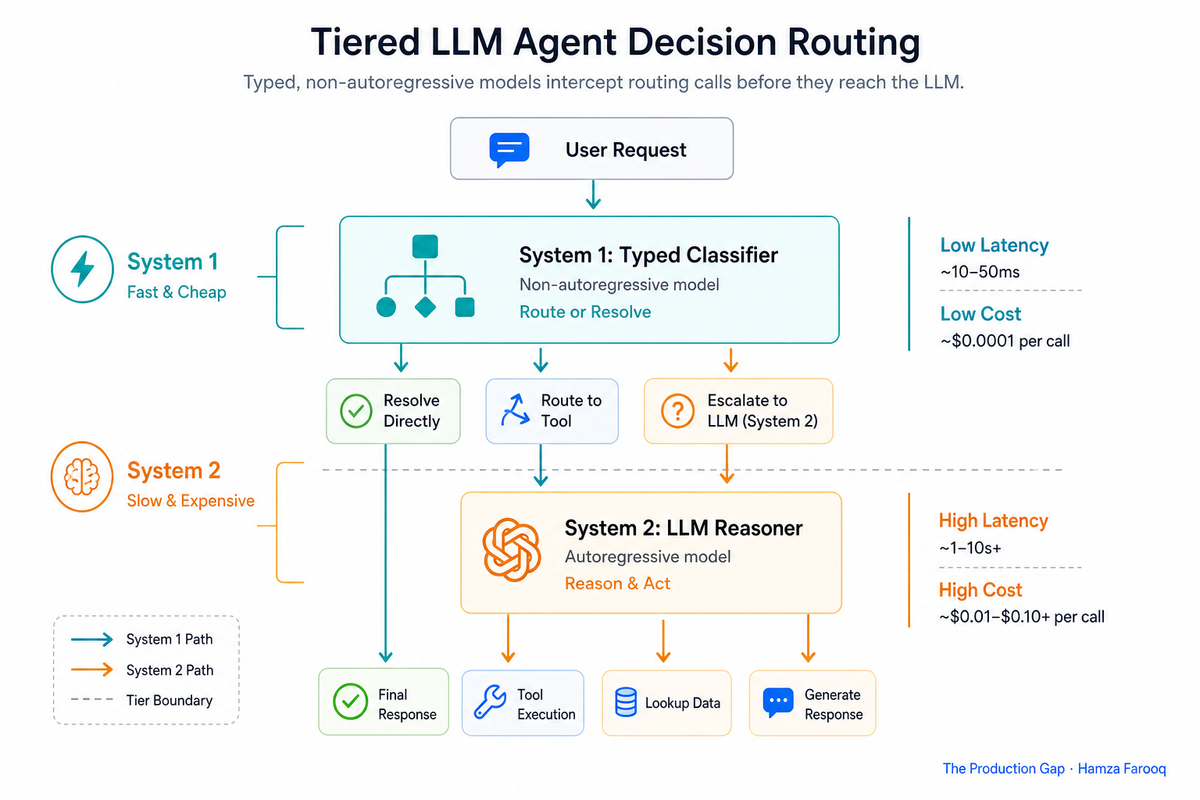
TL;DR: LLM agent decision routing calls for replacing an LLM with a typed classifier (also called a typed router or non-autoregressive model) when the task has a fixed output schema, latency or cost constraints are strict, and training data covers the decision space. Score each routing node across four axes: label space size, input ambiguity, distribution stationarity, and auditability. Roll back when out-of-distribution inputs spike, confidence calibration degrades, or edge-case failure rates exceed your defined threshold. As of 2026, this pattern is in active use across production agent pipelines.
Agent pipelines often make many routing calls per user request, and you are paying LLM inference prices for every single one. The fix is not a cheaper LLM.
Key Takeaways
- Not every pipeline step needs a language model; some are better handled by faster, cheaper typed classifiers (also called typed routers or non-autoregressive models).
- Four criteria determine which model wins: label space size, input ambiguity, distribution stationarity, and auditability.
- Confidence thresholds are your safety net: a score floor automatically escalates uncertain decisions to the LLM tier.
- Out-of-distribution inputs are the primary failure mode: a typed classifier will confidently misroute inputs outside its training distribution.
- Rollback criteria must be defined before deployment. Wire observability before go-live.
Why Is Using an LLM to Route Agent Decisions a Category Error?
The System 1 / System 2 framing justifies tiered architectures: System 1 is fast and cheap; System 2 handles ambiguity. The router is the System 1 layer. If it is autoregressive, the performance differential between tiers narrows, and in a workflow where many routing decisions each hit a large LLM, that overhead accumulates before a single tool is invoked.
Patronus.ai defines an AI router agent as a component that "determines which agent is best suited to handle the input at a specific stage of an LLM pipeline." That is a classification problem with a finite label set, not a generation problem. Treating it as a generation problem is the category error.
The Four-Factor Routing Rubric: Which Signals Tell You to Swap the LLM?
Label space size. If the decision maps to a fixed set of destinations, it is a classification problem. When the label space is small and stable, a typed classifier is worth evaluating. Open-ended or expanding label spaces belong with the LLM.
Input ambiguity. Low-ambiguity inputs such as structured queries, templated actions, and API-triggered events do not need a language model's semantic richness. A practical rule of thumb: if a human labeler can tag the routing class quickly with high inter-annotator agreement, the LLM is likely overkill.
Distribution stationarity. A typed classifier trained on a fixed distribution degrades when inputs drift. Settled enterprise workflows have stationary priors, so the typed classifier is safer there. Early-stage products with rapidly evolving intents belong in the LLM tier.
Auditability. Typed classifiers produce a class label and calibrated confidence score, which are auditable by default. LLMs produce text that requires parsing, introducing ambiguity in the audit trail. For regulated industries or SLA enforcement, this distinction carries real operational weight.
The Four-Factor Routing Decision Rubric
| Factor | Use typed classifier | Use LLM router |
|---|---|---|
| Label space | Finite, stable classes | Open-ended or expanding |
| Input ambiguity | Low (high labeler agreement) | High: novel phrasings, mixed intents |
| Distribution | Stationary, settled domain | Drifting, early-stage, novel intents |
| Auditability | Required (regulated, SLA-bound) | Optional or not required |
Three or four factors in the left column: swap to a typed classifier. Two or fewer: keep the LLM and document why.
What Happens When the Typed Classifier Is Wrong, and How Do You Catch It?
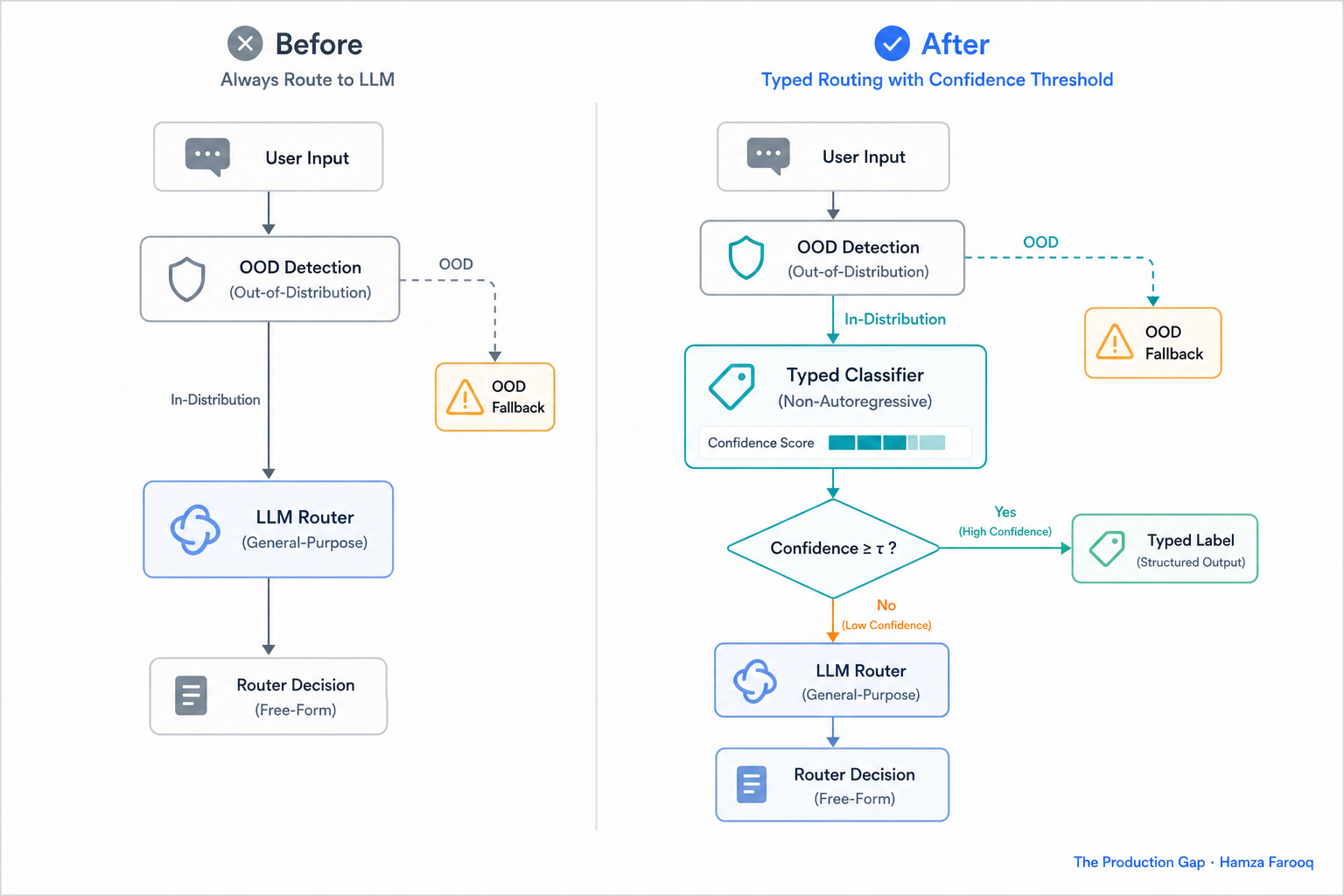
Confidence threshold escalation is the primary mitigation. Define a score floor. If the maximum softmax probability falls below your chosen threshold, escalate to the LLM tier:
if classifier.predict_proba(input).max() < CONFIDENCE_FLOOR:
 route_to → LLM_router
else:
 route_to → typed_label
Rollback criteria must be defined before deployment. Triggers worth wiring: escalation rate exceeds baseline by more than two standard deviations, downstream tool error rate spikes, or a manual audit flags systematic misrouting. The arXiv agent orchestration preprint (2509.07571) makes this concrete; routing models require a fallback path when selection confidence is insufficient. Wire alerting before the typed classifier goes live.
How Do You Measure Whether a Typed Classifier Is Ready to Replace the LLM in Production?
Gate 1, Accuracy: Validate on held-out data covering the current label set. Below acceptable accuracy, error rates compound across agent steps and degrade end-to-end task success faster than latency savings justify. Set your own threshold based on the cost of misrouting in your specific pipeline.
Gate 2, Calibration: Apply Platt scaling or temperature scaling post-training and verify with a reliability diagram. An uncalibrated model's confidence score is unreliable as a threshold signal. Skipping this gate is, as a practical rule of thumb observed in the framework used in this guide, a common reason typed classifiers underperform in production.
Gate 3, Escalation rate: Shadow-run the typed classifier against live traffic and monitor what fraction of calls escalate to the LLM tier. The r/AI_Agents 4-tier pattern shows this working correctly: most calls hit the cheap tier and never escalate. A high escalation rate signals label space gaps or a threshold that needs tuning.
Production observability: Log classifier label, confidence score, escalation flag, and downstream tool outcome for every call. A rising escalation rate signals drift. Tool error rate correlated with specific labels signals systematic misrouting. Both surface before customer complaints do, if observability is wired from the start.
Frequently Asked Questions
At what point in an agent graph should I stop using an LLM and use a typed classifier instead? When the routing decision maps to a finite, stable set of destinations and inputs are low-ambiguity. Apply the four-factor rubric and replace the LLM when three or four factors score in favor of the typed classifier.
How do I handle out-of-distribution inputs when a typed classifier is the first decision point? Set a confidence threshold floor. Inputs scoring below it escalate automatically to the LLM tier. Pair this with an upstream input distribution monitor to catch out-of-distribution drift before it compounds across agent steps.
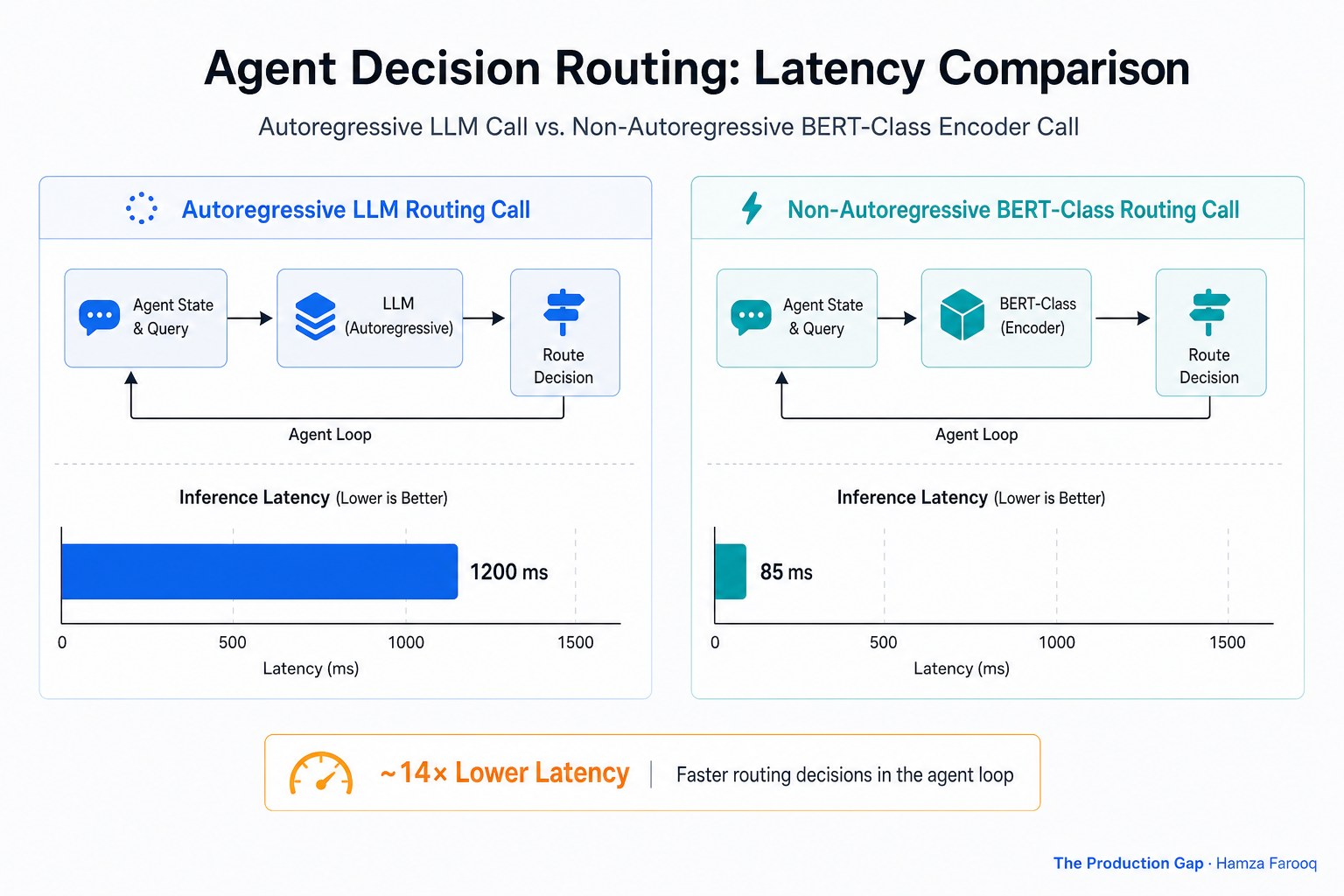
What are the latency and cost tradeoffs between a fine-tuned encoder and a prompted small LLM for routing? A fine-tuned encoder (a typed classifier) produces a label in a single forward pass rather than generating tokens autoregressively, which makes it architecturally faster per call. The exact margin depends on your hardware, model size, and batching strategy. As a practical rule of thumb used in this framework, the per-call overhead of autoregressive generation is the primary reason to prefer a typed classifier at high-volume routing nodes. Concrete numbers for your stack require benchmarking on your own infrastructure; treat any published figure from a different hardware configuration as illustrative order-of-magnitude guidance only.
Can I use confidence thresholds on a typed classifier to trigger graceful escalation to a full LLM? Yes, this is the standard mitigation pattern described in this guide. Define a minimum confidence floor calibrated on a held-out validation set. Calls below it route to the LLM tier; calls above resolve at the typed classifier layer. Monitor escalation rate as a leading indicator of drift or label coverage gaps.
Conclusion
Most production agent decision nodes are structurally classification problems. The System 1 / System 2 framing only delivers its promised gains if the System 1 layer is genuinely fast and cheap. A calibrated typed classifier at the routing node reserves the LLM tier for the ambiguous, novel inputs that actually need generation.
The three-gate checklist (accuracy, calibration, escalation rate) is the concrete starting point for any team evaluating this swap, backed by AWS multi-LLM routing guidance and the arXiv agent orchestration literature.
Next step: Audit your agent graph this week. Score every routing node against the four-factor rubric and shadow-run a typed classifier on your top green nodes before the next sprint closes.
Learn from me

Agent Engineering Bootcamp: Developers Edition, my Maven cohort. Advanced agentic RAG, multi-agent orchestration, memory, evals, and guardrails. Take agents from prototype to production. Join the next cohort →
Hire us
Traversaal.ai. We're a team of forward deployed engineers solving the toughest AI problems for Fortune 100 companies: document intelligence, agentic data platforms, and real-time web intelligence, deployed in production. Work with our team to deploy your next agentic ecosystem. Talk to Traversaal.ai →
Join us
Want to solve these problems with us? We're always looking for forward deployed engineers who want to ship production AI. jobs@traversaal.ai