LLM Search API: How to Ground AI Agents in Real-Time Web Data
LLM search APIs fix knowledge cutoffs by grounding AI agents in real-time web data. Learn how to add retrieval, citations, and freshness to your agent.

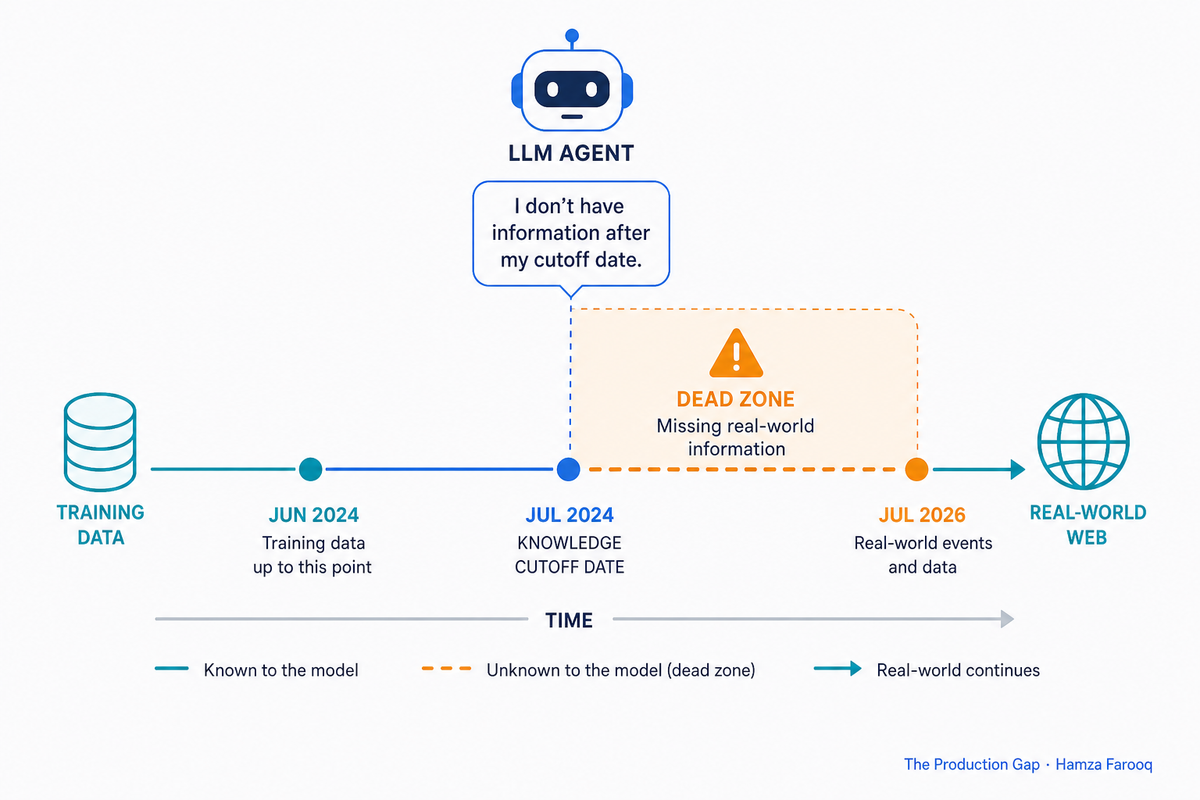
TL;DR: An LLM search API connects AI agents to live web data at query time, solving the core problem that static training knowledge goes stale and causes hallucinations on time-sensitive topics. Purpose-built APIs like Ares retrieve, rank, and format real-time results specifically for LLM consumption, enabling grounding, verifiable citations, and freshness control without overwhelming context windows or blowing inference budgets.
Key Takeaways
- Knowledge cutoffs break production agents: Static training data produces confidently wrong answers in fast-moving domains.
- LLM search APIs differ from SERP APIs: They return clean, structured, prompt-ready text, no parsing pipeline required.
- Freshness windows must match the use case: Hours for news; weeks for documentation. The wrong window wastes money or triggers hallucinations.
- Citation integrity is a compliance issue: In finance and healthcare, an unverifiable citation creates regulatory exposure.
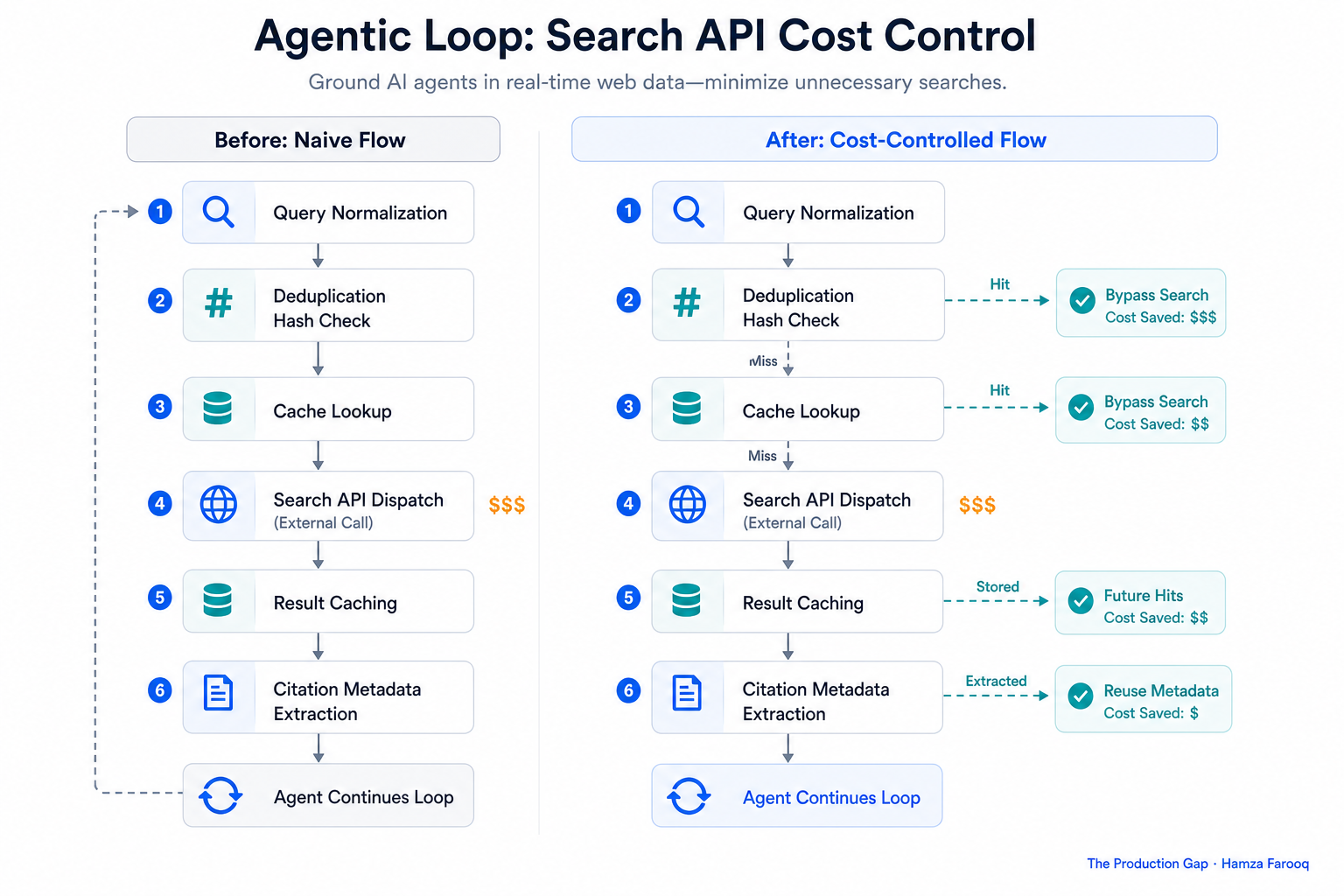
- Agentic loops multiply costs fast: Without caching, call budgets, and deduplication, costs spiral quickly.
- MCP has made search a baseline tool: Search API integration is now expected in any serious agent architecture.
Introduction
The Model Context Protocol (MCP) has standardized tool-calling across frameworks, and OpenAI, Anthropic, and Google have all shipped native search grounding. Search is now baseline infrastructure. The structural problem: every LLM has a knowledge cutoff, and in finance, healthcare, and legal, a stale or hallucinated citation isn't a UX problem, it's potential regulatory exposure. Plugging in a search API is only half the fix; how you wire retrieval into the agent loop is what actually matters.
Why does a knowledge cutoff break production AI agents?
An LLM's knowledge cutoff means every agent built on static training data will serve wrong answers in any domain where facts change faster than model release cycles.
Models are trained on a corpus with a hard end date, then deployed for 12–24+ months. Drug dosage guidelines, SEC deadlines, sanctions lists, all change faster than release cycles. In multi-step agents, one wrong premise produces a confidently wrong conclusion three steps later.
Here's the failure mode most teams miss. Stale results injected into long-context agents are more likely to conflict with the model's training data. When that conflict occurs, the model sides with what it already knows, the retrieved document loses, and the user gets a wrong answer with a plausible-looking citation attached. In time-sensitive domains, static knowledge isn't a minor limitation, it's an architectural flaw.
How does an LLM search API actually work differently from a standard SERP API?
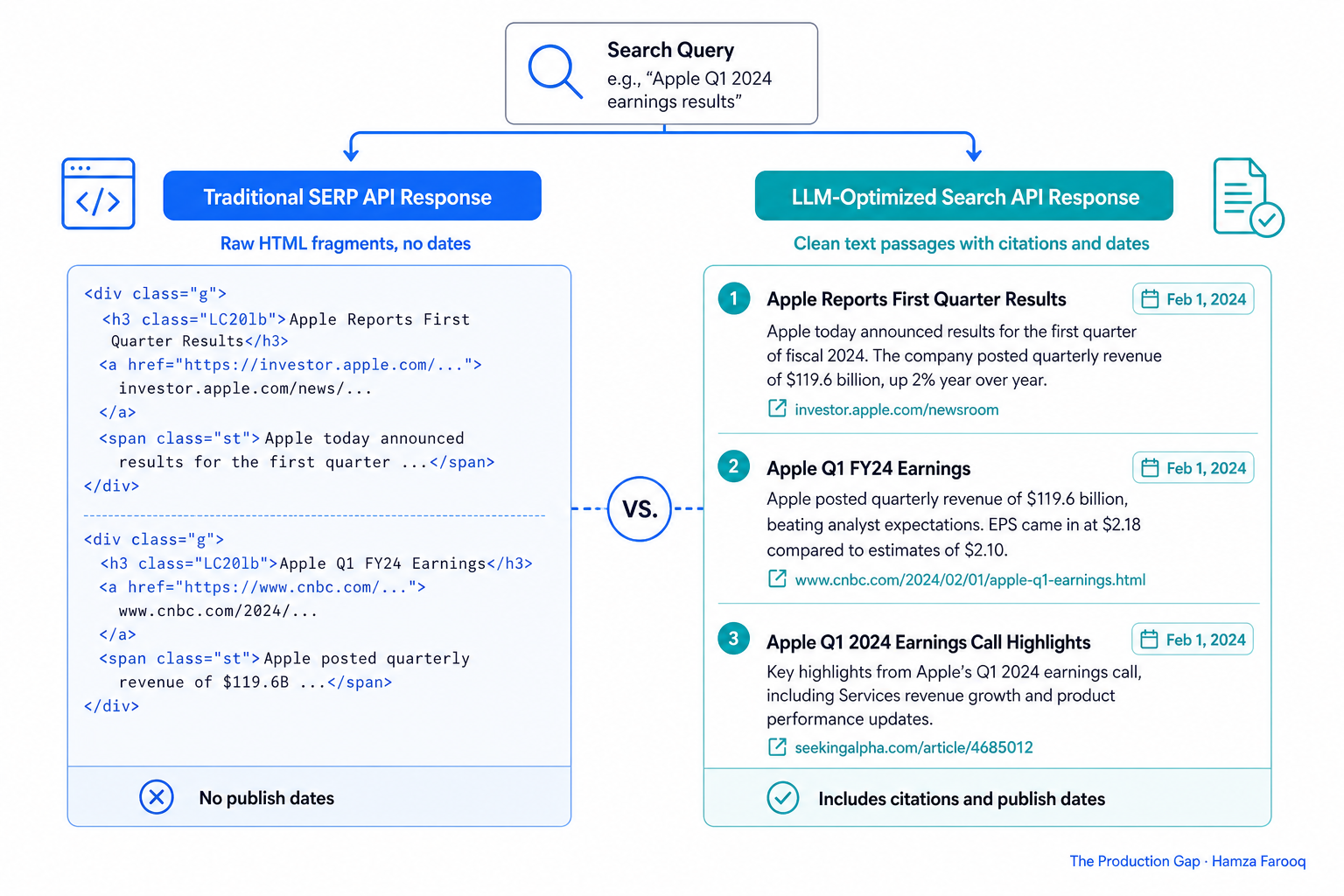
A search API built for LLM consumption returns cleaned, chunked, semantically structured text that a model can reason over directly, not raw HTML or rank metadata that needs a separate parsing pipeline.
A traditional SERP API returns ranked URLs, snippets, and metadata. You must fetch, parse, clean, and chunk each page before it enters a prompt, and every step is a failure point and a cost center. An LLM-optimized search API returns pre-extracted text passages with source URLs and publication dates already formatted for prompt injection. The pipeline collapses.
One underused design pattern: query normalization before dispatch. Inside agentic loops, models rewrite queries iteratively (a problem called query drift) which pulls them away from the user's original intent. A normalization step anchors the query semantically before it hits the API. Re-ranking the output won't fix drift that's already happened upstream.
| Feature | Traditional SERP API | LLM-optimized search API |
|---|---|---|
| Output format | Raw HTML / snippet fragments | Clean, chunked text passages |
| Citation metadata | URL + title | URL + title + publish date + author |
| Prompt-ready | No (requires parsing pipeline) | Yes |
| Freshness filtering | Limited | Configurable time windows |
| Semantic ranking | No | Yes (neural/hybrid ranking) |
| Cost model | Per-request | Per-request + token output tiers |
How should you configure freshness windows and prevent hallucinated citations?
Freshness windows aren't just a cost-control dial. Stale results conflict with a model's training data and produce confident, wrong synthesis, so tighter windows directly reduce hallucination risk.
Configure by domain: - News / market monitoring: ≤4 hours - Regulatory compliance: ≤24–48 hours - Technical documentation: ≤30 days - General knowledge: ≤90 days
For citation integrity, pass source URLs and publication dates as structured metadata fields alongside text, never embedded in prose. This forces the LLM to treat them as verifiable external references rather than generating citations from pattern memory. LangChain's Document schema and LlamaIndex's NodeWithScore both support this pattern. In finance (SEC, FINRA) and healthcare (FDA, HIPAA-adjacent workflows), an unverifiable citation is a compliance requirement, not a quality preference.
How do you control search API costs inside agentic loops?
A single agentic session can trigger 20–50 back-to-back search calls without circuit breakers, turning a $0.01-per-query API into a session cost that exceeds the value of the interaction.
Four practical patterns:
- Query deduplication: Hash normalized queries before dispatch; skip the API call if an identical query fired within the session window. A cosine similarity threshold of ~0.92 works well in practice.
- Result caching with TTL: Cache responses keyed to normalized query plus freshness window. A 15-minute TTL handles most non-breaking-news use cases.
- Per-session call budgets: Set hard ceilings (for example, 10 calls per session) enforced at the orchestration layer. LangChain, LlamaIndex, and MCP tool registries all support this.
- Freshness window as cost lever: Wider windows pull from a larger cached index and cost less per call. Reserve tight windows where recency is a functional requirement.
Frequently Asked Questions
What is an LLM search API and why do AI agents need one? An LLM search API returns clean, structured text from the live web formatted for direct prompt injection. Without it, agents in fast-moving domains will serve outdated answers regardless of how capable the underlying model is.
How do you prevent hallucinated citations when grounding an LLM with live search results? Pass source URLs and publication dates as structured metadata fields, never inline prose, so the model treats them as external references rather than generating citations from pattern memory. Enforce this at the retrieval layer using LangChain's Document schema or LlamaIndex's NodeWithScore.
What freshness window should I configure for my search API? Match the window to the domain's rate of change: hours for news and markets, 24–48 hours for regulatory data, up to 30 days for technical documentation. The wrong window either wastes money or triggers stale-data hallucinations when results predate the model's training cutoff.
How does a search API integrate with MCP-compliant agent frameworks in 2026? MCP-compliant frameworks expose search as a declared tool in the registry; freshness settings, citation schemas, and call budget constraints are configurable at the manifest level. Platforms like Monid provide a unified layer for agents to discover and access APIs and tools, making it easier to connect specialized capabilities within an agentic workflow. Ares ships MCP-compatible integration that exposes these parameters directly in the tool declaration, making governance visible to the orchestration layer rather than buried in application code.
Conclusion
Adding search to an agent is straightforward. Getting reliable results under agentic pressure is the harder problem. An LLM-optimized search API eliminates the parsing pipeline and delivers citation metadata as a first-class feature; query normalization before dispatch stops drift from compounding errors; freshness windows and call budgets need to be treated as production requirements from the start, not tuning afterthoughts. Ares is built with all three as deliberate design decisions, configurable freshness, structured citation metadata, built-in query normalization, and MCP compatibility with cost governance at the manifest level.
Search grounding shapes whether your agent is trustworthy or just fluent.
Start with Ares API to wire real-time search into your agent in under 10 minutes.
Learn from me

Agent Engineering Bootcamp: Developers Edition, my Maven cohort. Advanced agentic RAG, multi-agent orchestration, memory, evals, and guardrails. Take agents from prototype to production. Join the next cohort →
Hire us
Traversaal.ai. We're a team of forward deployed engineers solving the toughest AI problems for Fortune 100 companies: document intelligence, agentic data platforms, and real-time web intelligence, deployed in production. Work with our team to deploy your next agentic ecosystem. Talk to Traversaal.ai →
Join us
Want to solve these problems with us? We're always looking for forward deployed engineers who want to ship production AI. jobs@traversaal.ai