Managing Multiple AI Agents: How to Identify and Fix the Hidden Coordination Tax
Managing multiple AI agents? Learn what causes coordination breakdown, how to fix agent sprawl, and the governance layer most orchestration frameworks skip.

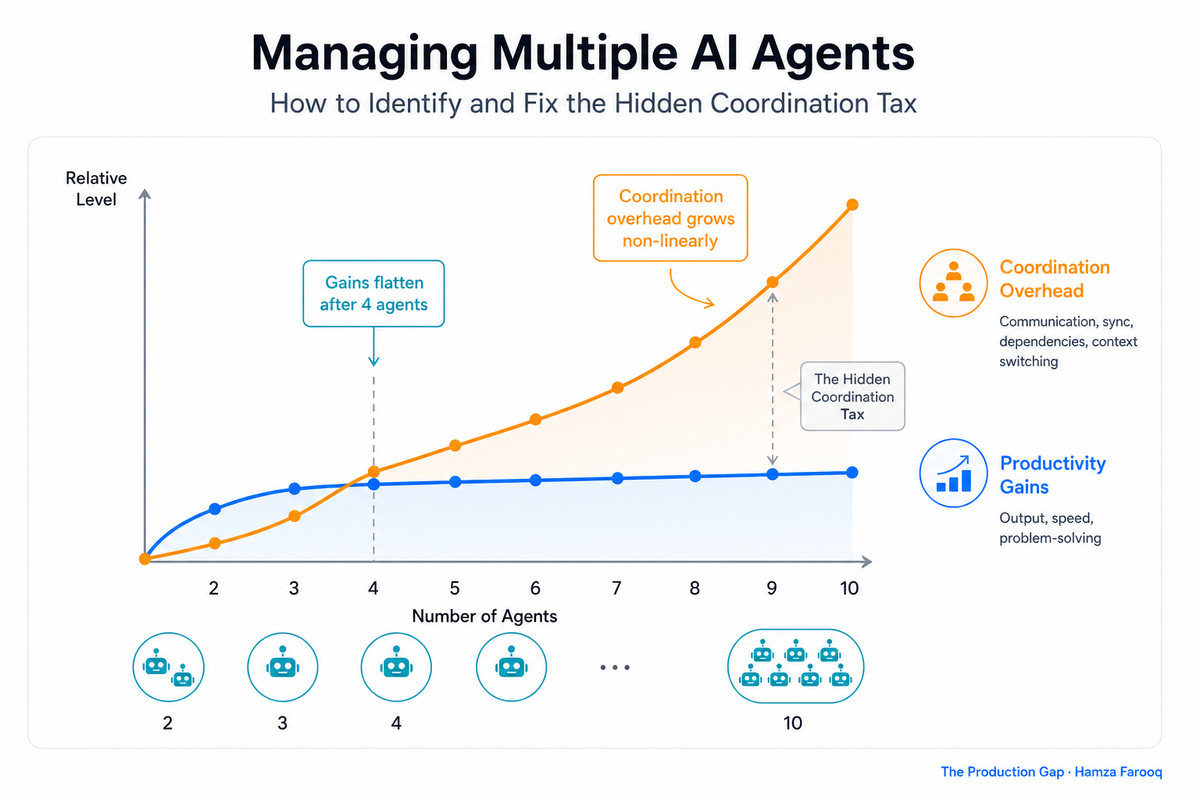
TL;DR: Every AI agent added to a production system creates compounding coordination overhead that most teams never budgeted for. This guide names the three root causes of multi-agent breakdown, offers a practical consolidate-versus-separate decision matrix, and provides a governance layer most orchestration frameworks still skip.
Key Takeaways
- Every AI agent added to a production system creates compounding coordination overhead that most teams never budgeted for.
- Overlapping roles are the root cause of coordination breakdown: shared responsibility produces confusion and contradictory actions, not useful redundancy.
- Ownership gaps break accountability: no named human owner means no governance, just liability waiting to surface.
- Consolidate versus separate is a genuine architectural decision: fuzzy boundaries mean merging reduces friction faster than tuning communication.
- Auditability degrades as agents multiply: log decisions at every agent boundary before something goes wrong, not after.
- Sprawl is an organizational problem, not a technical one: most teams lack the internal structure to own, rationalize, and govern the agents already deployed.
Introduction
Every AI agent added to a production system creates compounding coordination overhead that most teams never budgeted for. Teams that deployed their first AI agents spent the next phase adding more. Many are now running several agents in production and discovering that second-order costs were never in the plan. Practitioners on r/AI_Agents confirm it: the productivity boost from parallel agents is real, but so are the coordination problems that arrive with it. This article covers what breaks after you have built a multi-agent system, and the governance layer most frameworks still do not address.
What exactly is the coordination tax, and how does it compound?
The coordination tax is the cumulative overhead in human attention, debugging time, and duplicated work that grows with every new AI agent added to a production system. The cost is largely human, not compute: someone has to figure out why two agents wrote conflicting records to the same database, and that investigation happens in Slack threads nobody budgeted for.
IBM defines a multi-agent system as multiple AI agents working collectively to perform tasks on behalf of a user or another system, but that definition does not account for handoff surface. As agent count rises, so does the number of potential failure points and accountability gaps between them.
What causes coordination breakdown, and why is ownership ambiguity the root problem?
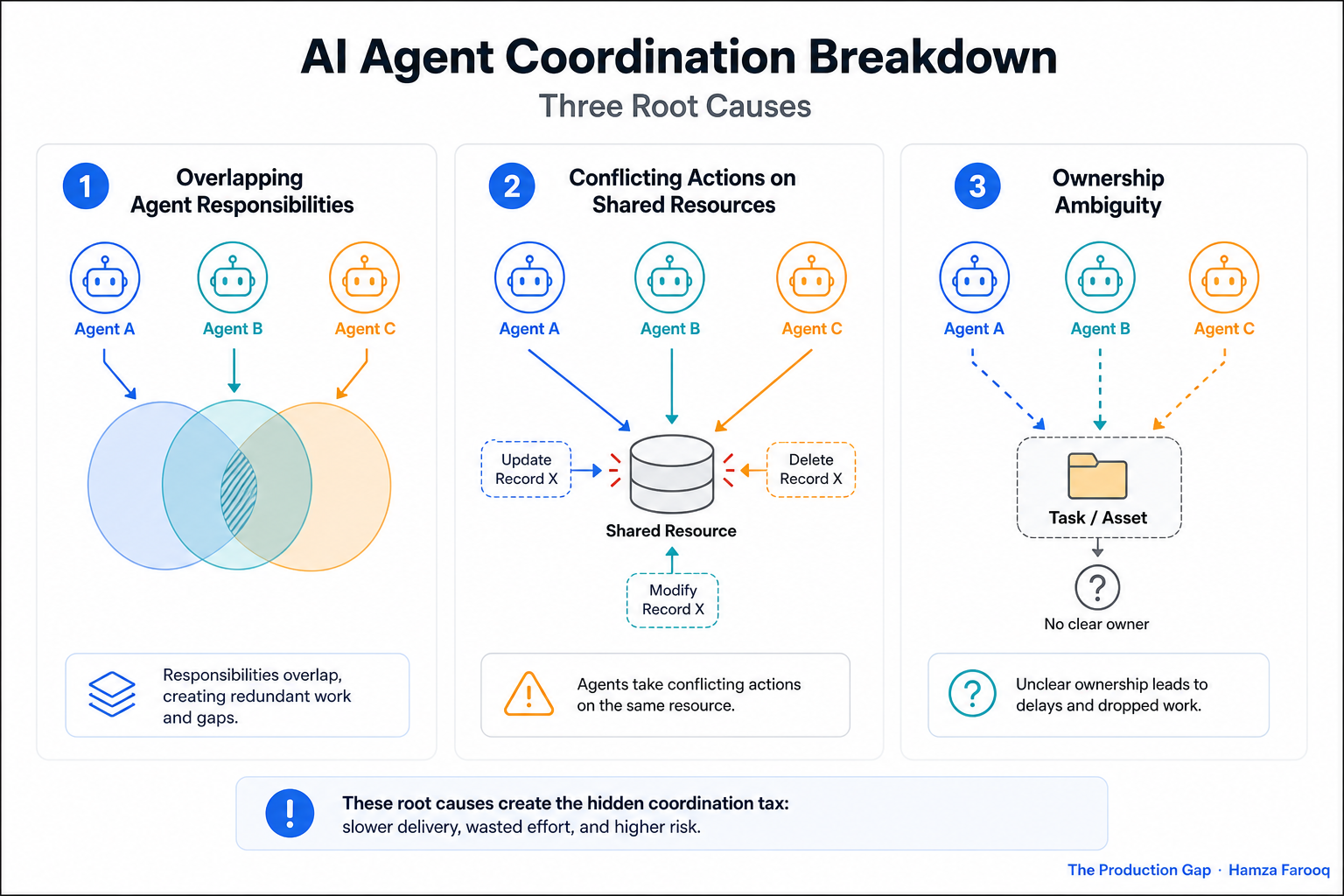
Coordination breakdown has three root causes, as identified in the framework used in this guide: overlapping agent responsibilities, conflicting actions on shared resources, and ownership gaps that leave no human accountable for a specific agent's behavior.
Overlapping responsibilities mean two agents with similar charters both attempt the same task. That produces a race condition, not redundancy: a customer success agent and a billing agent both issuing a refund on the same ticket can result in two refunds, or none, depending on timing. Conflicting actions on shared resources occur when parallel agents write to the same system in ways that corrupt each other's work, a merge conflict with no diff to review before the damage lands.
Ownership ambiguity is the most persistent of the three. When an agent crosses team boundaries, neither team fully owns it, and technical frameworks generally assume ownership is already resolved before deployment. That assumption is where most governance failures begin.
How do you decide when to consolidate agents versus keep them separate?
Consolidate two AI agents into one when their task boundaries overlap in practice, not just in theory, or when no single person can clearly own and audit each agent independently. Table 1 below, the Consolidate-vs-Separate Decision Matrix used in this guide, translates those criteria into actionable signals.
Table 1: The Consolidate-vs-Separate Decision Matrix
| Signal | Consolidate | Keep Separate |
|---|---|---|
| Task overlap | Agents act on the same resources or data | Tasks are distinct with no shared state |
| Ownership | No single team can own both independently | Each agent maps to one accountable owner |
| Auditability | Difficult to attribute outcomes to one agent | Each agent's decisions are independently traceable |
| Failure mode | Debugging requires tracing across both agents | Failures are isolated and self-contained |
| Handoff frequency | Agents hand off more than they act independently | Handoffs are rare and well-defined |
As a practical rule of thumb used in this guide, two or more "consolidate" signals is a reasonable threshold for reconsidering whether separate agents are warranted. Credal notes that a multi-agent framework is meant to solve problems a single agent cannot handle alone. If your agents constantly hand off tasks that either one could handle independently, that reflects fragmentation rather than genuine specialization.
Refer back to Table 1 whenever you add a new agent or conduct a rationalization review. Orchestration frameworks make separation technically straightforward, and that ease becomes a liability when the organizational cost of maintaining separate agents outweighs the technical benefit of splitting them.
How do you build governance before something goes wrong?
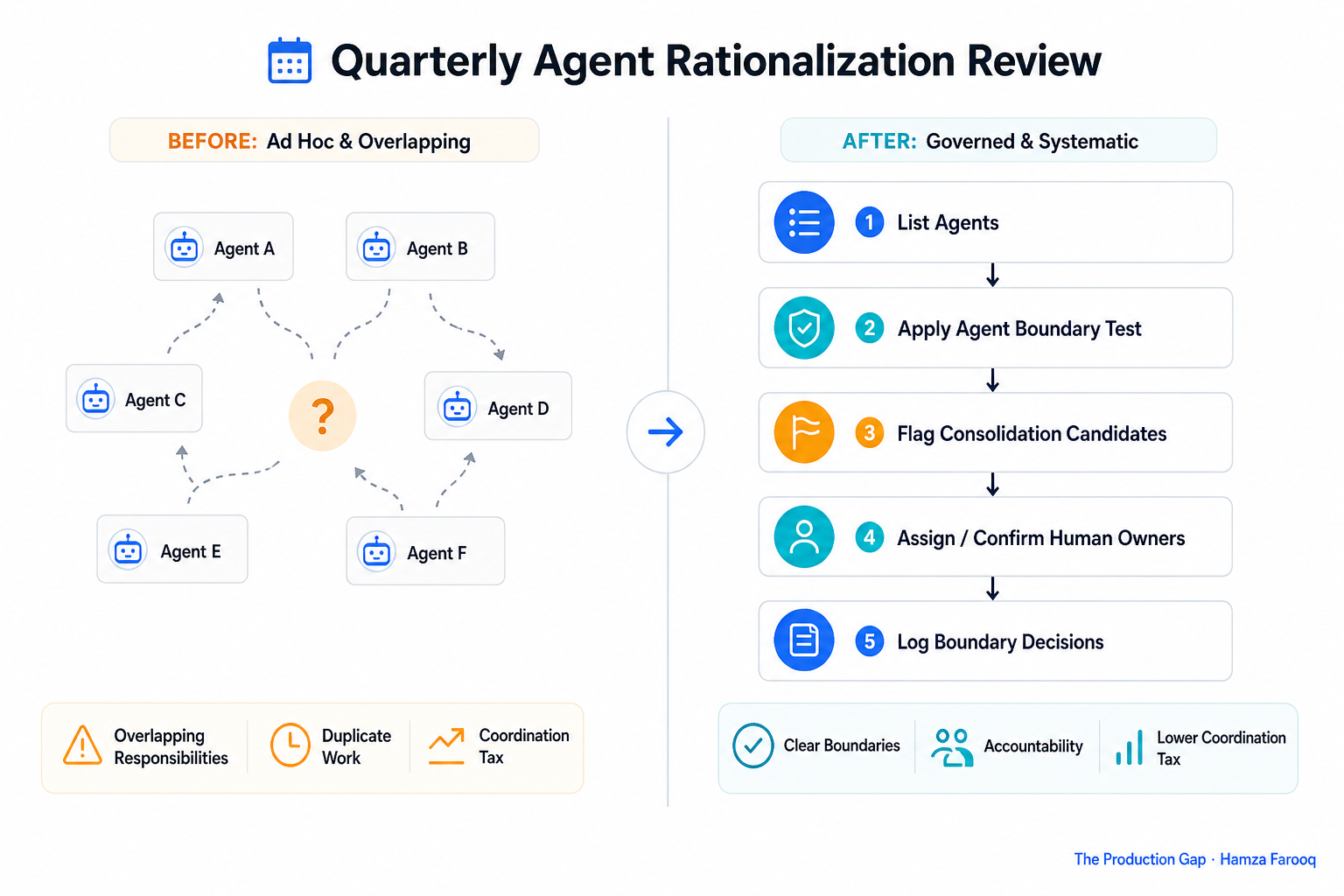
Effective multi-agent governance requires logging decisions at every agent boundary, assigning a named human owner to each agent, and running a periodic rationalization review before agent count exceeds manageable oversight.
Log at boundaries, not just at endpoints. Most teams capture inputs and final outputs, but the information that matters for debugging lives in the handoffs: what did Agent A pass to Agent B, and on what basis? Every boundary should produce a structured log entry covering which agent acted, what input it received, what decision it made, and what it passed forward.
Name a human owner for every agent. That means a specific person who can explain what the agent was built to do and authorize a rollback, not just the team that shipped it. Practitioners on r/AI_Agents report learning this under pressure: productivity gains collide hard with coordination failures when no one person is accountable for a given agent's behavior.
Run a regular agent rationalization review. List every agent, its owner, its task scope, and its overlap with adjacent agents. Any agent that scores consistently on the consolidate side of Table 1 is a merge candidate worth addressing before it becomes a debugging problem.
Frequently Asked Questions
What happens when two AI agents take conflicting actions on the same resource? Without explicit conflict resolution logic and a human owner to escalate to, conflicting actions corrupt state, duplicate work, or produce silent failures. In a properly architected system, agents handle different parts of a process with clear scope boundaries. When those boundaries blur, shared-resource locking and explicit scoping address the problem more reliably than prompt adjustments.
Who should own an AI agent that spans two teams? The team whose systems the agent acts on most, or whose outcomes are most affected, should own it, not the team that built it. Genuine ownership ambiguity is usually a signal that the agent's scope is too wide and warrants review against Table 1.
How do you audit what a specific agent did when tasks pass through multiple agents? Log structured decision records at every handoff boundary: which agent acted, what input it received, what decision it made, and what it passed forward. Without boundary-level logging, post-incident review depends on reconstruction rather than evidence.
Conclusion
Agent sprawl is a product failure mode. Adding an agent is a product decision. Failing to define who owns it and how it will be audited is also a product decision, and one with compounding consequences. Apply the signals in Table 1: The Consolidate-vs-Separate Decision Matrix to your current agent inventory as a practical starting point for identifying which agents warrant a closer look before the coordination tax becomes impossible to ignore.
Learn from me
Agentic AI for Product Managers, my Maven cohort. Learn how to design, evaluate, and ship reliable AI systems: the technical fluency PMs need to lead agentic products, no engineering background required. Join the next cohort →
Hire us
Traversaal.ai. We're a team of forward deployed engineers solving the toughest AI problems for Fortune 100 companies: document intelligence, agentic data platforms, and real-time web intelligence, deployed in production. Work with our team to deploy your next agentic ecosystem. Talk to Traversaal.ai →
Join us
Want to solve these problems with us? We're always looking for forward deployed engineers who want to ship production AI. jobs@traversaal.ai