Natural Language Data Analytics: How Agentic BI Turns Questions Into Charts, Tables, and Forecasts
Natural language data analytics explained: see how agentic BI converts plain-English questions into charts, forecasts, and SQL—without the guesswork.

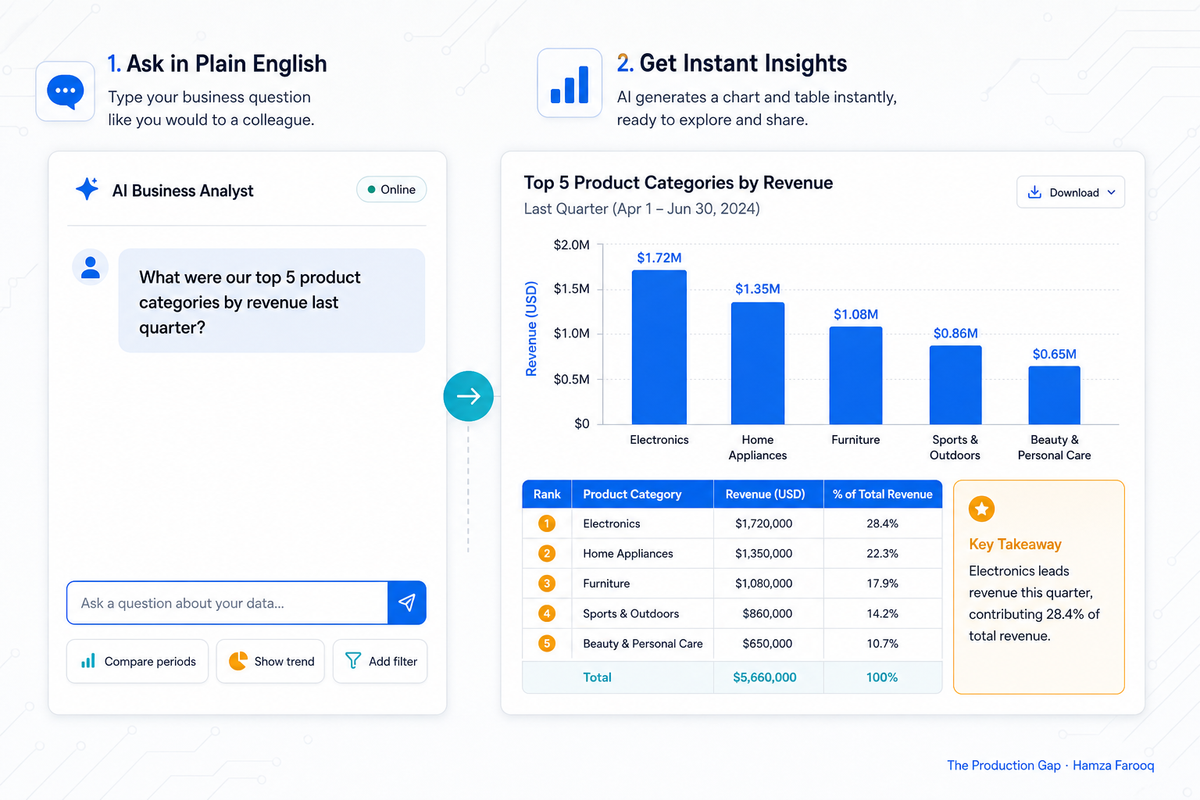
TL;DR: Natural language data analytics lets users ask plain-English questions and instantly receive charts, tables, and forecasts without writing SQL or manipulating spreadsheets. Agentic BI systems make this work by grounding queries against live schemas, resolving ambiguity, and calibrating confidence before returning results. Analysts shift from building reports to validating outputs and defining the business logic that keeps AI-generated answers trustworthy.
A CFO typed "show me churn by region for Q2" into her data analysis tool and got a beautiful chart in four seconds. What nobody told her: the agent had quietly resolved three ambiguous terms, and one was wrong.
Key Takeaways
- Natural language queries need a translation layer: Plain English questions are converted into precise database code before any data is touched.
- Schema grounding is the hard part: The agent must understand your specific data structure before it can answer reliably.
- Ambiguous questions trigger clarification loops: A well-built system asks follow-ups rather than quietly picking an interpretation.
- Trust depends on showing your work: Users act on AI-generated charts far more when they can see exactly what data was pulled.
- Analysts shift from pulling data to auditing it: Routine retrieval is automated; the job becomes catching what the agent gets wrong.
- Compliance obligations are arriving fast: AI-generated answers shaping business decisions now carry legal accountability requirements most deployments aren't built for.
Introduction
Platforms like Olive OS, Databricks AI/BI Genie, Snowflake Cortex Analyst, and Microsoft Fabric Copilot now process millions of natural language data analytics queries weekly against live enterprise schemas. Agentic BI has moved from controlled pilots into production infrastructure.
The core tension is this: fluency creates false confidence. A system that answers in four seconds with a clean chart feels authoritative even when it's wrong. This article shows how the translation pipeline works, where it breaks, and what it means for analysts responsible for the data underneath it.
How does natural language get turned into a database query?
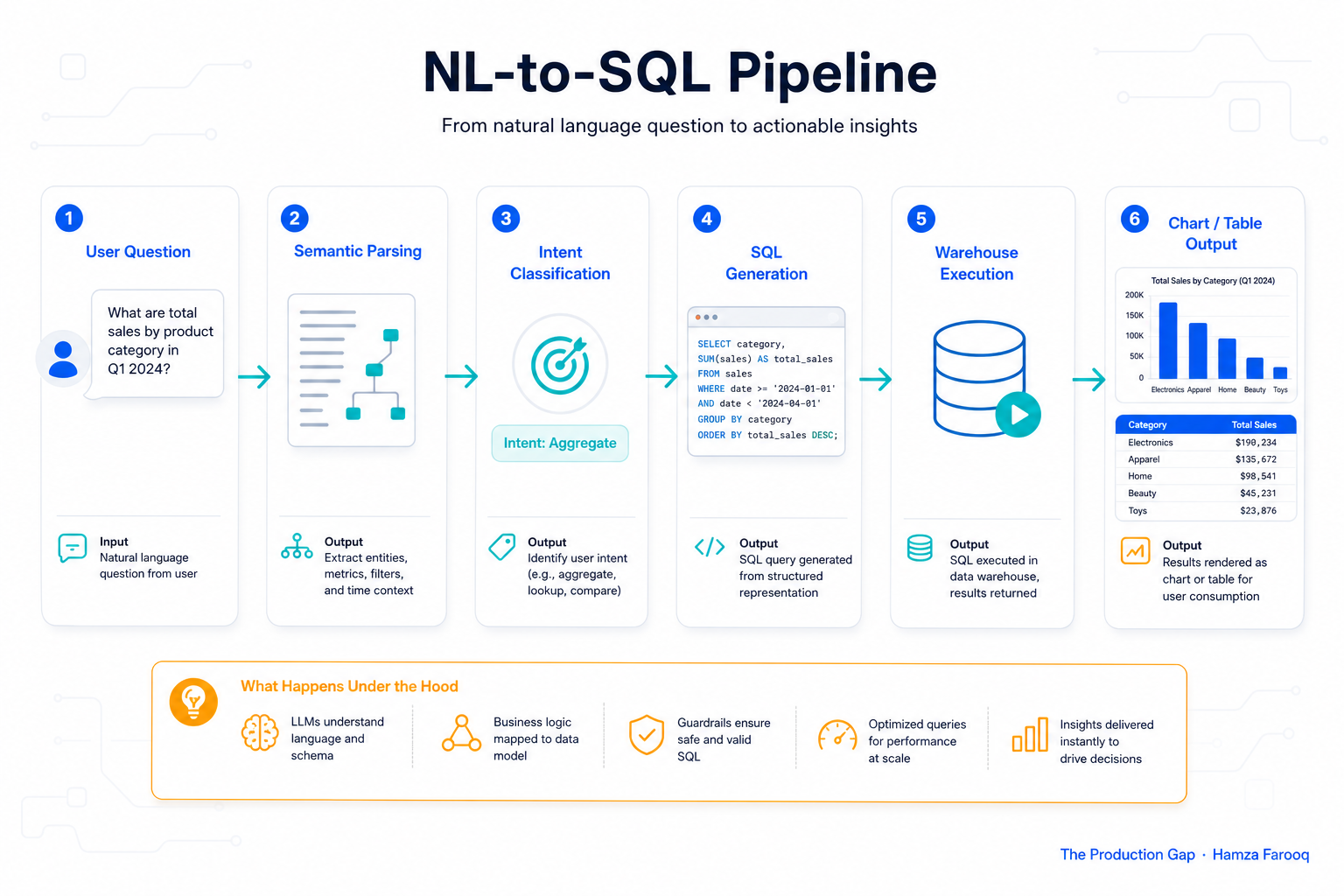
When you ask a natural language analytics tool a business question, it passes your words through a multi-stage pipeline, semantic parsing, intent classification, and SQL generation, before a single row of data is touched.
Take: "Which sales reps missed quota in the Northeast last quarter?" That sentence travels through four stages before any data moves.
Semantic parsing: what did you actually mean?
Semantic parsing extracts business entities from your question and maps them to candidate database concepts. The parser identifies four entities: "sales reps" (a users or reps table), "quota" (a target metric), "Northeast" (a geographic filter), and "last quarter" (a time boundary). That last term is already ambiguous, fiscal or calendar? Q1 or Q2? The parser flags it for resolution before proceeding.
This step uses the underlying LLM reading your question alongside a compressed schema representation. The model isn't querying your warehouse yet. It's matching words to concepts, the way a new analyst would scan a data dictionary before writing any code.
Intent classification: what kind of answer do you want?
Intent classification determines the query pattern, aggregation, filtering, trend analysis, or multi-table join. The "missed quota" question resolves as aggregation-and-filter: compare performance against target, filter by geography and date, return a ranked list. Getting this wrong produces an answer that looks right but measures the wrong thing. "How are sales trending?" could legitimately generate a time-series chart or a period-over-period percentage table, different visualizations, different business implications.
SQL generation: writing the query
The model produces a SQL statement from the parsed intent and schema context. A simplified version:
SELECT rep_name, region, actual_revenue, quota_target
FROM sales_performance
WHERE region = 'Northeast'
  AND fiscal_quarter = 'Q2_2026'
  AND actual_revenue < quota_target
ORDER BY (quota_target - actual_revenue) DESC;
Olive OS embeds semantic layer definitions, column descriptions, join relationships, metric logic, into generation context so the model produces warehouse-native SQL. Output quality is entirely determined by that context. Think of it as a fast intern who speaks every SQL dialect but needs a detailed data dictionary handed to them first. The intern is fast. The onboarding is the hard part.
Execution and rendering
Once the query runs, the rendering layer decides whether to show a table, bar chart, or trend line based on the result's shape. A ranked list becomes a sorted table; a time-series becomes a line chart. This decision is rule-based, not AI-driven, and it's where a technically correct answer can still mislead if the wrong visualization is chosen.
Why schema grounding determines whether the answer is right or plausible-looking
Schema grounding, connecting natural language terms to your specific database structure, determines whether agentic BI produces correct answers or confident-sounding ones. It is not a configuration step. It is ongoing maintenance.
The semantic layer is the actual product
The semantic layer, the structured mapping of business terms to database objects, is what separates a working deployment from a broken one. Without it, the model guesses. It might map "revenue" to gross when your company reports net, or hit the wrong orders table because you have three with overlapping names.
Databricks AI/BI Genie requires data teams to define curated datasets with business-friendly column descriptions and verified metric logic before enabling natural language queries. This pre-work takes weeks on complex schemas. Organizations that skip it get fast answers that are wrong in ways that are very hard to catch.
Name collisions and tribal knowledge
Enterprise schemas contain terminology that only makes sense if you know the company's history, and that tribal knowledge must be manually encoded before the agent can use it. A column called customer_id might refer to billing accounts in one table and individual users in another. "Active customers" might exclude trials in finance's definition but include them in product's.
Most pilots stall here. The schema looks clean, the demo works, then someone asks about "contracted ARR versus recognized ARR" and the agent either produces a wrong number or a confident number neither team can trace back to a source definition.
The governance collapse nobody is talking about
Auditability is the problem agentic BI deployments are least prepared for: knowing what questions are being asked, by whom, and whether the answers are driving correct decisions.
When a CFO queries data through a conversational analytics interface, that query often leaves no trace in analyst monitoring systems. No Jira ticket, no notebook. A confidently rendered chart gets screenshotted into a board deck without anyone checking the underlying SQL. Analysts lose visibility at the moment stakes are highest. Healthcare and financial services are feeling this first: a deployment must log not just what query ran, but which semantic layer version answered it.
Learn from me
Agentic AI for Product Managers, my Maven cohort. Learn how to design, evaluate, and ship reliable AI systems: the technical fluency PMs need to lead agentic products, no engineering background required. Join the next cohort →
Hire us
Traversaal.ai. We're a team of forward deployed engineers solving the toughest AI problems for Fortune 100 companies: document intelligence, agentic data platforms, and real-time web intelligence, deployed in production. Work with our team to deploy your next agentic ecosystem. Talk to Traversaal.ai →
Join us
Want to solve these problems with us? We're always looking for forward deployed engineers who want to ship production AI. jobs@traversaal.ai