Prompt Skill Context Resolution: Why Static SKILL.md Libraries Break in Live Agentic Workflows (and How to Fix It)
Prompt skill context resolution fails with static SKILL.md files. Learn why live agentic workflows need per-call resolution to stop silent drift failures.

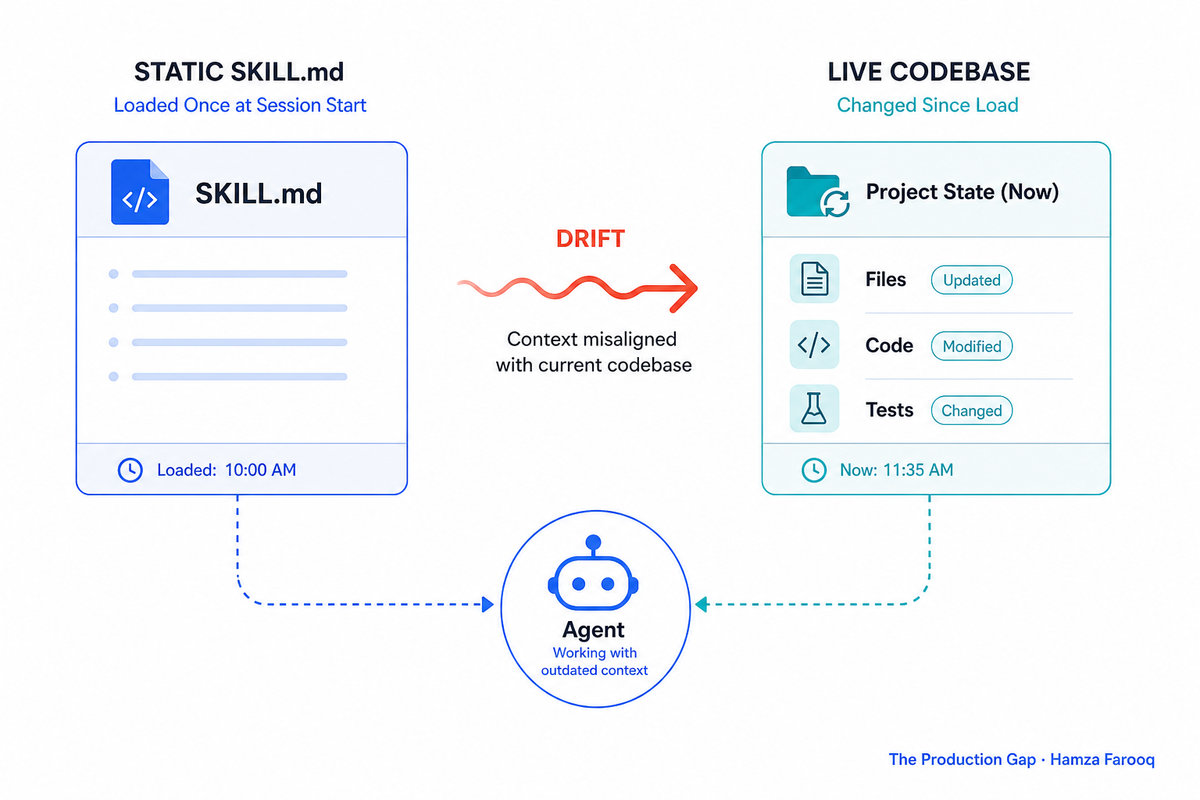
TL;DR: Prompt skill context resolution fails under static SKILL.md libraries because a file loaded once at session start cannot reflect the project state that exists when an agent actually executes a task. Live agentic workflows require skills to be resolved fresh per call against current build artifacts, dependencies, and environment conditions. Teams must migrate from session-level loading to per-call resolution pipelines tied to real-time project state.
Key takeaways
- Static SKILL.md files go stale: a skill loaded once at session start captures a snapshot that becomes wrong as the codebase changes.
- Per-call resolution is the fix: the live-context model rebuilds a skill artifact fresh on every call against current project state.
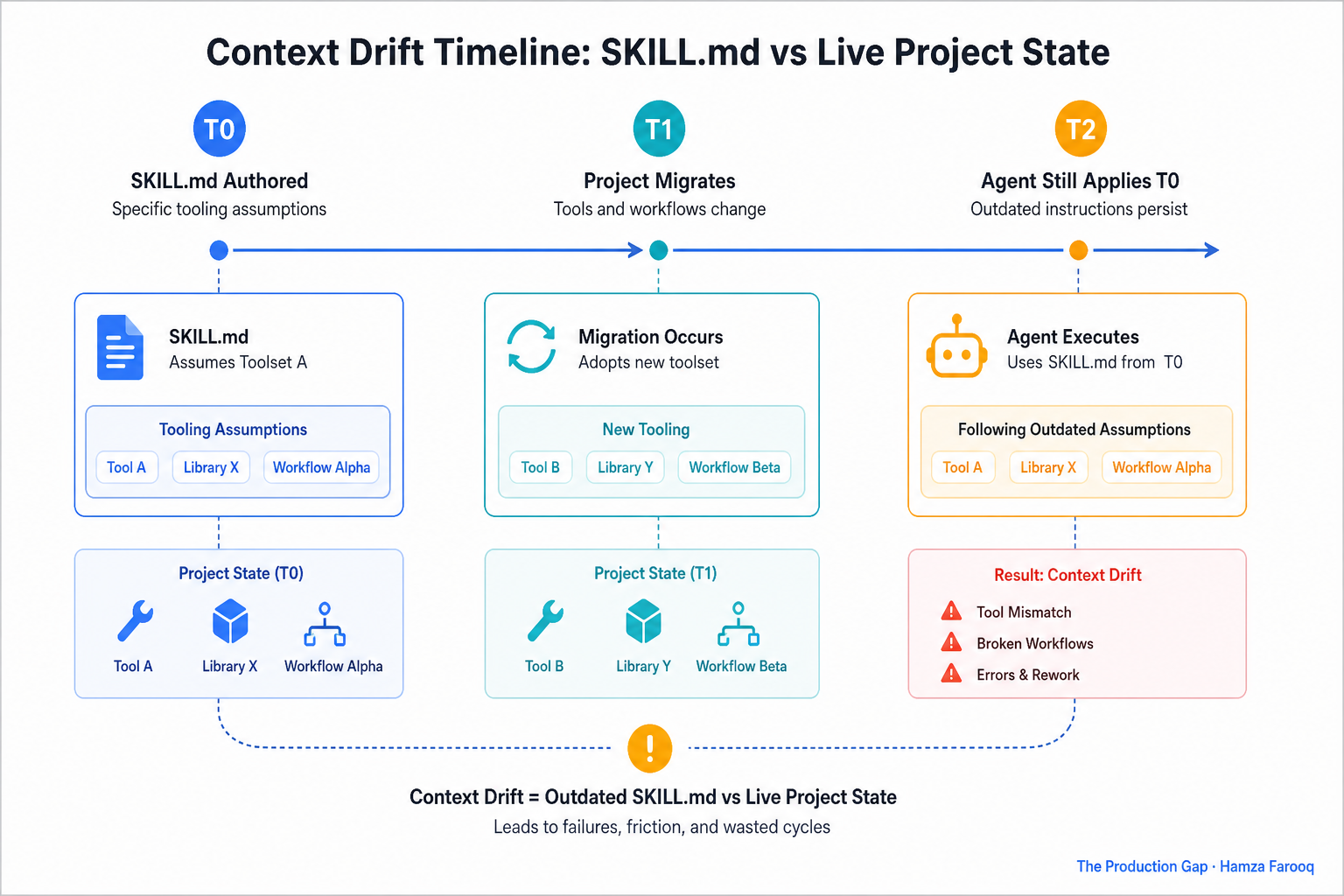
- Context drift causes silent output failures: the agent confidently follows instructions that are no longer true.
- Skills become build artifacts: a compiled, call-scoped package, not a static text file maintained by hand.
- Test that context is fresh: validate resolved output against current project state on each call, not at authoring time.
- Migration starts with a mental model shift: stop treating skills as reusable prompt templates and start treating them as scoped, per-call context builders.
Introduction
Most teams running Claude Code or OpenClaw maintain a SKILL.md library, some inherited, some hand-built over months. Practitioners on r/ClaudeCode report that static skills give the same instructions regardless of current project context. The skill file doesn't know the codebase changed. The agent doesn't either. The output looks plausible and is wrong.
This is an agent skill library architecture problem, not purely a prompt quality problem. Teams treating it as the latter can spend considerable effort refining phrasing when the issue is structural. The fix isn't a better-written SKILL.md; it's asking whether the file, as currently structured, should exist at all.
What exactly breaks when a SKILL.md is loaded once at session start instead of resolved per call?
This failure has a recognizable pattern: a skill written when the project used one set of tools produces outputs that may appear valid but reflect the wrong architecture after a migration to different tools. Context drift fails quietly rather than loudly, the agent follows the instructions it was given without any signal that those instructions no longer describe the project accurately.
How does live-context resolution build a skill artifact differently from reading a static file?
Live-context resolution treats skill construction as a build step executed fresh on every call, assembling a call-specific artifact from current project state rather than reading a pre-written file that may no longer describe the project accurately.
The established practitioner position is that skills are about context design, not prompt engineering, designing the context window the model reasons within, not just writing instructions. The ai4ra-mcp project's issue #31 makes this concrete: SKILL.md serves as source text, references are fetched at call time, and a .skill zip is built per component. That is a compiled artifact model, not a flat-file read.
| Dimension | Static SKILL.md (file-read model) | Live-context resolution (build-artifact model) |
|---|---|---|
| When constructed | Once, at authoring time | Fresh on every agent call |
| What it encodes | Author's snapshot of project state | Current project state at call time |
| Drift detection | None | Context mismatch is catchable |
| Unit of skill | Text file maintained by hand | Compiled .skill artifact, call-scoped |
| Failure mode | Silent, confident wrong output | Resolvable at call time |
| Testability | Review at authoring time only | Validate resolved output per call |
| Maintenance burden | High (author keeps file accurate manually | Lower) resolution logic handles currency |
The shift from file-read to build-step is the architectural distinction the community is converging on. Prompt refinement is optimization within a model that remains limited by static state.
How do you test that a skill is resolving the correct context rather than stale assumptions?
Testing prompt skill context resolution means validating that the skill's resolved output accurately reflects current project state on each call, not reviewing the source file once at authoring time.
As stack72.dev frames it: skills are context, and context needs tests. In my experience, two approaches help make this concrete:
- State-match check. After resolution, verify that the artifact's declared dependencies match what
package.jsonorpyproject.tomlactually contain today. If the skill references a tool the project no longer uses, resolution should catch and correct that, or surface the mismatch clearly. - Call-scope comparison. Run the same skill against two branches with meaningfully different states. If the resolved artifact is identical, the skill is likely reading static assumptions rather than resolving dynamically.
If your skill testing consists of reading the file, you are auditing the author's intent at the moment of writing, not testing whether the skill describes the project as it exists now.
What is the migration path from a static SKILL.md library to per-call build artifacts?
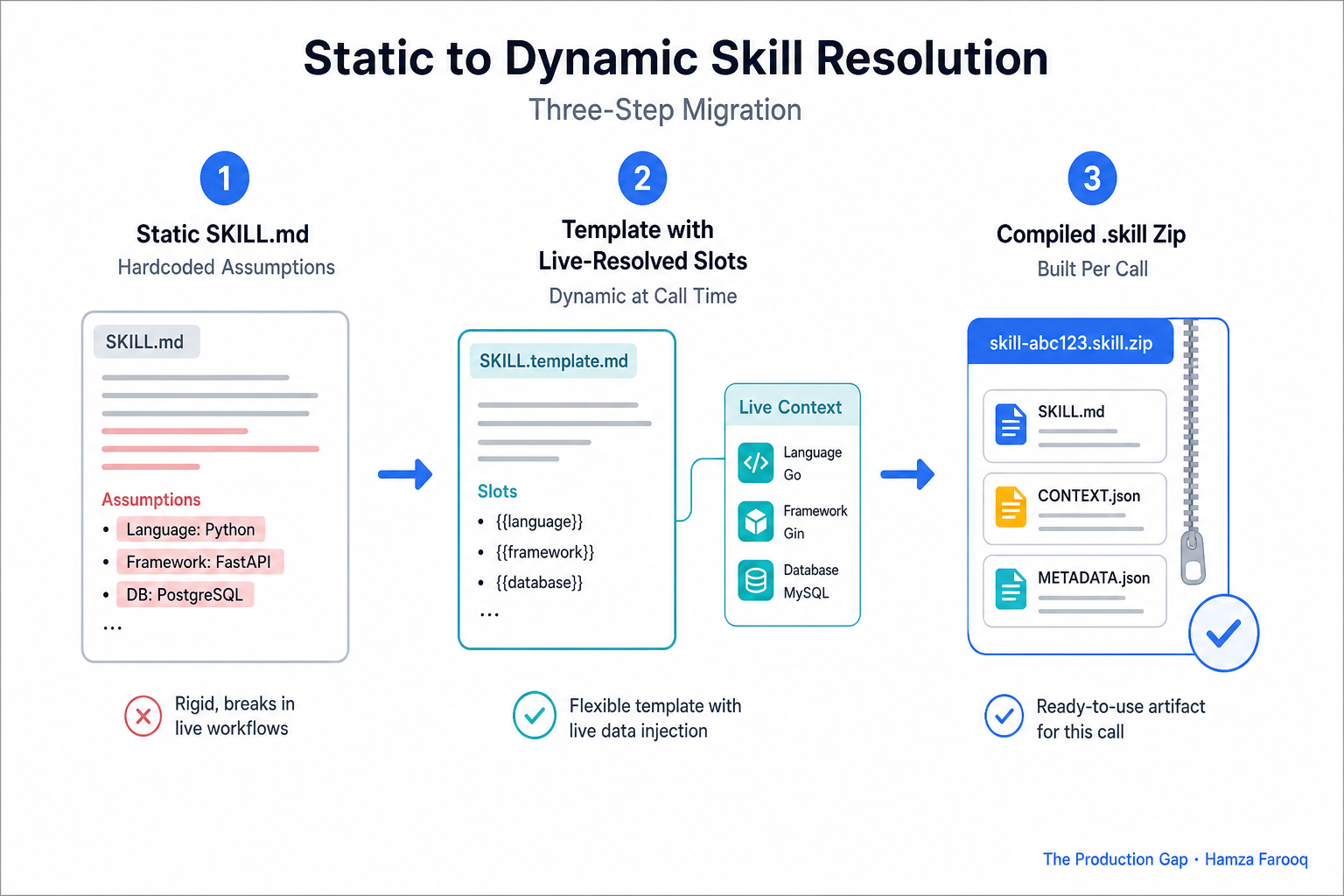
Migrating requires three steps: audit which assumptions are project-state-dependent, extract them into resolution logic that runs at call time, and redefine the skill's output as a validated artifact rather than a pre-written text block.
Step 1, Assumption audit. Mark every claim in each SKILL.md that references project state: framework versions, folder structures, linting rules, CI configuration. These are the drift-prone lines. Instructions that describe reasoning approach rather than project state are less likely to drift and can remain in place.
Step 2 (Externalize state-dependent context. Move drift-prone claims into a resolution script that reads live project files at call time. As the r/ClaudeCode community describes: "make the script write the prompt") SKILL.md becomes a template with slots filled by live-resolved values, not hardcoded assertions.
Step 3, Adopt the build-artifact output model. Treat the skill's output as a compiled package assembled per call. The ai4ra-mcp .skill zip pattern implements this concretely, and Towards Data Science confirms this static-vs-dynamic SKILL.md distinction is a recognized architectural shift, not a fringe experiment.
The goal is a builder that stays current, not a document that needs to be kept accurate by hand.
Frequently asked questions
What is prompt skill context resolution? The process of constructing a skill's context window fresh on each agent call by reading live project state, rather than loading a pre-written SKILL.md that may no longer be accurate.
Why do static SKILL.md files produce subtly wrong outputs instead of obvious errors? The model reads the file, finds instructions, and follows them, it has no way to detect that the project no longer matches the state those instructions assumed.
What is the .skill zip build-artifact model? A packaging approach where a skill's text, references, and examples are assembled into a compiled, call-scoped artifact at runtime, treating skill construction as a build step, not a file read.
How do I know if my existing skill library is drift-prone before starting a migration? Run a call-scope comparison: invoke the same skill against two branches in meaningfully different states. If the resolved context is identical, the skill is reading static assumptions, and every state-specific claim is a potential silent failure. )
Conclusion
Teams optimizing their SKILL.md files may be solving the wrong problem, treating the skill as a document to maintain when the more durable model treats it as a build step to execute. Context drift is the structural consequence of any agent skill library architecture that encodes project-state assumptions at authoring time.
The reasoning logic in your SKILL.md survives migration. What changes is the assumption that a file written at some earlier point still describes your project accurately. Start the audit now: open your oldest SKILL.md, find every line naming a framework, version, folder path, or config value, and ask whether that claim is still true. That list is your migration backlog, and its length reflects how much silent drift your agent is currently working with.
Learn from me
Claude Code in Practice, my Maven cohort. Master Claude Code from fundamentals to advanced orchestration: skills, subagents, hooks, MCP, and production automation. Join the next cohort →
Hire us
Traversaal.ai. We're a team of forward deployed engineers solving the toughest AI problems for Fortune 100 companies: document intelligence, agentic data platforms, and real-time web intelligence, deployed in production. Work with our team to deploy your next agentic ecosystem. Talk to Traversaal.ai →
Join us
Want to solve these problems with us? We're always looking for forward deployed engineers who want to ship production AI. jobs@traversaal.ai