
The $1.77 Trillion Problem AI Still Can’t Solve Until Now

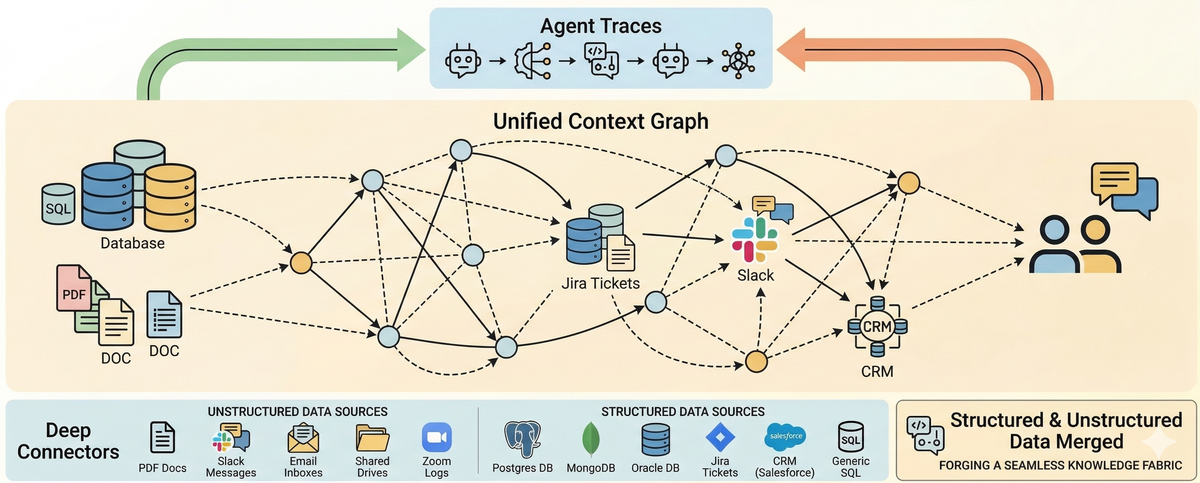
Introducing Olive OS: The Agentic OS Built on Context Graphs That Finally Bridges Structured and Unstructured Data
Olive OS is Traversaal.ai's flagship agentic operating system built on context graphs that unifies structured and unstructured data to answer deep analytical questions and autonomously build research-grade machine learning pipelines, without human input.
Preamble
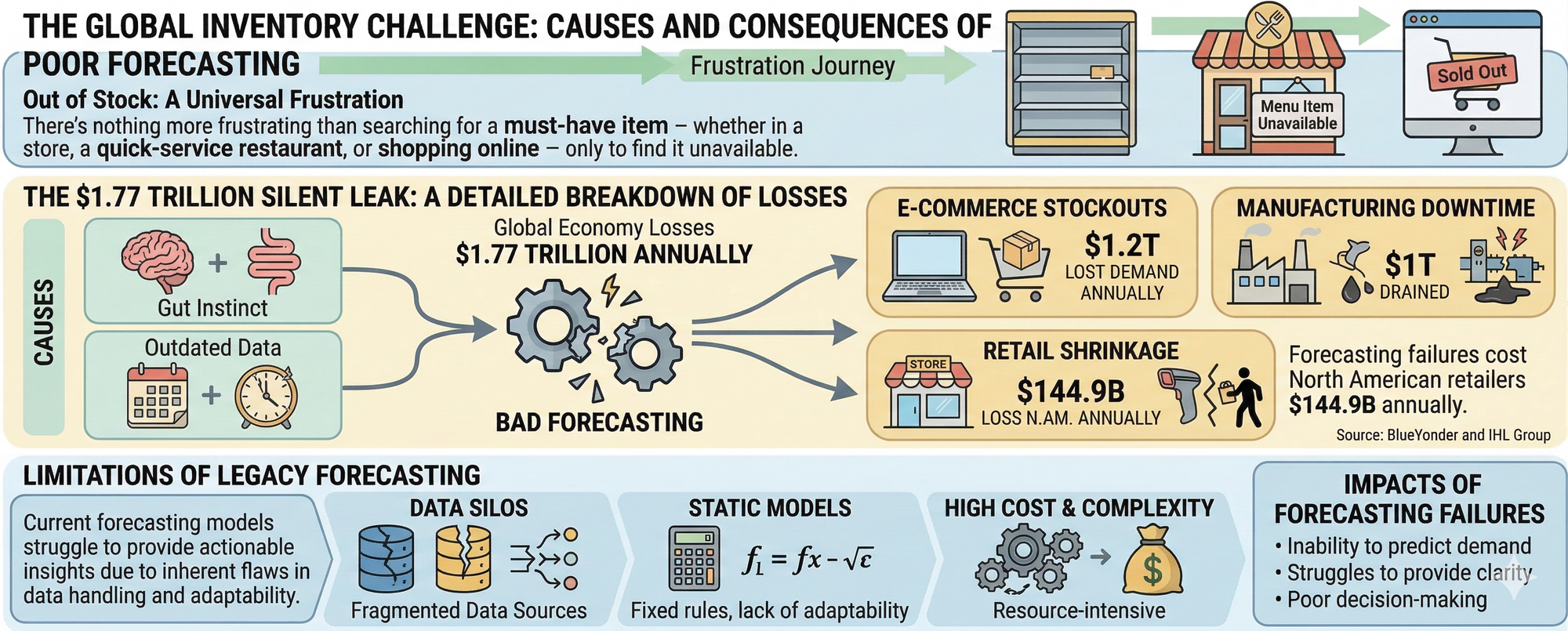
Every year, the global economy loses $1.77 trillion to bad forecasting. Not from a lack of data, but from a lack of understanding it.
- E-commerce companies lose $1.2 trillion annually to inventory misalignment.
- Manufacturers drain $1 trillion through unplanned outages.
These aren't edge cases. They're the baseline. And despite billions poured into AI, the problem is getting worse, not better.
AI Has a Structured Data Problem
The current wave of generative AI has transformed industries built on text and documents. Legal, marketing, customer support: these sectors have seen AI adoption explode. But as a recent Forbes analysis highlighted, industries built on structured data (financial services, manufacturing, retail, insurance) have been largely left behind.
The reason is architectural. Large language models were trained on text, not tables. When you feed a spreadsheet into an LLM, it flattens rows into token sequences and strips away the meaning encoded in schemas, column relationships, and numerical semantics. The typical workaround, generating SQL or Python and hoping the output is correct, breaks down the moment you encounter an ambiguous column name or need to join tables that were never designed to fit together.
This is why enterprises still maintain sprawling portfolios of task-specific machine learning models, each with its own data pipeline, feature engineering, monitoring, and retraining schedule. The data analytics market is projected to exceed $600 billion by 2030, yet the industries most dependent on structured data have barely scratched the surface of what AI can deliver.
The gap isn't intelligence. It's context.
Why LLMs Alone Will Never Be Enough
Here's the uncomfortable truth: even the most advanced LLMs and general-purpose agents perform poorly on real-world data science tasks. They can generate code. They can summarize reports. But when it comes to the kind of multi-table reasoning, time-series forecasting, and scenario analysis that drives million-dollar decisions, they fall short, and dramatically so.
The fundamental issue is that enterprise data doesn't live in one place. It's scattered across ERPs, CRMs, data warehouses, PDF reports, spreadsheets, and slide decks. Structured and unstructured. Clean and messy. Current and historical. No single model, no matter how large, can reason over this landscape without a unifying layer that makes sense of it all.
AI models can now use tools, but they still lack the process knowledge needed to automate work reliably. Systems of record capture decisions, but the real operational reality unfolds across dozens of disconnected systems. Without a structured view of how data actually relates, AI cannot deliver the accuracy enterprises demand.
Enter Olive OS
Today, we're launching Olive OS, our flagship agentic operating system built on context graphs.
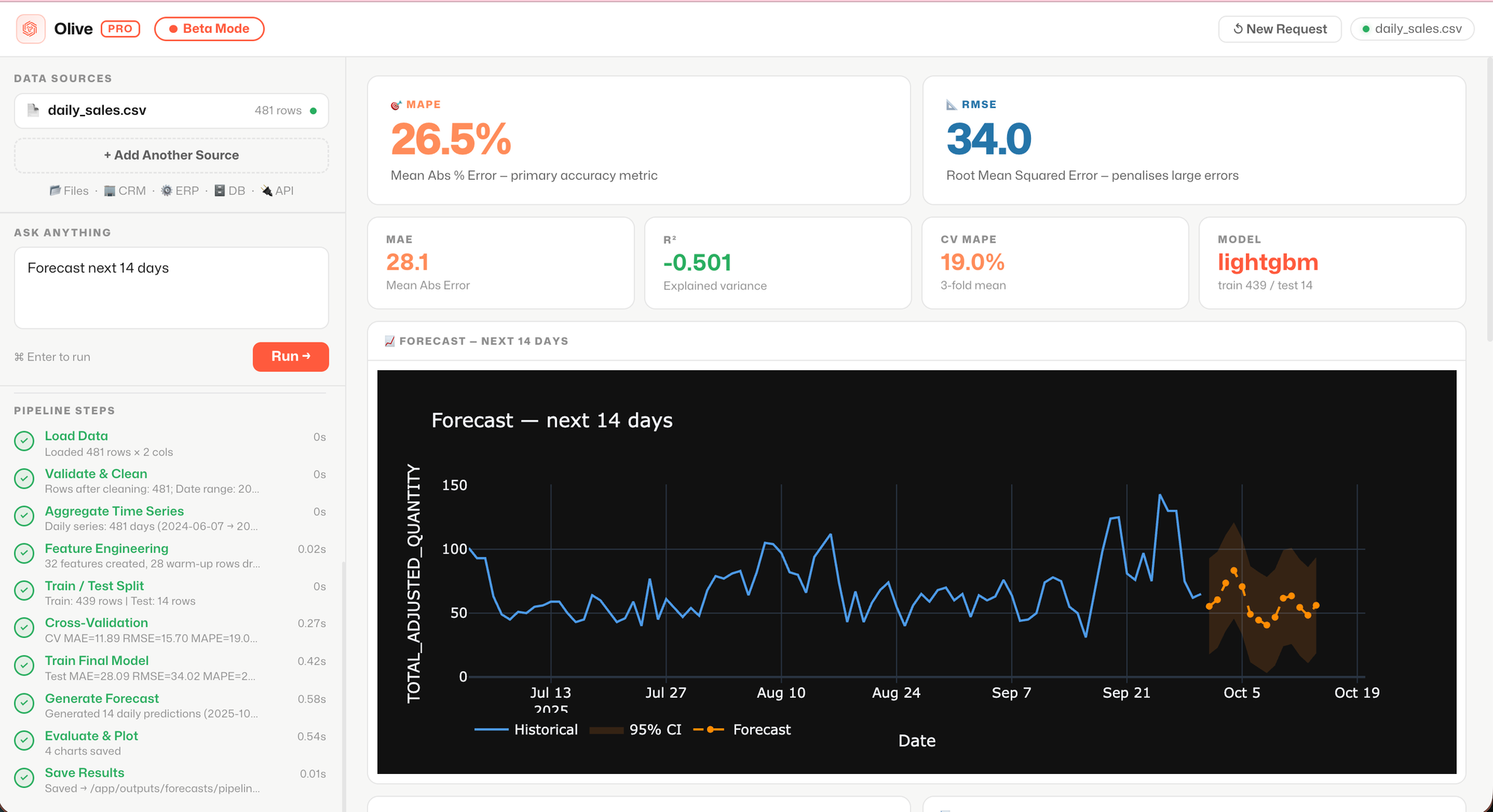
Olive OS isn't another chatbot bolted onto a dashboard. It's a fundamentally new architecture that combines autonomous AI agents, context graphs, and tabular intelligence to reason across your entire data ecosystem (structured and unstructured) in real time. It answers deep analytical questions and autonomously builds end-to-end machine learning pipelines, from feature selection to model training and validation, without requiring a single line of human-written code.
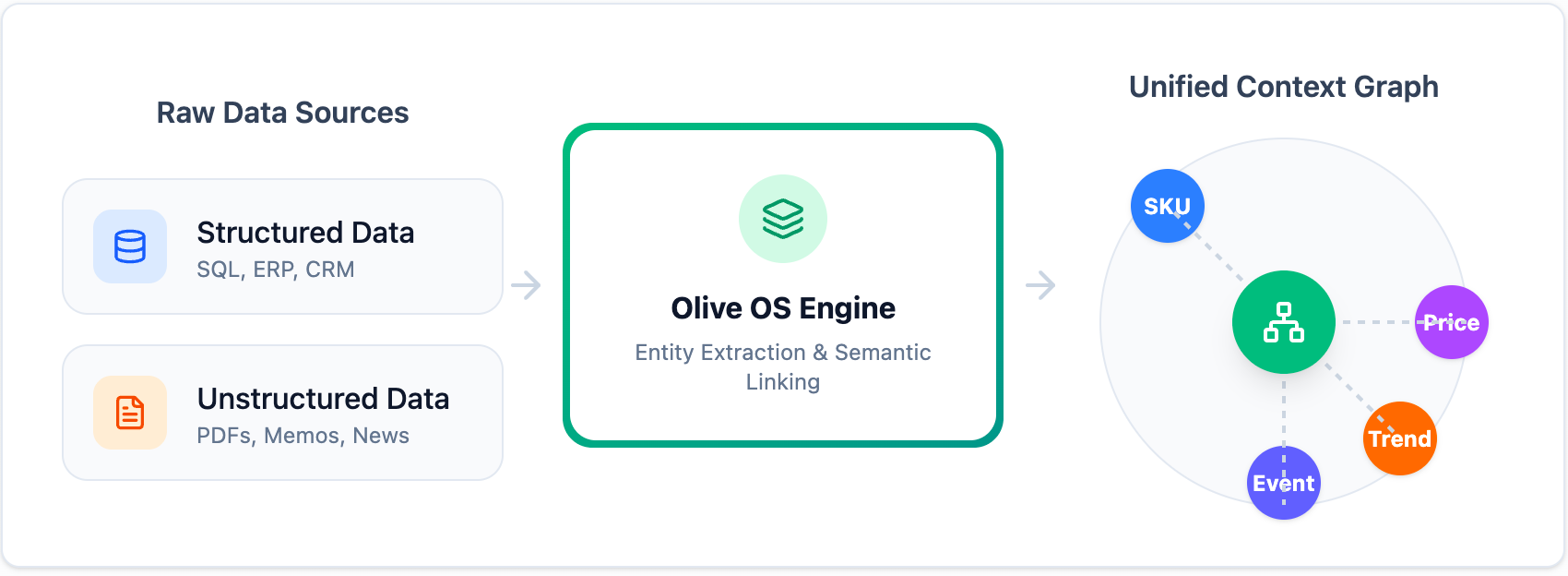
Built on a context graph architecture, here's what makes Olive OS different:
Unified Data Ingestion. Olive OS connects to your structured databases, ERP systems, CRM platforms, unstructured PDF reports, and strategic slide decks, building a single, coherent knowledge graph from all of it. No more data silos. No more fragmented views.
Context Graph-Powered Reasoning. The context graph is the core architectural primitive of Olive OS, not just a feature, but the foundation everything else is built on. As Jaya Gupta and Ashu Garg recently articulated, context graphs represent the next trillion-dollar opportunity in enterprise AI, serving as the enduring layer that captures not just what happened, but why it happened and how decisions were made. By mapping the relationships, processes, and patterns hidden across your structured and unstructured data, the context graph enables accuracy levels that pure LLMs and tabular models alone cannot reach. When you layer unstructured context (market reports, internal memos, supplier communications) on top of structured data (sales figures, inventory levels, logistics data), forecast accuracy improves by multiples, not percentages.
Agentic Intelligence. Olive OS deploys autonomous AI agents that don't just answer questions. They reason through multi-variable scenarios, simulate futures, and recommend specific next steps. These agents also autonomously construct full machine learning pipelines: selecting features, engineering variables, training models, running validation, and delivering production-ready forecasts, all without human intervention. Ask a question in plain English. Get an actionable answer in seconds.
Self-Improving Architecture. Unlike traditional ML models that require constant retraining, Olive OS learns from every interaction. Agent execution traces feed back into the system, reinforcing successful patterns and flagging anti-patterns, creating a continuously improving forecasting engine.
The Proof: 75.8% Accuracy on DSBench
Claims are easy. Benchmarks are hard.
We put Olive OS through DSBench Analytic Subset, a rigorous evaluation framework for data analysis tasks. The results speak for themselves:
Olive OS doesn't just outperform other AI systems. It operates in an entirely different league. Where the best general-purpose LLMs top out around 33% accuracy on real-world analytical tasks, Olive OS achieves 75.8%, more than double the next-best result.
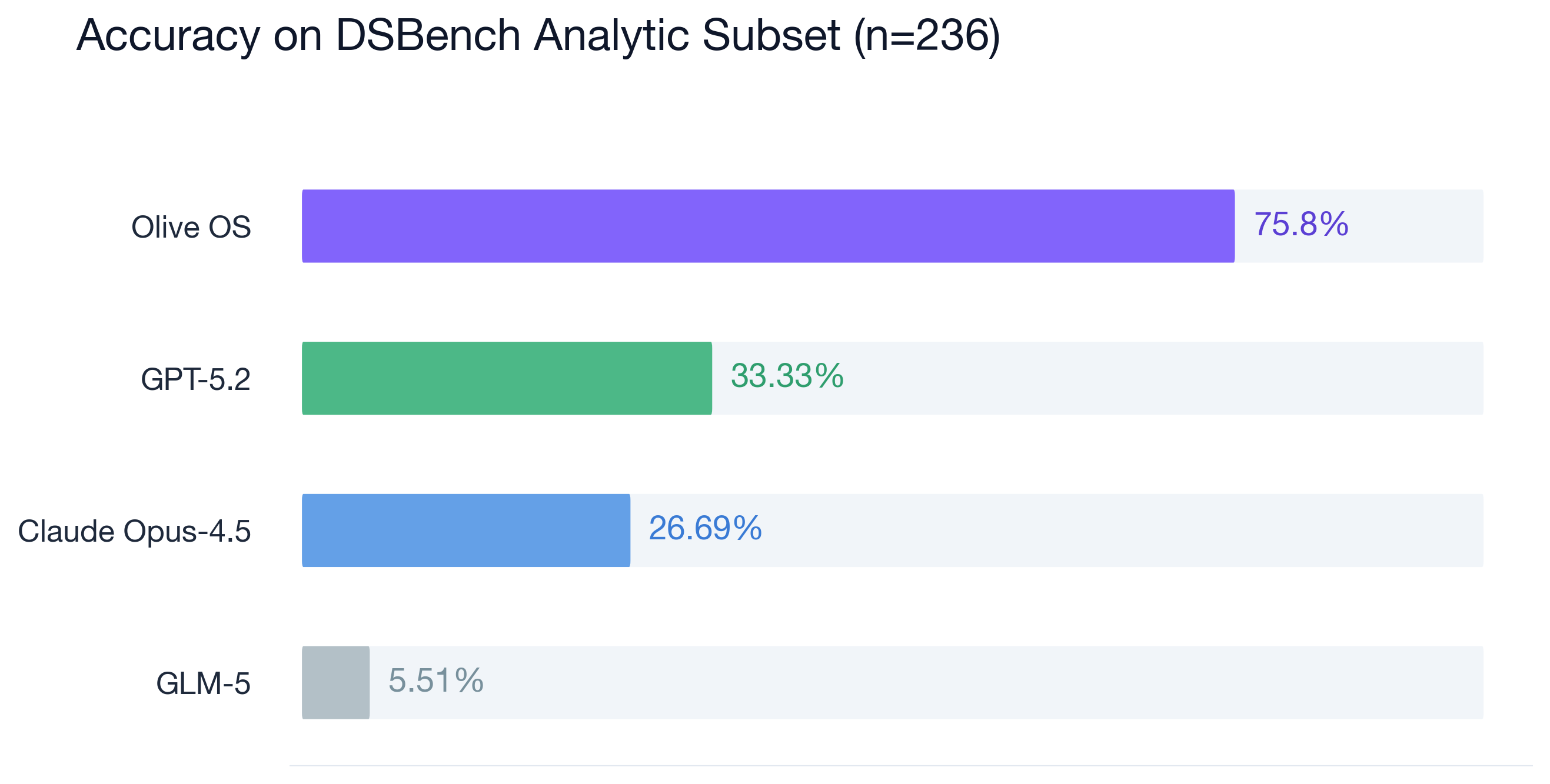
This isn't a marginal improvement. It's the difference between a system that occasionally gets it right and one that enterprises can actually trust for decision-making.
The secret isn't a bigger model. It's a better architecture, one anchored in context graphs that natively understand structured data, enrich it with unstructured context, and deploy specialized agents that reason the way data scientists do, but at machine speed and scale.
Why Context Graphs Changes Everything
The breakthrough behind Olive OS is deceptively simple: context graphs boost performance by up to 50%.
Consider a traditional demand forecast. A standard model looks at historical sales data, maybe seasonality and price. That's the structured view. But real demand is shaped by factors that live outside your databases: a competitor's promotion mentioned in a trade publication, a weather event flagged in a logistics report, a social media trend captured in a marketing brief.
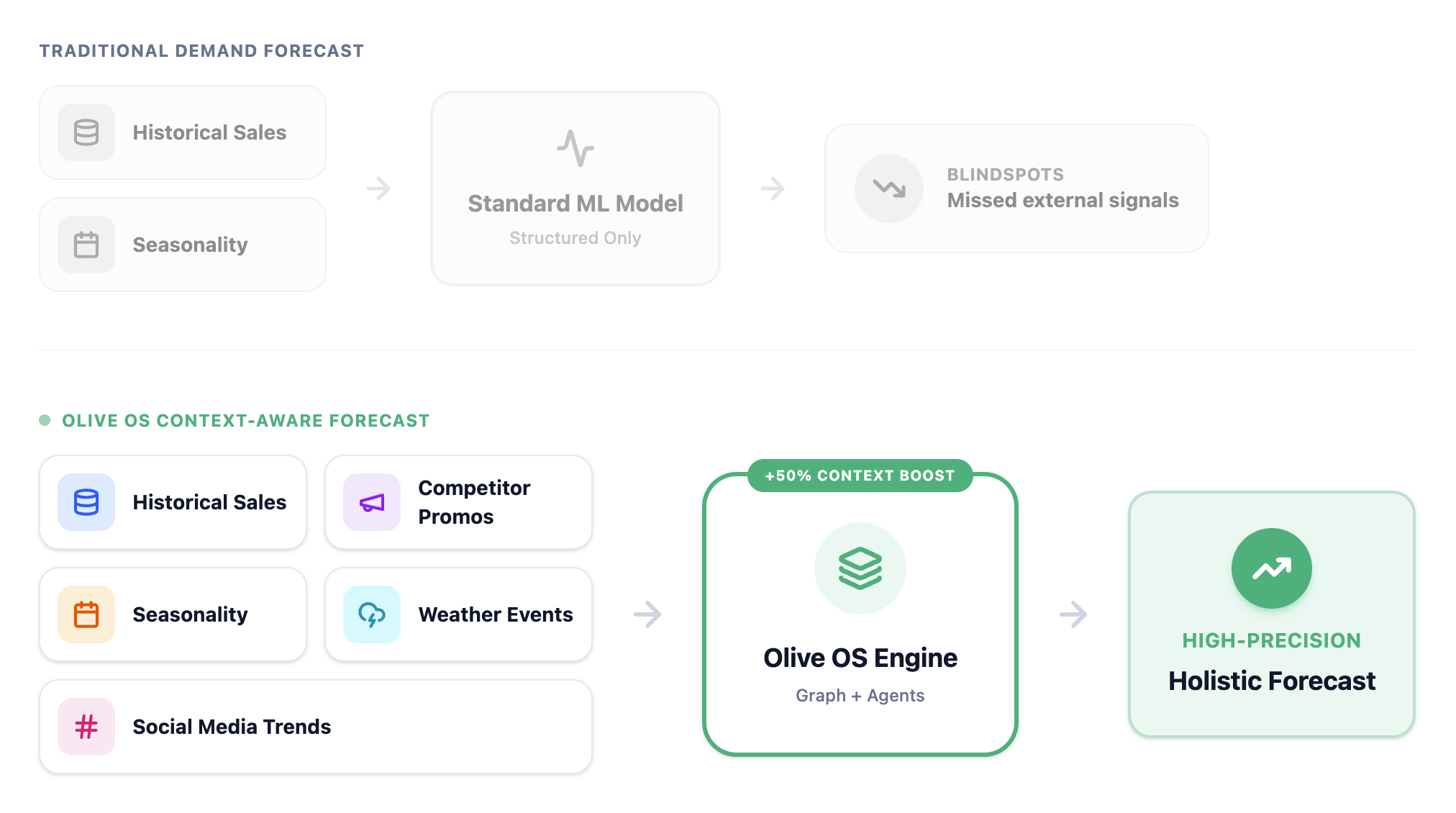
Olive OS builds a knowledge graph that connects all of these signals. It doesn't just know what your numbers say. It understands why they're moving and what's likely to happen next. This is the same principle that companies have validated with context graphs in the enterprise knowledge space, except Olive OS applies it specifically to the forecasting and data science domain where the stakes are measured in billions.
When one of ours customer deployed Olive's agents to forecast demand for Limited Time Offers, the results were concrete: 18% reduction in food waste and maximized revenue from high-demand items. When a leading US retailer with over 1 million SKUs adopted the platform, they saw a 15% reduction in inventory costs and a 10% increase in on-shelf availability.
Eliminating the Data Science Tax
There's another cost that rarely makes headlines but quietly drains enterprise budgets: the Data Science Tax. Companies spend $500,000+ annually on data science teams (hiring, tools, infrastructure) yet the average turnaround for a custom forecast is still measured in weeks to months. And a persistent communication gap between business leaders and technical teams means insights often arrive too late or in the wrong format to drive action.
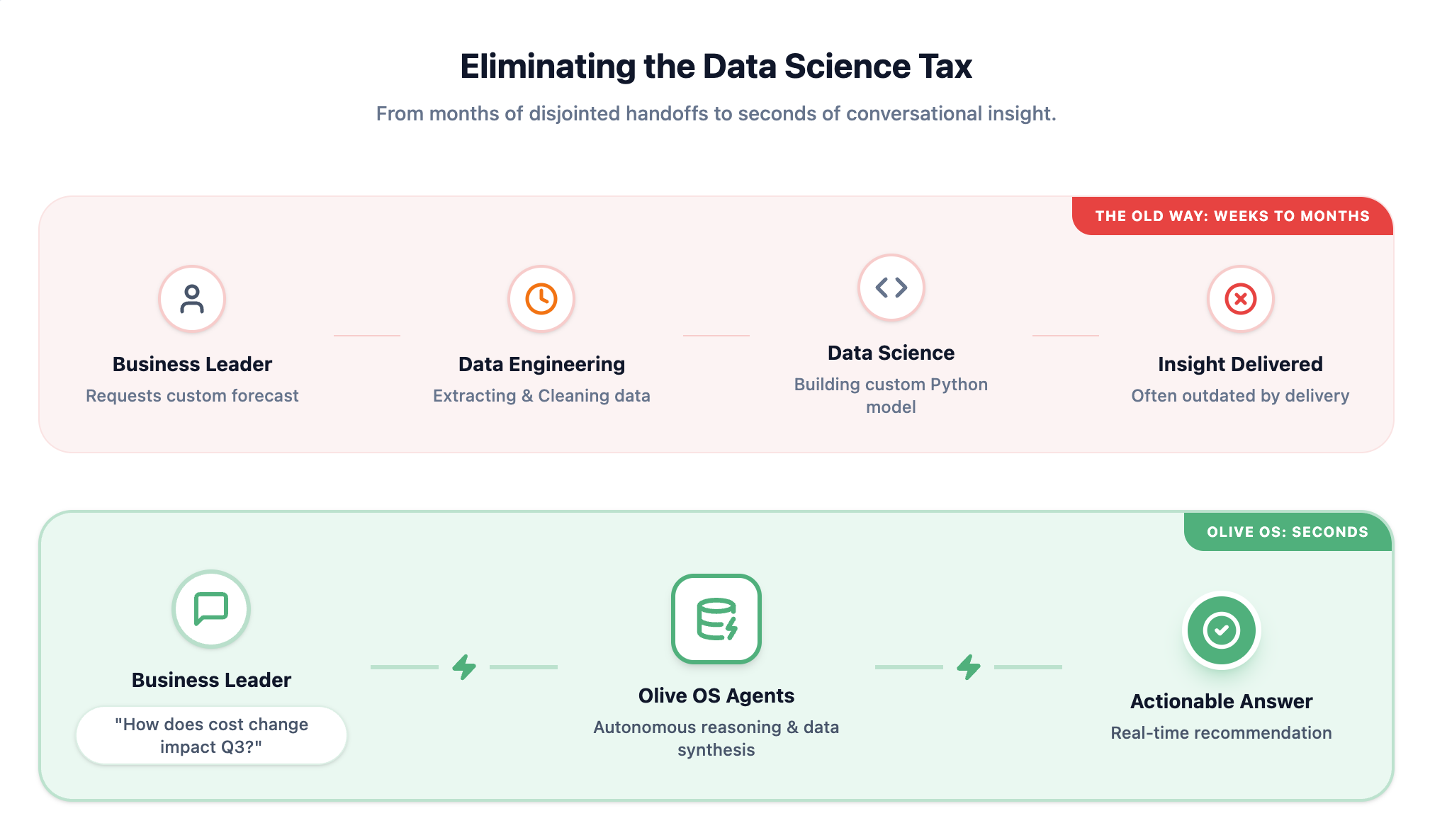
Olive OS eliminates this tax entirely. Any business user can ask a question in natural language and get an answer. Not a chart that needs interpretation, not a Jupyter notebook that needs debugging, but a clear recommendation with the reasoning behind it. Behind the scenes, Olive's agents autonomously build the underlying ML pipeline (feature selection, model training, validation) so users get research-grade, deeply analytical outputs, not chatbot-level responses.
"What is the projected demand for Product X in Region Y next quarter, considering current market trends and promotions?"
"How would a 15% increase in raw material costs impact our Q3 profit margins?"
"What are the optimal inventory levels for Warehouse C to minimize stockouts while reducing carrying costs over the next 6 months?"
These aren't demo queries. These are the questions Olive OS answers every day for QSRs, retailers, and manufacturers.
Olive OS Pricing
Olive OS is built on a SaaS model designed to make enterprise-grade data science accessible, not just to Fortune 500 companies with massive analytics budgets, but to any organization ready to make data-driven decisions.
| Dimension | Traditional Data Science | Olive OS |
|---|---|---|
| Cost | $500K+/year per team | SaaS pricing |
| Speed to Insight | Weeks to months | Real-time |
| Interface | Code & dashboards | Plain English |
| Scalability | Limited by headcount | Infinite scalability |
| Maintenance | Constant retraining | Self-improving |
| Accessibility | Data scientists only | Any business user |
Our land-and-expand model starts with a pilot for a single department at a fractional cost, scales to cross-functional adoption as agents prove ROI, and grows into an enterprise platform that becomes your organization's forecasting operating system. Pilot to production in 60 to 90 days.
The Future of Forecasting Is Conversational
The $1.77 trillion leak in the global economy isn't a technology problem. It's an architecture problem. Enterprises have the data. They have the tools. What they've lacked is a system that can reason across all of it, in real time, in plain language.
Olive OS is that system.
The era of static models, siloed data, and gut-instinct decisions is over. The future of forecasting is agentic, contextual, and conversational.
Let's talk. Visit oliveos.ai or reach out to us at support@traversaal.ai