UnitedHealth AI Cost Ratio Drops to 12.8%: What Q3 2026 Earnings Reveal About Payer Agentification at Scale
UnitedHealth AI cost ratio hit 12.8% in Q3 2026—but does AI deserve credit? Unpack payer agentification ROI claims, denial litigation risks, and data gaps.

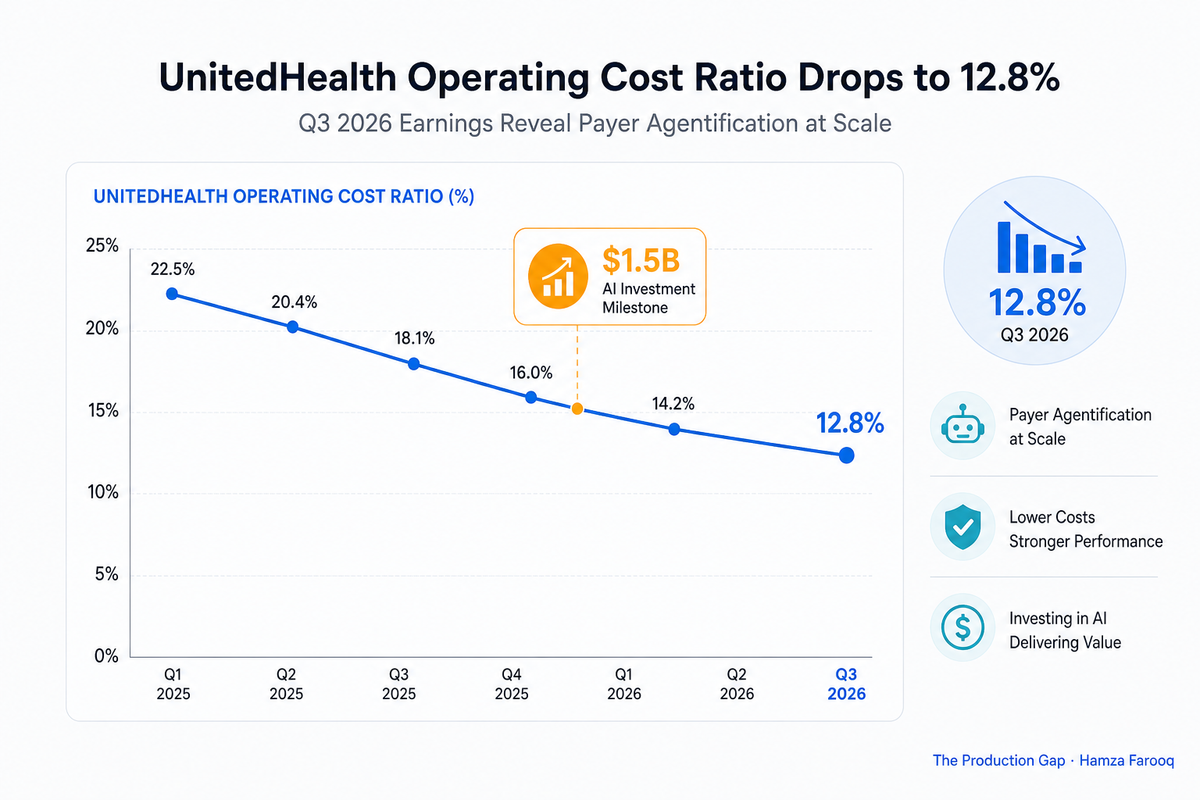
TL;DR: UnitedHealth's operating cost ratio dropped to 12.8% in Q3 2026, and the company credits AI automation as a key driver. However, no public filing separates AI's contribution from other efficiency levers, the claimed 2:1 ROI is self-reported without third-party audit, and active litigation alleging a roughly 90% AI denial error rate puts every headline metric under simultaneous legal and regulatory scrutiny.
Key Takeaways
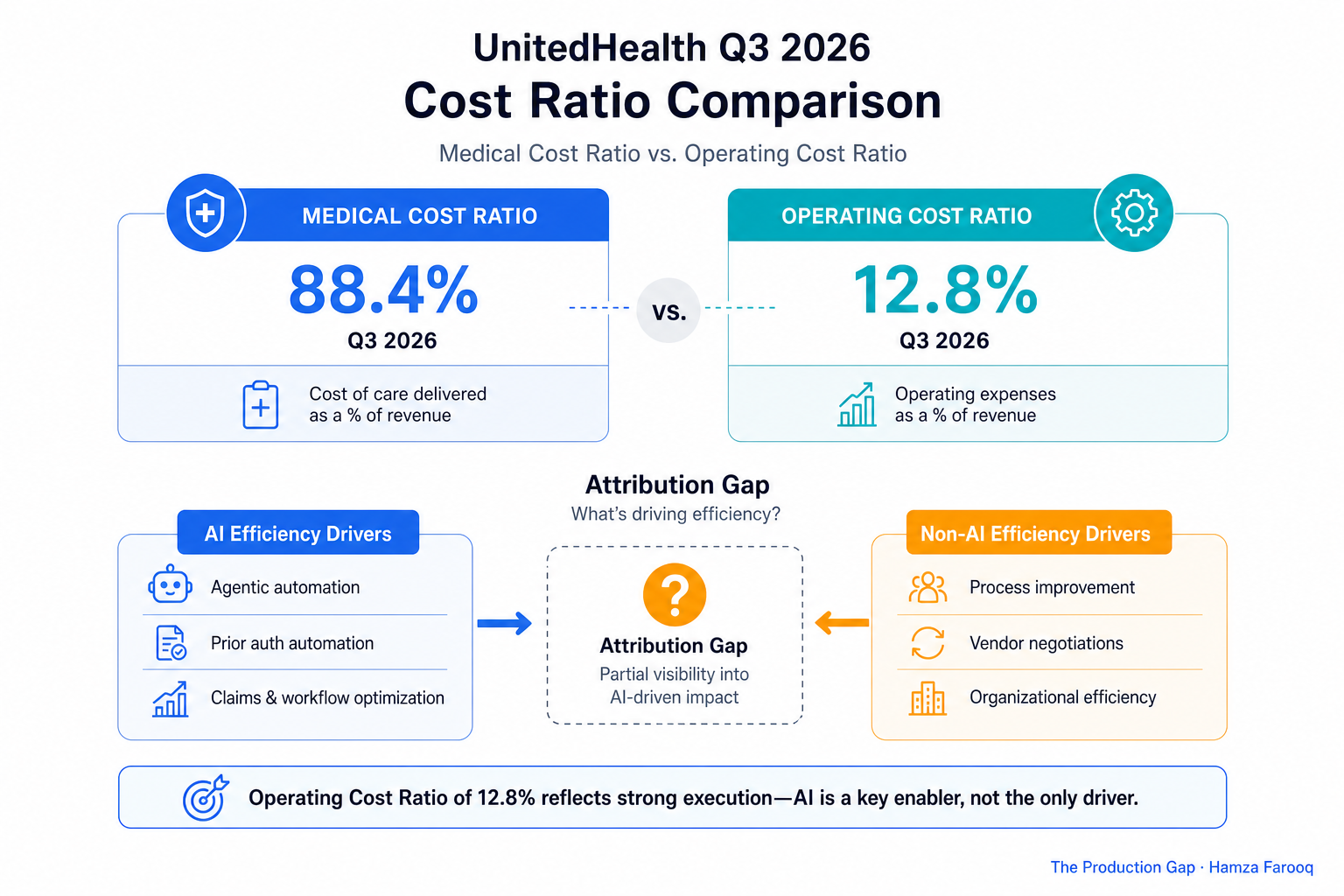
- Operating cost ratio hit 12.8%: Down year-over-year; AI receives narrative credit, but no SEC filing disaggregates AI's contribution from benefit design changes, membership mix shifts, or vendor renegotiations.
- Medical cost ratio improved to 88.4%: Down from 89.9% in Q3 2025, driven by medical cost management initiatives per Becker's Payer.
- The claimed 2:1 AI ROI is vendor-reported only: No independent actuarial review or third-party audit of this figure has been published as of Q3 2026.
- Active litigation alleges a roughly 90% AI denial error rate: If accurate, a forced rollback of AI denial workflows would directly widen the operating cost ratio, making litigation risk a financial variable, not merely a reputational one.
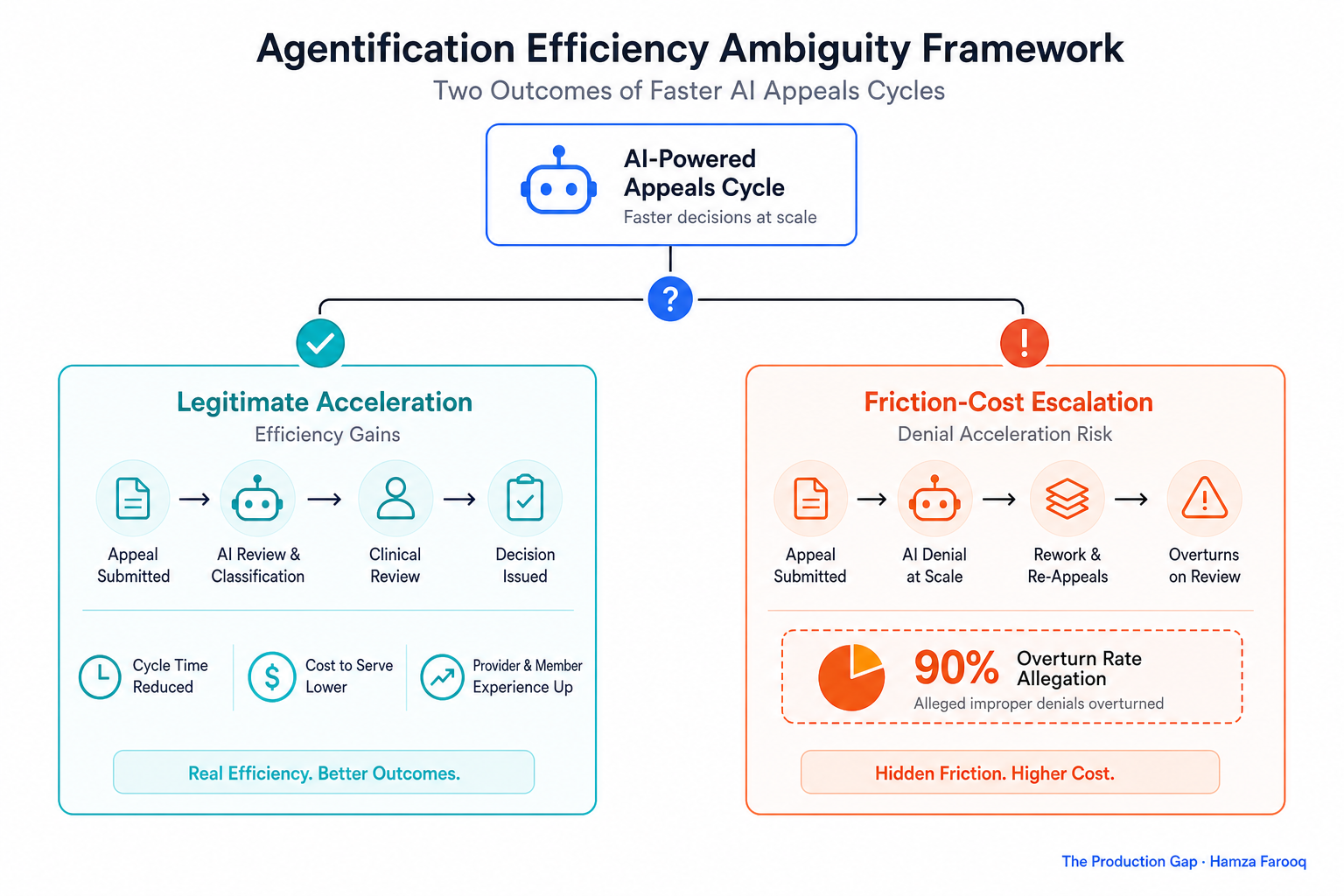
- The Agentification Efficiency Ambiguity (author synthesis) identifies a structural measurement gap: Headline processing-speed metrics cannot distinguish legitimate claim acceleration from friction-cost escalation that closes cases before appeals can succeed.
What does UnitedHealth's 12.8% operating cost ratio actually measure, and how much is AI?
The 12.8% operating cost ratio measures administrative overhead as a share of total revenue, and while UnitedHealth credits AI automation for the year-over-year improvement, no public filing separates AI's contribution from other efficiency levers, per Seeking Alpha.
| Metric | Q3 2025 | Q3 2026 | YoY Change | Attribution status |
|---|---|---|---|---|
| Medical cost ratio | 89.9% | 88.4% | -1.5 pp | Reported; multiple drivers per Becker's Payer |
| Operating cost ratio | Prior period | 12.8% | Decline | AI cited; no disaggregation per Seeking Alpha |
| Claimed AI ROI | Not disclosed | 2:1 | N/A | Vendor-reported; no third-party audit |
| AI investment (2026) | Not applicable | $1.5B | N/A | Confirmed; Becker's Payer |
| Operating cost savings target | Not applicable | ~$1B | N/A | Reported expectation; unaudited |
What does UnitedHealth's AI spend reveal about enterprise payer procurement risk?
UnitedHealth's $1.5 billion AI spend in 2026 targets prior authorization automation, software enhancement, and pharmacy benefits, but contract growth velocity is not the same as demonstrated outcomes, per Becker's Payer.
Speed of deployment is a real procurement signal and also a risk indicator if implementations are rushed to meet investor-facing growth metrics. Any vendor-reported productivity gains presented without a defined measurement methodology are marketing inputs, not reproducible baselines. Independent outcome data from live deployments would substantiate or contradict such claims; none is publicly available as of Q3 2026.
Does faster AI-assisted processing help patients or help the payer?
Faster AI-assisted claims processing could represent genuine acceleration for patients contesting denials, or it could mean cases are closed faster before disputes can escalate, which benefits the payer's cost line while increasing friction for claimants.
Two interpretations exist and neither can be ruled out without outcome-stratified data. First: AI reduces administrative lag so legitimate appeals resolve sooner in the claimant's favor. Second: AI accelerates closure before appeals gather supporting documentation, cutting reversals that would otherwise overturn the original denial.
This structural measurement problem is the framework used in this guide and is referred to here as the Agentification Efficiency Ambiguity. The Agentification Efficiency Ambiguity describes the structural inability of headline processing-speed metrics to distinguish legitimate claim acceleration from friction-cost escalation that closes cases before appeals can succeed. Processing speed figures are the most ambiguous numbers in UnitedHealth's Q3 2026 disclosure, because without resolution rates broken out by denial upheld versus overturned, the efficiency gain is uninterpretable.
How should competing payers interpret UnitedHealth's 2:1 AI ROI claim given parallel litigation risk?
Competing payers should treat UnitedHealth's 2:1 AI ROI claim as internal management accounting rather than an audited benchmark, especially when the same AI infrastructure generating those claimed savings faces litigation alleging a roughly 90% denial error rate measured by appeal overturn rates.
An independent actuarial review of UnitedHealth's AI ROI methodology is the minimum standard before any competing CFO cites this benchmark internally. Consider also whether the efficiency gain holds if litigation forces changes to the denial model. A rollback of AI-assisted denial workflows would raise manual review labor costs and widen the operating cost ratio. Litigation risk is not a separate reputational issue; it is a direct financial risk to the reported gains.
Frequently Asked Questions
What is an operating cost ratio and why does 12.8% matter for health insurers? It measures administrative overhead as a percentage of total revenue. At 12.8%, that is 12.8 cents of every revenue dollar going to running the business, which signals cost discipline to investors and competitive pressure to rival CFOs. The lower this figure, the more of each premium dollar is theoretically available for care delivery.
How much of UnitedHealth's improvement is directly attributable to AI? UnitedHealth hasn't broken it out. The company credits "operational agentification" broadly, but benefit design and membership mix also move this metric, and no third-party audit has been published as of Q3 2026, per Seeking Alpha.
What evidence should a competing payer's CFO require before benchmarking against the 2:1 ROI claim? A competing payer's CFO should require at minimum: a defined measurement methodology, the member population and time period over which savings were calculated, and an independent actuarial review. Without those three elements, a vendor-reported ROI figure is a marketing input, not a board-ready benchmark.
Does the litigation risk around AI denial accuracy create financial exposure that could reverse these efficiency gains? Yes. If litigation forces modification of the AI denial model, prior authorization automation would need recalibration, driving up manual labor costs and widening the operating cost ratio. The efficiency gains reported in Q3 2026 are therefore contingent on the denial model surviving legal challenge without material operational changes, per Becker's Payer.
Conclusion
UnitedHealth's Q3 2026 metrics tell a clean efficiency story: a 12.8% operating cost ratio, an 88.4% medical cost ratio, rapid AI deployment across multiple business lines, and a claimed 2:1 return on investment. The problem running through every metric is identical. None is broken out by outcome quality, and all are self-reported by the entity that benefits from the narrative.
The operating cost ratio is a real number from a real filing, per Becker's Payer. The allegation of a roughly 90% AI denial error rate is a real claim in active litigation. Both are simultaneously in play, which is what makes Q3 2026 consequential: a major insurer named agentification as an earnings driver while facing litigation suggesting its AI is systematically wrong at the decision that matters most.
A cost ratio that falls because AI works better is an efficiency gain. A cost ratio that falls because AI makes appeals harder to win is a liability dressed up as a margin.
If you are evaluating a similar AI investment, the concrete next step is this: before your CFO models a comparable ROI, request an outcome-stratified breakdown of denials upheld versus overturned from any vendor referencing UnitedHealth's numbers as a benchmark.
Learn from me
Agentic AI for Product Managers, my Maven cohort. Learn how to design, evaluate, and ship reliable AI systems: the technical fluency PMs need to lead agentic products, no engineering background required. Join the next cohort →
Hire us
Traversaal.ai. We're a team of forward deployed engineers solving the toughest AI problems for Fortune 100 companies: document intelligence, agentic data platforms, and real-time web intelligence, deployed in production. Work with our team to deploy your next agentic ecosystem. Talk to Traversaal.ai →
Join us
Want to solve these problems with us? We're always looking for forward deployed engineers who want to ship production AI. jobs@traversaal.ai