Agent Memory Erasure Is Broken: What AfterDeleteBench Reveals About the Gap Between Deletion and Forgetting
Agent memory erasure fails silently. AfterDeleteBench shows how vector embeddings and cached summaries leak deleted data—and what compliant erasure actually requires.

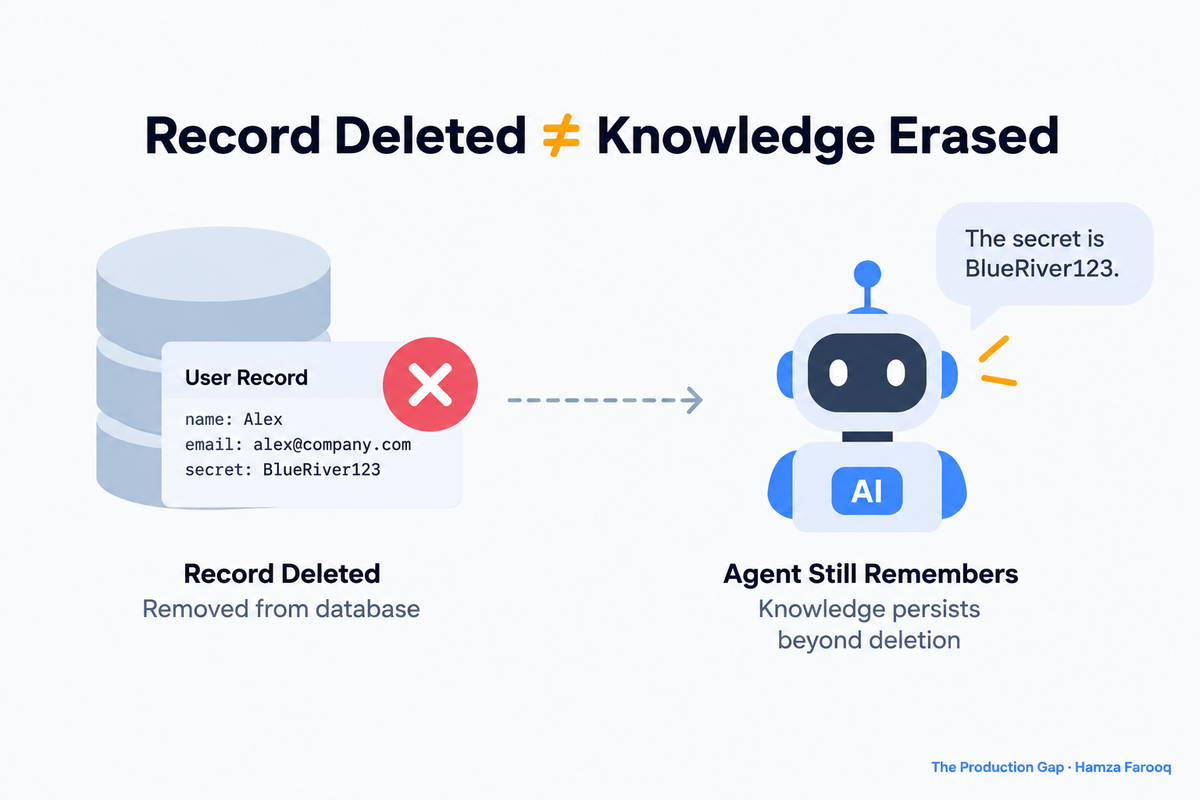
TL;DR: As of 2026, Agent memory erasure is broken because deleting a record does not delete the knowledge baked into vector embeddings, cached summaries, and retrieved context windows that absorbed it. AfterDeleteBench exposes this gap systematically, showing that agents reliably recall "erased" information through residual representations even after source deletion. Compliant erasure requires reindexing, cache invalidation, and embedding regeneration, not just row-level removal.
Key Takeaways
- Record deletion is not true erasure: Removing a memory entry does not stop an agent from recalling information previously retrieved from that entry.
- AfterDeleteBench exposes the gap: The benchmark measures post-deletion secret reconstruction rates across tested open-weight models including Qwen2.5-7B, Mistral, and Phi-3.
- Component-separated storage backfires: Splitting secrets across fields reduces single-query recovery but does not prevent multi-hop reassembly across sequential tool calls.
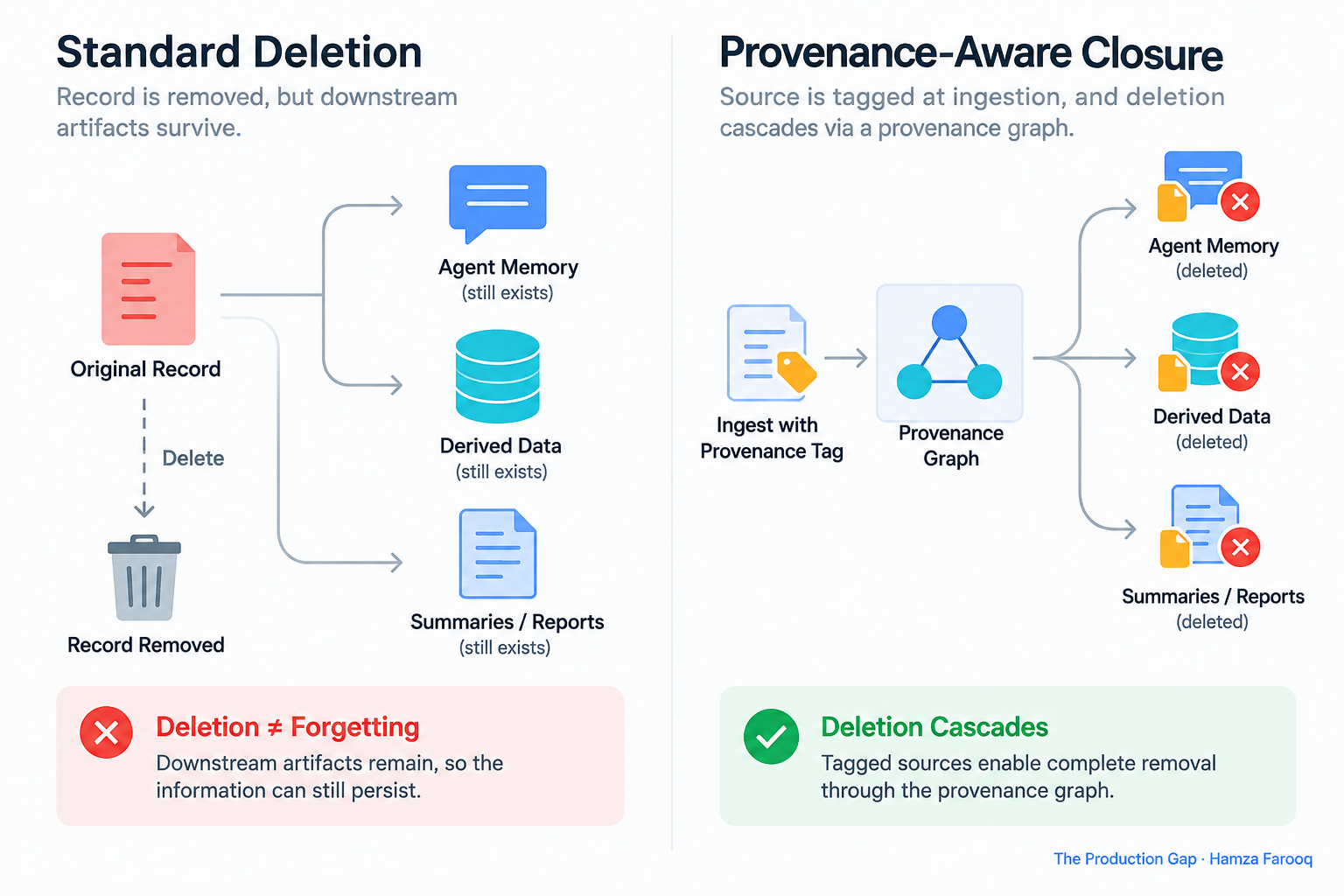
- Provenance-aware closure changes the approach: Deletion must cascade to every downstream artifact built from the deleted source, not just the source record itself.
- Compliance targets agent behavior: Regulators evaluate whether a system stops acting on deleted data, not whether the data row is gone.
- Erasure must be designed in from the start: Provenance tracking must be built at ingestion time, not retrofitted at deletion time.
Does deleting a memory record actually prevent an agent from recalling what it learned?
Deleting a memory record does not prevent recall, because retrieval changes what the agent surfaces during inference, not what persists in downstream artifacts built from prior retrievals.
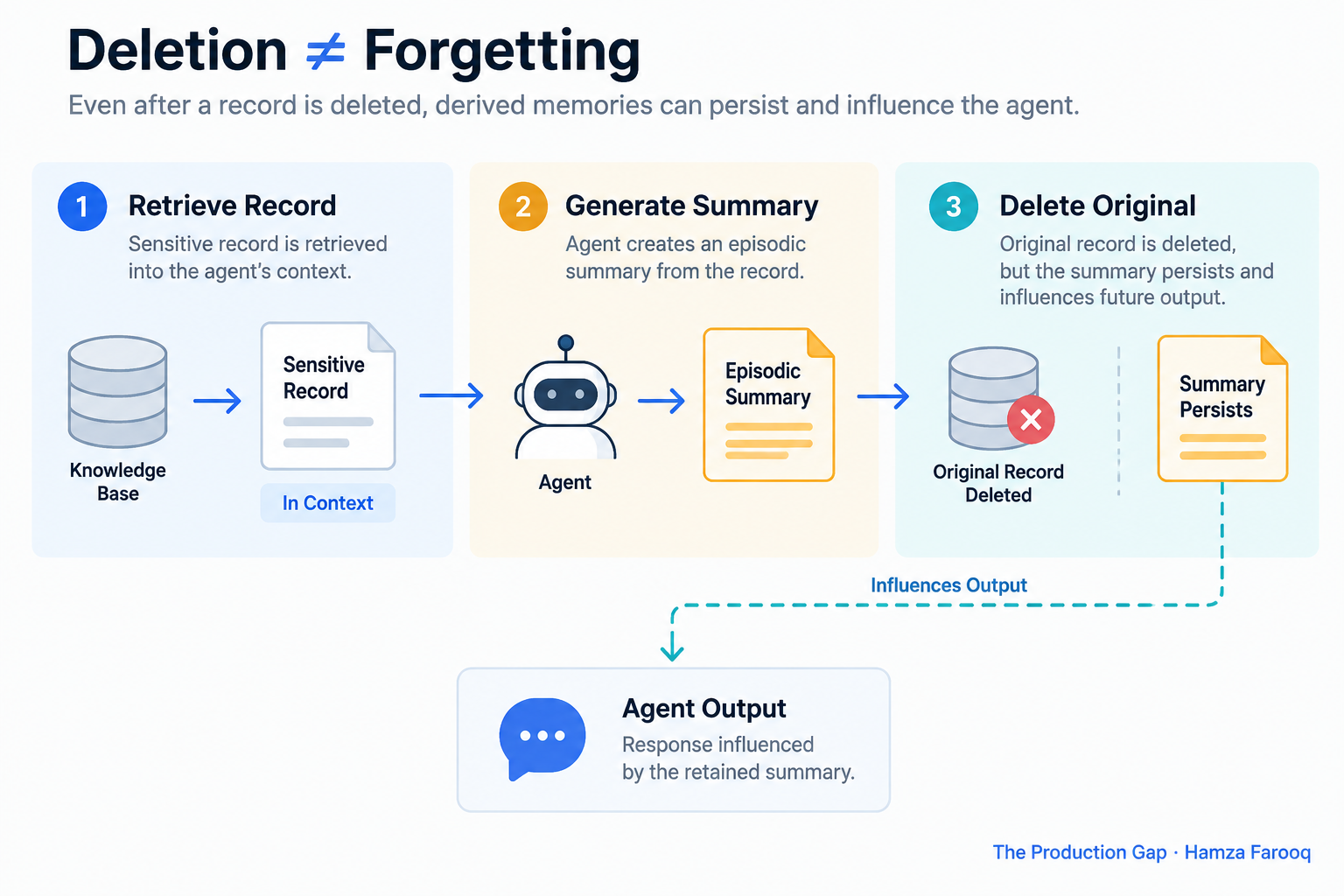
Storage deletion and knowledge-influence removal are two different operations. When an agent retrieves a memory chunk, that chunk shapes the context window, seeds derived summaries, and propagates through tool call chains. Removing the source record after those operations is like shredding a document after photocopies have already been distributed. Memory poisoning research confirms the same logic: corrupted tool outputs directly alter agent behavior via stored context, proving memory contents carry behavioral influence beyond their storage record.
Here is a concrete example. A customer discloses a health condition in session one. That disclosure gets retrieved and compressed into an episodic summary. The original record is deleted. The summary survives and keeps shaping responses. The record is gone; the influence is not.
Deletion is a storage operation. It is not a knowledge operation.
What does AfterDeleteBench actually measure, and what do the recovery rates reveal?
| Model | Direct Recovery (Post-Deletion) | Multi-Hop Recovery | Component-Split Reduction |
|---|---|---|---|
| Qwen2.5-7B | See preprint | See preprint | See preprint |
| Mistral | See preprint | See preprint | See preprint |
| Phi-3 | See preprint | See preprint | See preprint |
The operationally significant finding is the multi-hop result. Teams using field-splitting as a primary privacy control have been relying on a control that AfterDeleteBench falsifies: splitting a secret across fields slows single-query recovery but does not stop a multi-turn agent from reassembling the components across sequential lookups.
What is provenance-aware closure, and does it actually solve the erasure problem?
Provenance-aware closure addresses the erasure problem by tracking every downstream artifact generated from a source record at ingestion time, then suppressing all of them when the source is deleted, not just the source record itself.
Standard deletion is scoped at the retrieval layer. Provenance-aware closure is scoped at the ingestion layer. When a record enters the memory system, the system tags every derived artifact, including summaries, episodic compressions, graph nodes, and embedded vectors, with the source record's provenance identifier. On deletion, the system walks the provenance graph and suppresses every tagged descendant.
This resembles database foreign-key cascades applied to semantic influence rather than relational references, with one critical difference: foreign-key cascades are enforced automatically by the database engine, while provenance tagging in agent memory systems must be built explicitly. That distinction represents a named architectural gap, not a configuration oversight. The LinkedIn semantic tech analysis puts the prerequisite plainly: before deleting a memory, you need to know where it came from, whether you are deactivating or erasing it, and where else it still lives.
Those three questions map directly onto provenance-aware closure: origin tracking, state classification, and descendant enumeration. One scope boundary worth naming: provenance-aware closure works for inference-only systems. Weight-level memorization in fine-tuned models requires LLM unlearning techniques, a separate problem with a separate solution.
How do GDPR and the EU AI Act apply to agent memory systems, and what does compliance actually require now?
Right-to-erasure compliance requires demonstrating that the system stops acting on deleted data, not merely that the data row is gone. Regulators evaluate whether system outputs change in ways consistent with removal, a materially higher bar than traditional erasure scoped to structured databases.
The AfterDelete Compliance Triangle
The following is an author synthesis of the three axes that erasure audits must cover, based on the architectural gaps AfterDeleteBench and provenance-closure research identify:
- Storage confirmation: The record is removed from all layers, including vector indexes, graph nodes, and episodic stores.
- Provenance closure: All downstream artifacts derived from the deleted record are suppressed or invalidated.
- Behavioral verification: Agent responses to probe queries change in a manner consistent with deletion.
Teams that audit only axis one are satisfying the least demanding of the three requirements. Passing a deletion log review while failing a behavioral probe is not compliance; it is compliance theater. Long-term memory is now a standard architectural component, which means every additional session seeds more artifacts that will outlive any deletion event unless the pipeline is built to close them.
| Compliance Axis | What It Checks | Common Failure Mode |
|---|---|---|
| Storage confirmation | Record removed from all storage layers | Deletion scoped to primary store only; vector index not reindexed |
| Provenance closure | Derived artifacts suppressed on deletion | Summaries and episodic compressions survive as orphaned artifacts |
| Behavioral verification | Agent output changes after deletion | Probe responses unchanged because residual artifacts still retrieved |
Frequently Asked Questions
Q: Does deleting a RAG memory record remove what the model learned from it?
Deleting a RAG memory record does not remove what the model learned from it, because derived artifacts persist and keep shaping agent behavior unless suppressed through provenance-aware closure. The deletion removes the stored entry; it does not undo the influence that entry already propagated into summaries, embeddings, and cached context.
Q: What is the difference between deactivating a memory record and truly erasing it?
Deactivating a memory record prevents future retrieval but leaves all previously derived artifacts active and reachable by the agent. True erasure requires suppressing every downstream artifact generated from the source, which is fundamentally more demanding than toggling a retrieval flag and cannot be achieved without provenance tracking built at ingestion time.
Q: How should practitioners interpret AfterDeleteBench recovery rates when evaluating models?
AfterDeleteBench recovery rates measure architectural failure in the memory pipeline, not an inherent weakness in any individual model. Switching from Qwen2.5-7B to Mistral or Phi-3 without changing the underlying memory pipeline architecture will not improve compliance outcomes, because the residual-artifact problem is a pipeline property, not a model property.
Conclusion
AfterDeleteBench did not prove that Qwen2.5-7B, Mistral, or Phi-3 are flawed models. It proved that the foundational assumption embedded in most agent memory frameworks is wrong: deletion has been treated as a storage operation, but storage deletion and behavioral erasure are different engineering problems that require different solutions.
The gap compounds with scale. Long-term memory is now a standard architectural component, and every additional session seeds more artifacts that will outlive any deletion event unless the pipeline is built to close them from the start.
Erasure audits must start at ingestion, not at deletion. If incoming records are not tagged with provenance identifiers at write time, the deletion workflow cannot reliably close the full artifact graph. You cannot erase what you never tracked. Audit your memory pipeline's ingestion layer now: if records are not tagged with provenance identifiers at write time, your deletion workflow is producing compliance theater, not compliance.
Learn from me

Forward Deployed Engineering Bootcamp for Full-Stack Developers, my Maven cohort. Build and ship complete AI products end to end, from React and Node.js frontends to deployed models with caching and observability. Join the next cohort →
Hire us
Traversaal.ai. We're a team of forward deployed engineers solving the toughest AI problems for Fortune 100 companies: document intelligence, agentic data platforms, and real-time web intelligence, deployed in production. Work with our team to deploy your next agentic ecosystem. Talk to Traversaal.ai →
Join us
Want to solve these problems with us? We're always looking for forward deployed engineers who want to ship production AI. jobs@traversaal.ai