Agent Plugins 1.0.0: The Cross-Vendor Standard for Portable AI Skills and MCP Servers
Agent plugins standard explained: learn how this cross-vendor spec bundles MCP servers and AI skills to run across platforms without rewriting code.

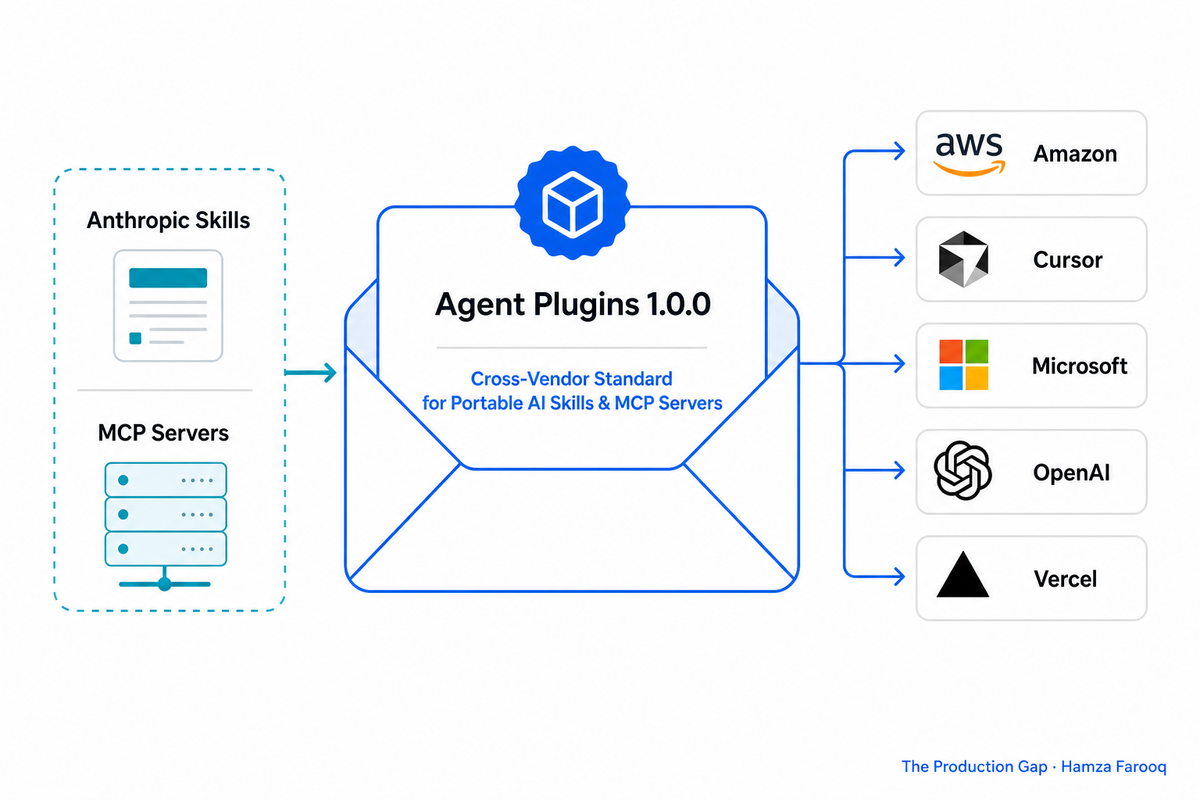
TL;DR: Agent Plugins 1.0.0 is a cross-vendor packaging standard, published in August 2026 by six major AI companies, that bundles AI skills and MCP servers into one distributable format deployable across multiple platforms without rewriting vendor-specific code. Governed by an open consortium, it wraps rather than replaces MCP and Anthropic Skills. Choose it for multi-platform distribution; choose Claude Code-specific Skills when hooks, CLAUDE.md integration, or Claude-only permission scopes are required.
Key takeaways
- Agent Plugins 1.0.0 is a packaging standard: One vendor-neutral format bundles AI tools and skills to run across different coding assistants without rewriting.
- MCP and Skills are wrapped, not replaced: Agent Plugins acts as a common envelope above existing formats.
- Multiple major vendors back the spec together: Six companies established the standard, with five rivals confirmed as having coordinated on its release.
- Clients control what plugins are allowed to do: Each host defines its own trust rules; the same plugin runs with tighter or looser access depending on deployment.
- Claude Code-specific Skills still make sense sometimes: If a tool relies on Claude-only behavior, staying native avoids unnecessary complexity.
- Architectural decisions need to happen now: Delaying the choice between portable plugins and Claude-specific Skills risks locking in the wrong path by default.
Introduction: the agent plugins standard as of August 2026
In August 2026, six major AI companies published Agent Plugins 1.0.0, a vendor-neutral spec for packaging AI skills, tools, and MCP servers into a single distributable format, live at agentplugins/agent-plugins-spec and analyzed by the Agentic AI Foundation (AAIF) as the next layer above existing Skills and tools. For teams built on Claude Code Skills, the choice between staying Claude Code-native or migrating to Agent Plugins will shape your maintenance burden for years.
What exactly is Agent Plugins 1.0.0 and what problem does it solve?
Agent Plugins 1.0.0 is a minimal, vendor-neutral packaging standard that bundles AI skills, tools, and MCP servers into a single distributable format so the same extension runs across different coding assistants without rewriting.
Before Agent Plugins, every platform had its own packaging contract. A Claude Code Skill was an Anthropic artifact; an MCP server was a raw protocol endpoint with no standardized discovery layer. Cross-platform reach meant maintaining separate implementations or accepting lock-in.
Agent Plugins 1.0.0 defines a common manifest format and bundle envelope. It does not rewrite how Skills execute or how MCP servers transport data; it wraps them in a shared outer layer that any conforming client can read, validate, and install. Google's developer guidance confirms this framing: Agent Plugins package your skills, tools, and more. The AAIF positions Agent Plugins as the next layer after Skills and tools, explicitly above the existing stack rather than replacing it.
A useful parallel, as a practical rule of thumb used in this guide, is a container image: Docker did not change how an app ran internally; it standardized the envelope so any OCI-compliant runtime could launch it. Agent Plugins does the same for AI extensions.
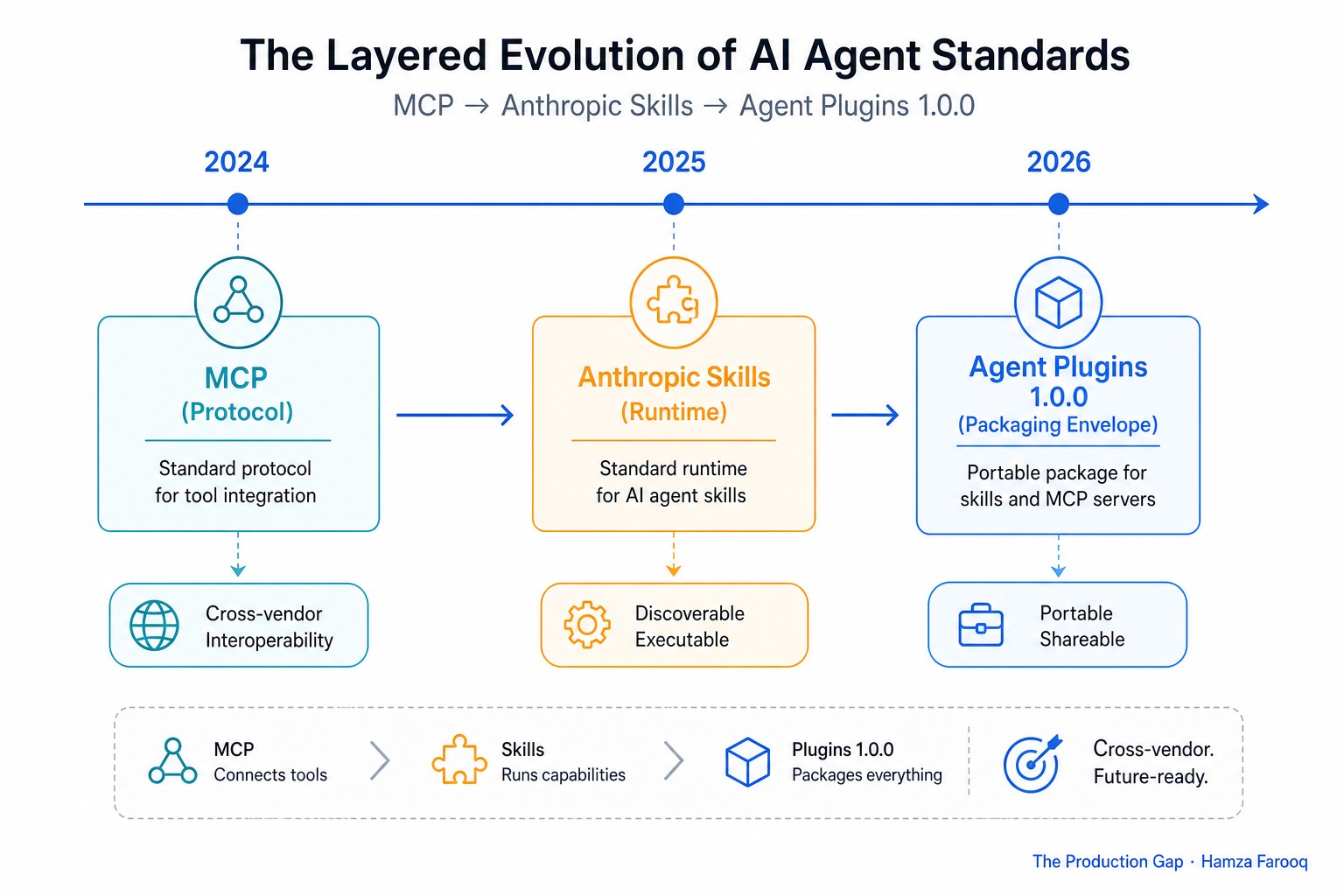
Does Agent Plugins replace MCP and Anthropic Skills?
Agent Plugins 1.0.0 does not replace MCP or Anthropic's Skills standard; it wraps both as inner payloads inside a common bundle, acting as an abstraction layer above them.
| Layer | What it defines | Who controls it | Can exist without Agent Plugins? |
|---|---|---|---|
| MCP | Tool-call transport protocol | Anthropic (open spec) | Yes |
| Anthropic Skills | Runtime execution model for Claude Code | Anthropic | Yes |
| Agent Plugins 1.0.0 | Packaging and distribution envelope | Multi-vendor governance body | Not applicable; wraps the others |
Consider the difference between a recipe (Skills), the kitchen equipment to execute it (MCP), and the cookbook format that lets any chef read and distribute it (Agent Plugins). The cookbook does not replace the recipe or the equipment, but it does constrain what recipes can be printed inside it, and that constraint matters when estimating migration cost.
Who governs the Agent Plugins spec?
Agent Plugins 1.0.0 is backed by six major tech companies, with five rivals confirmed as having coordinated on the standard; no single vendor controls the specification.
The multi-vendor backing means the spec has broad industry support rather than a single controlling party. Because the spec must satisfy multiple vendors simultaneously, it reflects, as a matter of author synthesis, a cross-vendor feature set rather than the full depth of any single platform. Teams relying on platform-specific depth should account for this when planning migration scope.
What does the client-defined trust model mean for enterprise deployments?
Trust decisions in Agent Plugins 1.0.0 are delegated entirely to each consuming client, not enforced in the plugin bundle itself, which means enterprise security teams must evaluate each client runtime independently.
Should your team build Claude Code-specific Skills or adopt Agent Plugins 1.0.0?
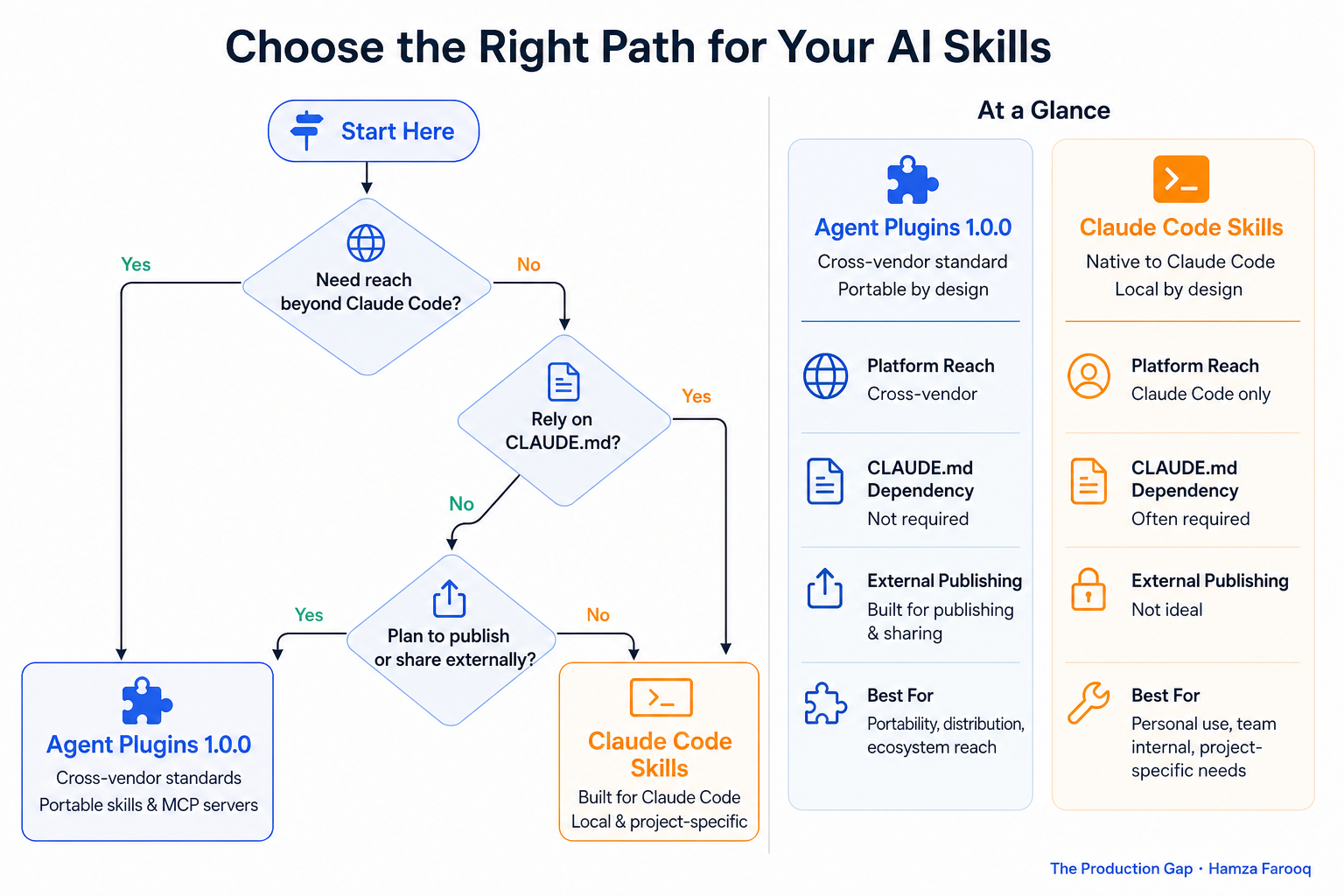
Choose Agent Plugins 1.0.0 for multi-platform distribution; choose Claude Code-specific Skills when hooks, CLAUDE.md integration, or Claude-only permission scopes are required.
The framework used in this guide treats those two conditions as a primary decision gate. Everything else, internal vs. external audience, single-platform vs. multi-platform team, marketplace publishing intent, follows from that gate.
Table 1: Agent Plugins vs. Claude Code-specific Skills, Decision Matrix
| Signal | Recommended path |
|---|---|
| Need to run on Cursor, Codex CLI, or Copilot | Agent Plugins 1.0.0 |
| Heavy CLAUDE.md / hooks / Claude-only behavior | Stay Claude Code-specific |
| Internal tool, single-platform team | Stay Claude Code-specific |
| Publishing to external developers or a marketplace | Agent Plugins 1.0.0 |
| Skill uses runtime features not in cross-vendor scope | Maintain both surfaces |
That last row is not an edge case. For any team with deep Claude Code-specific Skills that also needs external distribution, maintaining both surfaces is the likely outcome, not the fallback plan. Portable packaging, as noted in this guide, does not guarantee behavioral equivalence; Claude-specific behaviors like hooks and CLAUDE.md injection will not surface in non-Claude clients even when the plugin bundle is technically valid.
Frequently asked questions
Does Agent Plugins replace MCP and Anthropic Skills? No. Agent Plugins wraps both as inner payloads; neither is deprecated. The AAIF explicitly positions Agent Plugins as the next layer above Skills and tools.
How do I package an existing Claude Code Skill as an Agent Plugin without losing Claude-specific functionality? Package the Skill inside the manifest as the inner content type. Claude-specific behaviors like hooks and CLAUDE.md integration still work in Claude Code clients but will not surface in non-Claude clients. Maintain a Claude-specific extension layer alongside the standard manifest if those features matter in production.
What does client-defined trust mean for enterprise plugin deployments? Each client host sets its own permission policy independent of the manifest. A plugin requesting file system access may be granted it in one client and denied in another. Security teams must review per client runtime, not per plugin.
When should a team stay Claude Code-specific instead of adopting Agent Plugins? When the Skill relies on runtime features, including hooks, CLAUDE.md injection, and granular permission scopes, that fall outside the cross-vendor scope of the spec. Portability is real; behavioral equivalence is not guaranteed.
Conclusion
Agent Plugins 1.0.0, as of August 2026, solves a real problem: fragmented packaging across platforms. The backing is substantial, with six companies, five confirmed coordinating rivals, AAIF analysis, and a live spec on GitHub, and adoption will happen. But it solves the packaging problem, not the behavioral equivalence problem. Teams that assume they can wrap an existing Skill in the manifest and ship it may find they are maintaining two surfaces regardless.
Before committing to migration, audit against three questions drawn from the framework used in this guide. Does the Skill use CLAUDE.md injection, hooks, or Claude-specific permission scopes? Does your team need it to run on a non-Claude client in the near term? Would you maintain a separate extension layer anyway? If the first answer is yes and the second is no, staying native is the stronger call. Portable is not the same as equivalent.
Next step: Review the v1.0.0 spec at agentplugins/agent-plugins-spec and the AAIF analysis at aaif.io to identify which of your current Skills surface only cross-vendor behaviors before committing to a migration timeline.
Learn from me
Claude Code in Practice, my Maven cohort. Master Claude Code from fundamentals to advanced orchestration: skills, subagents, hooks, MCP, and production automation. Join the next cohort →
Hire us
Traversaal.ai. We're a team of forward deployed engineers solving the toughest AI problems for Fortune 100 companies: document intelligence, agentic data platforms, and real-time web intelligence, deployed in production. Work with our team to deploy your next agentic ecosystem. Talk to Traversaal.ai →
Join us
Want to solve these problems with us? We're always looking for forward deployed engineers who want to ship production AI. jobs@traversaal.ai