AI Agent Interoperability: Why Half Your Enterprise Agents Are Dead Weight (And How to Fix It)
AI agent interoperability decides if your multi-agent strategy compounds or stagnates. Fix enterprise AI sprawl with this diagnostic framework and buying checklist.

TL;DR: AI agent interoperability is the deciding factor between enterprise AI that compounds in value and a collection of expensive, isolated tools that can't share context or coordinate action. Without it, agents duplicate work, miss critical handoffs, and force humans to manually bridge the gaps, turning automation investments into overhead. Fixing fragmentation requires treating connectivity as core infrastructure, not an afterthought.
Key Takeaways
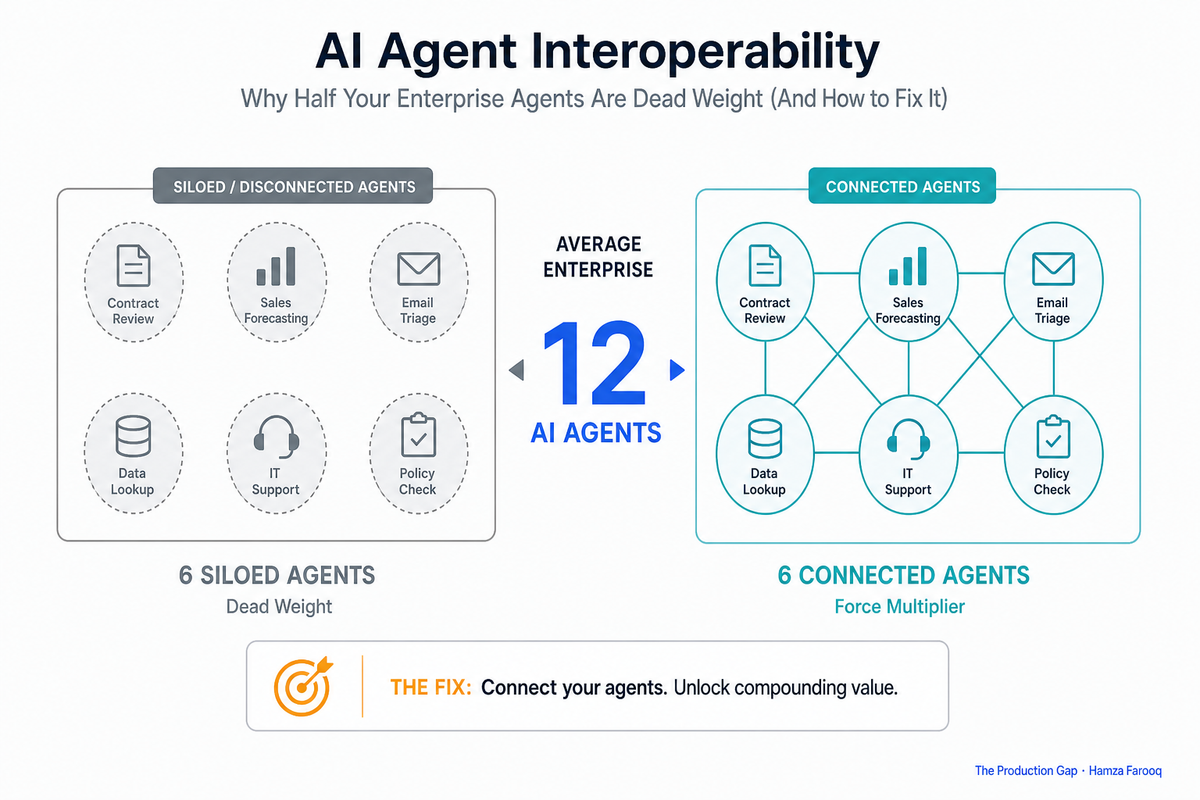
- Agent sprawl is a debt problem: The average enterprise runs 12 AI agents, but roughly half are siloed, disconnected from other systems and agents.
- Disconnected agents create overhead: Siloed agents require human coordination and redundant work that erodes automation gains.
- Interoperability is infrastructure, not a feature: Agent connectivity determines whether your AI investment compounds or stagnates.
- Fragmentation is accelerating: Multi-agent adoption is projected to surge 67% by 2027, every siloed agent added today becomes a harder liability to address later.
- Standards now exist to solve this: Emerging protocols give procurement teams a concrete checklist before you buy.
- Governance determines who survives: Enterprises that establish connectivity ownership and audit trails now will outrun those still detangling silos next cycle.
Introduction
The Salesforce 2026 Connectivity Benchmark confirmed what IT leaders already suspected: the average enterprise runs 12 AI agents, and roughly half are invisible to each other. That's a portfolio of disconnected deployments, not a functioning network.
Agents got bought vendor-by-vendor, business unit by business unit, each with its own ROI justification and nobody responsible for what happens between them. Multi-agent adoption is projected to surge 67% by 2027, which means every silo added today will be harder to address in the next cycle. 86% of IT leaders already report concern that AI agents are adding complexity rather than value.
This article offers a diagnostic framework and a concrete buying checklist, not another agent, but the connective tissue the agents you already have are missing.
Why are half your enterprise AI agents siloed from each other?
Enterprise AI agents are siloed because separate business units bought them with separate budgets, each justified on standalone ROI, with no central owner responsible for making them communicate. BU leaders who bought each agent have little incentive to surface the fact that it can't interact with anyone else's system. The budget for interoperability infrastructure belongs to no existing line item and no named role.
The pattern resembles what happened when enterprises independently adopted Salesforce, Workday, and Marketo in the early 2010s, they later had to build an integration layer that nobody originally planned or funded. Siloed AI agents follow the same procurement logic, at a faster pace.
Three structural conditions produce this outcome: decentralized procurement with BU-level budget authority; vendor incentives to close sales without requiring cross-platform compatibility; and no named owner for the interoperability layer. Middleware alone won't resolve a procurement and governance problem.
What does AI agent interoperability actually cost you?
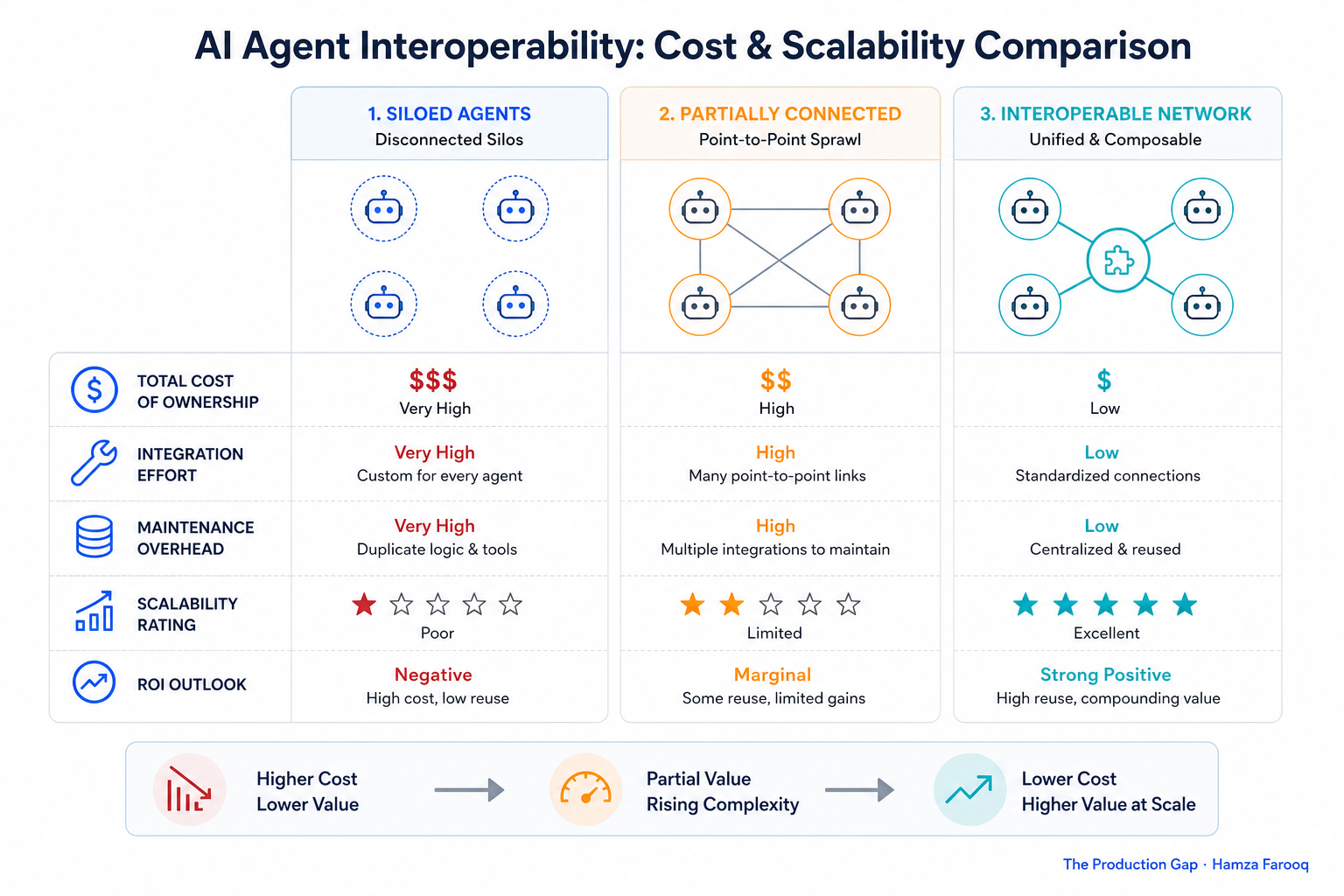
Siloed AI agents create costs in three compounding ways: redundant tooling, manual coordination that erodes automation gains, and a growing liability that becomes harder to address with every new deployment.
Cost layer 1, Duplicated tooling. When agents can't share outputs, teams often rebuild similar integrations independently. Agent sprawl is already being framed as an enterprise AI governance crisis, with siloed agents identified as a central driver.
Cost layer 2, Coordination overhead. Humans become the integration layer when agents can't hand off work to each other. That manual coordination reduces the practical value of automation and introduces delays the original business case didn't account for.
Cost layer 3, Compounding debt. With multi-agent adoption projected to surge 67% by 2027, every siloed agent added today is a harder problem to unwind in 18 months.
| Agent Estate Type | Coordination Model | Cost Profile | Scalability |
|---|---|---|---|
| Fully siloed | Human-mediated handoffs | High overhead, duplicated tooling | Degrades with each new agent |
| Partially connected | Point-to-point integrations | Moderate, brittle at scale | Limited, high maintenance |
| Interoperable network | Protocol-driven agent mesh | Lower overhead, shared data layer | Improves with each new agent |
What standards and protocols govern AI agent interoperability in 2026?
In 2026, AI agent interoperability is governed by emerging agent communication protocols, open standards for agent-to-agent messaging, shared context layers, and orchestration APIs, that procurement teams can use as a concrete evaluation checklist before signing any new platform contract. The Salesforce 2026 Connectivity Benchmark points to a broad shift toward agentic enterprise infrastructure, with semantic context and integration emerging as concrete, evaluable capabilities. AI agent interoperability isn't optional at scale, it's a prerequisite.
Use this Agent Connectivity Checklist before signing any new AI platform contract:
- Agent-to-agent messaging: Can agents send structured task handoffs without human mediation?
- Shared context and memory: Does the platform expose a shared data layer so agents aren't working from stale or duplicate information?
- Orchestration API: Is there a documented API that lets a central orchestrator assign, monitor, and retrieve work from sub-agents?
- Audit and observability: Can you trace a decision across agents?
- Open protocol alignment: Does the vendor support emerging open standards, or are they building a proprietary wall?
If a vendor can't answer all five clearly before you sign, you're buying another silo.
How do you build a governance structure that actually owns the interoperability layer?
AI agent interoperability governance requires a named infrastructure owner with cross-functional authority over connectivity standards, budget, and audit, because no existing IT or business unit role currently fills that gap. The 86% complexity concern reflects an accountability gap as much as a technology one. IT can see the fragmentation, but the BU leaders who bought the agents have no incentive to surface their own silos, and responsibility for multi-agent connectivity falls between them.
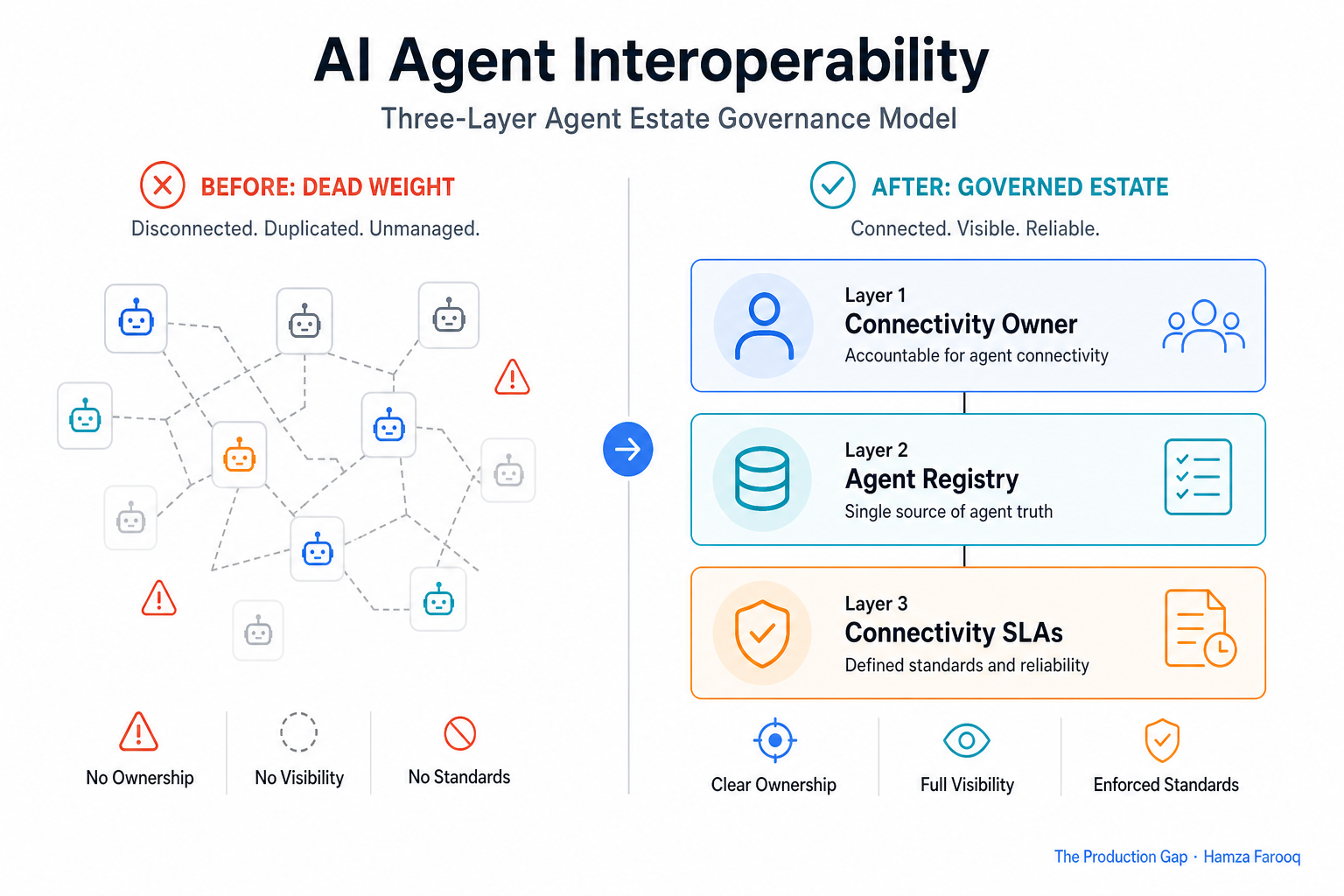
The Agent Estate Governance Model closes that gap with three layers:
- Layer 1, Connectivity Owner: A named role, enterprise architect, AI Infrastructure Lead, or cross-functional committee chair, with explicit authority over interoperability standards and veto power on any new agent procurement that fails the Agent Connectivity Checklist.
- Layer 2, Agent Registry: A live inventory of every agent in production: who owns it, what systems it touches, what protocols it supports. You can't govern what you can't see.
- Layer 3 (Connectivity SLAs: Formal agreements requiring agents to meet interoperability standards before going to production. Treat connectivity like security) non-negotiable.
The 12 AI agents per company figure is described as just the beginning of enterprise agent proliferation. Sound governance gives that growing estate a structure to build on rather than a tangle to manage around.
Frequently Asked Questions
How do I know if my enterprise's AI agents are actually connected to each other? If you can't name every agent in production, what systems it touches, and what protocol it uses to hand off work, your agents aren't connected, they're coexisting. Run an agent registry audit and flag any with zero agent-to-agent handoffs.
What is the ROI difference between siloed agents and interoperable agent networks? Siloed agents deliver point-in-time task automation within a single system. Interoperable networks allow agents to share context and pass work without human mediation, which in my view is where durable automation ROI comes from. That difference becomes more material with every additional agent you deploy.
What protocols govern AI agent interoperability in 2026? The capabilities that matter are agent-to-agent messaging standards, shared context layers, orchestration APIs, and open protocol alignment. Evaluate every vendor against the five-dimension Agent Connectivity Checklist and treat these as infrastructure requirements, not feature preferences.
Who should own the AI agent interoperability budget in an enterprise? No existing role naturally owns it, which is exactly the gap. Assign a named Connectivity Owner, typically an enterprise architect or AI Infrastructure Lead, with cross-functional authority over agent standards, registry maintenance, and procurement veto rights.
Conclusion
The Salesforce 2026 Connectivity Benchmark didn't reveal a technology crisis so much as an accountability one. The average enterprise runs 12 agents, and roughly half are invisible to everything around them, with no named owner responsible for closing that gap.
With 67% multi-agent growth projected by 2027, enterprises that establish connectivity ownership and procurement standards now will be better positioned than those still untangling silos when that wave arrives. Interoperability isn't something you bolt on after buying all your agents, it's the infrastructure criterion that should have shaped the first purchase.
Start with the Agent Connectivity Checklist. If a vendor can't answer all five dimensions clearly, you're not buying intelligence, you're buying isolation.
Learn from me

Agentic AI for Product Managers, my Maven cohort. Learn how to design, evaluate, and ship reliable AI systems: the technical fluency PMs need to lead agentic products, no engineering background required. Join the next cohort →
Hire us
Traversaal.ai. We're a team of forward deployed engineers solving the toughest AI problems for Fortune 100 companies: document intelligence, agentic data platforms, and real-time web intelligence, deployed in production. Work with our team to deploy your next agentic ecosystem. Talk to Traversaal.ai →
Join us
Want to solve these problems with us? We're always looking for forward deployed engineers who want to ship production AI. jobs@traversaal.ai