FedRAMP High Agentic AI Authorization: What the First Wave of Autonomous Capability ATOs Means for Federal Deployment Engineers
FedRAMP High agentic AI authorization demands new control overlays. Learn how to redraw ATO boundaries, satisfy NIST AI RMF, and meet agency audit requirements.

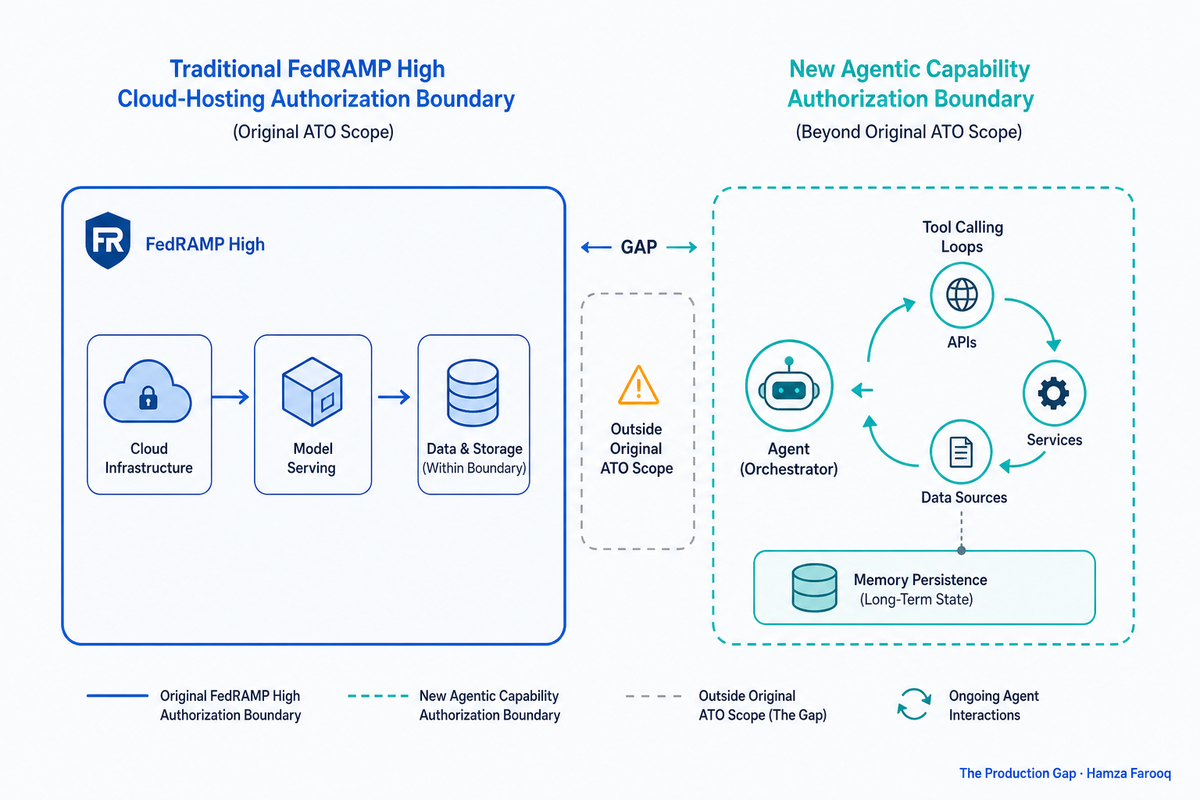
TL;DR: FedRAMP High agentic AI authorization differs from a standard FedRAMP High cloud-hosting ATO by adding control overlays scoped to autonomous decision-making, inter-agent communication, and runtime action boundaries. Federal deployment engineers must layer agentic-specific governance (least-privilege action scopes, human-in-the-loop checkpoints, and audit continuity) directly onto existing cloud infrastructure controls.
Key Takeaways
- Agentic boundaries require their own documentation: FDEs must explicitly define a new authorization boundary when the agentic layer spans an authorized cloud host and external tool endpoints.
- MCP transport authorization is a new control surface: The November 2025 MCP specification introduces a distinct technical layer assessors must evaluate against NIST SP 800-53.
- Three control families carry the heaviest burden: AC, AU, and CM are most heavily implicated by autonomous tool-calling and memory persistence.
- Agency sponsors want action-level evidence: Authorizing officials require individual agent actions to be governed and auditable, not just the underlying infrastructure.
- Cross-framework obligations don't substitute for each other: FedRAMP High, NIST AI RMF, EU AI Act Article 43, and Colorado SB 205 are legally distinct and must be satisfied in parallel.
Introduction
FedRAMP High authorizations have historically governed where federal data lives. Agentic AI breaks that assumption: the boundary must now account for what an agent is permitted to do, not just where its compute runs.
The Model Context Protocol specification, published November 25, 2025, formalizes this at the protocol level, introducing authorization semantics at the transport layer that make the boundary question technically precise. (MCP Authorization Specification) An agentic orchestration layer covering tool-calling loops, memory backends, and multi-step reasoning pipelines is not covered by a boundary document scoped to a model-hosting container.
This article maps which control families are implicated, how the authorization boundary must be redrawn, and what agency sponsors now require as evidence.
Why doesn't an existing FedRAMP High ATO automatically cover agentic AI capabilities added after authorization?
A FedRAMP High ATO authorizes the boundary as it existed at authorization. Autonomous tool-calling, memory persistence, and multi-step reasoning added afterward are new attack surfaces requiring their own boundary documentation and control evidence.
NIST defines authorization as "access privileges granted to a user, program, or process or the act of granting those privileges." (NIST CSRC Glossary) An AI agent autonomously calling external tools is a new process requesting new privileges, not an extension of an authorization scoped to a model-hosting container. (auth0: What is Authorization)
A vendor holding a FedRAMP High ATO for document analysis SaaS that adds an agentic feature calling an external scheduling API illustrates the gap directly: that API call sits outside the original boundary. Presenting the existing ATO as full coverage leaves the FDE with an undocumented risk posture. Adding agentic capability means reopening the boundary definition, not assuming inheritance.
Which NIST SP 800-53 control families carry the heaviest burden in a FedRAMP High agentic AI authorization?
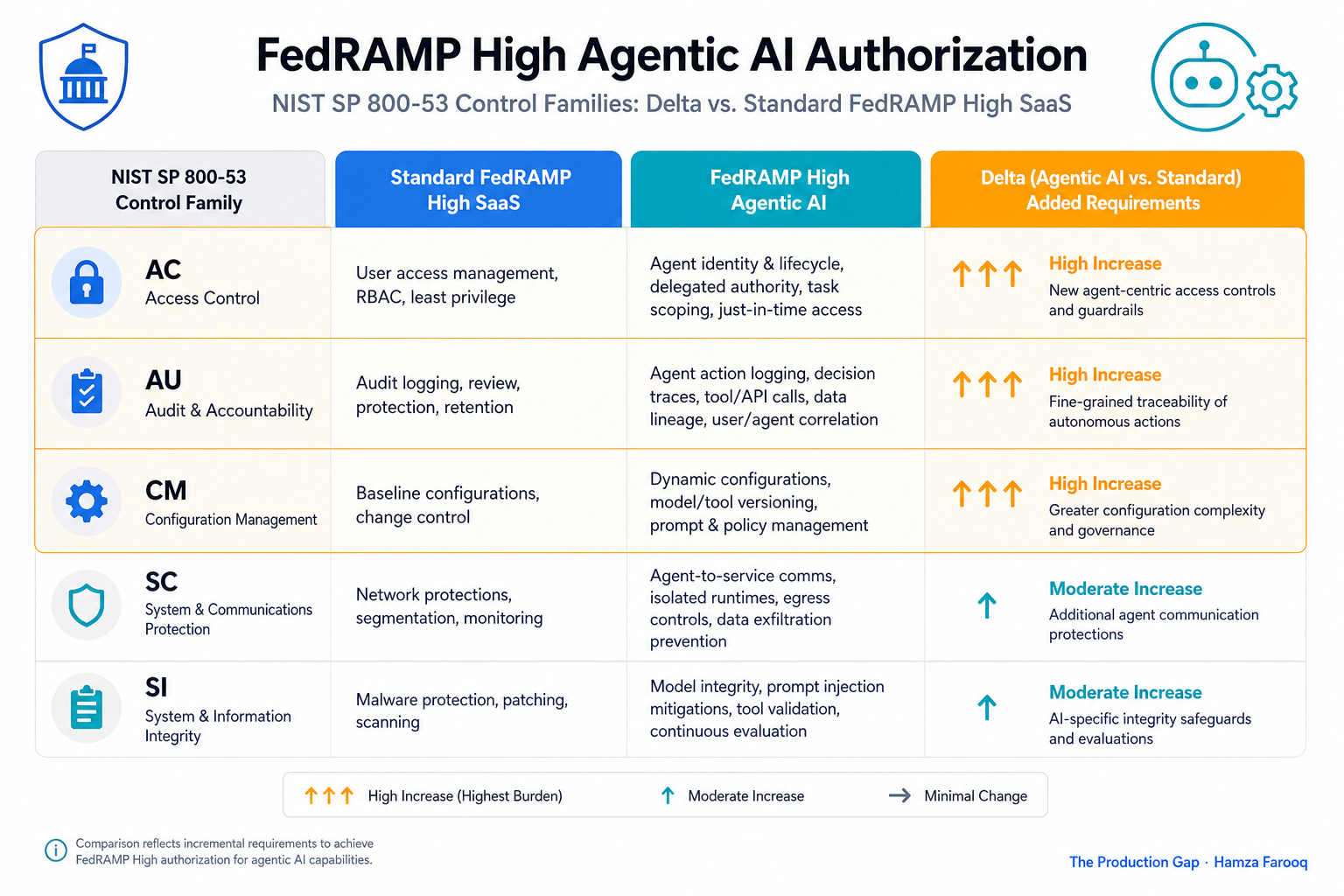
Access control (AC), audit and accountability (AU), and configuration management (CM) are the control families most heavily implicated by autonomous tool-calling and memory persistence.
AC: Agents request access without a human in the loop, so least-privilege must be designed into the agent's permission set at design time. OWASP defines authorization as "verifying that a requested action or service is approved for a specific entity" (OWASP Authorization Cheat Sheet); for an agent, that entity is a process whose privilege surface must be explicitly enumerated in the SSP. The governing control is AC-6 (Least Privilege).
AU: Every autonomous action must be logged in a way that reconstructs why it was taken, not just that it occurred. Standard API logging does not satisfy this requirement. AU-12 (Audit Record Generation) and AU-9 (Protection of Audit Information) govern this obligation.
CM: MCP tool registries, agent memory backends, and reasoning pipeline configurations are all configuration items. Changes can alter agent behavior without triggering traditional change management, a CM surface most existing SSPs do not yet account for. CM-8 (System Component Inventory) must be extended to include tool registry entries and memory backend configurations as tracked items.
Table 1: NIST SP 800-53 Control Family Requirements, Standard FedRAMP High SaaS vs. Agentic AI (Author synthesis, 2026)
| Control family | Standard FedRAMP High SaaS | Agentic AI additional requirement |
|---|---|---|
| AC (Access control) | Role-based access for human users and service accounts | Per-tool, per-action least-privilege on agent process; no implicit privilege inheritance (AC-6) |
| AU (Audit and accountability) | API and access logs tied to user identity | Action-level reasoning chain logs; agent decision provenance traceable to authorization event (AU-12) |
| CM (Configuration management) | IaaS/PaaS configuration baselines; software inventory | MCP tool registry versioning; memory backend configuration as tracked CIs; pipeline change control (CM-8) |
| SI (System and information integrity) | Vulnerability scanning; malware protection | Prompt injection detection; adversarial input monitoring on agent inputs from external tool responses |
| CA (Security assessment) | Periodic control assessments against SSP | Capability-level assessment of autonomous action surfaces; agent behavior testing under adversarial conditions |
If your SSP lacks specific control language for each family at the agent action layer, your FedRAMP High package is incomplete regardless of what the underlying IaaS covers.
How does MCP transport-level authorization create a new control surface for federal risk assessors?
The specification states that MCP "provides authorization capabilities at the transport level, enabling MCP clients to make requests to restricted MCP servers." (MCP Authorization Specification) This operates at the protocol level, not the application layer, and cannot be inherited from the IaaS layer below it.
If the agentic layer sits above an authorized IaaS, compute may be covered, but MCP transport authorization (who the agent can call, with what credentials, under what constraints) is entirely customer-responsible. FDEs must document MCP server endpoints, the authorization semantics enforced at each, and the credential lifecycle for agent-to-tool calls as discrete SSP line items. AC-17 (Remote Access) and IA-3 (Device Identification and Authentication) are the primary applicable control identifiers.
How does the Authorization Layer Stack organize the full set of obligations for a FedRAMP High agentic deployment?
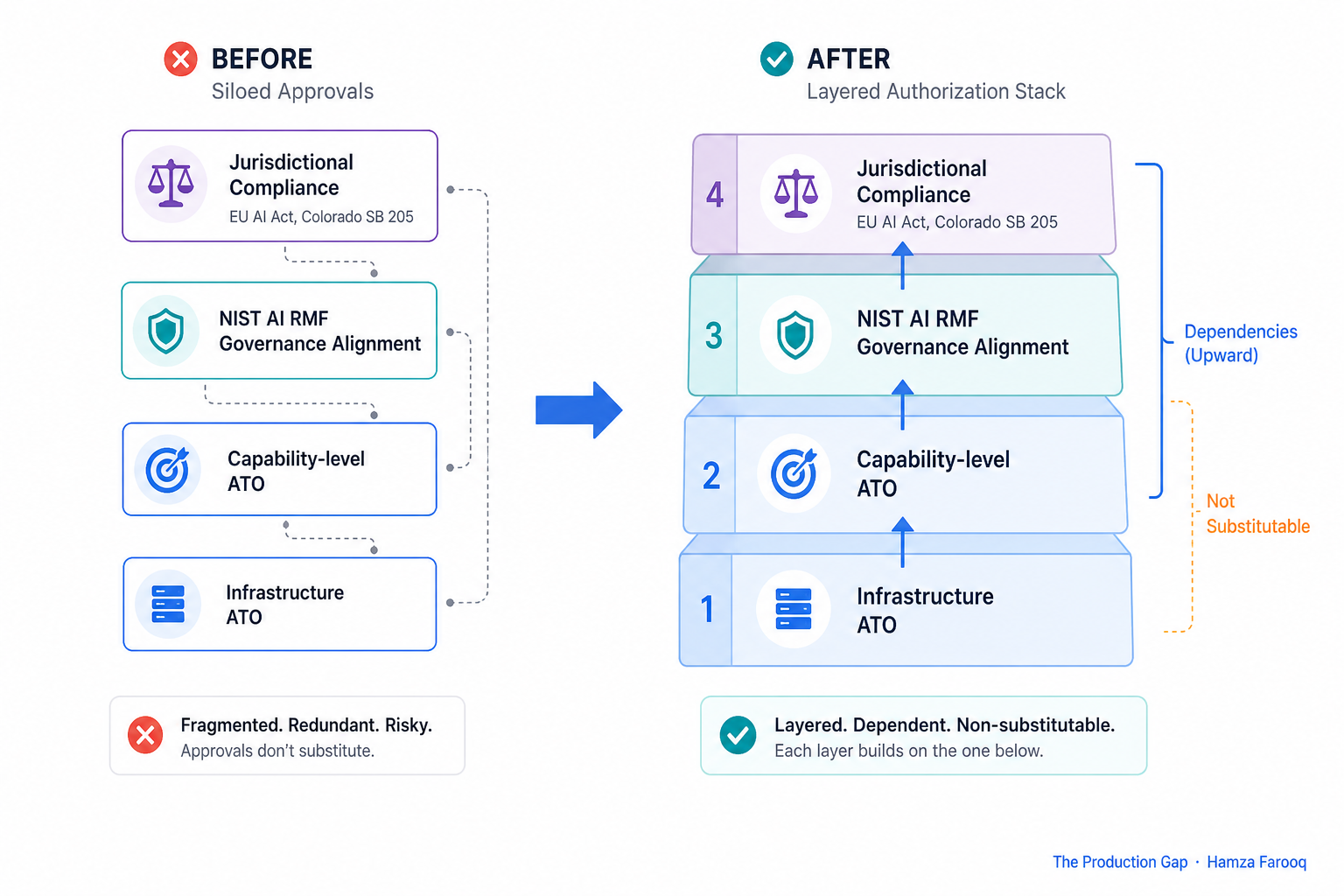
The Authorization Layer Stack organizes four distinct, non-substitutable obligation layers every FDE must track. No single framework satisfies the others.
The Authorization Layer Stack (Author Synthesis)
Layer 2, Capability-level ATO: The agentic orchestration layer, tool surfaces, memory backends, and reasoning pipelines. Requires its own boundary documentation and control evidence independent of Layer 1.
Layer 3, AI governance alignment: NIST AI RMF Govern and Map function outputs. These can serve as direct input to SSP boundary documentation but constitute a governance framework, not a technical control standard, and do not substitute for SP 800-53 controls.
Layer 4, Jurisdictional compliance: EU AI Act Article 43, Colorado SB 205, and equivalent obligations. These impose jurisdiction-specific requirements FedRAMP does not address and that are not satisfied by completing Layers 1 through 3.
A vendor with a FedRAMP High ATO for their IaaS has completed exactly one of four layers.
Frequently Asked Questions
Does an existing FedRAMP High ATO automatically cover agentic capabilities added after the original authorization boundary was defined? No. New agentic capabilities introduce new attack surfaces requiring boundary redefinition, updated SSP documentation, and new control evidence. AC-6 (Least Privilege) must be rewritten to enumerate the agent process's exact tool permissions rather than inheriting them from prior service account definitions.
How should an FDE document the authorization boundary for an agentic AI system spanning an authorized cloud host and external tool endpoints? The SSP must explicitly enumerate all external tool endpoints, MCP server connections, and memory backends as boundary components with assigned control owners and assessment procedures. Under CM-8, every MCP tool registry entry and memory backend must appear as a tracked configuration item before the package is considered complete.
What evidence does a FedRAMP High agency sponsor require to authorize AI agent actions rather than just AI model hosting? Agency sponsors require action-level audit logs reconstructing agent decision provenance, per-tool least-privilege documentation, and adversarial behavior test results demonstrating resilience to prompt injection. AU-12 must be implemented at the individual agent action level, not only at the API call level.
Conclusion
The authorization boundary is no longer a perimeter around a data center. It is a contract about what your agent is permitted to do, to whom, and provably why.
Audit your SSP boundary documentation against your agentic feature set today. Map agent action surfaces against AC, AU, CM, and SI using the control identifiers in Table 1. Document MCP transport authorization mechanisms as discrete SSP line items with assigned control owners. Work through all four layers of the Authorization Layer Stack in sequence, Infrastructure ATO, Capability-level ATO, AI RMF alignment, and jurisdictional compliance. Federal deployment engineers who treat these as a single undifferentiated requirement will carry authorization gaps into production.
Learn from me
Forward Deployed Engineering Bootcamp for Full-Stack Developers, my Maven cohort. Build and ship complete AI products end to end, from React and Node.js frontends to deployed models with caching and observability. Join the next cohort →
Hire us
Traversaal.ai. We're a team of forward deployed engineers solving the toughest AI problems for Fortune 100 companies: document intelligence, agentic data platforms, and real-time web intelligence, deployed in production. Work with our team to deploy your next agentic ecosystem. Talk to Traversaal.ai →
Join us
Want to solve these problems with us? We're always looking for forward deployed engineers who want to ship production AI. jobs@traversaal.ai