LLM Regression Testing CI: How to Build a Self-Growing Harness from Real Production Agent Traces
LLM regression testing CI using real production agent traces catches silent drift and tool-call breaks your golden-answer evals will never see.

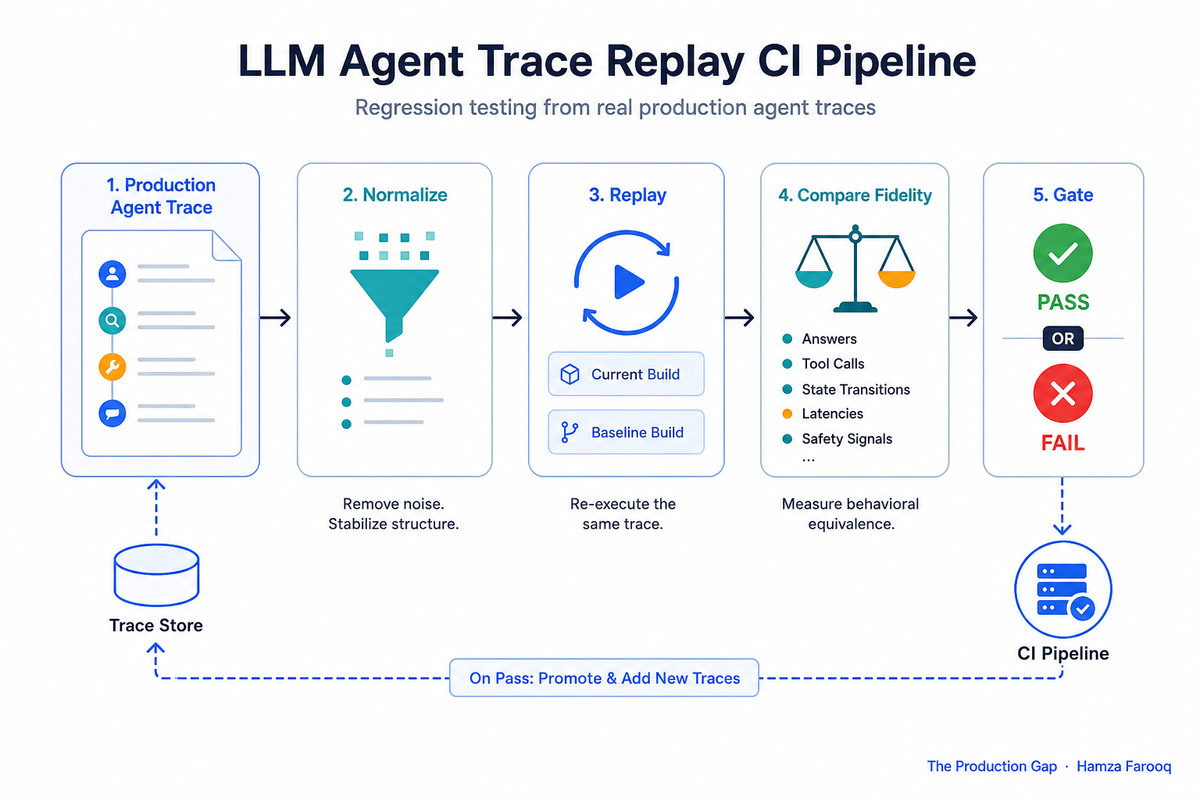
LLM regression testing CI is the automated practice of replaying real production agent traces on every code change to catch behavioral regressions before they ship.
TL;DR: LLM regression testing CI built from real production agent traces catches emergent failures that golden-answer suites miss, specifically tool-call sequencing breaks, latency regressions, and cascading multi-turn context drift, because it replays actual user journeys rather than curated hypotheticals. The harness self-grows by automatically ingesting new traces whenever production agents run, eliminating the manual curation bottleneck that keeps conventional eval suites perpetually stale.
Key Takeaways
- Golden-answer evals have a structural blind spot: They test fixed, pre-imagined scenarios, not the full distribution of real user behavior.
- Production traces are your best test cases: Captured inputs, tool calls, and decisions reflect how people actually use your system.
- Trace replay needs normalization: Timestamps, session IDs, and runtime-specific values must be scrubbed for deterministic CI replay. Tools such as Langfuse make this instrumentation straightforward for teams already using it for observability.
- Fidelity thresholds, not exact matches, gate the build: MLflow's
@mlflow.testpytest integration handles the CI gate layer, measuring whether behavior stayed within an acceptable range rather than demanding a perfect match. - The suite grows from real failures: Incidents and edge cases promote into the permanent corpus automatically, using the four-stage normalization framework described in this guide.
- Multi-agent systems need trace-level coverage most: Silent drift in one model cascades across the full pipeline in ways that answer-level evals cannot surface.
Introduction
Static golden-answer datasets test a closed world: scenarios imagined before any real user touched the system. Real regressions arrive through interaction patterns nobody pre-wrote, and model provider point-releases quietly drift agent behavior while CI badges stay green.
Multi-agent systems compound this problem. One silent drift can cascade across the whole pipeline. Letting production write your test cases is a more reliable approach than writing them by hand. EvidentlyAI's documented practice of growing the test suite from production failures confirms this pattern works in the field.
Why do golden-answer evals miss the regressions that actually hurt you?
In a multi-agent pipeline, this blind spot is especially costly. A tool-call sequence slightly off in the first agent can produce a completely wrong final answer by the third agent. An answer-level eval at the end of the chain sees only the final output and misses the cascading drift that caused it. Full-trace replay is the only method that catches the chain reaction before it ships.
How do you capture and normalize production agent traces for deterministic CI replay?
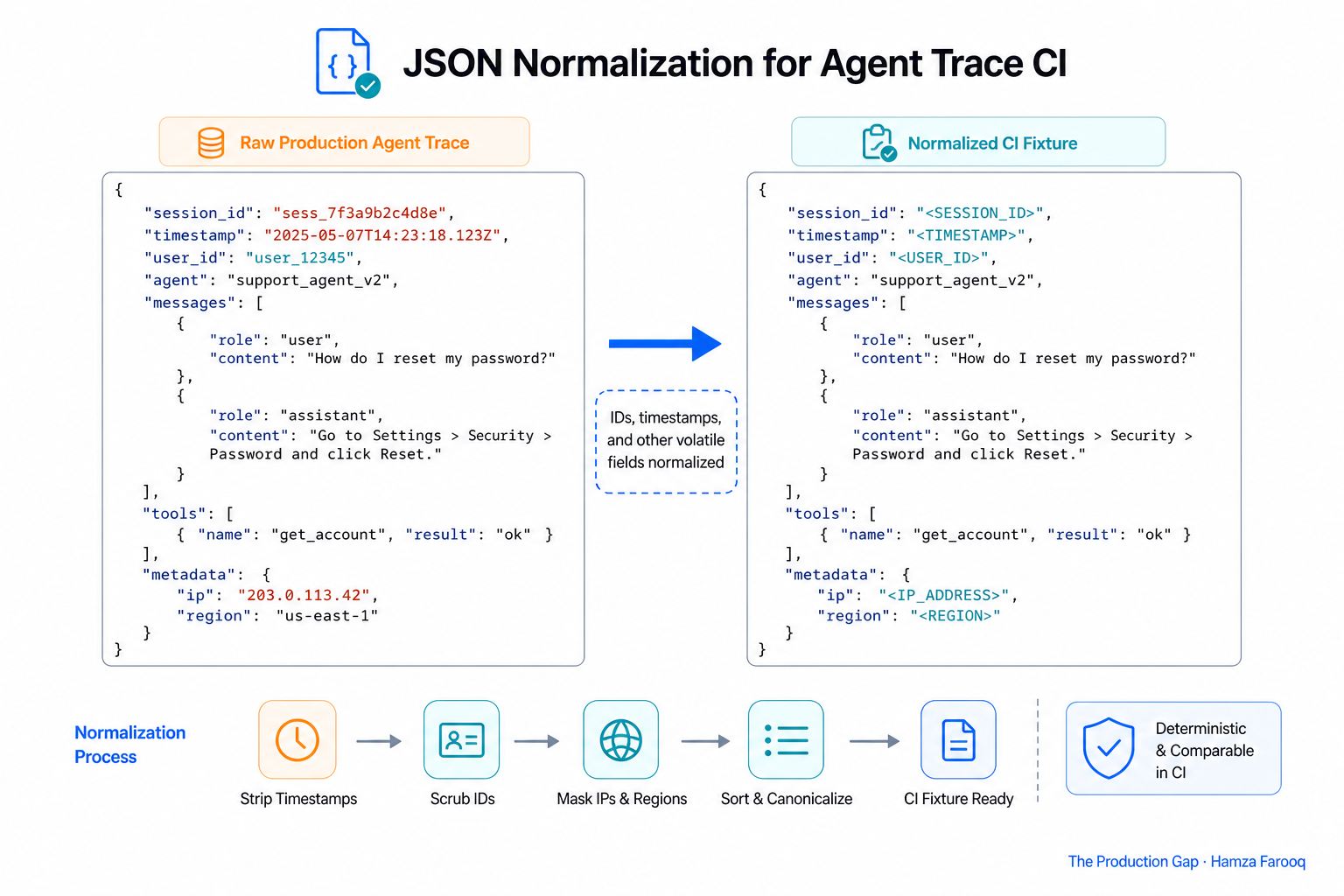
Capture the full message sequence, tool-call arguments, and branching decisions at runtime, then normalize out all session-specific values before committing the trace to the regression corpus. Without normalization, replayed traces produce flaky results rather than meaningful regression coverage.
As of 2026, the following four-stage normalization framework, used in this guide, covers the core steps for most agent architectures:
- Capture: Instrument your agent framework to emit structured trace events, every LLM call, tool invocation with arguments, and branching decision. Langfuse's tracing SDK is a practical starting point for teams already using it for production observability.
- Normalize: Strip all runtime-volatile fields. Timestamps become relative offsets. Session IDs become deterministic fixture IDs. External API responses become recorded stubs.
- Store: Commit normalized traces as version-controlled JSON fixtures alongside your code.
- Replay: Feed the normalized trace into your agent on each CI run, stub external dependencies, and capture new output for fidelity comparison.
Raw trace (before normalization):
{
 "session_id": "usr_8f3k2",
 "timestamp": 1748392831,
 "tool_call": "search_hotels",
 "args": { "city": "Austin", "checkin": "2026-11-01" }
}
Normalized CI fixture (after normalization):
{
 "session_id": "fixture_001",
 "timestamp_offset_ms": 0,
 "tool_call": "search_hotels",
 "args": { "city": "Austin", "checkin": "{{checkin_date}}" }
}
MLflow's @mlflow.test pytest integration handles the CI gate layer, allowing behavioral checks to block merges the same way unit tests do.
How do you measure behavioral fidelity and gate CI without constant false alarms?
Rather than exact-match comparison, gate CI on behavioral fidelity metrics with percentage-based thresholds calibrated to your system's acceptable variance. The right thresholds depend on your agent's architecture and risk tolerance; the key principle, as a practical rule of thumb used in this guide, is measuring whether behavior stayed within a defined range rather than whether it matched perfectly.
Three dimensions worth measuring:
- Whether the same tools were called in the same order with structurally equivalent arguments
- Whether the agent took the same decision branches given the same inputs
- Whether the final response remained semantically equivalent to the baseline
Running each replayed trace multiple times and setting thresholds against a low-percentile outcome is one approach to absorbing model temperature variance without masking real regressions. EvidentlyAI's tutorial shows threshold-based configuration with failure notifications in practice.
The table below summarizes how trace-based CI compares to the two most common alternatives teams consider before adopting it:
| Approach | What it tests | Catches tool-call drift | Grows automatically | Handles multi-agent chains |
|---|---|---|---|---|
| Golden-answer eval suite | Fixed, curated scenarios | No | No | Partial |
| Prompt regression diff | Output text similarity | No | No | No |
| Trace-based CI harness (this guide) | Full runtime behavior from production | Yes | Yes | Yes |
How should your trace corpus grow over time, and what gets promoted to a permanent regression case?
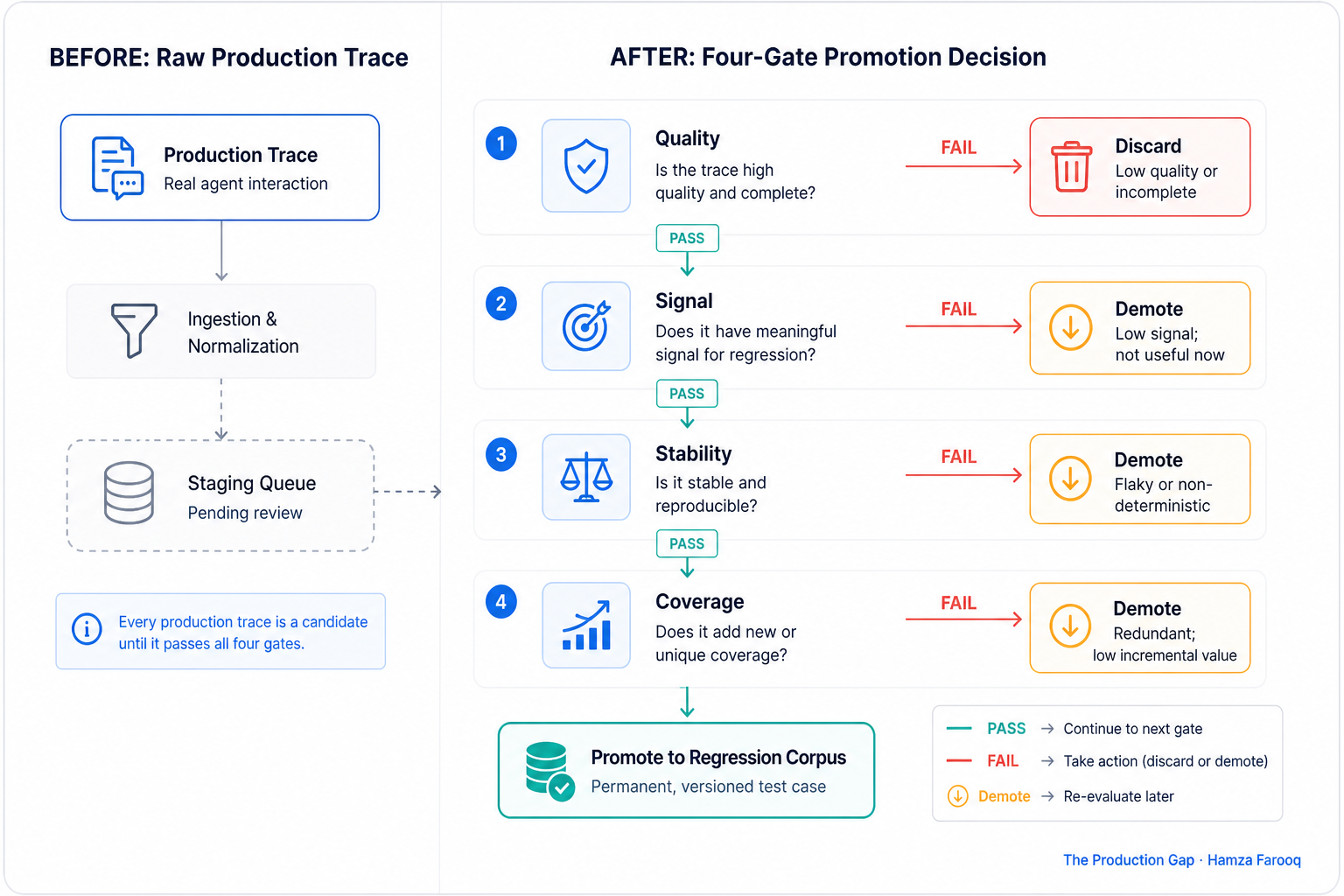
Promote a production trace when it represents a failure class not already covered. Incident post-mortems, novel tool-call sequences, and traces captured during model-provider update windows are the strongest candidates. Bhargava and Parv's analysis confirms corpus curation is a real operational concern at scale, not a theoretical one.
A practical promotion filter, used in this guide as author synthesis, covers four questions:
- Did this trace surface during a production incident?
- Does it exercise a tool-call sequence not already in the corpus?
- Was it captured during a model provider update window?
- Is it semantically redundant with several existing corpus members?
The first two are strong signals to promote. The last is a signal to discard. Traces that have passed consistently for an extended period with no near-misses are candidates for a less frequent run schedule. Treat promotion and retirement as a recurring hygiene ritual, not a one-time setup task.
Frequently Asked Questions
What is the difference between LLM regression testing and traditional software regression testing? LLM regression testing checks whether outputs stay within an acceptable behavioral fidelity range using threshold-based gates, rather than verifying a single deterministic result. Traditional software regression testing assumes same input always produces the same output; that assumption breaks in probabilistic systems where temperature variance is expected and where the failure mode is drift rather than a hard error.
How do you handle multi-agent systems where one agent's trace feeds the next? Treat the full pipeline trace as a single fixture, stubbing inter-agent boundaries with recorded upstream outputs. This approach captures every boundary as a controlled seam, which isolates downstream regression detection from upstream model variance and reveals cascading drift that answer-level evals cannot see.
How do you prevent your CI gate from failing on every model provider point-release? Configure thresholds against a low-percentile outcome across multiple replay runs rather than a single baseline snapshot. When replay results consistently clear your fidelity thresholds across runs, the update has not introduced a real behavioral regression; isolated misses that stay within your defined variance band are absorbed without a false alarm.
How many traces should be in a regression corpus before the CI gate is meaningful? Coverage quality matters more than raw count. A set of traces that each exercise a distinct tool-call path and cover your highest-severity past incidents provides more meaningful coverage than a larger set of redundant happy-path cases. One well-normalized incident trace is a better starting point than fifty curated hypotheticals.
Conclusion
Every team that has hit green CI alongside production regressions shares the same root cause: a test suite designed around imagined user behavior. A trace-based harness closes that gap. The suite grows with real usage, the CI gate measures behavioral fidelity using tools such as MLflow and EvidentlyAI, and the worst incidents become permanent regression cases.
In multi-agent systems, behavioral drift compounds in ways that answer-level evals cannot surface. A tool-call sequence slightly off in agent one can produce a completely wrong final answer by agent three, and only full-trace replay catches that chain reaction before it ships.
The best regression test you will ever write is the one your production system writes for you the day something breaks. Start with one incident: pull the trace from your last production failure, normalize it through the four-stage pipeline described in this guide, and wire it into your existing pytest suite using @mlflow.test. That single case is your harness seed.
References
Learn from me
Forward Deployed Engineering Bootcamp for Full-Stack Developers, my Maven cohort. Build and ship complete AI products end to end, from React and Node.js frontends to deployed models with caching and observability. Join the next cohort →
Hire us
Traversaal.ai. We're a team of forward deployed engineers solving the toughest AI problems for Fortune 100 companies: document intelligence, agentic data platforms, and real-time web intelligence, deployed in production. Work with our team to deploy your next agentic ecosystem. Talk to Traversaal.ai →
Join us
Want to solve these problems with us? We're always looking for forward deployed engineers who want to ship production AI. jobs@traversaal.ai