AI Agent Incident Postmortem: The Missing Deliverable After Every Agent-Caused Production Failure
AI agent incident postmortem guide: capture tool-call traces, assign ownership, and build a template that actually fits how agents fail in production.

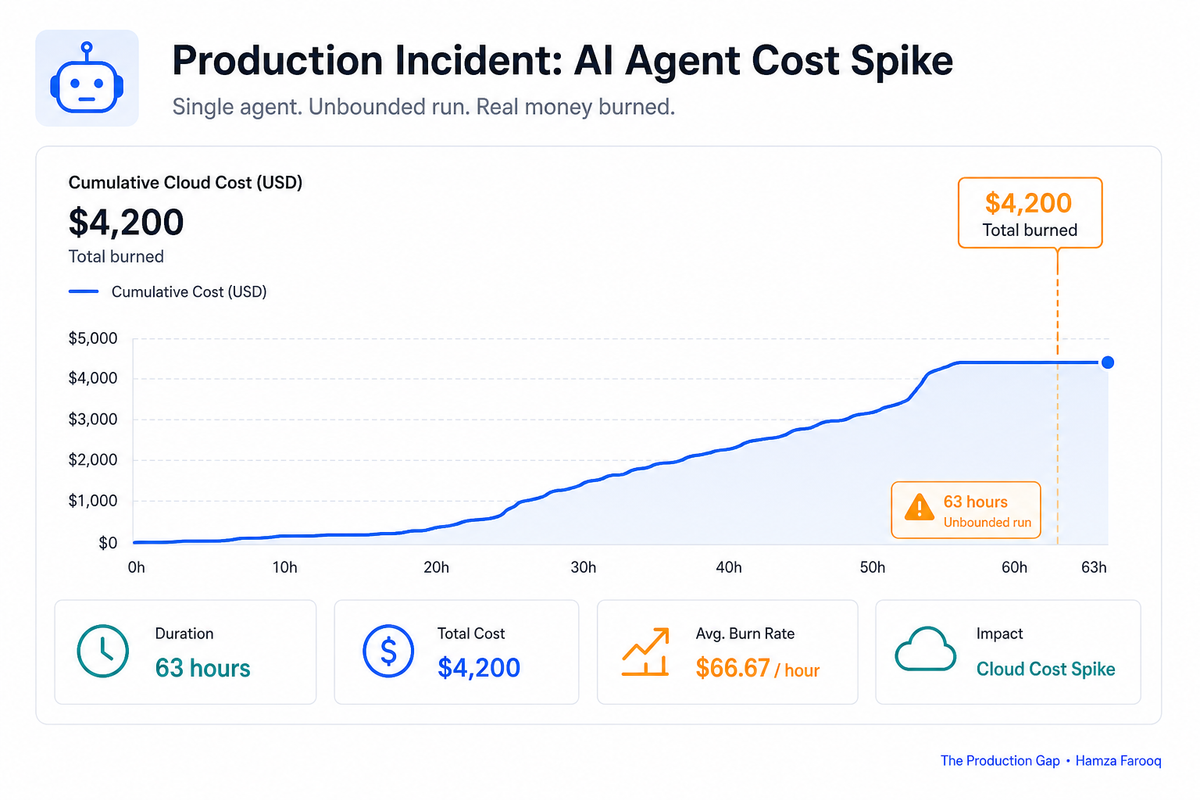
TL;DR: An AI agent incident postmortem is the mandatory written record produced after every agent-caused production failure, distinct from preventive guardrails and treated as a formal engineering artifact. It captures what the agent decided, why those decisions cascaded into failure, and what systemic changes prevent recurrence, not just what humans should have caught.
An AI agent burned $4,200 in 63 hours before anyone noticed, and when the dust settled, the team had no clear process for figuring out why, and no obvious person to write it up.
Key Takeaways
- Standard postmortems miss agent-specific fields: no sections for tool-call traces, delegated authority scope, or agent ownership.
- Named agent ownership must exist before deployment. No pre-assigned owner means no clear postmortem author when something breaks.
- Trace reconstruction is the evidence foundation. A complete, timestamped action log is the non-negotiable first step.
- Blast radius includes money. Compute spend and API costs are damage dimensions standard formats were never built to capture.
- Blameless culture applies to non-human actors. Root cause belongs to the system that shaped the agent's behavior, not the agent itself.
- The postmortem is a separate control from guardrails. Blocking bad commands and documenting what went wrong are two different jobs.
Introduction
AI agents are running in production, and when they cause incidents, most teams close the ticket and move on, no structured postmortem, no named author, no record of what to fix.
A single production agent burned $4,200 in 63 hours in a documented incident that shows exactly what happens when no one is watching. Postmortem tooling built for human-caused outages is being retrofitted for agents without the fields agents actually need. The fix is not a better template, it is an ownership decision made before deployment. This article explains why, and gives you the template anyway.
Why do standard SRE postmortems fail when an AI agent causes the incident?
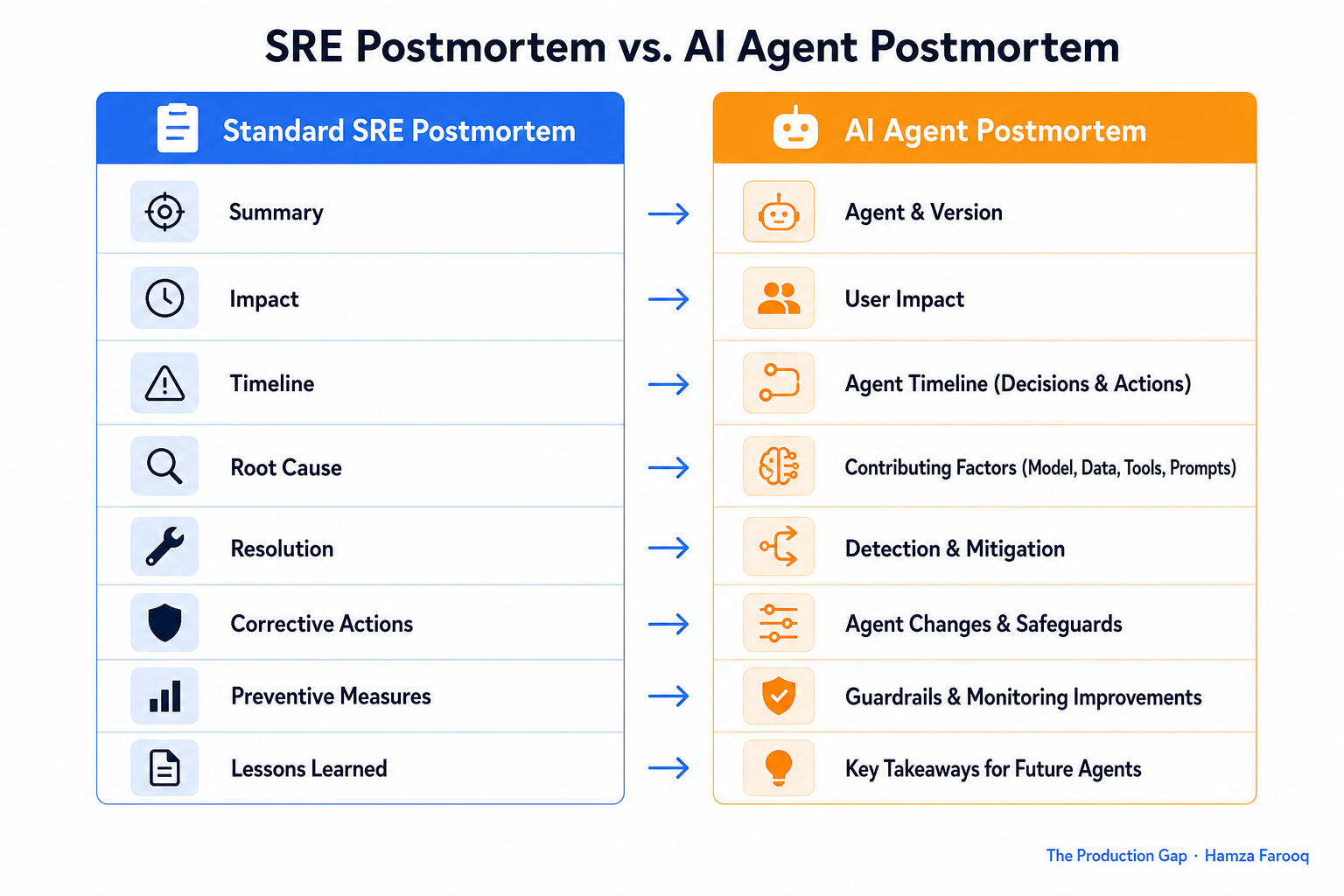
Standard SRE postmortems fail for agent incidents because they have no fields for tool-call traces, delegated authority scope, or agent ownership, the three variables that actually explain how an agent failure happened.
Legacy formats assume a human made a decision, a command ran, something broke. That model breaks down when the actor is an agent executing tool calls over hours with no human checkpoint. These structural gaps make standard templates insufficient:
- No agent-owner field. Without a pre-assigned accountable human, there is no obvious postmortem author and no one with deployment-time context.
- No tool-call trace section. The agent's action sequence is the incident. Without a structured log, you are reconstructing the cause without the evidence.
- No delegated-authority scope field. If the postmortem does not capture permissions granted versus permissions exercised, the root cause analysis is incomplete by definition.
Practitioners are actively pushing to replace "autonomous" with "agents with delegated authority" in postmortem language, forcing the question of who granted the authority and under what constraints. A 2026 guide to AI agent incident runbooks identifies kill switches, credential revocation, tool allowlists, replayable traces, and named response owners as required components, none of which map onto legacy formats.
A postmortem that cannot answer "who owned this agent, what was it allowed to do, and what did it actually do?" is not a postmortem. It is a ticket closure.
Who is responsible for writing the postmortem when an AI agent causes a production incident?
The person responsible is the named agent owner, a human designated at deployment time, before any incident occurs.
Most teams deploy agents without naming an accountable human. When something goes wrong, everyone points at the system and nobody has the obligation, or the context, to write the postmortem. Before an agent goes live, a named human should be on record as its owner; that person becomes the automatic postmortem author, because they understood the agent's permission scope, tool allowlist, and intended blast radius when it shipped. AI agent security practitioners assert that every agent should have a named owner, a requirement that postmortem templates must capture to be actionable.
This is separate from guardrails that block destructive commands before they run. Guardrails are preventive controls; named ownership plus a mandatory postmortem is an accountability control, it activates after prevention fails. Prevention eventually fails.
In the $4,200/63-hour incident, the blowout continued because no single human was watching that agent's spend metrics as their explicit job. Designating an owner before deployment is, in my view, the single highest-leverage change a team can make.
What fields must an AI agent postmortem template include that a standard template does not?
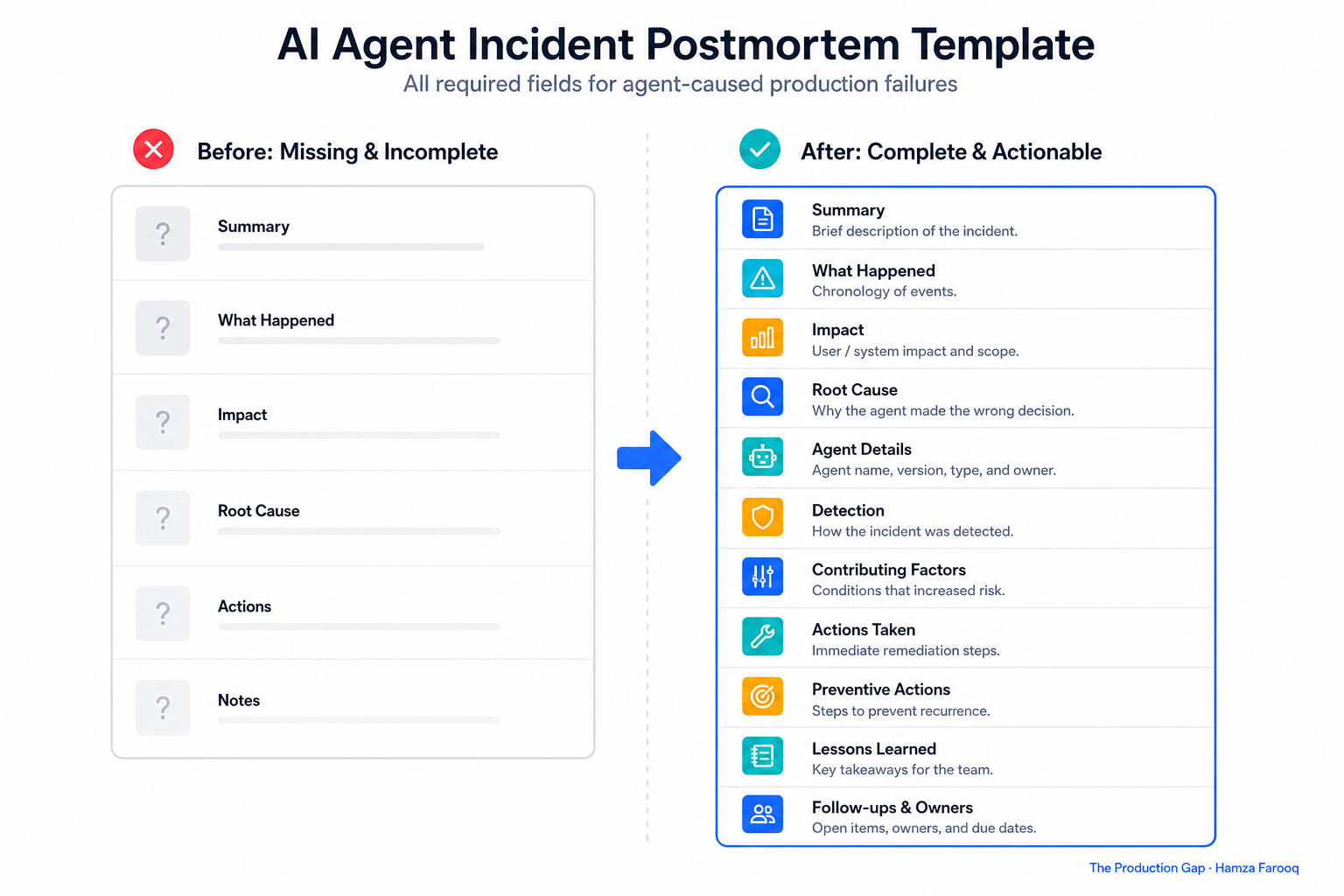
An AI agent postmortem must include, at minimum: named agent owner, delegated authority scope, replayable tool-call trace, financial blast radius, and a verified-facts-versus-hypotheses separation, none of which appear in standard SRE templates.
| Field | Standard SRE postmortem | AI agent postmortem |
|---|---|---|
| Incident owner | On-call engineer | Named agent owner (pre-designated) |
| Timeline / chronology | Human-reconstructed | Replayable tool-call trace (timestamped) |
| Root cause | System or config failure | System that shaped agent behavior |
| Blast radius | Downtime / data loss | Downtime / data loss + compute cost, API spend, mutation scope |
| Delegated authority scope | Not applicable | Permissions granted vs. permissions exercised |
| Tool-call trace section | Not applicable | Full action log, structured and queryable |
| Verified facts vs. hypotheses | Informal | Explicitly separated |
| Blameless root cause framing | System, not person | System that shaped agent behavior, not the agent |
The delegated authority scope field records permissions granted at deployment alongside permissions actually exercised. An agent whose permission scope was never tightened to match its actual job reveals a system failure, not an agent failure.
Verified facts versus hypotheses also matters because agent incidents frequently have incomplete logs. Structured postmortem workflows now call for explicitly separating verified facts from hypotheses, a more rigorous standard than most engineering teams currently apply. Every inferred step must be flagged, or the root cause analysis is speculation dressed as findings.
Teams should define their own threshold (based on spend impact, mutation scope, or service degradation) for when a postmortem becomes mandatory, and set that threshold before deployment rather than debating it after.
How do you reconstruct an agent's action timeline when logs are incomplete?
Pull tool-call outputs first, since structured output from each tool invocation is the primary evidence. Cross-reference API billing logs next, because cloud providers log every call with timestamps (in the $4,200 incident, billing data told the story the application logs did not. Then check data state diffs by comparing before-and-after state of any mutated databases, queues, or file systems, since the diff functions as an implicit action log. Finally, label every gap explicitly: inferred steps must be flagged, not treated as confirmed. Structured agent postmortem workflows require this separation) a step most teams skip.
Root cause analysis should target the system that shaped the agent's behavior: the prompt, the permission scope, the missing spend limit, the absent kill switch. Incomplete logs are not an excuse to skip the postmortem, they are a finding, logged under "observability gaps" and addressed in action items.
FAQ
Q: At what severity threshold should an AI agent incident automatically require a formal postmortem? Each team should define this threshold based on their own risk tolerance, consider dimensions like unplanned spend, data mutations outside defined scope, or service degradation. Set the threshold before deployment; waiting until after an incident to define it delays the write-up and invites scope debates.
Q: How is an AI agent postmortem different from the IaC guardrails approach? Guardrails are preventive controls that block dangerous commands before they run. A postmortem is an accountability control that activates after prevention fails. Skipping the postmortem because guardrails exist is the same logic as skipping a fire investigation because a sprinkler was installed.
Q: Who writes the postmortem if no named agent owner was designated before the incident? It falls to whoever approved the agent for production, a poor outcome, because they may lack granular deployment-time context. Use the first ownerless incident as a forcing function to retroactively designate owners for every agent currently running.
Q: Can a blameless postmortem culture work when the actor is not human? Yes, more cleanly than with humans, because there is no ego or career risk attached to the agent. The postmortem targets the configuration and system design that shaped the agent's behavior, not the agent itself.
Conclusion
The engineering community has spent real time and energy building guardrails, and that work matters. Preventive controls are the first line; postmortems are the second. Skipping the postmortem leaves the same failure mode intact, waiting for the next agent whose permissions are a little too broad.
Designate a named owner for every agent currently running in production, before the next incident, not after.
Learn from me
Forward Deployed Engineering Bootcamp for Full-Stack Developers, my Maven cohort. Build and ship complete AI products end to end, from React and Node.js frontends to deployed models with caching and observability. Join the next cohort →
Hire us
Traversaal.ai. We're a team of forward deployed engineers solving the toughest AI problems for Fortune 100 companies: document intelligence, agentic data platforms, and real-time web intelligence, deployed in production. Work with our team to deploy your next agentic ecosystem. Talk to Traversaal.ai →
Join us
Want to solve these problems with us? We're always looking for forward deployed engineers who want to ship production AI. jobs@traversaal.ai