The Agent Production Readiness Checklist: A Five-Gate Framework for Go/No-Go Decisions That Cut AI Incident Rates
Agent production readiness checklist: use 5 binary gates—security, permissions, HITL, observability, LLM validation—to stop AI incidents before they start.

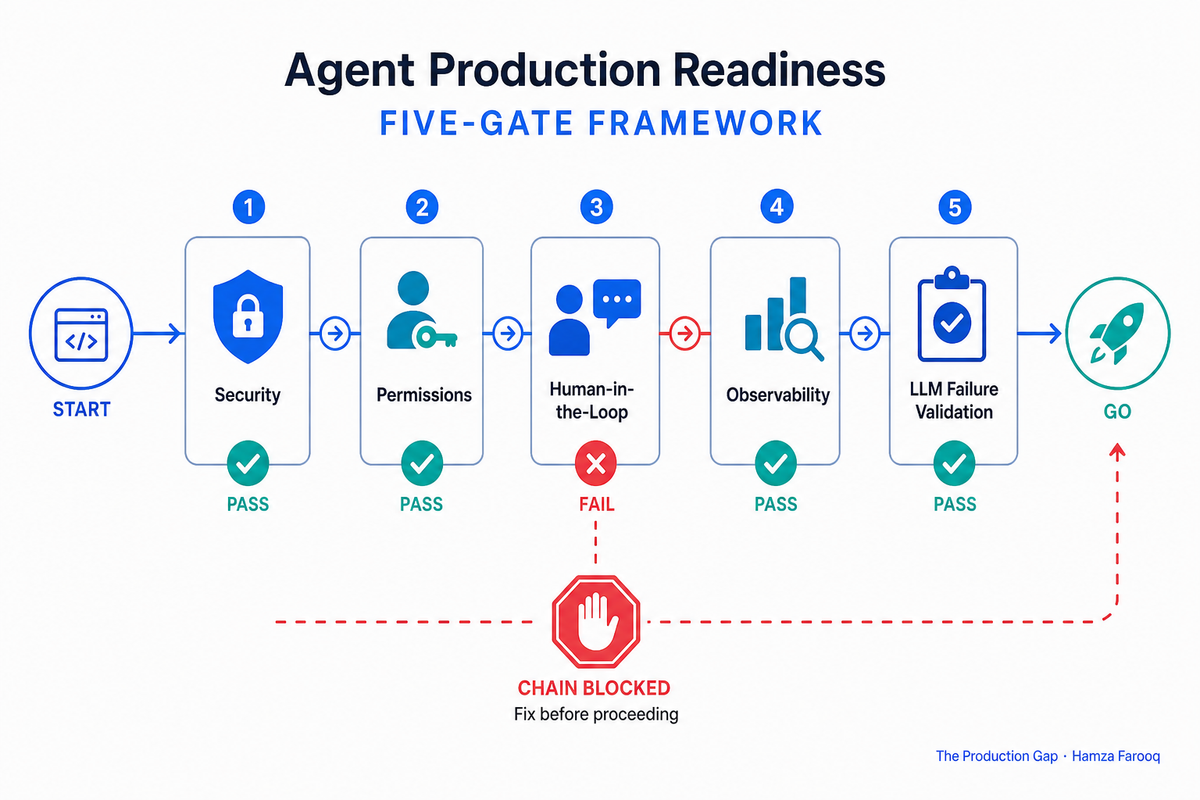
TL;DR: An agent production readiness checklist built around five structured gates is designed to replace subjective demo-based sign-offs with named, binary pass/fail checkpoints. The five gates are Security Scoping, Permission Minimization, Human-in-the-Loop Verification, Observability Confirmation, and LLM Failure Mode Validation. Every gate requires a named owner and written sign-off. A single failure blocks promotion until that gate clears.Key takeawaysDemo success is not production readiness: Pilots validate capability, not the safety controls required for autonomous action on live systems.Permissions must be scoped before deployment: Lock every API, database, and tool to minimum required access.Human-in-the-loop is a gate, not a feature: Approval workflows must be tested and confirmed under load, not just designed.Observability must be built in from day one: Live monitoring, structured logs, and a tested rollback plan must be operational before the first production action.LLM failure modes need dedicated validation: Prompt injection and hallucinated action chains are invisible to standard QA and require their own adversarial test suite.Structured gates replace subjective sign-off: Named, binary checkpoints create organizational accountability that demo consensus cannot.
Why does demo success fail to predict production-authority readiness?
No stakeholder in the demo room typically asks whether override mechanisms work under load or whether credentials are scoped to minimum access. The demo room is a controlled environment. Live production is not.
Think of it like surgical credentialing. A surgeon performing well on a cadaver has demonstrated skill, but hospital credentialing asks different questions: OR protocols, peer oversight, malpractice history. The demo is the cadaver. Without a named framework, abstract authority risks stay abstract until they become incidents.
The framework used in this guide treats demo performance and production readiness as genuinely different categories of evaluation, each answered by a different set of questions.
What are the five gates every AI agent must clear before receiving production authority?
Every AI agent should clear five hard binary checkpoints before it earns any autonomous production authority: Security Scoping, Permission Minimization, Human-in-the-Loop Verification, Observability Confirmation, and LLM Failure Mode Validation.
The gates described below reflect the author synthesis of current deployment practice across security, MLOps, and AI safety disciplines.
Gate 3: Human-in-the-Loop Verification
Gate 3 asks whether approval workflows and override mechanisms have been tested, not merely designed. A workflow that breaks under concurrent requests does not pass this gate. Designing an approval path is not the same as confirming it works in staging under realistic load.
Gate 4: Observability Confirmation
Gate 4 asks whether live monitoring, structured logs, alerting thresholds, and a tested rollback plan are operational before the agent's first production action. Dashboards that exist but have never triggered an alert, and rollback scripts that have never executed, do not pass this gate.
Gate 5: LLM Failure Mode Validation
Gate 5 asks whether the agent has been explicitly tested for prompt injection, hallucinated action chains, and tool misuse. These failure modes do not appear in standard QA because they come from probabilistic model behavior, not deterministic code paths. A separate adversarial test suite is required to surface them.
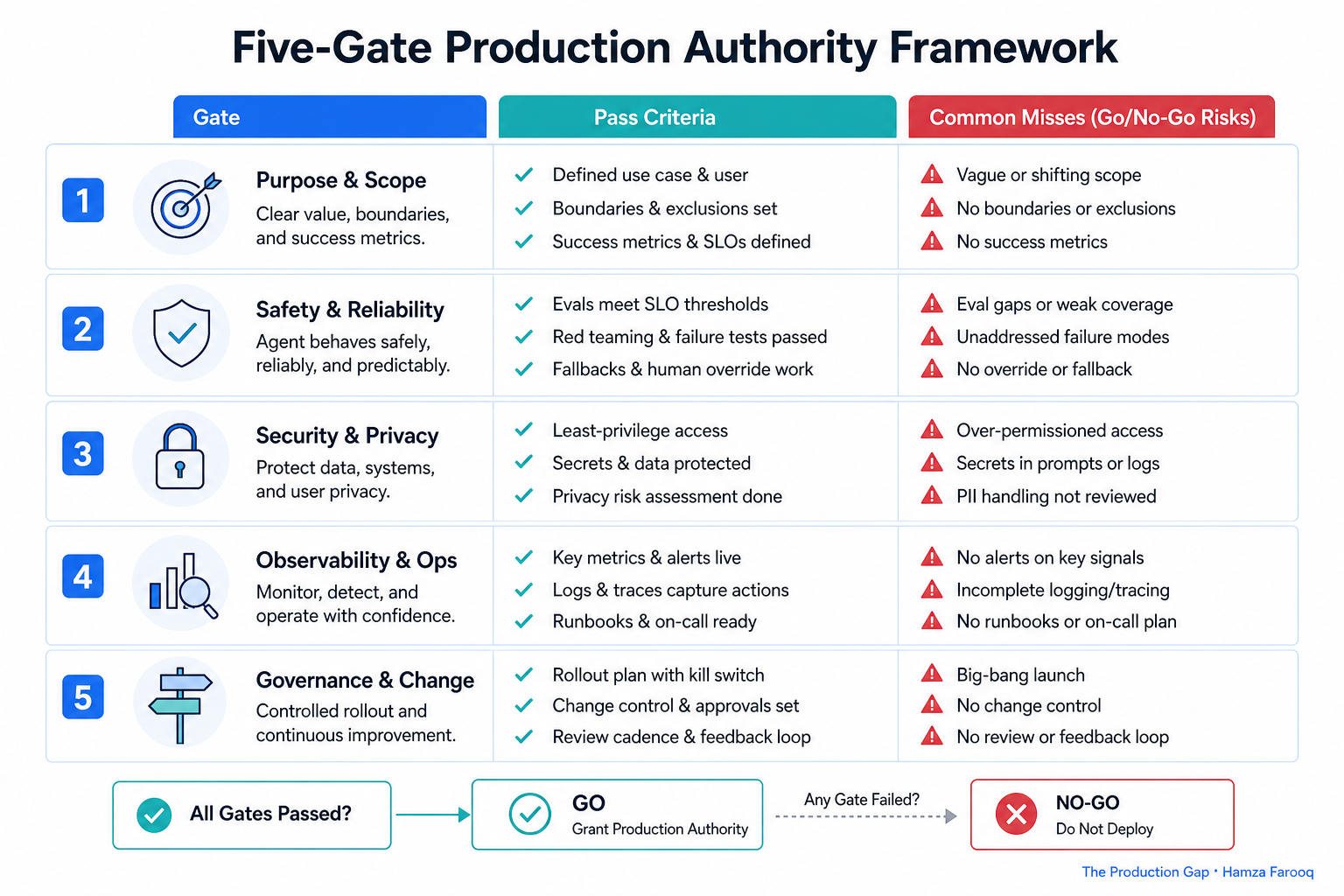
Five-Gate Go/No-Go Matrix (AutoLearning Agents, 2025)
| Gate | What it validates | Common miss | Pass criterion |
|---|---|---|---|
| 1. Security Scoping | Full access surface documented | Shadow credentials, undocumented API calls | Signed security audit complete |
| 2. Permission Minimization | Least-privilege enforcement | Broad read/write inherited from dev | Access scope locked and reviewed |
| 3. Human-in-the-Loop | Override workflows tested under load | Approval path designed but never load-tested | Override confirmed operational in staging |
| 4. Observability | Monitoring and rollback operational | Dashboards exist; rollback script untested | Rollback executed successfully in staging |
| 5. LLM Failure Mode Validation | Prompt injection, hallucination, tool misuse | Standard QA only; no adversarial LLM testing | Adversarial test suite passed |
How should teams apply the Five-Gate Framework to make a defensible go/no-go decision?
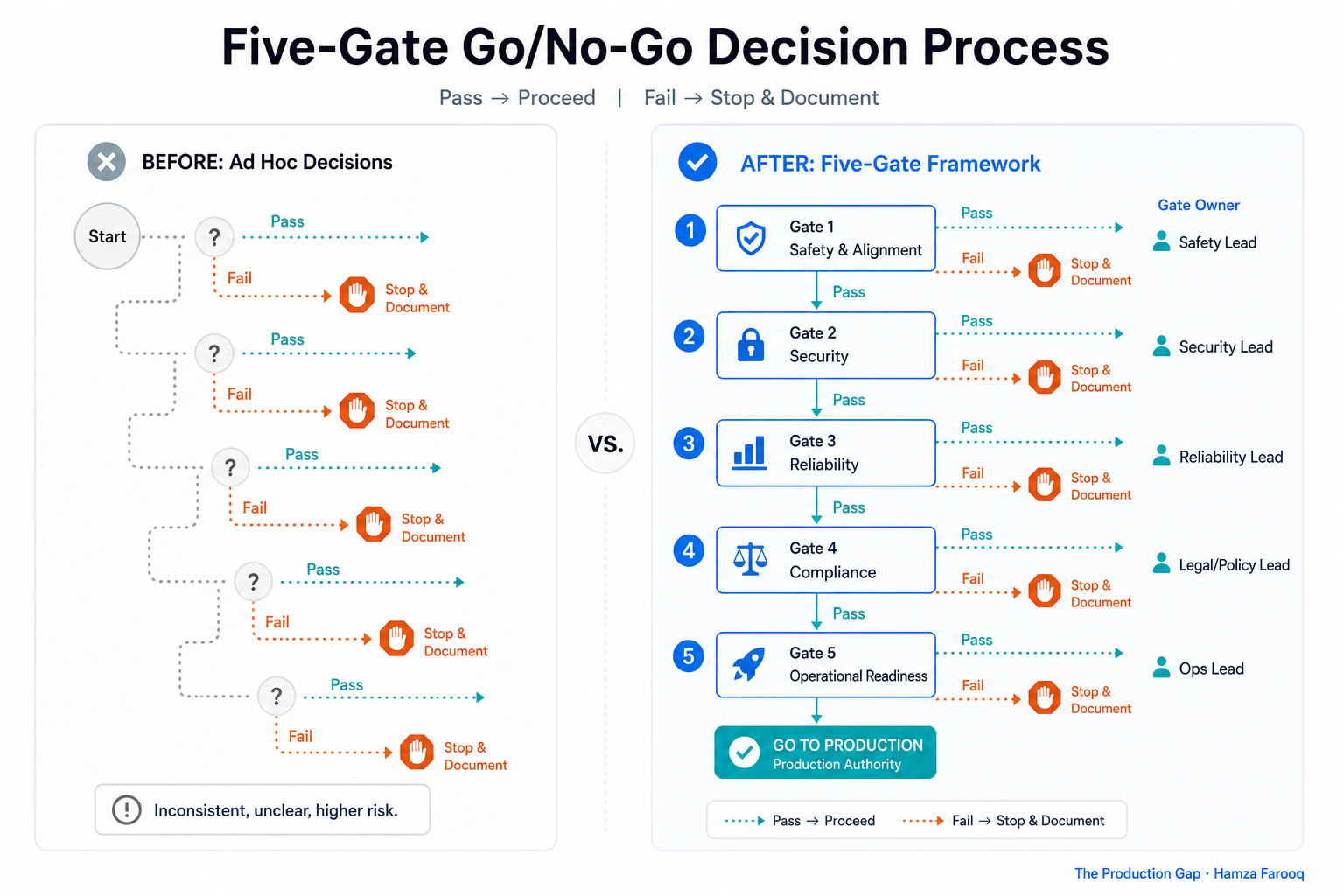
A defensible go/no-go decision requires each gate to be evaluated as an independent hard stop, not a weighted average, and each gate owner must sign off in writing before the promotion decision is recorded.
Assign explicit owners before the review begins. As a practical rule of thumb used in this framework: Security Scoping goes to the security lead, Permission Minimization and Observability to the MLOps lead, Human-in-the-Loop jointly to the product manager and engineering lead, and LLM Failure Mode Validation to the ML engineer. Without named owners, gates tend to collapse into committee non-decisions where no single person accepts accountability.
Each owner signs one line: "Gate [N] passes / fails. I accept accountability for this determination." This converts a technical checklist into an organizational accountability instrument, so pilot sponsors can no longer rely on demo consensus as cover.
When a gate fails, stop. Document the specific failure, assign a named remediation owner, set a re-review date with defined pass criteria, and promote only when all five gates clear in the same review cycle. A late-stage gate failure is the system working as intended, not a process breakdown.
Frequently asked questions
What is the difference between an AI agent passing a demo and being production-ready? A demo validates task performance in a controlled environment, while production readiness confirms that safety controls, permissions, oversight mechanisms, and failure-mode defenses are operational in a live system.
What are the five gates an AI agent must clear before receiving production authority? Security Scoping, Permission Minimization, Human-in-the-Loop Verification, Observability Confirmation, and LLM Failure Mode Validation. Each is a hard binary stop requiring a named owner and written sign-off before promotion proceeds.
Why can't a marginal pass on one gate be offset by a strong pass on another? Production authority is a risk threshold, not a risk average. A single gate failure means a confirmed, unmitigated risk is active in production. No strength elsewhere changes that exposure.
How do LLM failure modes differ from standard software QA failures, and why do they need their own gate? Standard QA validates deterministic behavior. LLM failure modes such as prompt injection, hallucinated action chains, and tool misuse come from probabilistic model behavior that standard test coverage cannot surface. A separate, adversarial test suite is needed to find them.
Conclusion
The Five-Gate Production Authority Framework is designed to require every stakeholder, including product managers, security leads, ML engineers, and executives, to explicitly own a risk category they might otherwise wave away by pointing at a demo recording.
A demo tells you what your agent can do. The Five-Gate Framework asks whether your organization is prepared for what it might do. Those are not the same question, and treating them as equivalent is where most agentic deployment incidents begin.
Next step: Assign a named owner to each gate today, schedule a structured go/no-go review before your next pilot reaches its promotion milestone, and require written sign-off from every gate owner before any agent touches a production workflow.
Learn from me
Forward Deployed Engineering Bootcamp for Full-Stack Developers, my Maven cohort. Build and ship complete AI products end to end, from React and Node.js frontends to deployed models with caching and observability. Join the next cohort →
Hire us
Traversaal.ai. We're a team of forward deployed engineers solving the toughest AI problems for Fortune 100 companies: document intelligence, agentic data platforms, and real-time web intelligence, deployed in production. Work with our team to deploy your next agentic ecosystem. Talk to Traversaal.ai →
Join us
Want to solve these problems with us? We're always looking for forward deployed engineers who want to ship production AI. jobs@traversaal.ai