Human-in-the-Loop AI Design Patterns: A PM's Framework for Approval Gates, Confidence Thresholds, and Escalation Routing
Human-in-the-loop AI done right: match approval gates, confidence thresholds, and escalation routing to your actual error costs before removing oversight.

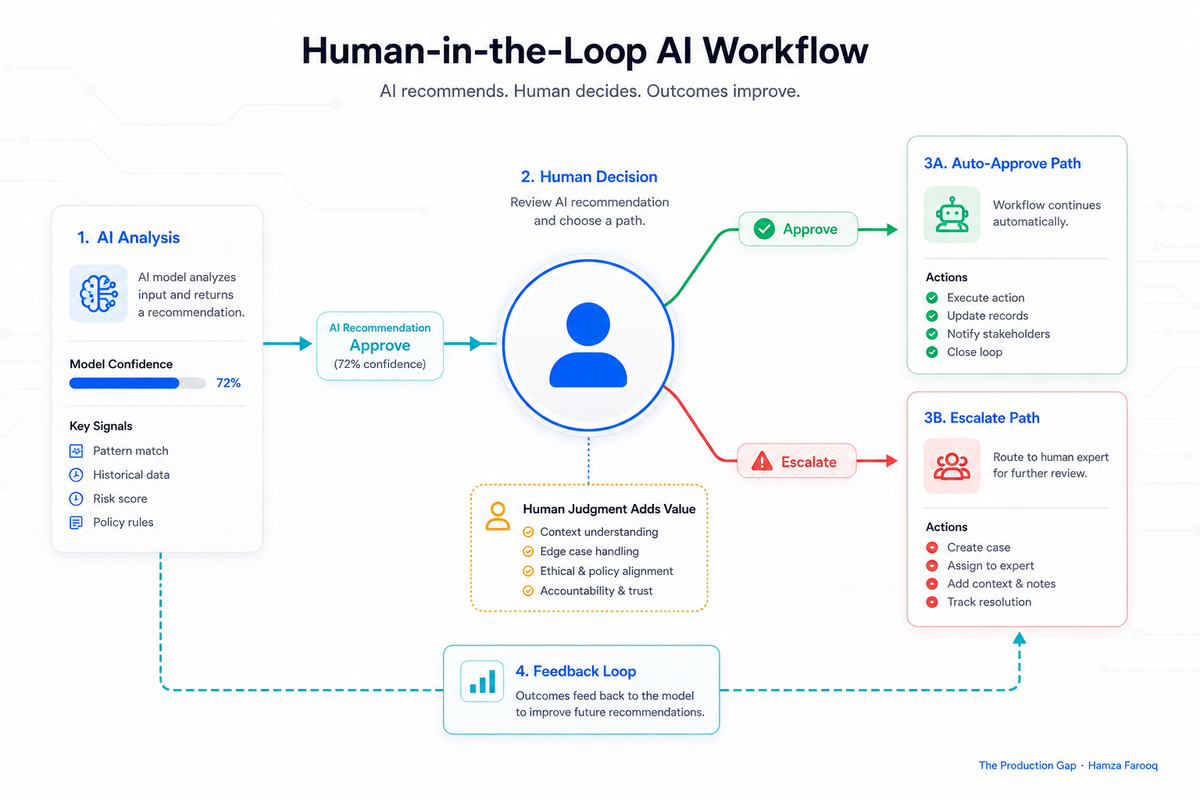
TL;DR: Human-in-the-loop AI design works best when you match the oversight pattern to your error cost and AI confidence level: use approval gates for high-stakes irreversible actions, confidence thresholds for automating routine decisions safely, and escalation routing when failure severity varies by case. Tighten human involvement early in deployment, then loosen it as your model proves reliable in production.
Key Takeaways
- Approval gates aren't one-size-fits-all: checkpoint design depends on reversibility and harm severity.
- Confidence thresholds need a business number, not just a model score: tie model certainty to an error rate stakeholders have actually agreed to accept.
- Escalation routing assigns the right reviewer, not just any reviewer: matching case complexity to expertise prevents bottlenecks and improves label quality.
- Shadow mode lets AI earn autonomy before it gets it: parallel logging reveals failures without real-world consequences.
- Better models create a false sense of safety: rising accuracy shrinks everyday errors while leaving tail-risk failures untouched.
- EU AI Act compliance makes HITL a legal requirement: Article 14 mandates documented, meaningful oversight for high-risk automated decisions.
A fintech company removed its last human review checkpoint after hitting 97% accuracy, and within six weeks had quietly approved $14M in fraudulent loans, all clustered in the 3% the model never learned to catch. The question isn't whether your AI is good enough to go unsupervised. It's whether you've identified which decisions it will never be good enough to make alone.
Agentic AI is approving loan applications, triaging medical intake, and merging code to production. EU AI Act Article 14 is under full enforcement as of 2026. Teams are dismantling human-in-the-loop AI safeguards at precisely the moment they're most dangerous to remove, when accuracy is highest and tail-risk failures are least visible.
How do you choose the right HITL design pattern?
The right pattern depends on two variables: how reversible the action is, and how much harm a wrong decision causes before anyone notices.
The common framing, shadow mode at the bottom, full automation at the top, climb as confidence grows, is wrong. These five patterns are parallel, permanent design choices for different decision classes. A mature AI product runs all five simultaneously, automating 80% of volume while protecting the 20% that causes irreversible harm.
Gmail's Smart Reply is permanently in "suggest, don't send" mode, not because Google can't automate the send, but because Send is irreversible and personal. That's a product decision, not a roadmap item waiting for the model to improve.
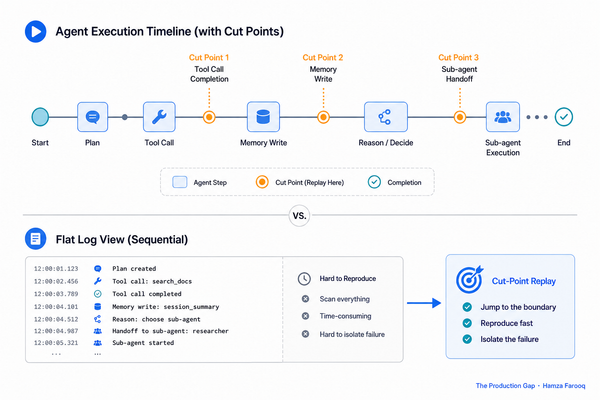
The five patterns: 1. Approval gates, AI proposes, human approves before execution 2. Confidence thresholds, auto-act above a score, route to human below it 3. Escalation routing, tiered review matching complexity to reviewer expertise 4. Review queues, asynchronous oversight after action, before downstream consequence 5. Shadow mode, AI decision logged in parallel, not executed
| Decision Type | Reversibility | Harm if Wrong | Recommended Pattern |
|---|---|---|---|
| Email draft suggestion | Reversible | Low | Confidence threshold + auto-send |
| Loan approval ($10K–$50K) | Irreversible | High | Approval gate + escalation routing |
| Medical triage flag | Irreversible | High | Approval gate; shadow mode during calibration |
| Customer support routing | Reversible | Low | Confidence threshold; review queue for outliers |
| Code deployment to production | Irreversible | High | Approval gate with senior engineer escalation |
| Procurement order under $500 | Reversible | Low | Confidence threshold; periodic audit queue |
Approval gates: when to block, not slow down
Approval gates belong on every decision that is irreversible and consequential, removing them to cut friction is almost always the wrong trade.
The design mistake PMs make is treating gate latency as a product failure. Reduce review time by fixing the reviewer interface, surface reasoning, confidence signal, and comparable past cases so a human can decide in under 90 seconds.
Confidence thresholds: turning model scores into business rules
A confidence threshold only becomes useful when it's anchored to an error rate stakeholders have explicitly agreed to accept.
A model score is not a business decision until you translate it: "Above 0.91 we auto-approve, roughly 4 in 100 will be wrong, and we've agreed that's acceptable for this decision class." Without that conversation, the threshold is just a number someone picked.
Thresholds need scheduled recalibration, score distributions drift, so a threshold set in January may be systematically overconfident by June. Teams should also set separate thresholds for false positives and false negatives when harm is asymmetric, because approving a fraudulent loan and declining a legitimate one are not equivalent errors and the logic should reflect that.
Escalation routing: matching case complexity to reviewer expertise
Escalation routing fails when it routes to a queue instead of a person, a queue has no expertise, no accountability, and no ability to prioritize.
Smart routing treats reviewers as a typed resource pool. A borderline SMB loan application should go to an underwriter with SMB experience, not the next available agent. The benefit extends beyond accuracy: reviewers who consistently handle matched cases develop sharper judgment, and their decisions become higher-quality training signal. Mis-routed escalations generate noisy labels that degrade retraining, routing is data quality infrastructure.
Review queues and shadow mode: the underused pair
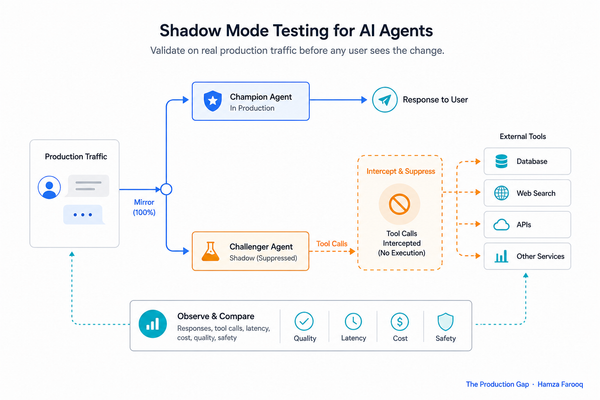
Review queues catch errors before they propagate; shadow mode measures how often the AI would have caused an error in the first place.
A review queue sits between action and consequence, the AI acts, but the downstream effect is delayed until a human confirms. This works where natural latency exists: a 24-hour hold on large first-time transfers, a pre-publication content queue, a staged deployment.
Shadow mode gets misused as a pre-launch ritual. The standard pattern, run it 30 days, confirm alignment, launch, retire the shadow run, discards the tool's highest value, which is post-launch continuous sampling against live decisions to detect drift before damage appears. That gap is where tail-risk failures incubate.
The most sophisticated setups use shadow mode to generate a continuous alignment score. When it drops more than 5 percentage points from baseline, it triggers automatic threshold tightening before any human notices a pattern in outcomes.
When to tighten or loosen human involvement over time
Loosen human oversight only when you have evidence the model is safe in that specific decision slice, not because it's performing well overall.
A model improving from 91% to 97% accuracy represents a 66% reduction in everyday errors, but the remaining 3% is often more concentrated in harder edge cases than the original 9% was. Aggregate accuracy is not a safe proxy for tail-risk reduction. Before pulling back a gate or raising a threshold, segment performance by decision subtype, recency of training data, and distribution shift since last calibration, then make the case for that slice specifically.
Learn from me
Agentic AI for Product Managers, my Maven cohort. Learn how to design, evaluate, and ship reliable AI systems: the technical fluency PMs need to lead agentic products, no engineering background required. Join the next cohort →
Hire us
Traversaal.ai. We're a team of forward deployed engineers solving the toughest AI problems for Fortune 100 companies: document intelligence, agentic data platforms, and real-time web intelligence, deployed in production. Work with our team to deploy your next agentic ecosystem. Talk to Traversaal.ai →
Join us
Want to solve these problems with us? We're always looking for forward deployed engineers who want to ship production AI. jobs@traversaal.ai