Shadow Mode Testing for AI Agents: Validate on Real Production Traffic Before Any User Sees the Change
Shadow mode testing lets you run AI agents on live production traffic—catching real regressions before users ever see a change. Here's how it works.

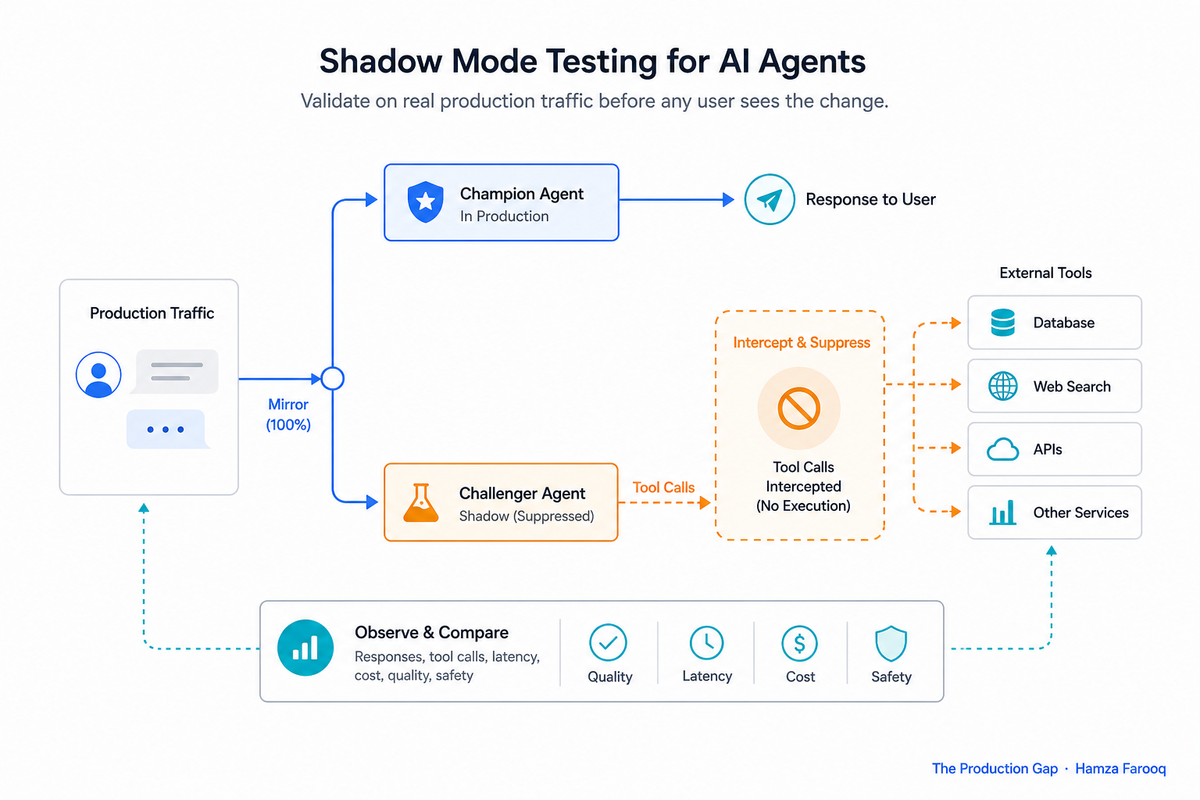
TL;DR: Shadow mode testing lets you validate an AI agent against live production traffic before any user sees its output, by running the new version in parallel with your current system while suppressing all side effects. As of Q2 2025, it sits before canary deployment in your release pipeline, catching regressions on real behavioral edge cases that synthetic tests miss. The doubled infrastructure cost is justified when agent failures carry high user-impact risk or rollback costs exceed the price of parallel compute.
Key Takeaways
- Shadow mode comes before canary: the challenger runs on live traffic without any user ever seeing its output.
- Traffic mirroring duplicates every request: real production inputs, not synthetic data, reach the challenger simultaneously with the champion.
- Side-effect suppression is non-negotiable: every tool call must be intercepted so no external system is triggered twice.
- Parallel execution roughly doubles compute cost per request: justified only when one irreversible failure costs more than the entire shadow run.
- Output comparison requires divergence scoring: structured evaluation detects meaningful regression beyond surface-level lexical difference.
- Clear exit criteria determine promotion: graduate to canary only when the challenger meets predefined thresholds across output quality, tool call accuracy, latency, and error rate.
- Passing shadow mode does not guarantee safe canary behavior: output fidelity and action fidelity are distinct and both must be validated.
How does shadow mode testing work for AI agents?
Shadow mode testing duplicates every incoming production request and routes a copy to a challenger agent that processes it fully, but whose outputs and tool calls are suppressed before reaching any user or external system. As documented by Dev.to contributor Mukundakatta, real traffic surfaces edge cases that synthetic test sets consistently miss, because a curated eval set cannot reproduce the entropy of a live production workload.
The request router clones each request in real time. The champion handles the live request normally. The challenger receives the duplicate asynchronously, runs its full reasoning chain, and writes its response to a log rather than returning it to the caller. That log is the entire evaluation artifact.
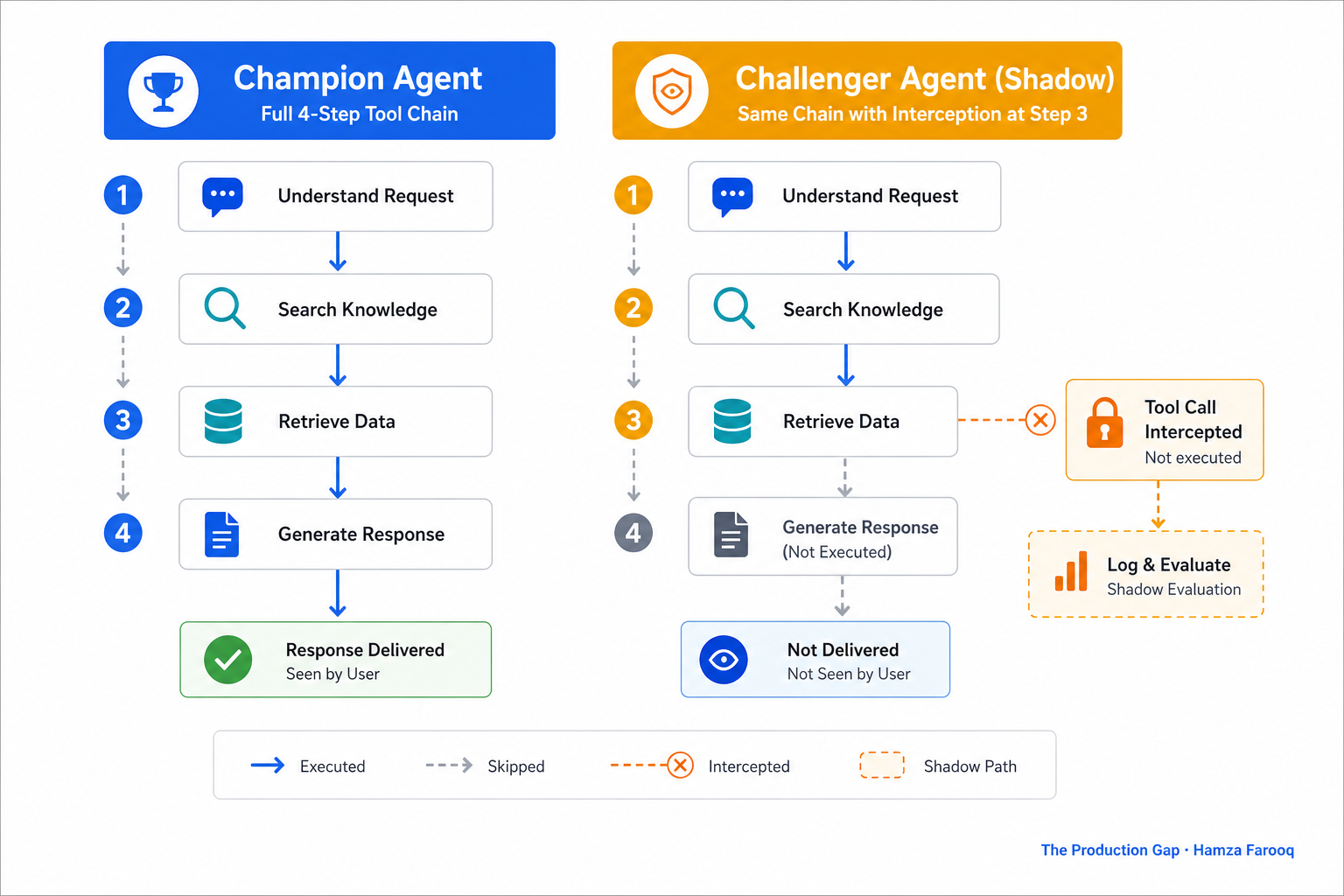
Multi-step workflows add meaningful complexity. One user request may trigger a five-step reasoning chain: retrieve a record, evaluate a policy, draft a response, queue a follow-up, log the interaction. The shadow agent must run the full chain. Validating only the first inference hop produces dangerously incomplete signal.
Shadow mode's core value: real traffic breaks things synthetic tests never surface, but only if the full agent chain runs.
Verified context: Shadow deployments for AI agents enable testing in production without breaking anything by running a parallel version that processes real traffic but whose outputs and actions are suppressed from end users.
How do you suppress tool calls and side effects without breaking the evaluation signal?
Side-effect suppression requires intercepting every outbound tool call at the executor layer and replacing real execution with a logged no-op that returns a plausible mock response, so the agent's reasoning chain continues unbroken while no external system is touched.
The tool executor is swapped for a shadow executor that records the intended call, including tool name, arguments, and sequence position, and returns a synthetic response shaped like a real one. The agent continues reasoning as if the call succeeded. As documented in the dedicated agent-shadow-mode library, this interception pattern was built specifically after a failure where shadow mode was believed to be active but was not, resulting in 400 emails firing before anyone caught it. The library was built to prevent that outcome from recurring.
If mock responses are too generic, downstream reasoning diverges from what the agent would produce with real data, which poisons the evaluation signal. Response schemas must mirror real output shapes without triggering real actions.
There is also a distinction worth keeping clear. As framed by Agentic Forge Hub, shadow mode functions as a pre-authorization validation layer: you are validating reasoning before granting real permissions. An agent can produce output that appears identical in shadow mode and still behave catastrophically once it holds live tool permissions.
Shadow mode validates reasoning. Canary validates consequences. Conflating them is the most dangerous mistake in agent deployment.
Suppress execution. Never suppress logging. The log is the entire evaluation artifact.
What is the difference between shadow mode and canary deployment?
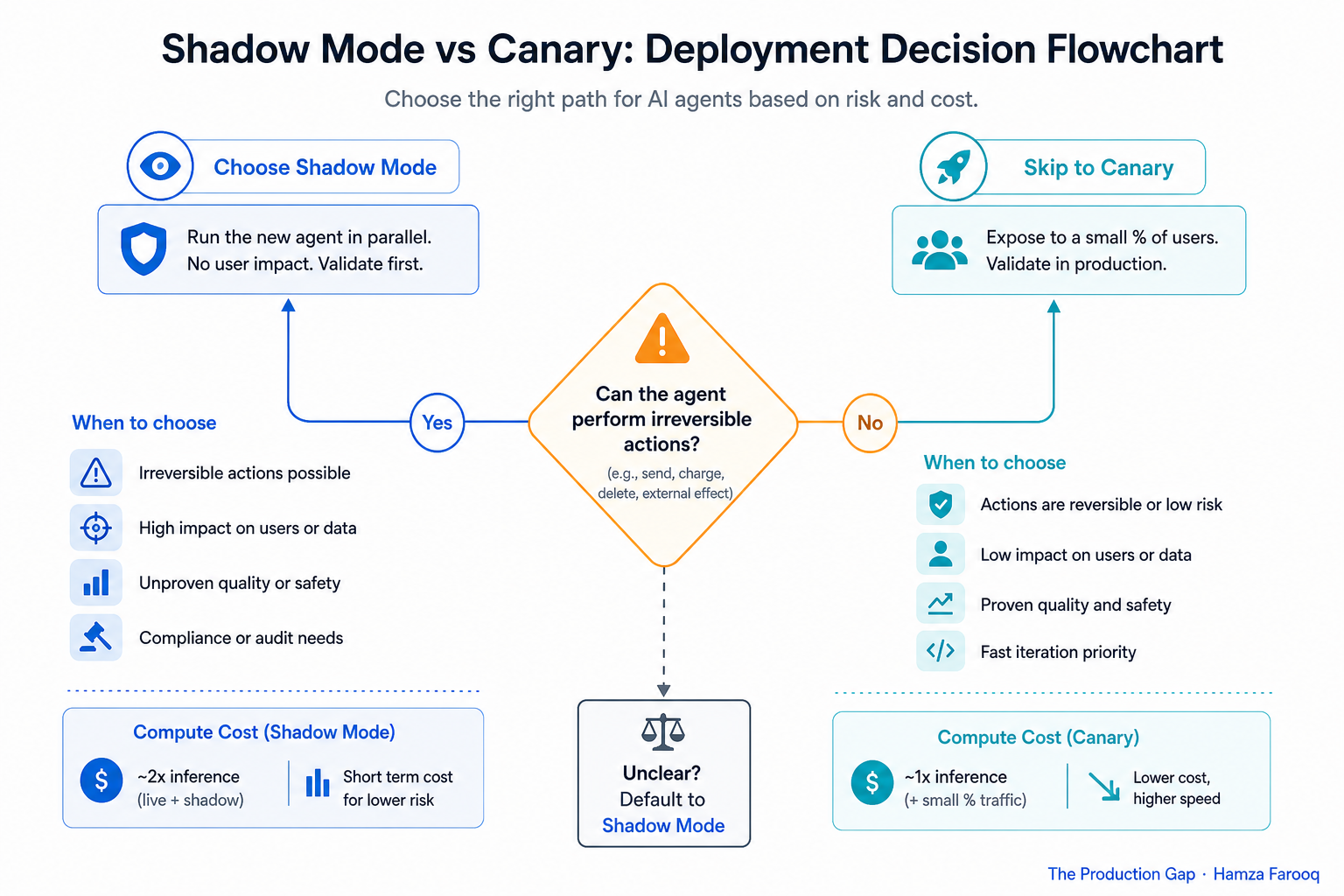
Shadow mode and canary deployment are formally distinct release stages, not interchangeable options: shadow mode exposes zero users to the challenger and suppresses all tool execution, while canary exposes a controlled user slice to the challenger running with live permissions.
The sequencing is fixed: shadow mode, then canary, then full rollout. Shadow mode validates reasoning quality with zero user exposure. Canary validates real-world consequences with a controlled slice. As covered in the LLMOps testing documentation at ai-tldr.dev, these are separate validation patterns that address different risk surfaces.
| Dimension | Shadow mode | Canary deployment |
|---|---|---|
| User exposure | Zero | Small slice |
| Real tool execution | Suppressed | Live |
| What it validates | Output and reasoning fidelity | Action consequences |
| Compute overhead | Roughly 2x per request | Minimal additional |
| Failure blast radius | None | Limited |
| Precondition | Staging and synthetic pass | Shadow mode pass |
| When to use | Before any user sees the change | After shadow confidence is established |
How much does shadow mode testing cost?
Shadow mode testing costs roughly double the per-request compute during the validation window, an overhead that is warranted when a single irreversible failure costs more than the entire shadow run.
When an agent performs no irreversible actions and a failed canary can be instantly reverted with zero durable harm, the doubled cost is harder to justify. Pure text-generation endpoints with no tool access often go straight to canary for this reason. The cost calculation is straightforward: estimate the worst-case blast radius of a bad deployment, then compare it against the price of running parallel inference for a representative traffic window.
What metrics determine when to exit shadow mode and promote to canary?
Shadow mode ends when the challenger meets predefined thresholds on output divergence, tool call accuracy, latency, and error rate, measured over statistically sufficient traffic volume rather than a fixed calendar window.
Because shadow mode logs every intended tool call without executing it, teams can audit whether the challenger called the right tool, with correct arguments, in the correct sequence. This is the closest proxy for action fidelity available inside shadow mode, and it is the metric teams most often skip.
The GATE Framework for Shadow Mode Exit Criteria
- Grade: Output quality at or above the champion baseline, measured against a team-defined semantic parity threshold
- Action intent: Tool call argument accuracy at or above a team-defined threshold
- Throughput: Latency within acceptable bounds under peak load conditions
- Error rate: Shadow failure rate at or below the champion's observed rate
Define coverage by p95 and p99 traffic patterns, not calendar days. Seven days of low-traffic Sundays does not equal seven days of production coverage. Promotion is a data-driven decision against pre-registered thresholds, not a judgment call made at the end of an arbitrary time window.
Frequently Asked Questions
What is shadow mode testing for AI agents? Shadow mode testing runs a new agent version on copied production traffic, fully suppressing its outputs and tool calls so no user sees the result and no external system is touched.
How do you compare agent outputs when responses are non-deterministic? Raw string matching is insufficient for LLM output. In practice, semantic similarity scoring or LLM-as-judge evaluation catches divergence that reflects meaningfully different reasoning rather than surface-level variation in phrasing.
When does shadow mode's compute overhead become unjustifiable? When the agent performs no irreversible actions and a failed canary can be instantly reverted with zero durable harm. Pure text-generation endpoints with no tool access often proceed directly to canary.
Can shadow mode replace canary deployment? No. Shadow mode validates reasoning with suppressed tool calls. Canary validates real consequences with live permissions on a small user slice. An agent that passes shadow mode can still behave unexpectedly once it holds real tool permissions. Both stages are required, in sequence.
Conclusion
AI agents execute irreversible real-world actions at scale. Shadow mode testing is the formal pre-canary gate that validates reasoning quality before those consequences can materialize.
The most dangerous outcome is not a detected failure. It is a false pass. An agent matching the champion on semantic similarity can still behave in unintended ways the moment it holds real tool permissions. The distinction matters: output fidelity, what the agent decided, is not the same as action fidelity, what it would have done with live access. Shadow mode measures the first. Canary measures the second. Both are required, in sequence, and neither replaces the other.
References
Learn from me
Forward Deployed Engineering Bootcamp for Full-Stack Developers, my Maven cohort. Build and ship complete AI products end to end, from React and Node.js frontends to deployed models with caching and observability. Join the next cohort →
Hire us
Traversaal.ai. We're a team of forward deployed engineers solving the toughest AI problems for Fortune 100 companies: document intelligence, agentic data platforms, and real-time web intelligence, deployed in production. Work with our team to deploy your next agentic ecosystem. Talk to Traversaal.ai →
Join us
Want to solve these problems with us? We're always looking for forward deployed engineers who want to ship production AI. jobs@traversaal.ai