When to Use AI Agents (And When Not To): A Decision Framework for Product Teams
When to use AI agents isn't always obvious. Use this decision framework to pick the right AI architecture — and avoid costly over-engineering.

TL;DR: Use AI agents when your task requires dynamic decision-making, multi-step tool use, or unpredictable branching that simpler systems can't handle. Knowing when to use AI agents means first ruling out deterministic automation, single LLM calls, and structured workflows, agents are the right choice only when the problem genuinely demands autonomy, not just because they feel more sophisticated.
Key Takeaways
- Agents are one tier, not the default: Four architecture levels exist; most problems are best solved at a simpler, cheaper tier.
- Low barrier to build does not mean low risk to ship: Easy tooling has pushed teams to over-engineer features that fail quietly in production.
- The decision hinges on two questions: Fixed path plus low error tolerance means an agent will create more problems than it solves.
- Agents carry a real cost tax: Runaway token spend, unpredictable latency, and untraceable failures are recurring patterns, not edge cases.
- Human oversight requirements should drive architecture: The more a mistake matters, the more your design needs a checkpoint.
- Ship the simplest thing that works: A single well-prompted call often outperforms a multi-step agent on speed, cost, and reliability.
Introduction
Building an AI agent in 2026 is almost trivially easy. LangGraph, AutoGen, OpenAI's agent runtime, all production-ready, all cheaper than a year ago. That accessibility is the problem. Teams are defaulting to agents the way a previous generation defaulted to microservices: because the tooling exists, not because the problem demands it.
This blog gives you a two-axis decision test and a four-tier architecture map. Run your problem through both before writing a single agent prompt.
What actually separates an AI agent from a simpler AI feature?
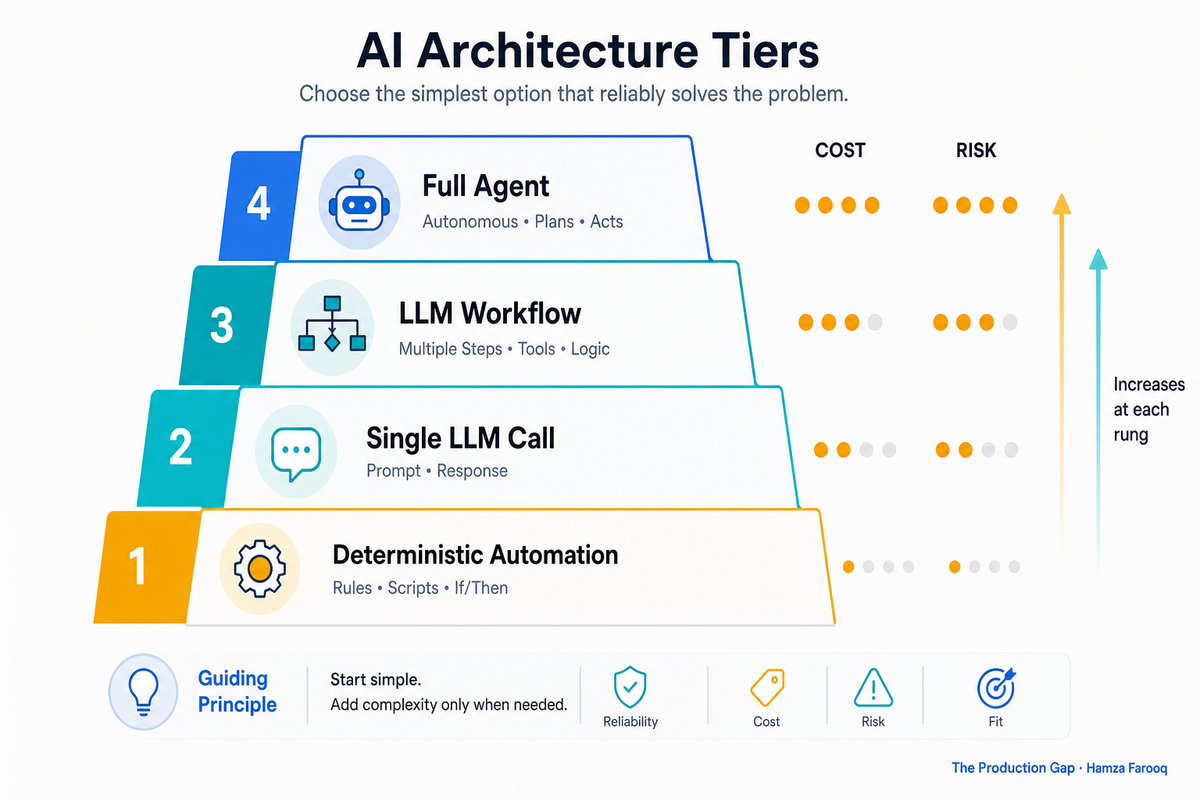
An AI agent autonomously decides its own next action, selects tools, and loops until it reaches a goal, rather than executing a fixed, pre-defined sequence.
Tier 1, Deterministic automation: Rule-based logic, no model. Zero variance, zero LLM cost. Example: auto-tagging a ticket by keyword.
Tier 2, Single LLM call: One prompt in, one structured output out. No memory, no loops. Fast, cheap, auditable.
Tier 3, LLM workflow: Multiple LLM calls in a fixed developer-defined sequence. The model fills content; the developer controls the path.
Tier 4 (Full agent: The model controls the path) selecting tools, looping, and terminating on its own judgment. Example: researching a competitor and writing a briefing.
The critical line is Tier 3 versus Tier 4: who controls the execution path, the developer or the model. That single decision carries all downstream risk.
| Tier | Architecture | Who Controls the Path? | Typical Latency | Relative Cost | Debuggability |
|---|---|---|---|---|---|
| 1 | Deterministic automation | Developer (hardcoded) | Milliseconds | $ | Very high |
| 2 | Single LLM call | Developer (one prompt) | Seconds | $$ | High |
| 3 | LLM workflow | Developer (fixed sequence) | Seconds–minutes | $$$ | Medium |
| 4 | Full agent | Model (dynamic) | Minutes+ | $$$$ | Low |
Most features you're debating are Tier 2 or 3. Tier 4 is a choice you justify, not the natural endpoint of "adding AI."
What two questions determine whether your problem actually needs an agent?
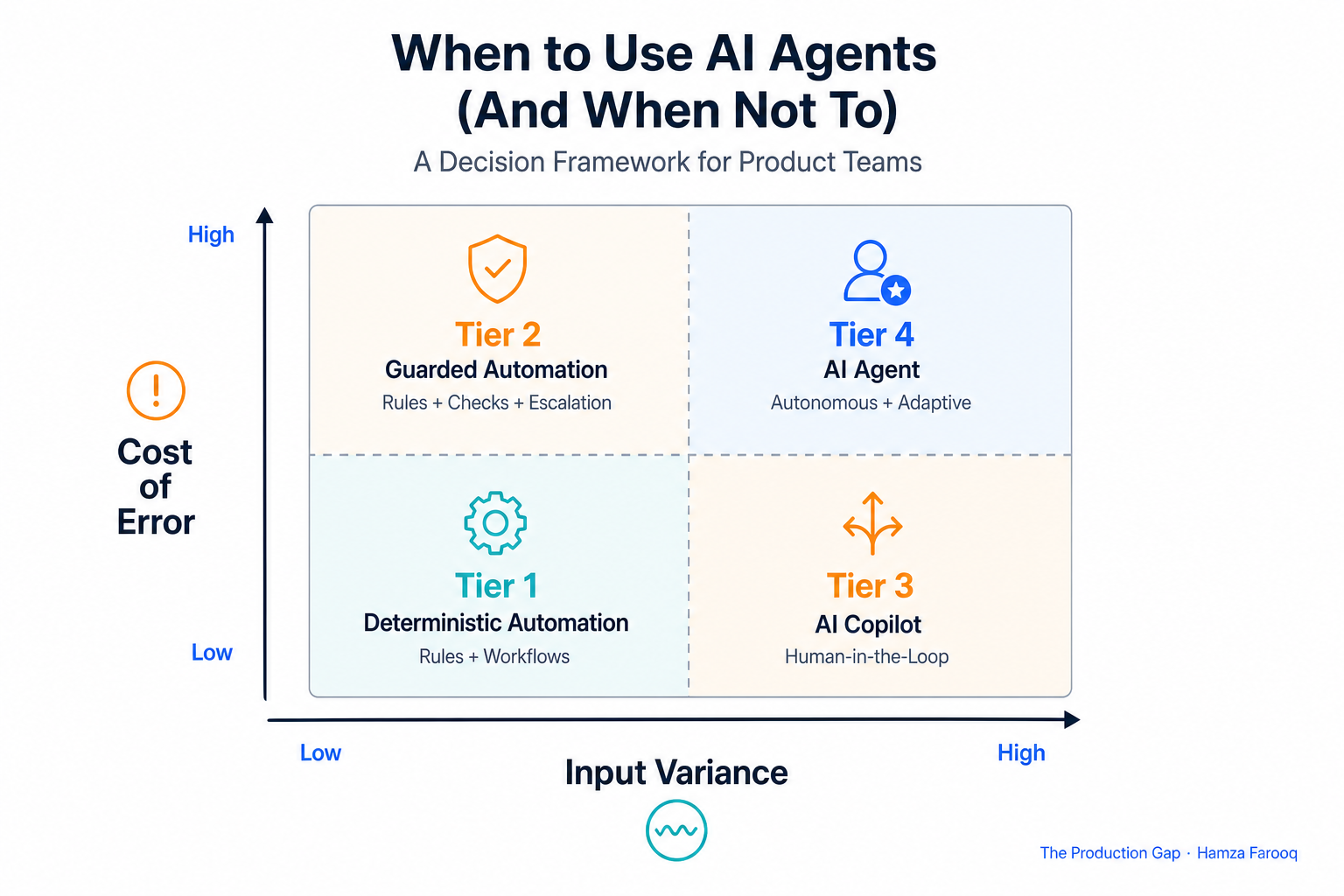
Before building an agent, ask: does the task's path change unpredictably based on inputs? And what happens when it makes a mistake?
Axis 1, Input variance: Does the task always follow the same steps, or does the path depend on what the input contains? Low variance means you can hardcode the sequence; high variance means the model needs to decide dynamically.
Axis 2, Cost of error: An incorrect draft email costs seconds to fix. An incorrectly triggered refund or misfiled legal document costs hours, money, or customer trust.
The four quadrants map directly to architecture:
- Low variance + Low error cost → Tier 1 or 2.
- Low variance + High error cost → Tier 3 at most. Hardcode the path, add human checkpoints.
- High variance + Low error cost → Tier 3 or 4. Errors are recoverable.
- High variance + High error cost → Agent with mandatory human-in-the-loop, or no agent at all.
That last quadrant is where most enterprise rollbacks originated.
What are the real production costs teams don't account for before building agents?
The true cost of an agent in production isn't the API bill, it's debugging time, latency unpredictability, and silent failures that never surface in demos.
Three recurring failure modes dominate real rollouts:
Silent mid-chain failures. An agent step returns malformed output; downstream steps proceed with degraded data. The user gets a result, the wrong one. No exception is raised.
Runaway token loops. An agent hits an ambiguous state and re-plans repeatedly. Without hard loop limits set before launch, a single bad input can burn thousands of tokens in seconds.
Unpredictable latency. A Tier 2 call takes 1–3 seconds. An agent that re-plans twice and calls three external tools can take 30–90 seconds. It technically worked, it just wasn't usable.
The oversight trap compounds this in regulated industries. Build the cost model before the sprint. Token cost, P95 latency, debugging hours per failure, and oversight time are all real line items.
When does a problem actually justify building a full AI agent?
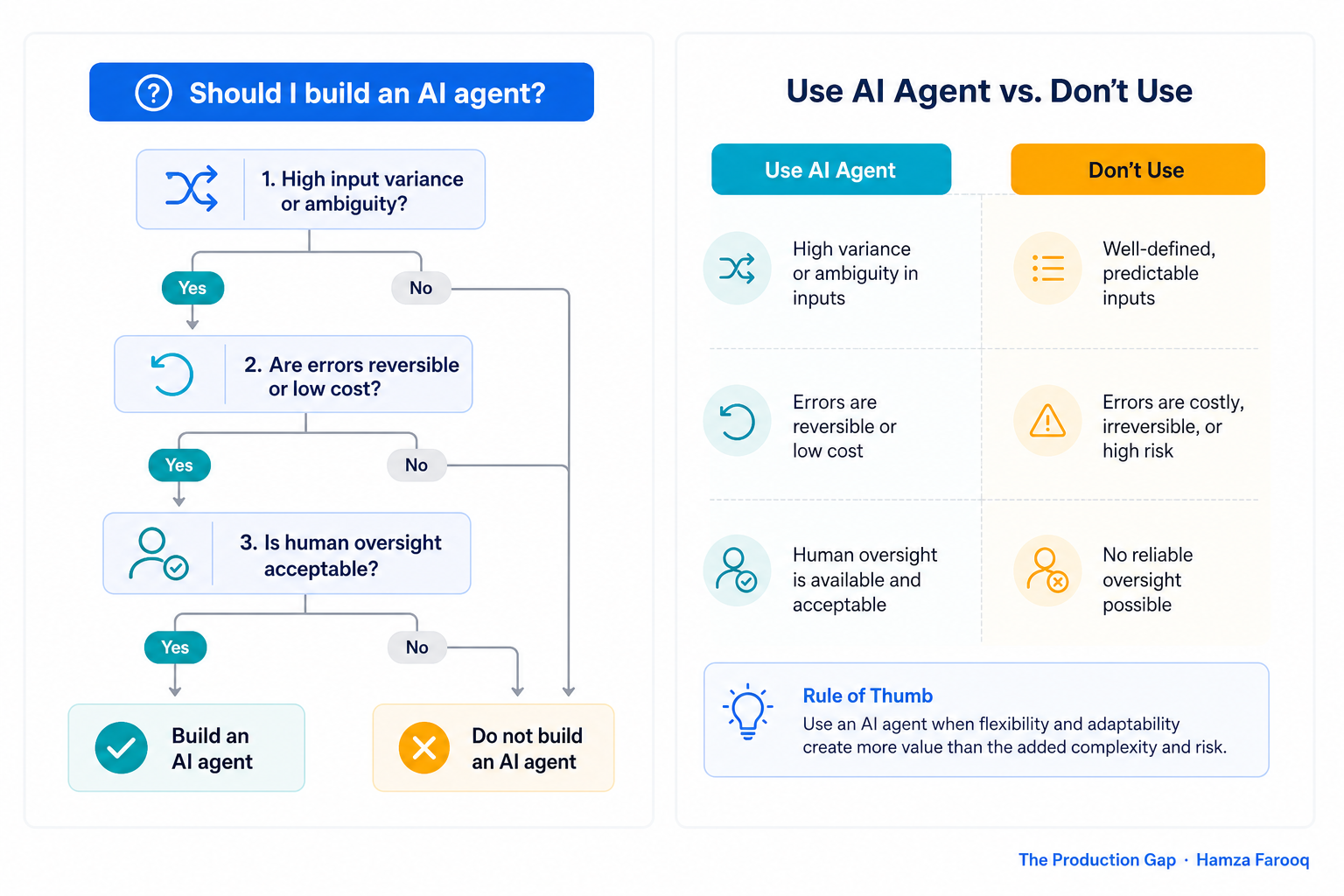
A problem justifies a full agent when the task path is genuinely unpredictable, delay costs exceed occasional error costs, and output can be reviewed before it causes harm.
Open-ended research and synthesis is the clearest fit, the agent explores an uncertain information space and produces a draft for human review before errors compound.
Long-horizon dev and ops automation works when the environment provides clear success/failure feedback. GitHub Copilot Workspace is a useful example: the agent operates across files and test runners, but pass/fail signals constrain its behavior and humans review diffs before merge.
Adaptive customer-facing workflows justify agents when two users asking the "same" question need fundamentally different response paths, not just different answers.
Even in these cases, three non-negotiables apply before launch: (a) explicit tool permission scopes (the agent calls only whitelisted tools; (b) hard loop and token limits) set before the first incident; (c) human checkpoints at every irreversible action.
The reversibility test: before any agent takes an action, ask whether it can be undone in under 60 seconds without data loss. If no, require human confirmation. This single rule prevents enterprise agent failures.
Frequently Asked Questions
What is the difference between an AI workflow and an AI agent? In a workflow, the developer defines the sequence and the model fills in content. In an agent, the model decides its own sequence dynamically, that distinction is the origin of all risk, cost, and debuggability differences.
How do I know if my use case actually needs an AI agent? Apply the two-axis test: high input variance plus recoverable errors may justify an agent. When unsure, default down and upgrade only when you hit a documented wall.
What are the most common AI agent failure modes in production? Silent mid-chain errors, runaway token loops, and P95 latency spikes, all three are harder to detect than failures in simpler architectures, so monitoring must be designed before launch.
How do I explain to stakeholders why we don't need an agent for this feature? Use the tier table and two-axis framework as artifacts and frame it as deliberate architecture: "We're using the tier that fits this problem", not a statement about what the team can or can't build.
Conclusion
The agent tooling available in 2026 is capable. The judgment required to use it well is harder to come by. A five-step autonomous pipeline at 95% per-step accuracy fails 23% of the time, at 10,000 daily runs, that's 2,300 broken outcomes your team will eventually have to explain.
The best AI architecture is the simplest one that solves the problem, and for most features, that isn't an agent.
Before your next sprint, run the two-axis test and print the four-tier table. If you can't defend in one sentence why Tier 3 isn't enough, don't build Tier 4.
Learn from me
Agentic AI for Product Managers, my Maven cohort. Learn how to design, evaluate, and ship reliable AI systems: the technical fluency PMs need to lead agentic products, no engineering background required. Join the next cohort →
Hire us
Traversaal.ai. We're a team of forward deployed engineers solving the toughest AI problems for Fortune 100 companies: document intelligence, agentic data platforms, and real-time web intelligence, deployed in production. Work with our team to deploy your next agentic ecosystem. Talk to Traversaal.ai →
Join us
Want to solve these problems with us? We're always looking for forward deployed engineers who want to ship production AI. jobs@traversaal.ai