Why Enterprise AI Pilots Fail to Reach Production, and What the Teams That Ship Do Differently
AI pilot production gap explained: why 90% of enterprise AI pilots never ship—and the strategies high-performing teams use to actually reach production.

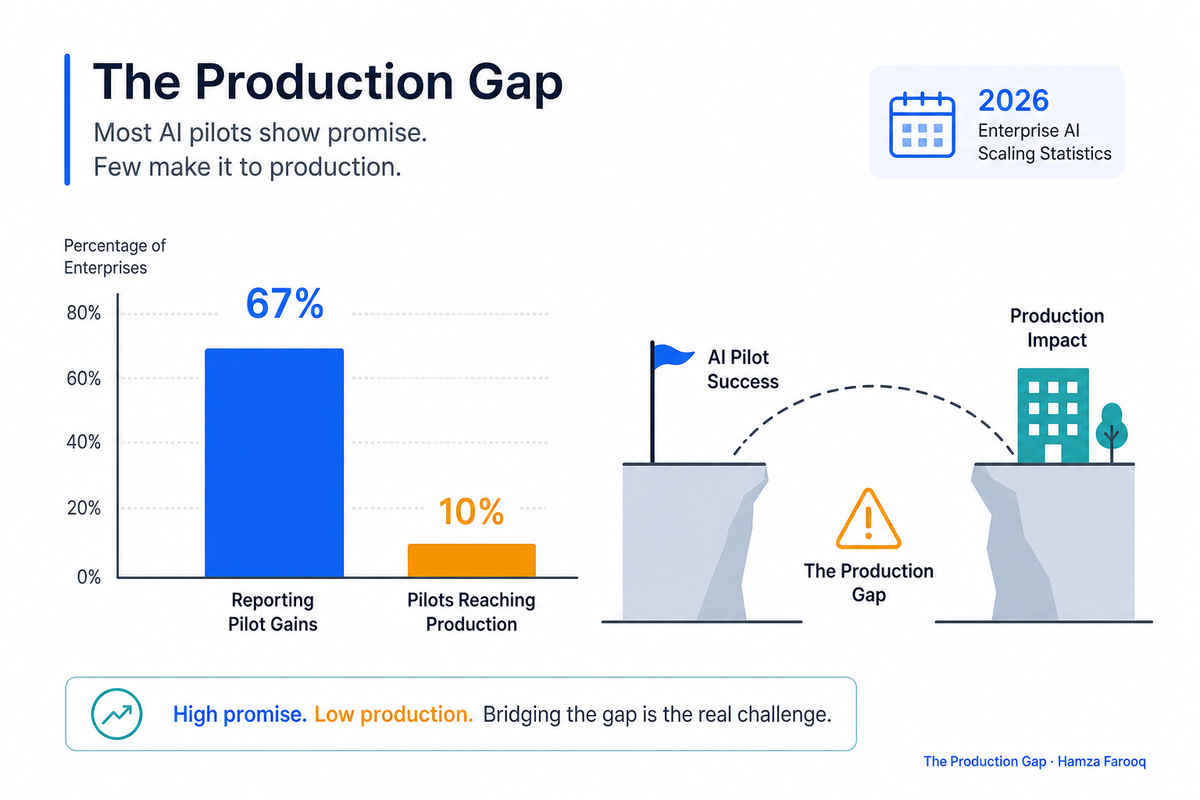
TL;DR: The AI pilot production gap exists because most enterprise teams treat pilots as proof-of-concept experiments while ignoring the operational realities that kill deployment: data infrastructure debt, absent evaluation frameworks, procurement friction, integration complexity, and unclear ownership. Teams that successfully ship close this gap by building for production constraints from day one, not retrofitting them after a pilot succeeds.
Key Takeaways
- The 10% production rate is structural: Pilots fail not because the technology doesn't work, but because the organization was never built to receive it.
- Data pipelines break the handoff: Pilots run on clean, curated data that doesn't exist in production.
- Missing evals kill production confidence: Without measurable criteria, no one can sign off on shipping.
- Procurement friction outlasts momentum: Approvals take months; by then, the team has moved on.
- Nobody owns it after the demo: Engineering inherits a system it didn't design and wasn't resourced to maintain.
- High-shipping teams design for production first: Deployment constraints and ownership are pilot inputs, not post-demo problems.
Introduction
Enterprise AI investment is at an all-time high, and the production rate is embarrassingly low. According to DigitalOcean's February 2026 report, 67% of organizations surveyed reported meaningful gains from AI pilots, yet only 10% scale to full autonomous production. Boards now demand ROI accountability after two years of pilot spending.
Most post-mortems blame data quality or model accuracy. Both matter. But the more honest diagnosis points to organizational failures (not technical ones) and those are harder to write a ticket for.
Why do AI pilots succeed in demos but collapse before production?
Enterprise AI pilots fail to reach production because they're designed to impress stakeholders, not to survive real infrastructure.
Pilots are optimized for the demo: curated datasets, controlled inputs, sandbox infrastructure. Production data is messy, schema-inconsistent, and arrives through legacy pipelines never designed for ML inference, pilots sidestep this with one-time manual exports, so the demo looks clean while the underlying infrastructure would buckle under real load. Data pipeline debt is the most common culprit, and it's almost never surfaced until after demo expectations are locked in.
LLM evaluation frameworks are almost universally absent at the point of attempted production handoff. Without evals, no one can answer the question that matters before shipping: is this system actually working well enough? A pilot without evals has passed every test that was run, but the test set was never representative of production conditions.
What organizational failures cause the AI pilot-to-production handoff to break?
The most common reason a technically successful AI pilot never ships is that no one was ever responsible for owning it after the demo.
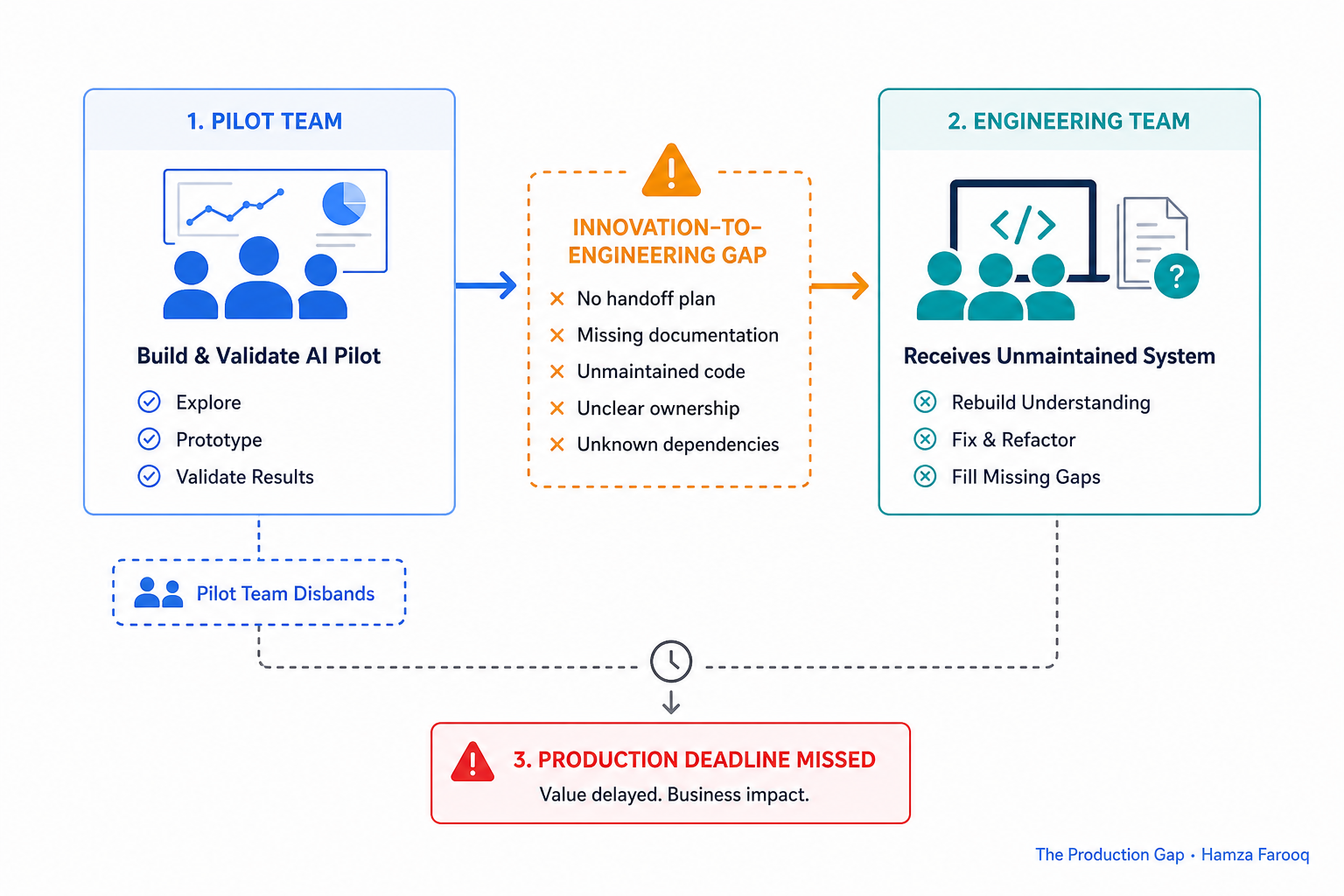
Pilots have an innovation budget, a sponsor, and an end date. They rarely have a named production owner, an operational budget line, or a team chartered to maintain them. When the pilot ends, engineering inherits a system it didn't design, doesn't trust, and wasn't resourced to maintain.
Procurement friction compounds the problem. Enterprise vendor approvals, security reviews, and legal sign-offs routinely take three to six months. By the time paperwork clears, the pilot team has disbanded and momentum is gone. AI integration debt adds a third layer: the ERPs, CRMs, and internal APIs the system needs were never part of the pilot scope, and retrofitting them post-demo frequently costs more than the pilot itself.
How do the teams that consistently ship AI differ from the teams that stall?
High-shipping teams treat deployment constraints, ownership, and integration requirements as inputs to the pilot design, not problems to solve after the demo.
Named ownership before kickoff is the single most important structural difference. A specific engineering manager or staff engineer with an operational budget must be identified before the pilot starts; if no one will own it in production, the pilot doesn't start. Evaluation criteria (specific, measurable behavioral tests) are written before model prompts or training pipelines, so engineering has a defined standard to sign off against rather than a judgment call at the end.
Running pilots on production data from week one surfaces pipeline debt early, when it's cheap to fix. Procurement starts at kickoff too, legal, security, and vendor approvals initiated on day one, in parallel with the build, so approval time overlaps development rather than following it.
Comparison table: pilot-first vs. production-first design
| Dimension | Pilot-first (stalls) | Production-first (ships) |
|---|---|---|
| Ownership | Innovation team owns until demo; no named successor | Named engineering owner assigned before kickoff |
| Data | Curated one-time export for clean demo | Real production data from week one; pipeline debt surfaced early |
| Evaluation | "It looked good in the demo" | Written eval framework defines ship criteria before build starts |
| Procurement | Vendor approvals begin after pilot succeeds | Legal and security review initiated at project kickoff |
| Integration | Legacy system compatibility scoped post-demo | Integration constraints defined as pilot design inputs |
What does a production-ready AI evaluation framework actually look like?
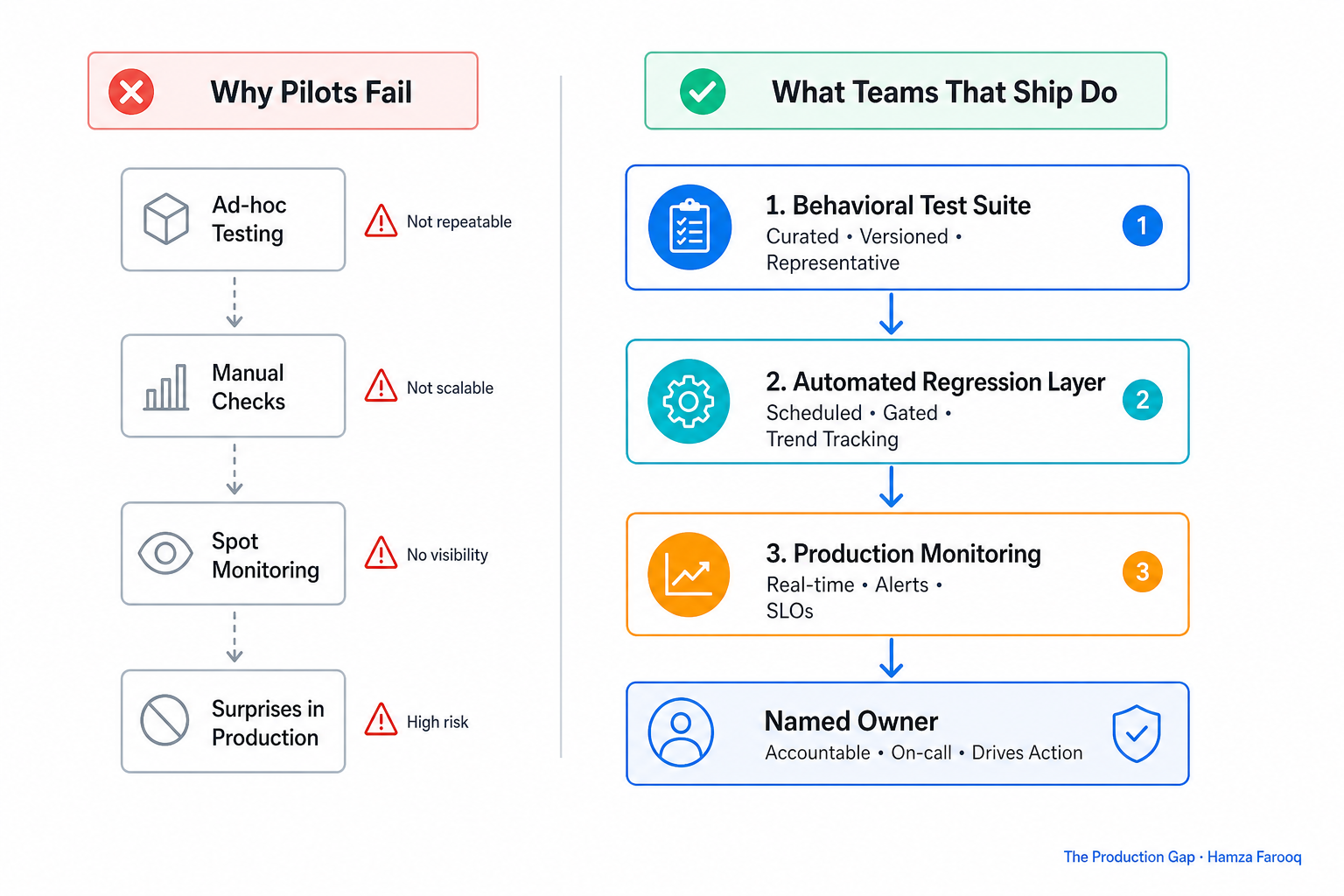
A production-ready LLM evaluation framework defines at least three things before the pilot starts: what correct behavior looks like, how it will be measured at scale, and who monitors it in production.
1. Behavioral test suite. A curated set of input/output pairs covering normal cases, edge cases, and known failure modes, written before the model is built. This is the contract between the pilot team and engineering.
2. Automated regression layer. A CI/CD-integrated eval runner that catches output degradation when the model, prompt, or data pipeline changes. Platforms like Braintrust and LangSmith provide this infrastructure. Without it, you find out the system is breaking from a customer, not a dashboard.
3. Production monitoring with a named owner. Someone must own the dashboard, triage failures, and have authority to roll back. A financial services document summarization system, for example, needs behavioral tests for hallucination on numeric figures, citation accuracy, and regulatory language, that specificity is what makes the eval defensible to compliance and signable by an engineering manager.
Evaluation is not a quality gate bolted onto the end of a pilot. It's the contract that defines whether the system is ready to ship.
Frequently Asked Questions
Why do AI pilots succeed in demos but fail in production environments? Pilots are built on curated data and sandbox infrastructure that shields them from real system complexity. Production exposes messy pipelines, access controls, and integration dependencies the demo never touched.
How do you assign ownership for an AI system before it reaches production? Name a specific engineering manager or staff engineer with a designated operational budget at pilot kickoff. If no one will commit before the pilot starts, the pilot should not start.
What is the difference between a proof-of-concept AI build and a production-grade AI build? A proof of concept demonstrates feasibility under controlled conditions; a production build optimizes for reliability, observability, ownership, and real-system integration. The gap is primarily organizational, not a model quality problem.
How do enterprise teams manage data pipeline debt when scaling AI pilots to production? Run pilots on real production data from week one, not curated exports. This forces the team to confront schema inconsistencies and access constraints before demo expectations are locked in.
Conclusion
The 10% production rate is a governance and ownership problem, and it's predictable rather than inevitable. Before approving any AI pilot budget, three questions need answers: Who owns this in production? What does "good enough to ship" mean, and how will it be measured? Does the production data pipeline exist today, and can the team test against it?
An honest no to any of those is a signal to fix the governance structure before spending on the pilot, not after.
Learn from me
Forward Deployed Engineering Bootcamp for Full-Stack Developers, my Maven cohort. Build and ship complete AI products end to end, from React and Node.js frontends to deployed models with caching and observability. Join the next cohort →
Hire us
Traversaal.ai. We're a team of forward deployed engineers solving the toughest AI problems for Fortune 100 companies: document intelligence, agentic data platforms, and real-time web intelligence, deployed in production. Work with our team to deploy your next agentic ecosystem. Talk to Traversaal.ai →
Join us
Want to solve these problems with us? We're always looking for forward deployed engineers who want to ship production AI. jobs@traversaal.ai