Banking Agent Control Plane Architecture: What agentOS Reveals About Transaction-Aware Permissioning, Audit Logging, and Regulatory Hooks
Banking agent control plane explained: how agentOS handles audit logging, transaction permissioning, and regulatory hooks your AI deployments actually need.

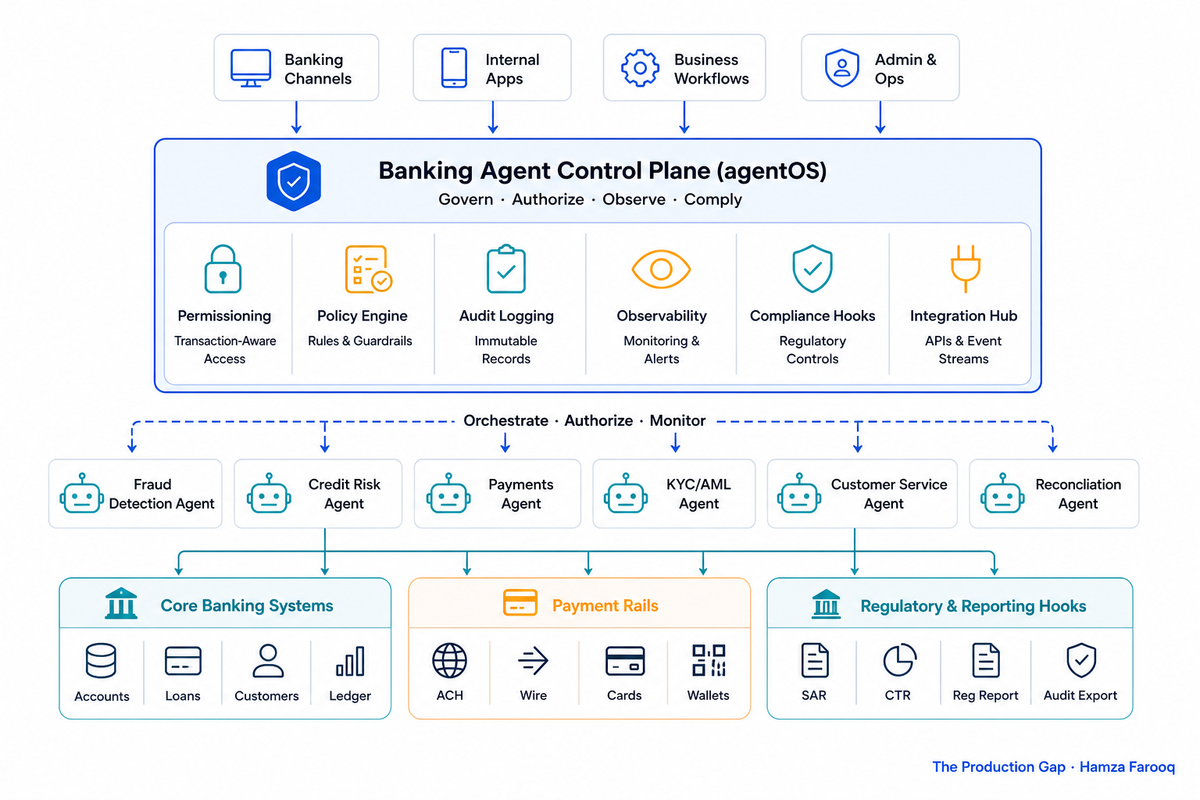
A bank's AI agent triggers a large corporate payout based on an emailed invoice, and the audit team cannot reconstruct which model version approved it, what policy was active, or whether the tool call was even in scope. The problem is not the agent. It is what is missing above it.
TL;DR: A banking agent control plane is the architectural layer that enforces what AI agents can access and do, captures every action immutably, and exposes structured hooks for regulators, distinct from the use cases running on top of it. As of mid-2025, agentOS demonstrates this through three interlocked subsystems: transaction-aware permissioning that adjusts authorization in real time based on amount, counterparty, and risk signals; append-only audit logs courts and examiners can consume directly; and pre-wired regulatory reporting interfaces that fire automatically on defined trigger events.
Key Takeaways
- A banking agent control plane is the dedicated governance layer that sits above agents and enforces authorization and accountability at runtime, not at design time.
- Transaction-aware permissioning evaluates an agent's tool-use rights against transaction type, dollar amount, and customer risk profile on every individual tool call.
- Audit logs must capture model version, active policy state, tools requested, and tools denied, not only what the agent ultimately did.
- Runtime enforcement intercepts and blocks agent actions as they happen; design-time guardrails cannot respond to live conditions such as a threshold breach.
- Each vendor agent that runs its own proprietary governance layer produces a fragmented audit trail that no single regulatory examination can fully resolve.
- Behind-the-firewall deployment is a hard architectural requirement: sensitive customer and transaction data must not cross an external API boundary.
- Control Plane Separation, the principle that governance logic must live outside agent logic, is the organizing rule this guide uses to evaluate every design decision below.
What exactly is a banking agent control plane, and how does it differ from an orchestration framework?
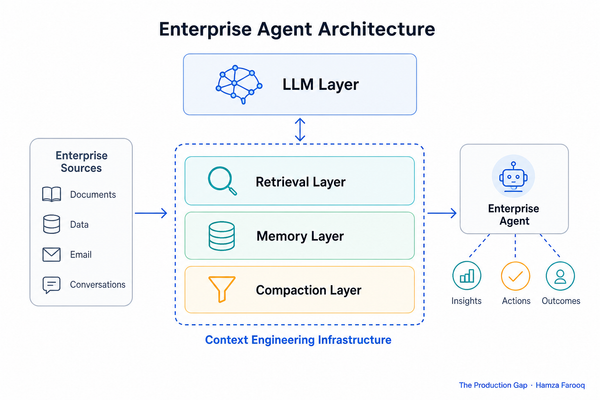
Backbase frames it directly: a control plane is "the part of an architecture that makes decisions about how other components operate." Orchestration frameworks like LangGraph or CrewAI manage sequencing. The control plane manages authorization and accountability. A bank that conflates the two ends up with an orchestrator that can route tasks but cannot block a prohibited tool call or produce a complete audit trail.
The organizing principle used throughout this guide is Control Plane Separation: governance logic must live outside agent logic, never bundled inside the same deployable artifact. An agent authorized to read emailed invoices and trigger corporate payouts cannot self-govern during a live transaction. The boundary around the agent is the critical governance unit, and that boundary must be externally enforced. If the control plane lives inside the agent, the bank does not have one.
How does transaction-aware permissioning work across multiple core banking systems simultaneously?
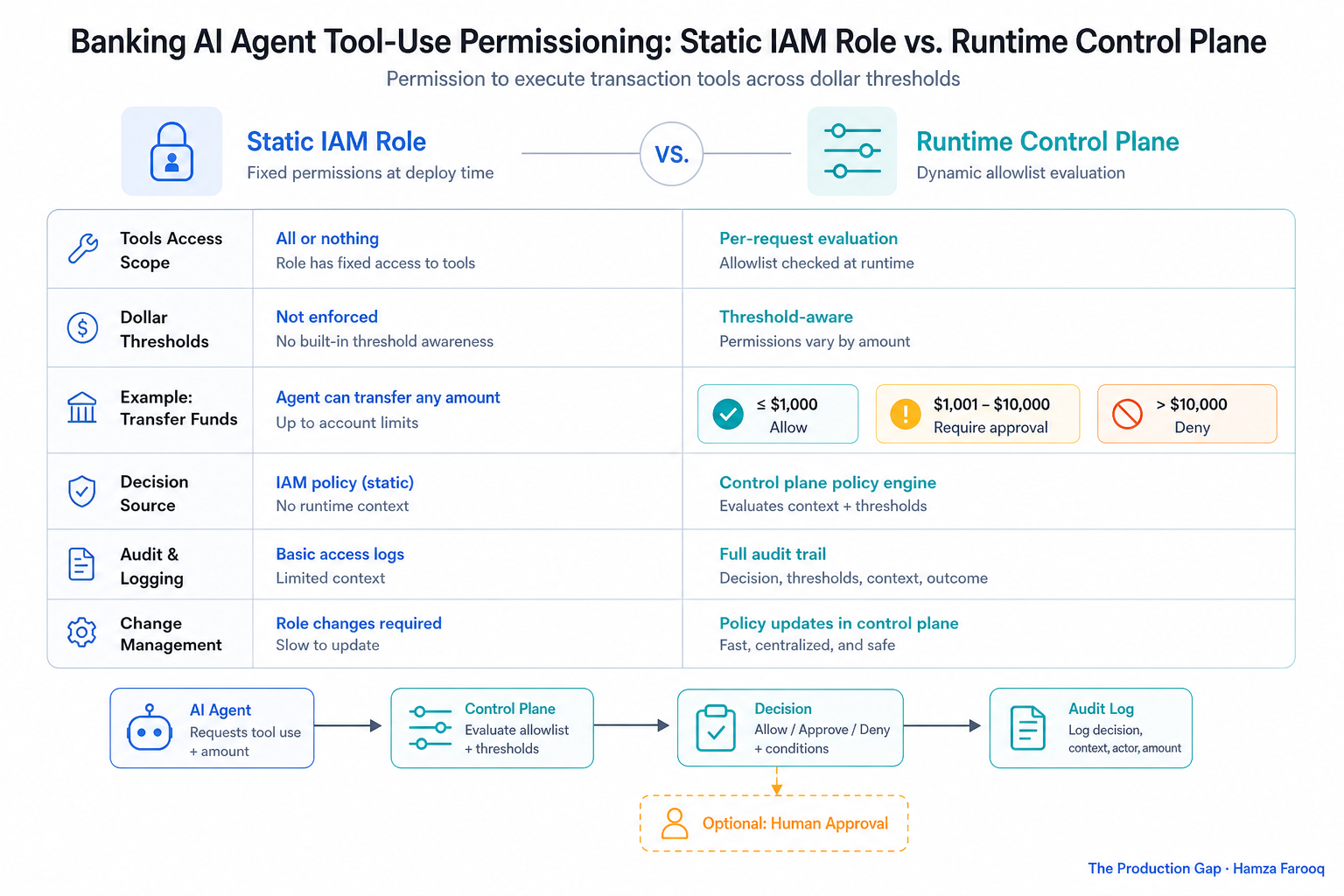
Static IAM roles break immediately when extended to non-human agent principals. Traditional IAM frameworks fall short for AI agents in financial services because an agent's context changes with every task invocation. As a practical rule of thumb applied in this guide: a loan underwriting agent handling a small retail application should carry materially different tool access than the same agent processing a large commercial facility. Same model, same deployment, but a different permission envelope appropriate to the risk. The control plane is what makes that dynamic evaluation possible.
The control plane enforces a tool-use allowlist at each tool call rather than at deployment time. Tuomola's governance architecture confirms this: tool-use allowlists and resource quotas are enforced at the control-plane layer, at runtime. Three variables should feed every authorization check, stated here as author synthesis: transaction type and dollar threshold; customer risk tier and jurisdiction; and the specific tool being called along with its potential blast radius.
Table 1: Permissioning Model Comparison
| Permissioning model | Evaluated when | Dollar-threshold aware | Regulatory exam defensible |
|---|---|---|---|
| Static IAM role | Deployment time | No | Partial |
| Agent-embedded guardrail | Design time | Sometimes | No |
| Control-plane allowlist (runtime) | Each tool call | Yes | Yes |
What must an immutable audit log capture to survive a model-risk or operational-risk regulatory exam?
A regulatory-grade banking agent audit log must capture, at the moment of each agent action, the workflow initiator, the active model version, the active policy state, every tool requested, every tool denied, and every sensitive resource accessed.
This enumeration is a minimum checklist. Workflow initiator establishes accountability. Model version lets examiners reconstruct exactly which model produced a decision. Active policy state, the element most architects miss, must reflect the version enforced at the moment of action, not the version running today. Tool-requested versus tool-denied matters equally: a regulator needs to see that the control plane blocked an out-of-scope action, not just that the agent eventually succeeded.
What is the systemic failure mode when a bank runs multiple vendor agents with incompatible control planes?
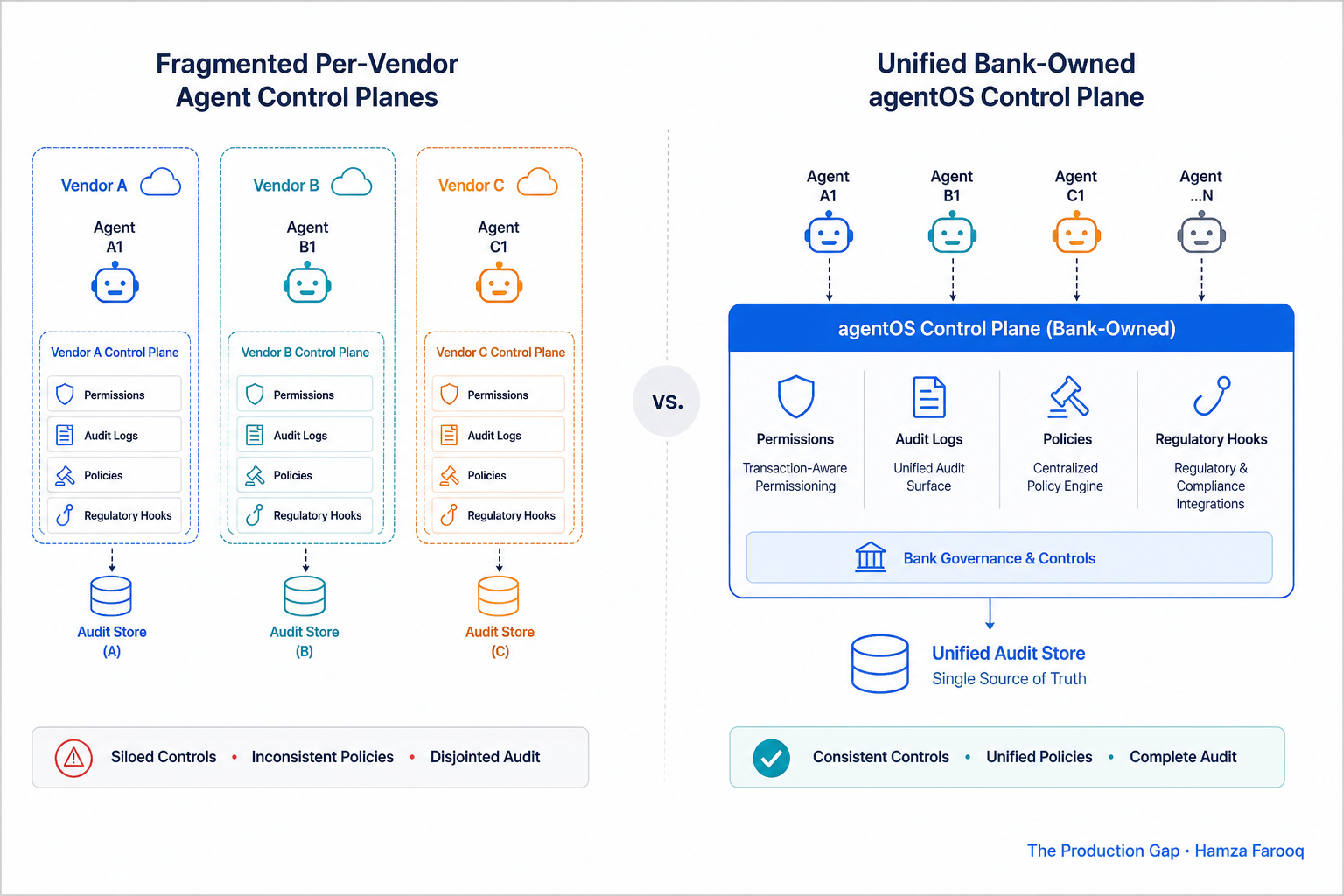
When each vendor agent runs its own proprietary governance layer, the bank ends up with fragmented audit trails that no single regulatory examination can fully resolve.
The fragmentation is structural. Each vendor-specific governance layer covers only that vendor's agent. Cross-agent actions, where an AML agent flags a transaction that a payments agent then processes, produce no shared log entry under any single governance surface. The bank cannot reconstruct the full decision chain from any one vendor's records. This is an observation about how proprietary, siloed governance layers interact architecturally, not a claim that any particular vendor has confirmed this gap in their own documentation.
The answer is a single, bank-owned governance layer that all agents, regardless of vendor, must route authorization requests through. Behind-the-firewall deployment is essential: the control plane must run inside the bank's own security perimeter so cross-vendor, cross-system agent actions appear on the same audit surface. This architectural decision must be made before the next vendor contract is signed, not after it.
Frequently asked questions
What is a banking agent control plane in simple terms? It is the governance layer above AI agents that decides what each agent is allowed to do, enforces those decisions in real time, and records every action for regulatory review. The analogy used in this guide: the same way a network control plane sets routing rules without forwarding packets itself, the banking agent control plane sets authorization rules without executing the transactions itself.
How does runtime policy enforcement differ from design-time guardrails? Design-time guardrails are coded before deployment and cannot respond to live conditions such as a dollar-threshold breach or a real-time sanctions update. Runtime enforcement intercepts each tool call at execution and evaluates it against the current policy state. The distinction matters most when conditions change after deployment, which in banking is the normal case, not the exception.
What does a regulatory examiner actually look for in a banking AI audit log? The specific model version active at decision time, the policy state enforced at that moment, tools requested and denied, and the initiating principal, not merely the transaction result. A log recording only the final outcome leaves material accountability gaps that examiners are increasingly trained to identify.
How should a bank evaluate whether a vendor's agentOS truly externalizes the control plane? Apply this practical test from the framework used in this guide: if you replace the vendor's agent with a competitor's, does the control plane still enforce permissioning and produce a complete audit trail? If not, the bank is buying a point-solution guardrail, not a control plane, and the audit gap remains regardless of what the vendor's documentation claims.
Conclusion
The architectural direction agentOS releases are converging on is clear: the banking agent control plane must be external to agent logic, bank-owned, behind the firewall, and capable of enforcing transaction-aware access control while producing a regulatory-grade audit log across every agent in the fleet, regardless of vendor.
The control plane is a layer, not a feature. Every week a bank defers this decision, another vendor agent ships with its own governance layer, and the audit gap grows by one more incompatible log format.
The practical starting point, stated here as author synthesis, is to map the current agent fleet against the Control Plane Separation principle: for each deployed agent, identify whether authorization requests route through a bank-owned, centralized policy enforcement point. More than one answer to that question means fragmented control planes, and a remediation project that will not get easier the longer it waits.
Learn from me
Forward Deployed Engineering Bootcamp for Full-Stack Developers, my Maven cohort. Build and ship complete AI products end to end, from React and Node.js frontends to deployed models with caching and observability. Join the next cohort →
Hire us
Traversaal.ai. We're a team of forward deployed engineers solving the toughest AI problems for Fortune 100 companies: document intelligence, agentic data platforms, and real-time web intelligence, deployed in production. Work with our team to deploy your next agentic ecosystem. Talk to Traversaal.ai →
Join us
Want to solve these problems with us? We're always looking for forward deployed engineers who want to ship production AI. jobs@traversaal.ai