MCP Gateway Enterprise: How a New Vendor Category Solves SSO, Audit Trails, and Config Drift at Scale
MCP gateway enterprise teams need SSO, audit trails, and config drift fixes. Learn the 2026 vendor landscape and a 5-dimension evaluation framework.

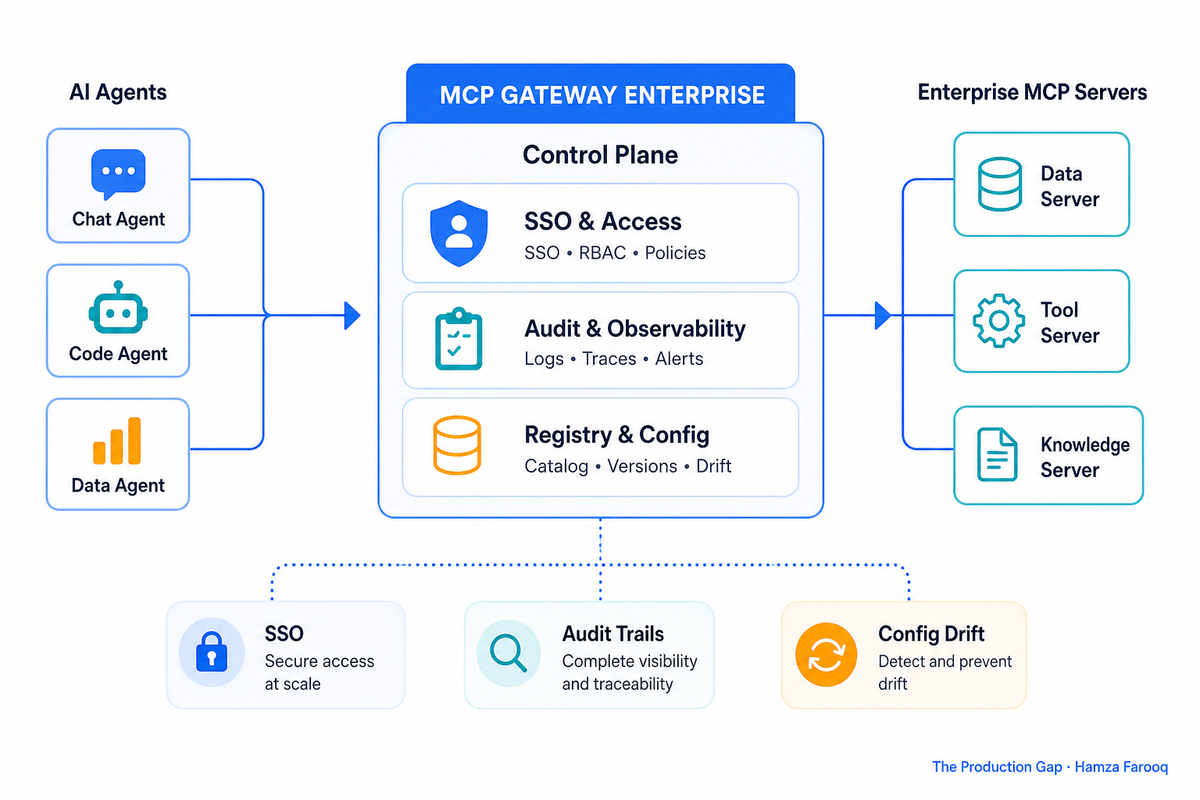
TL;DR: An MCP gateway enterprise layer sits between your AI agents and backend tools to enforce SSO, log every tool call for audit, and push config changes centrally. Without it, teams manage credentials manually, have no tamper-evident record of agent actions, and watch prompt or policy changes drift inconsistently across dozens of servers. This guide explains the three failure modes, the vendor landscape as of 2026, and a practical five-dimension evaluation framework.
Key Takeaways
- SSO integration requires a gateway layer between agents and servers.
- Compliance-grade audit trails only become possible with a gateway control plane.
- Config drift is the silent operational failure mode. Without a centralized registry, team configurations diverge quickly.
- As of 2026, Kong, TrueFoundry, Lunar.dev, Zuplo, and others have publicly positioned gateway products for enterprise teams.
- Evaluate gateways on Identity, Audit, Registry, Deployment, and Policy, in that order.
What does the raw MCP specification include and exclude?
MCP solved tool connectivity through deliberate minimalism. That is a feature at the prototype stage. At scale, it becomes a liability.
- No identity layer. No token validation, no OAuth handshake, no SAML assertion. Your identity provider has zero visibility into what agents are doing.
- No audit primitives. No logging interface, no standardized trace, no record of who called what and when.
- No registry contract. No canonical registry spanning multiple servers or enforcing schema consistency.
The analogy is instructive: TCP moves packets but has no concept of encryption. TLS had to be added as a separate layer. MCP moves tool calls but has no concept of governance. The gateway plays an equivalent role for MCP tool access governance, this is the framing used throughout this guide, not a claim from an external study.
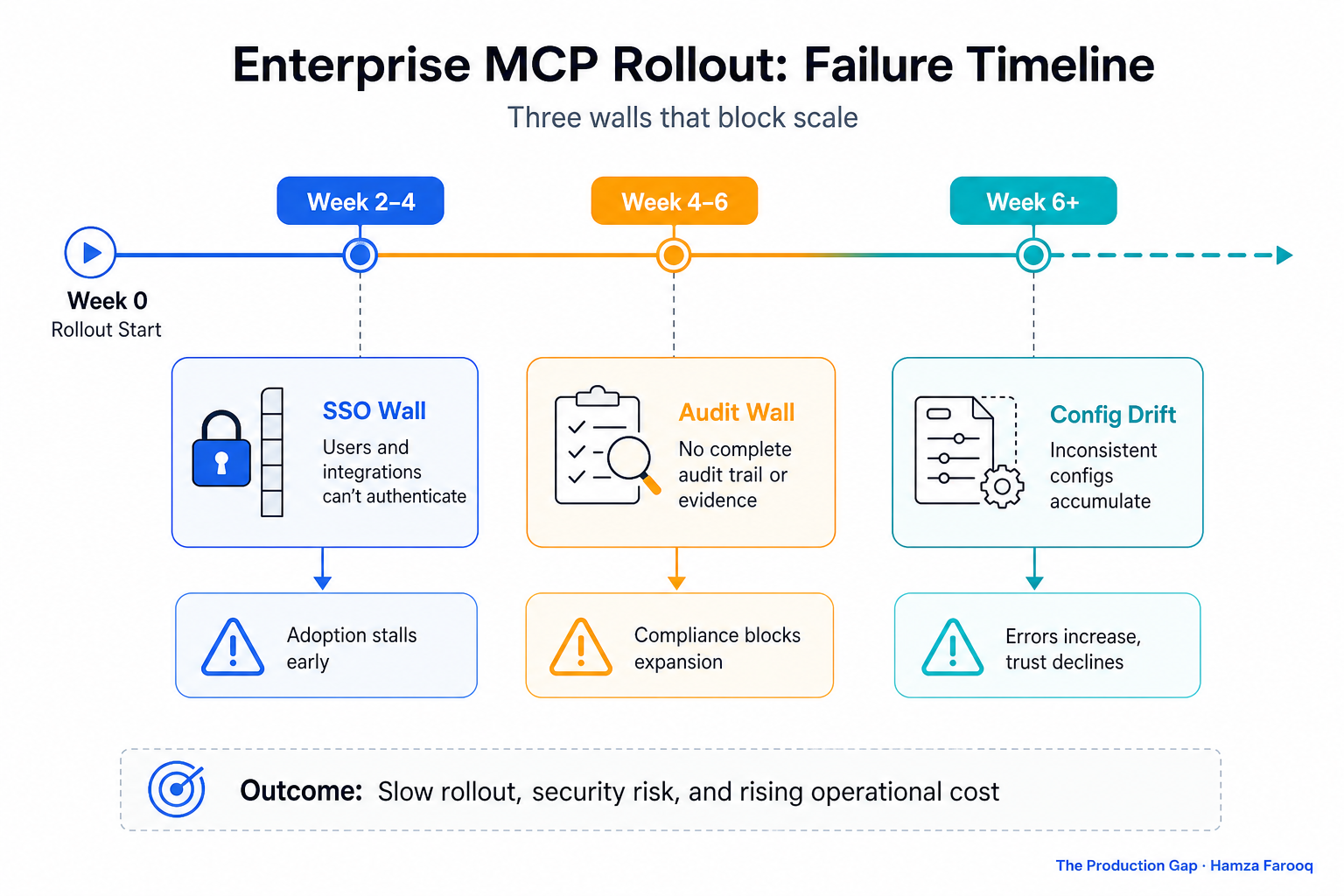
Why do enterprise MCP rollouts predictably hit the wall?
The SSO wall. The first security review flags that MCP tool access bypasses the corporate identity provider entirely. As Lunar.dev documents, an MCP gateway intercepts, authenticates, and governs every tool invocation, making it the insertion point for SSO integration without touching individual servers.
The audit wall. Compliance asks for a log of every tool call an AI agent made, with user identity attached. Those logs do not exist in the raw spec. Snowflake frames the gateway as a centralized control plane between AI clients and enterprise systems. Without that control plane, there is no single observation point for audit trail compliance.
The config drift wall. Teams fork server configs to move fast, tool schemas diverge, and nobody owns a canonical source of truth. TrueFoundry's registry architecture addresses this directly: a gateway-maintained enterprise MCP server registry centralizes discovery so it is never per-agent or ad hoc. In practice, this is the wall that catches teams off guard after they have already addressed SSO and audit.
Which MCP gateway vendors are production-ready, and how do they differ?
As of 2026, at least thirteen named MCP gateway products are positioned for enterprise teams, with Kong, TrueFoundry, Lunar.dev, and Zuplo among the most-documented options. The table below reflects publicly stated positioning from vendor sources as of 2026. Confirm deployment model, registry support, and integration details against each vendor's current documentation before selecting.
| Vendor | Stated positioning | Registry support noted in sources |
|---|---|---|
| Kong | Centralized access, security, and management for MCP servers | Yes |
| TrueFoundry | Centralized MCP server and tool registry; agent discovery | Yes (centralized) |
| Lunar.dev | Unified gateway intercepting all tool invocations | Yes |
| Zuplo | Virtual MCP servers with team-specific tool scoping | Yes |
| Aembit | Security and routing between agents and resources such as databases and APIs | Partial |
| Snowflake | Centralized control plane between AI clients and enterprise systems | Yes |
| Composio | Broad integration catalog; security, performance, governance criteria | Partial |
| Obot AI | Authentication, authorization, and policy enforcement per tool call | Yes |
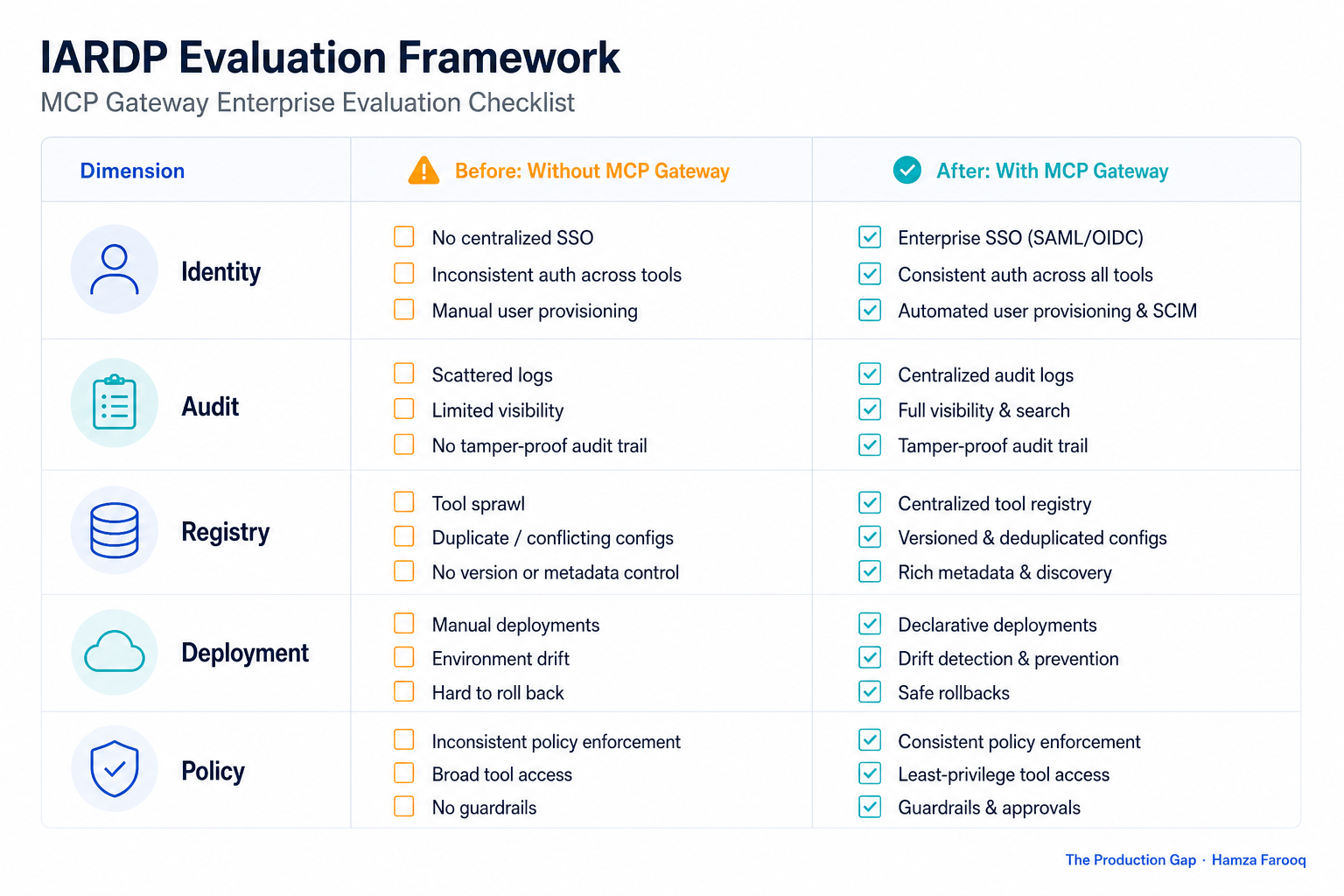
The IARDP Evaluation Framework for MCP Gateways
The framework used in this guide covers five dimensions: Identity, Audit, Registry, Deployment, and Policy (IARDP). Evaluate them in that order, because they map directly to the three failure modes described above. This is an author synthesis built from the documented vendor capabilities and the failure patterns covered in this article, not a published industry standard.
Identity (I). Does the gateway validate and enforce identity tokens from your existing identity provider, not merely pass them through? Does it support the authentication protocols your organization already uses? Confirm the specific IdP integrations each vendor supports against their current documentation.
Audit (A). Does every tool invocation produce a structured log with caller identity, timestamp, tool name, input payload, and response code? Can logs stream to your existing observability or SIEM tooling? Confirm that retention and log structure align with your applicable compliance requirements before selecting a vendor.
Registry (R). Does the gateway maintain a centralized, versioned registry of MCP servers and tool schemas? TrueFoundry's architecture illustrates the target model: agents never resolve tools independently. Weight this dimension at least as heavily as Identity, most teams do not, and config sprawl follows.
Deployment (D). SaaS, self-hosted, or cloud-prem? For regulated industries, data residency requirements can immediately narrow the shortlist. Confirm VPC deployment support before the second demo, not after.
Policy (P). Can you enforce per-tool, per-team, and per-agent permission scopes? Obot AI documents this requirement clearly: a gateway must enforce authentication, authorization, and policy for every tool call, not just at session initiation.
FAQ
Q1: What does an MCP gateway add that the raw MCP specification does not include?
An MCP gateway adds SSO integration, structured audit logging with caller identity on every invocation, a centralized server registry that prevents config drift, and policy enforcement controlling which agents invoke which tools. The spec handles connectivity. The gateway handles governance. These are not overlapping concerns: the spec was designed without enterprise governance in mind, and that gap is intentional at the protocol level.
Q2: How does an MCP gateway integrate SSO and identity providers with MCP tool access?
An MCP gateway integrates SSO by sitting between AI agents and MCP servers, validating identity tokens against your identity provider before forwarding any tool call. Without it, MCP servers receive calls with no identity context attached. The gateway becomes the enforcement point your identity provider can observe. Confirm specific IdP protocol support (OAuth 2.0, OIDC, SAML) against each vendor's current documentation before selecting.
Q3: How does a centralized MCP server registry prevent config drift across large teams?
A centralized registry gives every agent a single canonical source of tool definitions and server configs, versioned and enforced by the gateway. Without it, team configs diverge as squads fork configurations to move independently. Zuplo's virtual server model lets teams consume scoped subsets without forking the underlying config, which is the cleanest documented solution to this problem among the vendors reviewed here.
Q4: What compliance frameworks should an enterprise MCP audit trail satisfy?
The answer depends on your industry and applicable regulatory requirements, confirm the specific frameworks your organization must address with your compliance team. The practical test is whether your existing observability tooling can ingest the log stream and whether every entry carries enough context for a human auditor to reconstruct what an agent did and why.
Conclusion
The three walls (SSO, audit, config drift) surface in a recognizable sequence across enterprise MCP rollouts. As of 2026, the vendor category has matured enough that this is a real procurement decision with meaningful differentiation between options. Run the IARDP checklist against your shortlisted vendors before your next security review, and weight Registry at least as heavily as Identity.
The security audit passes or fails on SSO and audit trails. The longer-term operational review passes or fails on the registry. Schedule the demos before the compliance review lands, not after.
Learn from me
Forward Deployed Engineering Bootcamp for Full-Stack Developers, my Maven cohort. Build and ship complete AI products end to end, from React and Node.js frontends to deployed models with caching and observability. Join the next cohort →
Hire us
Traversaal.ai. We're a team of forward deployed engineers solving the toughest AI problems for Fortune 100 companies: document intelligence, agentic data platforms, and real-time web intelligence, deployed in production. Work with our team to deploy your next agentic ecosystem. Talk to Traversaal.ai →
Join us
Want to solve these problems with us? We're always looking for forward deployed engineers who want to ship production AI. jobs@traversaal.ai