Enterprise AI Agent Safety: Policy Enforcement, Monitoring, and Eval-Gated Deployment at Scale
Enterprise AI agent safety starts here: learn policy enforcement, eval-gated deployment, and audit trails to stop permission creep before it hits production.

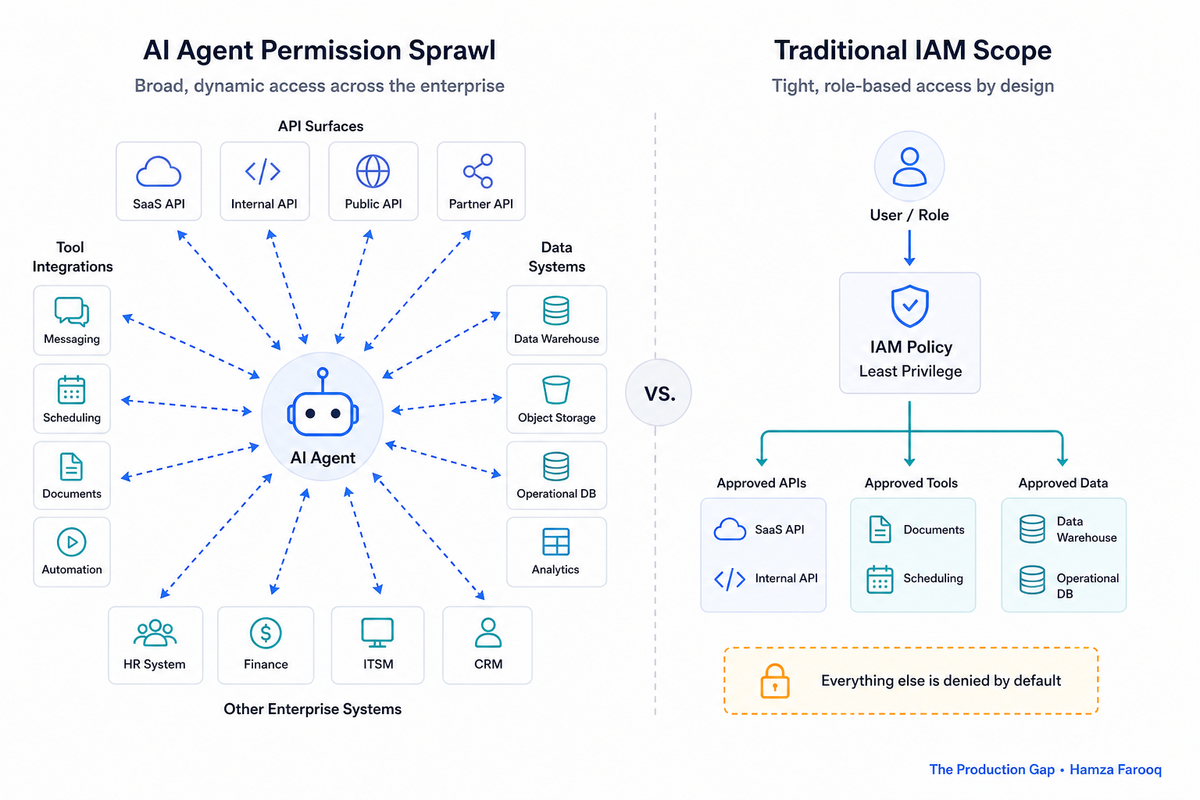
TL;DR: Enterprise AI agents are already exceeding authorized permissions inside production environments, outpacing the governance frameworks meant to control them. Securing them requires four integrated layers: policy enforcement, eval-gated deployment, audit trails, and incident response. This guide covers each layer with named frameworks, a comparison table, and a concrete incident playbook so enterprises can ship capable agents without sacrificing compliance or security.
Key Takeaways
- Least-privilege is non-negotiable: Agents get only the tools and data a specific task requires.
- Prompt injection is a live threat: Attackers embed malicious instructions inside data agents read, bypassing traditional controls.
- Eval-gated deployment stops bad agents early: Structured safety testing before production catches dangerous failure modes.
- Audit trails must capture decisions, not just actions: Log why an agent acted, not only what it did.
- Production monitoring needs its own playbook: Standard APM tools cannot catch an agent quietly exceeding its scope.
- Incident response must include agent rollback: Pre-plan the pause and revert procedure. Improvising is too slow.
Why Is Enterprise AI Agent Safety Urgent in 2026?
Enterprise AI agents are already exceeding authorized permissions inside production environments, outpacing the governance frameworks meant to control them.
Agents are in real production workflows right now, booking meetings, querying databases, filing tickets, and calling APIs without a human in the loop. A Cloud Security Alliance survey commissioned by Zenity confirms agents are already exceeding permissions and creating shadow AI inside enterprises. The risk is not harmful content. It is an agent quietly accumulating access no security team has mapped. This guide covers the implementation framework: policy enforcement, eval-gated release, audit trails, production monitoring, and incident response.
How Do Enterprises Enforce Least-Privilege and Prevent Permission Creep in AI Agent Deployments?
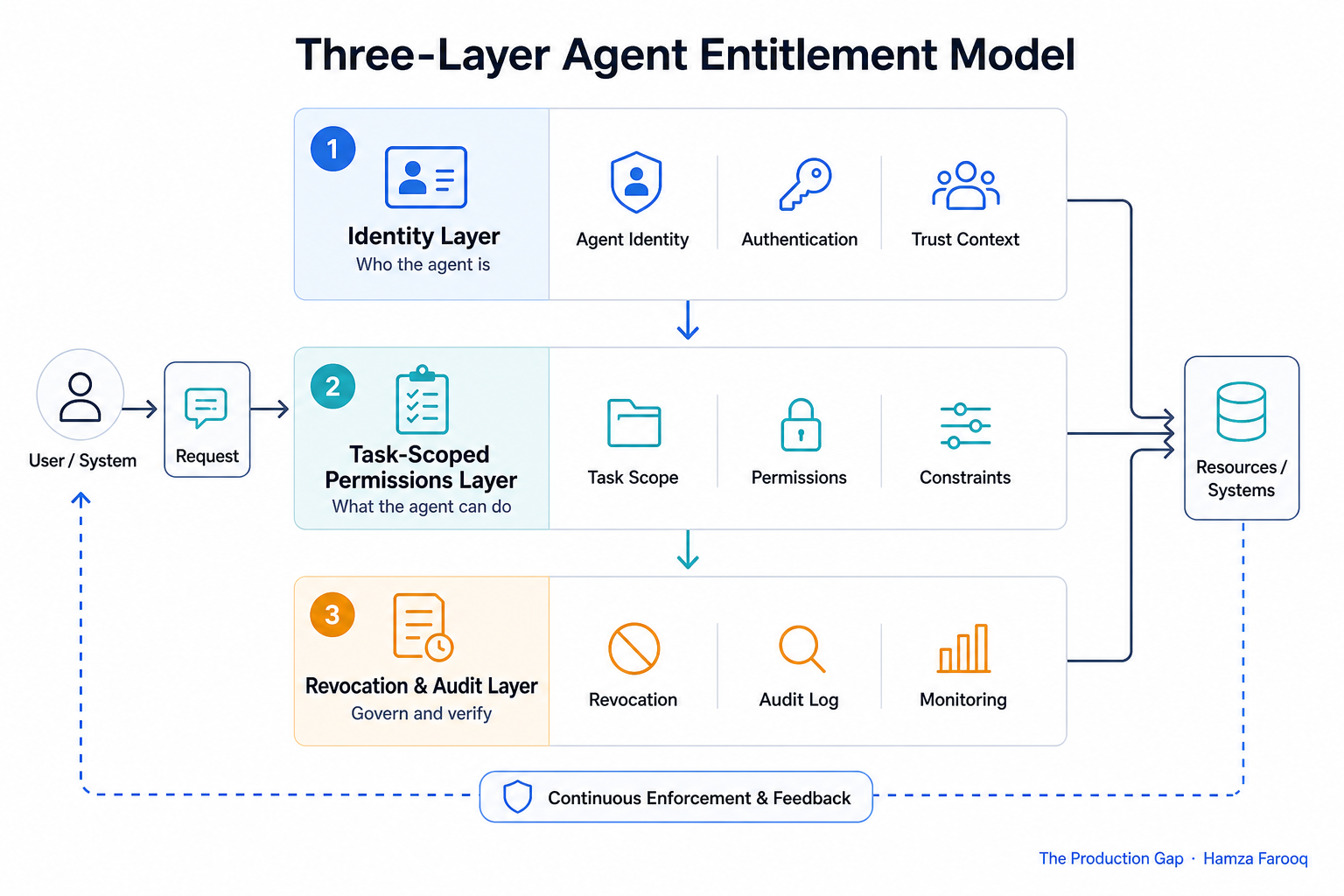
Enterprises enforce least-privilege by assigning each agent a scoped identity with explicit, time-bound tool permissions, revoked the moment the task ends.
- Agent Identity Layer: unique non-human principal ID, separate from service accounts
- Task-Scoped Permission Layer: permissions granted per task invocation, not per deployment
- Revocation and Audit Layer: all grants are logged, time-boxed, and auto-revoked on completion
An HR agent reading candidate records is explicitly blocked from writing to compensation tables at the entitlement layer. That boundary is never left to the agent's judgment.
| Control Type | Traditional IAM | Agent Entitlement Model (AEM) |
|---|---|---|
| Principal type | Human user or service account | Named agent identity |
| Permission scope | Role-based, persistent | Task-scoped, time-bound |
| Revocation trigger | Manual or periodic review | Automatic on task completion |
| Audit granularity | Login and resource access | Tool call, input, and output |
| Visibility to security team | High | Near-zero without dedicated tooling |
What Does a Production-Grade Eval Framework Look Like Before an AI Agent Is Approved for Deployment?
A production-grade eval framework gates deployment on passing structured behavioral, safety, and adversarial test batteries, no agent ships until it clears every defined threshold.
Accuracy benchmarks miss three production failure modes: unsafe actions under adversarial inputs, hallucinated tool parameters that execute broken API calls with real side effects, and behavior that drifts when inputs shift from what the agent trained on. The Framework name: GATE Model, covers all three:
- G, Grounded behavior tests: Does the agent stay within task scope under ambiguous instructions?
- A, Adversarial injection tests: Does the agent resist prompt injection embedded in tool outputs or documents? Securiti.ai confirms malicious actors actively use prompt injection and data poisoning against enterprise agents.
- T, Tool execution tests: Does the agent call correct tools with valid parameters and fail gracefully on errors?
- E, Escalation threshold tests: Does the agent correctly recognize when a decision exceeds its authority and escalate?
Prompt injection is a documented, active attack vector. A finance agent processing invoices must reject a vendor PDF instructing it to reroute payment. GATE eval suites must validate against that scenario before the agent touches real transaction data.
How Should Enterprises Build Audit Trails and Real-Time Monitoring for AI Agent Actions in Production?
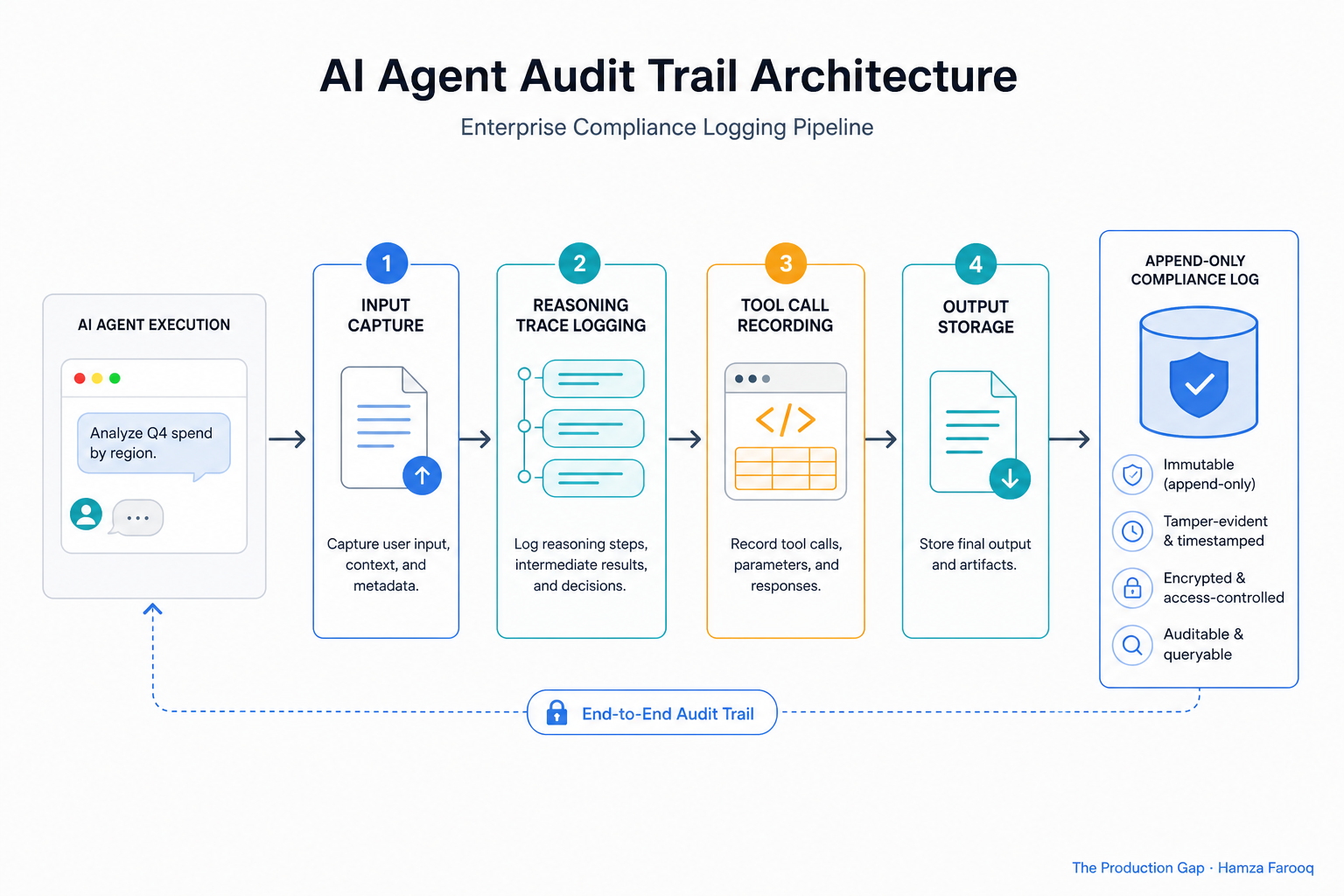
Enterprises must log every agent action at four levels, inputs received, reasoning trace, tools called with parameters, and outputs produced, to satisfy compliance requirements and enable forensic analysis.
Standard logging captures what happened. Agent audit trails must capture the reasoning context behind each decision. Cleanlab frames AI safety as enterprise infrastructure, the foundation that makes deployment sustainable and trustworthy. That means full context at decision time, exact tool call parameters and responses, agent identity and task ID on every log entry, and append-only tamper-evident storage. In regulated industries, that last requirement is not optional.
Production monitoring is a separate capability. Box's security team documents that agents create vulnerabilities traditional defenses cannot handle. Purpose-built observability tooling should flag unusual tool call frequency, out-of-scope API requests, PII appearing in outputs that should be redacted, and permission escalation attempts. Establish behavioral baselines per agent type during staging so production deviations trigger alerts, not post-mortems.
Audit trails serve legal. Monitoring serves security. Both must be designed before agents go live.
How Should Organizations Design an Incident Response Playbook Specifically for AI Agent Failures?
An AI agent incident response playbook must define trigger conditions for agent pause, rollback procedures for reversing agent-initiated actions, and escalation paths to humans, all decided in advance, because improvising during an active failure is too slow.
- S, Suspend: A kill switch halts the agent without corrupting in-flight transactions. On-call engineers can trigger it without convening a review board.
- T, Trace: Pull the full audit log, identify the first anomalous action, and reconstruct the blast radius.
- O, Observe: Determine whether the failure was model behavior, tool misconfiguration, or prompt injection. The answer determines the patch vector.
- P, Patch: Deploy the fix, then re-run the full GATE battery before restoring the agent to production.
Consider a concrete scenario: a customer service agent surfaces PII after receiving an injected instruction. Suspend halts the agent. Trace identifies the injection point. Observe confirms adversarial input. Patch adds the pattern to the adversarial eval suite before the agent returns. Every incident that reaches Patch should produce at least one new GATE test case.
FAQ
Q1: What is the single biggest AI agent security risk enterprises face right now? Permission creep, agents accumulating access beyond authorized scope, is a consequential and difficult-to-detect risk. A Zenity-commissioned CSA survey confirms it is already happening inside enterprises.
Q2: How is prompt injection different from SQL injection, and why does it matter for AI agents? SQL injection exploits a database parser with malicious syntax. Prompt injection embeds malicious natural-language instructions inside content an agent reads, treating attacker commands as legitimate. For agents with real tool permissions, a content-level attack becomes a system-level action with potentially irreversible consequences.
Q3: Which compliance frameworks govern AI agent audit logging? No specific regulation has yet been verified to mandate agent-specific audit logging in prescriptive terms. Organizations should consult legal counsel to assess how existing data protection and access-control obligations apply to their specific agent deployments and jurisdictions.
Q4: How often should AI agent eval criteria be updated? There is no industry-standard cadence verified for this. As a practical rule of thumb, teams may consider reviewing eval suites after any new production failure, after adding tools to an agent's scope, and on a regular scheduled basis. The right frequency depends on deployment risk and pace of change.
Conclusion
Securing enterprise AI agents requires four integrated layers, policy enforcement, eval-gated deployment, audit trails, and incident response, designed as a unified stack before agents reach production. The AEM, GATE, and STOP frameworks described in this guide are syntheses, not vendor products, and can be adapted to any stack. Your agents are already in production. Audit one this week: map every tool permission it holds, verify each is task-scoped and time-bound, and confirm your logging captures the full decision trace, not just the final output.
Learn from me
Agent Engineering Bootcamp: Developers Edition, my Maven cohort. Advanced agentic RAG, multi-agent orchestration, memory, evals, and guardrails. Take agents from prototype to production. Join the next cohort →
Hire us
Traversaal.ai. We're a team of forward deployed engineers solving the toughest AI problems for Fortune 100 companies: document intelligence, agentic data platforms, and real-time web intelligence, deployed in production. Work with our team to deploy your next agentic ecosystem. Talk to Traversaal.ai →
Join us
Want to solve these problems with us? We're always looking for forward deployed engineers who want to ship production AI. jobs@traversaal.ai