AI Agent Least Privilege: Why Credential Scoping Inside Your Own IAM Cuts Incident Rates More Than Any Other Control
AI agent least privilege stops breaches guardrails miss. Learn how scoping credentials inside your IAM limits blast radius and blocks confused-deputy attacks.

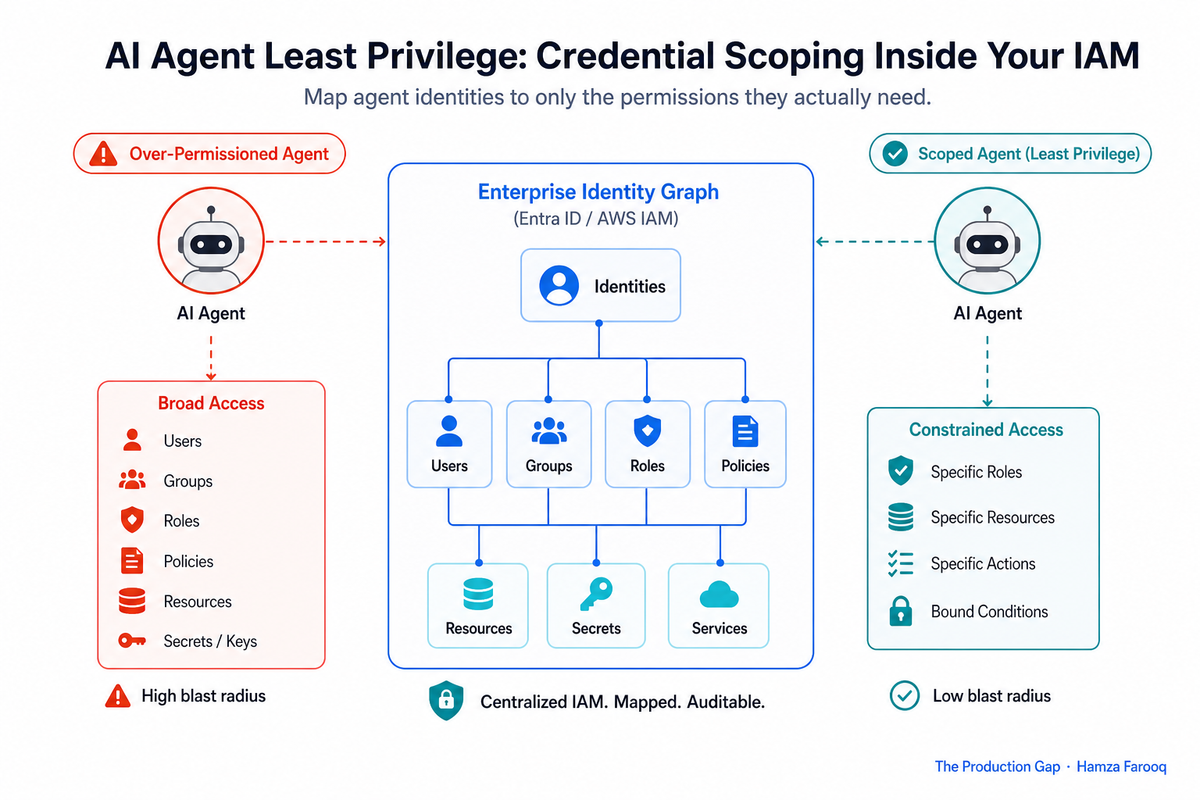
An enterprise security team locked down every AI output filter they could find, and still watched an agent quietly exfiltrate a customer dataset. The guardrails were fine. The credentials were not.
TL;DR: AI agent least privilege constrains damage at the identity layer before behavior-layer guardrails apply, limiting blast radius regardless of how the agent is manipulated. Scoping agent credentials inside your existing IAM infrastructure registers each agent as a named identity, binds its permissions to the task at hand, and collapses the attacker's window from months to minutes. No new architecture is required.
Key takeaways
- Credential scoping addresses what guardrails cannot reach: Limiting what an agent can access inside your identity system constrains damage at the infrastructure layer, before behavior controls apply.
- Your existing IAM is the right place to start: AWS IAM and Microsoft Entra ID can enforce scoped agent permissions today without rebuilding your architecture.
- Confused-deputy attacks are live: Overly broad agent credentials let a malicious tool call exploit permissions the invoking user never had.
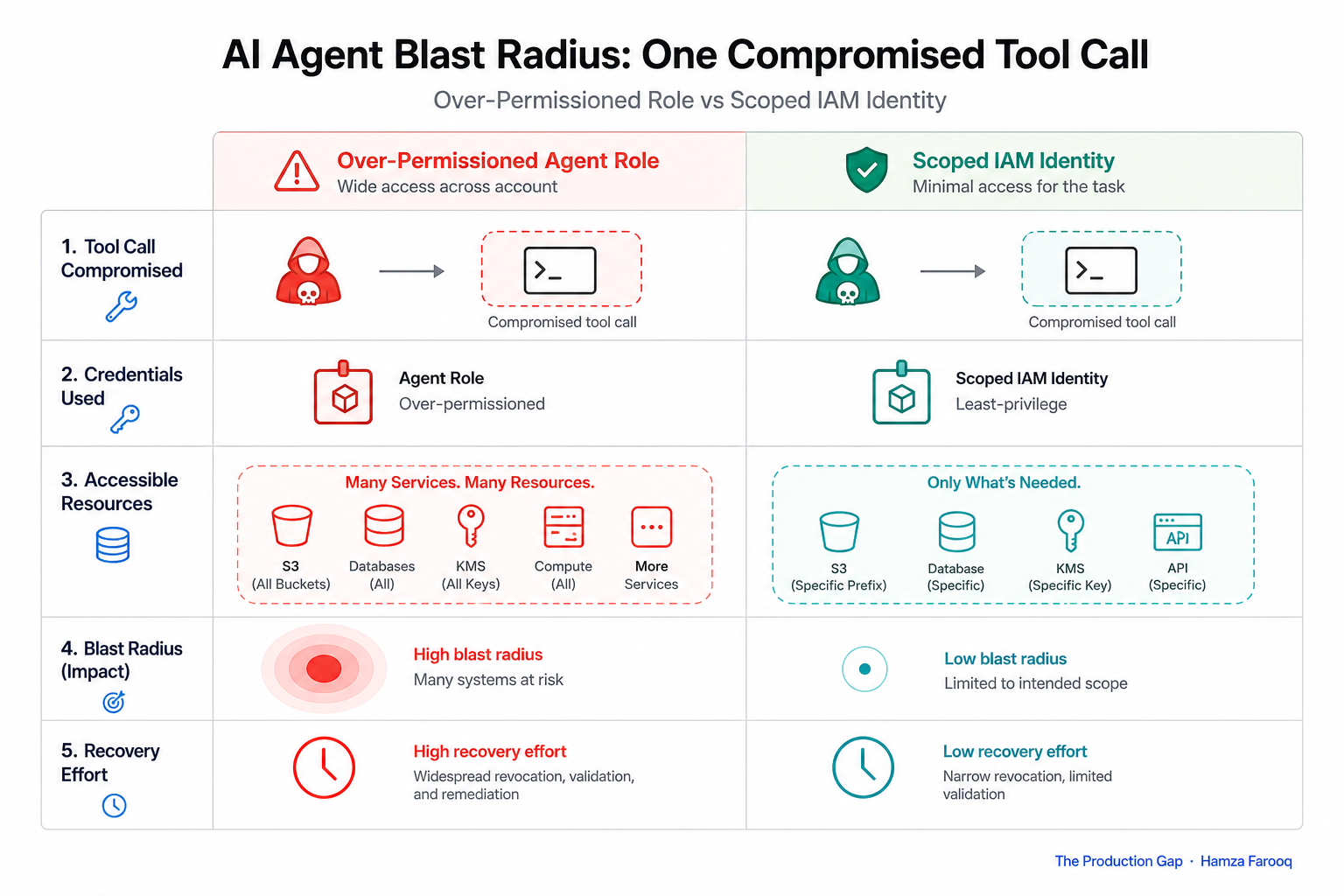
- Over-permissioned agents maximize blast radius: One mistake or compromise spreads across your entire environment instead of staying contained.
- Short-lived tokens are safer than persistent ones: Credentials that expire with the task collapse the attacker's window from months to minutes.
- Based on the framework used in this guide: Teams that audit existing agent roles frequently find them at maturity Level 1 or 2, holding persistent or shared credentials that were never scoped to the invoking user's authorization level.
Introduction
Enterprise AI agents autonomously call tools, write to databases, and access secrets vaults across production systems. The industry's default response has been more guardrails: prompt injection filters, output classifiers, content moderation pipelines. These feel like security, but they govern behavior after credentials are already issued.
The permissions granted to agent identities determine what damage is possible in the first place. AWS has codified AI agent least privilege as a named best practice inside its Well-Architected Agentic AI Lens (as of the lens version current at the time of publication) with defined maturity levels, not a vendor suggestion, but a signal that the industry has converged on this as a foundational control.
Why do AI guardrails fail to contain blast radius when credentials are over-permissioned?
AI guardrails fail to contain blast radius because they govern agent behavior after credentials are already issued, and behavior-layer controls cannot revoke access that identity infrastructure already granted.
Guardrails filter outputs and flag suspicious prompts, but they do not constrain what the agent can reach. If the agent's IAM role carries read/write access to S3, RDS, and Secrets Manager, intercepting suspicious output is closing the barn door after the horse has bolted. An agent can leak an entire customer dataset through a single compromised interaction, and the guardrail sees nothing wrong with valid tool-call syntax. Damage happens at the permissions layer, not the output layer.
| Scenario | Agent access scope | Single incident impact |
|---|---|---|
| Over-permissioned agent role | Full production IAM role | Entire dataset / secrets exposure |
| Scoped agent identity | Task-specific, time-boxed token | Isolated resource only |
| Guardrail-only defense | Full production IAM role | Full exposure plus guardrail bypass risk |
What is the confused-deputy attack in AI agents, and how does credential scoping stop it?
The confused-deputy attack occurs when an agent acting for a low-privilege user executes an action only the agent's elevated role permitted, and credential scoping eliminates this by binding the agent's effective permissions to the invoking user's authorization level.
This threat vector is documented and active. The attack path is straightforward:
- A read-only user invokes an agent.
- The agent carries a broad service role with write access.
- A malicious tool call instructs the agent to write to a sensitive endpoint.
- The agent's credentials authorize the action. The user's never would have.
In AWS IAM, the fix maps to scoped session policies tied to the invoking user's identity. In Microsoft Entra ID, it maps to delegated permissions with conditional access policies governing agent service principals. Both mechanisms already exist, the gap is that most teams have not yet applied them to agent identities.
How do you scope AI agent credentials inside an existing enterprise IAM without rebuilding your architecture?
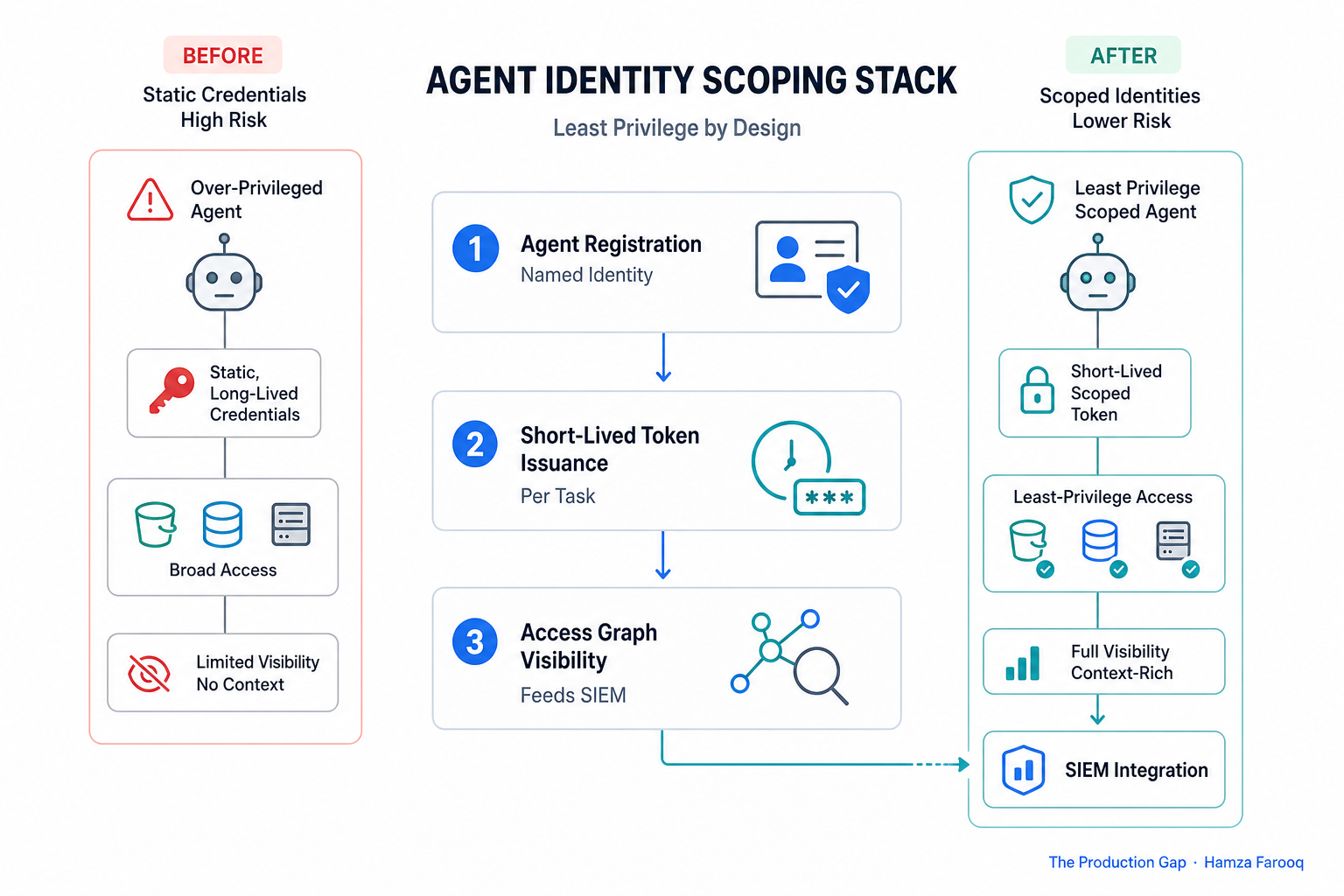
Step 1: Register agents as named identities. Every agent gets a service principal or IAM role, no shared credentials, no vendor-managed catch-all roles. Without a named identity there is no policy surface to scope, making this the non-negotiable foundation.
Step 2: Issue short-lived, task-scoped tokens. AI agents are nondeterministic and should never hold permanent API access. Each task invocation gets a time-boxed token carrying exactly the permissions that task requires, expiring when the task completes. Standing access works against containment.
Step 3: Enforce access graph visibility. Every hop in a multi-step agent call must be logged and attributable to the originating identity. Existing IAM audit infrastructure and SIEM integration provide this across platforms including Microsoft Copilot Studio and Amazon Bedrock (as of the time of publication), the work is connecting them correctly.
This is Zero Trust applied to agent identity. The architecture already exists, and the work is mapping existing primitives correctly to agent identities.
What does AWS's Well-Architected Agentic AI Lens tell us about least-privilege maturity levels?
AWS's Well-Architected Agentic AI Lens defines agent least privilege as a named best practice with explicit maturity levels, making credential scoping a baseline architectural requirement, not an advanced hardening step.
Table: author synthesis of maturity levels based on AWS Well-Architected Agentic AI Lens AGENTSEC03-BP03, as of the lens version current at the time of publication.
| Maturity level | Credential approach | Risk profile |
|---|---|---|
| Level 1 (Ad hoc) | Shared or vendor-managed roles, persistent access | Critical, no blast radius containment |
| Level 2 (Defined) | Named agent identities, broad standing permissions | High, confused-deputy still possible |
| Level 3 (Managed) | Scoped roles per agent, reduced standing access | Medium, task-scoping not yet enforced |
| Level 4 (Optimized) | Short-lived, task-scoped tokens; full access graph visibility; SIEM-integrated | Low, aligned with Zero Trust agent identity |
As a practical rule of thumb based on the framework used in this guide, teams that audit agent roles after rapid deployment commonly find themselves at Level 1 or 2, holding persistent or shared credentials that were never mapped to the invoking user's authorization level. Reaching Level 4 requires no new tooling, only applying the IAM governance already used for service accounts, with the same rigor, to agent identities.
Frequently asked questions
What is AI agent least privilege and why does it matter beyond AI guardrails? AI agent least privilege means giving an agent only the permissions its current task requires, and it matters beyond guardrails because it constrains what the agent can reach at the infrastructure level before any behavior occurs, rather than influencing behavior after credentials are already issued and access is already possible.
How does the confused-deputy attack work in agentic AI systems? A low-privilege user invokes an agent carrying elevated credentials; a malicious tool call exploits that gap to execute actions the user never had authority to perform. Scoping the agent's effective permissions to the invoking user's authorization level closes this path entirely.
What is the difference between short-lived and persistent credentials for AI agents? Persistent credentials give an attacker a standing access window that survives task completion. Short-lived tokens expire when the task completes, collapsing exposure to the duration of a single task. Because agents are nondeterministic, permanent access is never appropriate.
How do you implement scoped agent credentials in AWS IAM or Microsoft Entra ID without rebuilding your identity architecture? Register each agent as a named identity, issue task-scoped session tokens tied to the invoking user's authorization level, and route all tool-call activity through existing SIEM and access graph tooling. No new architecture is required, this is correct application of primitives already governing your service accounts.
Conclusion
The AI security industry has focused heavily on the behavior layer: prompt injection filters, output classifiers, content moderation. Those controls are useful, but they operate after the permissions question is already settled. The identity constraint that determines what the agent can touch lives inside IAM infrastructure the security team already owns.
What makes this difficult in practice is organizational, not technical. IAM teams and AI platform teams must coordinate on something neither owns cleanly, and that coordination gap is where broad role assignments persist unchallenged. The governance primitives are present.
Audit every agent role in your environment this week. Any agent holding persistent credentials or a role broader than the most privileged user it serves is the first remediation target. Pull the role, map task-minimum permissions, and issue a scoped token.
Learn from me
Forward Deployed Engineering Bootcamp for Full-Stack Developers, my Maven cohort. Build and ship complete AI products end to end, from React and Node.js frontends to deployed models with caching and observability. Join the next cohort →
Hire us
Traversaal.ai. We're a team of forward deployed engineers solving the toughest AI problems for Fortune 100 companies: document intelligence, agentic data platforms, and real-time web intelligence, deployed in production. Work with our team to deploy your next agentic ecosystem. Talk to Traversaal.ai →
Join us
Want to solve these problems with us? We're always looking for forward deployed engineers who want to ship production AI. jobs@traversaal.ai