Anthropic Enterprise Frontier Safeguards: How In-Cloud Misuse Detection Unlocks Compliant Claude Code Deployments
Anthropic Enterprise Frontier Safeguards keeps misuse detection in your cloud, unlocking HIPAA and FedRAMP-compliant Claude API deployments for regulated industries.

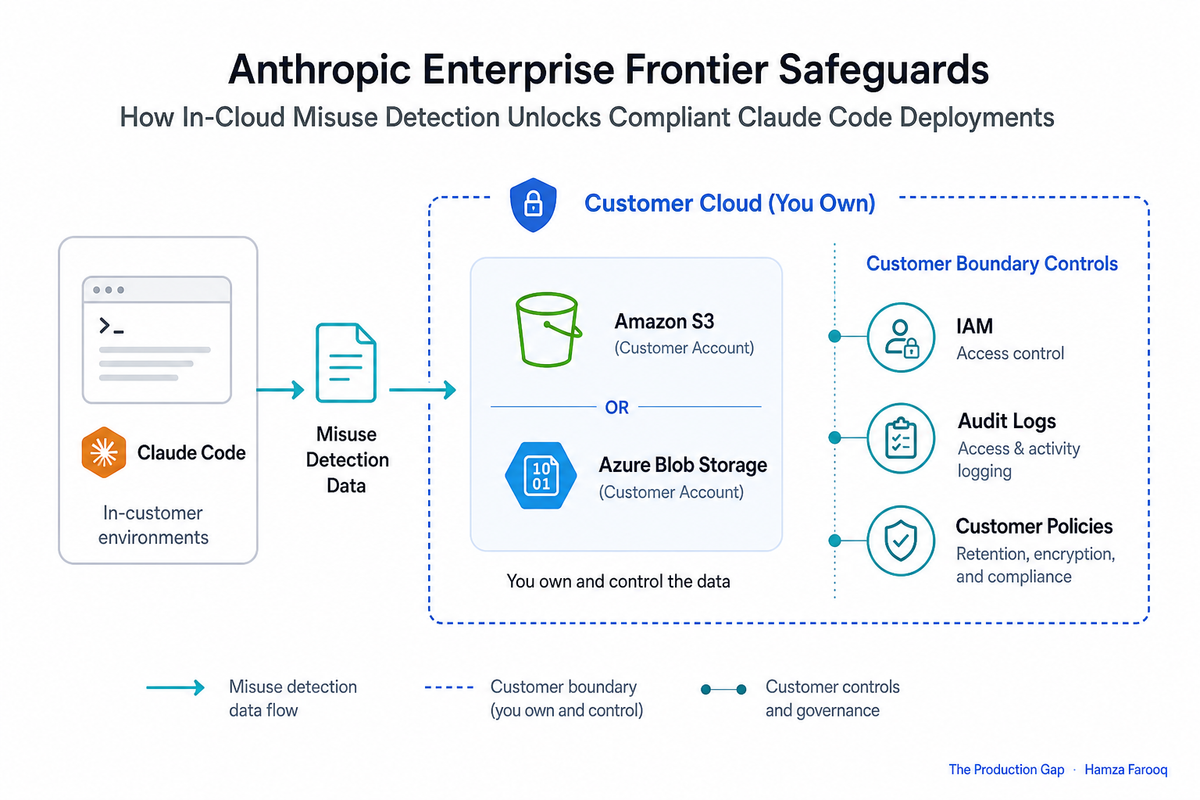
TL;DR: Anthropic Enterprise Frontier Safeguards (EFS) runs misuse detection inside the customer's own cloud environment rather than routing data through Anthropic's infrastructure, which means sensitive prompts and outputs never leave the organization's security boundary. This architecture lets regulated industries such as healthcare, finance, and defense deploy Claude API enterprise deployments while satisfying HIPAA, FedRAMP, and similar compliance requirements that a standard API integration cannot meet.
Key Takeaways
- Misuse detection stays in your cloud: EFS runs all monitoring inside the customer's own cloud; sensitive data never touches Anthropic's infrastructure.
- Zero retention and active monitoring coexist: EFS resolves the contradiction between zero data retention and ongoing safety monitoring by keeping both within the customer's security boundary.
- Fable and Mythos serve distinct roles: EFS ships as two named sub-components; their precise functional boundaries should be confirmed against Anthropic's technical documentation before mapping them to specific compliance controls.
- Regulated frameworks become reachable: Misuse-detection data routes to customer-owned S3 or Azure Blob, which may support HIPAA, FedRAMP, SOC 2, and financial MRM requirements depending on how the enterprise configures its boundary.
- High-stakes use cases are now unlocked: Healthcare coding assistants, government pipelines, and financial analysis tools can move from proof-of-concept to production.
- KPMG co-development strengthens audit readiness: KPMG's involvement during design gives enterprises a defensible posture when external auditors review AI governance controls.
Introduction
The blocker was never Claude's capabilities. For regulated enterprises, the problem was narrower: safety monitoring evidence crossed data-sovereignty lines they could not accept. Anthropic announced Enterprise Frontier Safeguards (EFS) on September 1, 2026, built with enterprise customers and KPMG. That KPMG involvement sets EFS apart from a simple marketing reframe. EFS does not solve the compliance wall by relaxing monitoring; it moves monitoring entirely inside the customer's own cloud.
How does EFS differ from a standard zero-data-retention Claude API deployment?
EFS relocates all misuse-monitoring processes into the customer's own cloud, so Anthropic retains no data and the enterprise keeps full custody of the safety evidence.
Standard zero-data-retention deployments solve one problem: Anthropic does not store your prompts. But misuse detection still runs on Anthropic infrastructure, meaning behavioral signals and policy-trigger logs exist transiently inside Anthropic's security boundary. For firms under FedRAMP or model risk management policy, that can be a hard contractual stop.
EFS routes monitoring data directly to customer-owned S3 or Azure Blob storage . The enterprise's own IAM roles, CloudTrail logs, and DLP policies govern misuse-detection data from the moment it is generated, which is what MRM auditors and FedRAMP assessors need to verify. As of September 1, 2026, this in-cloud routing architecture is the core structural distinction between EFS and any prior Claude API deployment option.
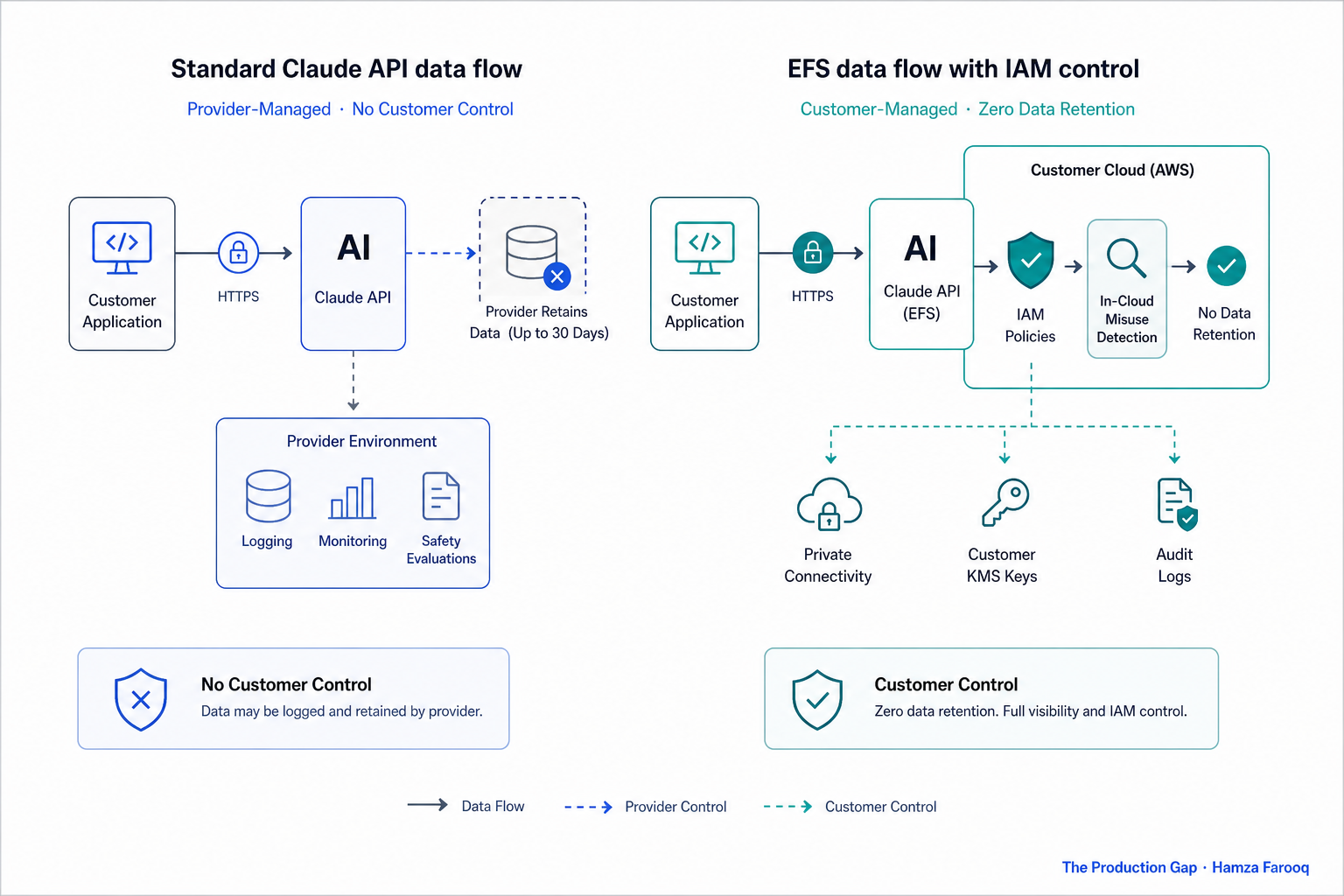
| Dimension | Standard Claude API (Zero Retention) | EFS |
|---|---|---|
| Where misuse detection runs | Anthropic infrastructure | Customer's cloud account |
| Who holds monitoring artifacts | Anthropic (transiently) | Customer (S3/Azure Blob) |
| IAM governance of safety evidence | Anthropic's policies | Customer's own IAM |
| Audit log access for third parties | Via Anthropic | Direct customer CloudTrail |
| Supports FedRAMP data residency requirements | No | Architecture-dependent |
| KPMG co-developed control design | No | Yes |
Source: Anthropic EFS announcement, September 1, 2026
What do Fable and Mythos each do inside EFS?
Anthropic designed EFS so enterprises can run Fable and Mythos without 30-day data retention at Anthropic. Both components write their output directly to customer-owned storage rather than Anthropic's infrastructure. The precise functional boundaries between Fable and Mythos, including what each monitors, enforces, or logs in detail, should be confirmed against Anthropic's technical documentation before mapping them to specific compliance controls.
What the verified architecture establishes is that monitoring artifacts route to customer-owned S3 or Azure Blob containers. The enterprise controls retention schedules, access permissions, and log integrity without routing through Anthropic. Auditors can request safety evidence directly from the enterprise, which is the structural compliance unlock EFS provides.
Which compliance frameworks does EFS support, and which use cases does that open up?
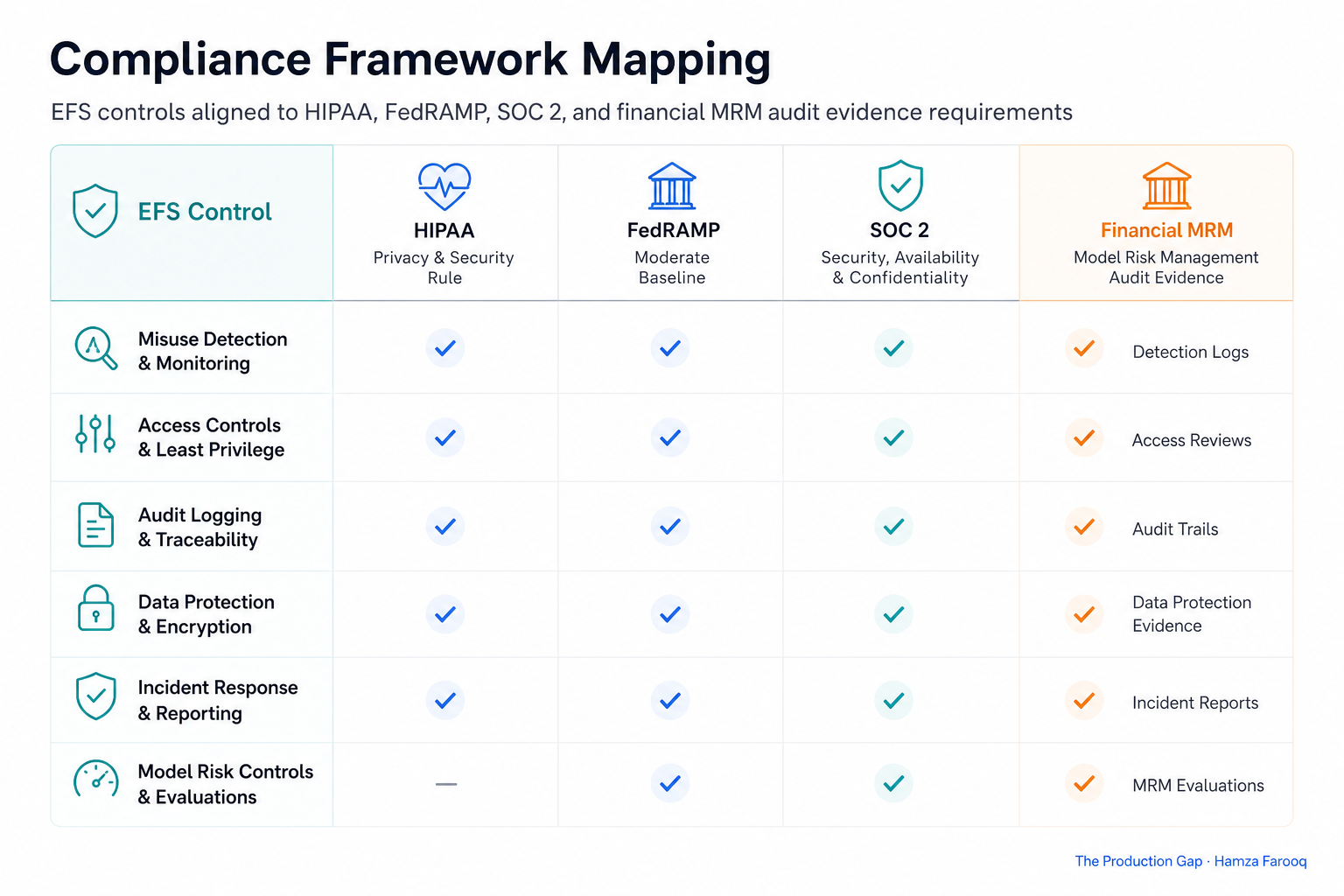
EFS combines zero data retention at Anthropic with automated misuse-monitoring capabilities, an architecture that regulated enterprises can map to HIPAA, FedRAMP, SOC 2, and financial MRM requirements, subject to their own boundary configuration.
- HIPAA: Monitoring artifacts stay inside the customer's cloud. Whether this satisfies specific technical safeguard or audit control requirements depends on the enterprise's BAA structure and configuration; engage your compliance team to confirm.
- FedRAMP: All monitoring data routes to customer-controlled storage, enabling the evidence chain FedRAMP assessors require. Authorization boundary work remains the enterprise's responsibility; engage your 3PAO.
- SOC 2 Type II: Safety evidence is directly available to third-party auditors under the enterprise's own access controls, without routing requests through Anthropic.
- Financial MRM: EFS gives MRM teams direct ownership of the monitoring evidence chain. Mapping to specific guidance such as SR 11-7 or OCC requirements should be validated with your own risk and compliance function.
Three use cases become more achievable with EFS: healthcare coding assistants, government software pipelines, and financial analysis tools subject to MRM review. EFS does not make Claude safer; it makes the proof of safety auditor-accessible.
How does the KPMG co-development partnership shape EFS audit readiness?
In the author's view, many enterprise AI compliance frameworks are built by AI companies and submitted to auditors after the fact. EFS reversed this by involving KPMG during design. When an auditor asks how the monitoring framework was validated, the answer is that KPMG co-developed the control structure, a materially different position than self-attested design. For procurement teams, KPMG's involvement provides third-party validation evidence during vendor risk assessments, which is worth surfacing in any AI governance review.
Frequently Asked Questions
Does EFS mean Anthropic can no longer see misuse data at all? Under EFS, the enterprise's own IAM controls govern visibility into monitoring artifacts; the enterprise, not Anthropic, determines who can read safety evidence.
Can EFS logs satisfy FedRAMP continuous monitoring requirements without additional configuration? EFS enables FedRAMP-compatible data residency, but authorization boundary configuration remains the enterprise's responsibility. Engage your 3PAO to confirm how EFS fits your specific authorization scope.
Does Mythos enforce policy in real time, or does it operate on Fable's batch output? The processing relationship between Mythos and Fable has not been publicly specified by Anthropic as of September 2026, meaning whether Mythos operates in real time or against Fable's batch output is not confirmed in available documentation. The timing distinction matters directly for time-sensitive enforcement scenarios, so confirm this against Anthropic's technical documentation before making latency-dependent architecture decisions.
Conclusion
EFS is not a compliance certification; it is the architecture that makes certification achievable. FedRAMP boundary work, BAA negotiations, and MRM model validation remain the enterprise's responsibility.
Next step: Map your Claude API enterprise deployment compliance blockers against the Fable and Mythos control inventory, request Anthropic's EFS technical documentation, and bring that mapping to your next MRM or audit committee review.
Learn from me

Claude Code in Practice, my Maven cohort. Master Claude Code from fundamentals to advanced orchestration: skills, subagents, hooks, MCP, and production automation. Join the next cohort →
Hire us
Traversaal.ai. We're a team of forward deployed engineers solving the toughest AI problems for Fortune 100 companies: document intelligence, agentic data platforms, and real-time web intelligence, deployed in production. Work with our team to deploy your next agentic ecosystem. Talk to Traversaal.ai →
Join us
Want to solve these problems with us? We're always looking for forward deployed engineers who want to ship production AI. jobs@traversaal.ai