Agent-Native Service Mesh: Why Sidecar Proxies Break for Agent-to-Tool Traffic and What Replaces Them
Agent-native service mesh fixes what sidecar proxies miss: schema-aware routing, per-tool rate limits, and MCP-native observability for AI agent traffic.

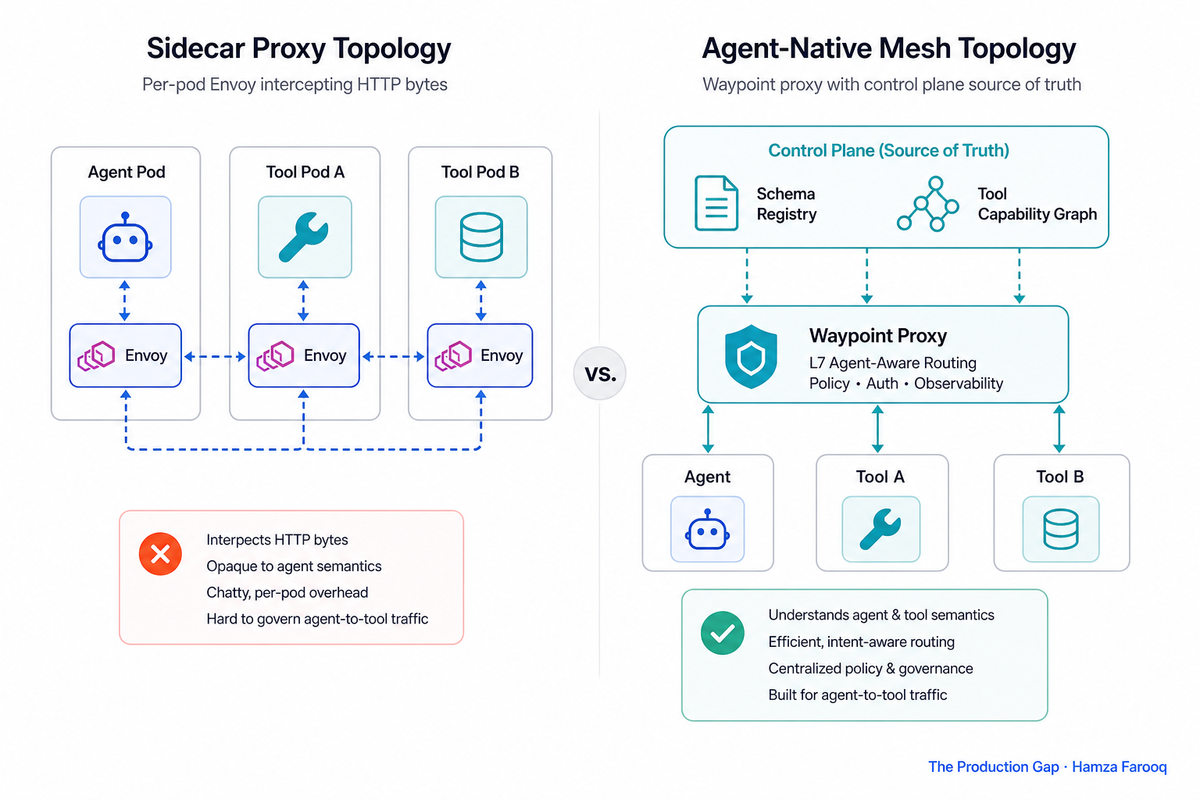
An agent-native service mesh replaces sidecar proxies because sidecars were built for HTTP request-response traffic, not the dynamic, schema-driven tool calls that AI agents make at runtime. Classical sidecars cannot enforce per-tool rate limits, route by semantic intent, or trace individual LLM-initiated calls. Agent-native service meshes solve this by embedding schema-aware routing, call-level observability, and tool-scoped policy directly into the data plane. If your mesh reports zero errors while agents silently consume malformed tool responses, the gap this article describes is already present in your infrastructure.
TL;DR: An agent-native service mesh replaces sidecar proxies because sidecars were built for HTTP request-response traffic, not the dynamic, schema-driven tool calls that AI agents make at runtime. Traditional sidecars cannot enforce per-tool rate limits, route by semantic intent, or trace individual LLM-initiated calls. Agent-native service meshes solve this by embedding schema-aware routing, call-level observability, and tool-scoped policy directly into the data plane. An Istio deployment can report nominal request rates and clean p99 latency while agents silently call the wrong version of a tool. The mesh cannot see the problem because it was not built to look for it.
Key Takeaways
- Sidecars were built for HTTP, not tools: Sidecar proxies route by network endpoint and have no model for tool-calling contracts.
- Schema-aware routing changes the rules: An agent-native mesh reads each tool's input/output schema to route to the instance that can actually satisfy the request.
- Per-tool rate limiting is a different problem: Classical meshes cap at the service level; agent workloads need per-tool, per-agent-identity quotas.
- Call-level observability fills a blind spot: Every tool invocation benefits from its own structured trace rather than aggregate request metrics.
- MCP is the protocol meshes must speak natively: Any infrastructure layer that cannot parse the Model Context Protocol is enforcing policy on an opaque byte stream.
- Waypoint proxies replace sidecars for agent traffic: A shared ambient proxy sees both sides of each MCP exchange, providing the visibility required to enforce schema contracts.
What is an agent-native service mesh and why does it matter?
An agent-native service mesh is a data-plane and control-plane architecture purpose-built for agent-to-tool traffic, where the source of truth is a tool capability graph rather than a network topology map. It matters because the classical sidecar model was designed for HTTP request-response workloads and has no architectural mechanism for schema-version enforcement, per-tool quota management, or per-invocation tracing, three capabilities that become load-bearing the moment AI agents start calling tools dynamically at runtime.
Why does the sidecar proxy model break for agent-to-tool traffic?
The sidecar proxy model breaks for agent-to-tool traffic because sidecars route by network endpoint, not by tool capability contract. They see bytes and headers, never intent, schema version, or tool semantics.
A predictable failure mode, as a practical rule of thumb in this guide's framing, is tool versioning drift. When a tool's output schema changes from v2 to v3, there is no enforcement layer at the sidecar to catch the mismatch. The agent receives a structurally different response with no error signal to trigger a retry. Istio is being repositioned as future-ready for AI workloads , an acknowledgment that schema-level enforcement is not part of its current architecture. The primary failure is semantic, not a performance issue.
What does an agent-native service mesh do structurally differently?
An agent-native service mesh moves its control plane's source of truth from network topology to a tool capability graph, enabling schema-aware routing, per-tool rate limiting, and call-level observability that classical meshes have no architecture for.
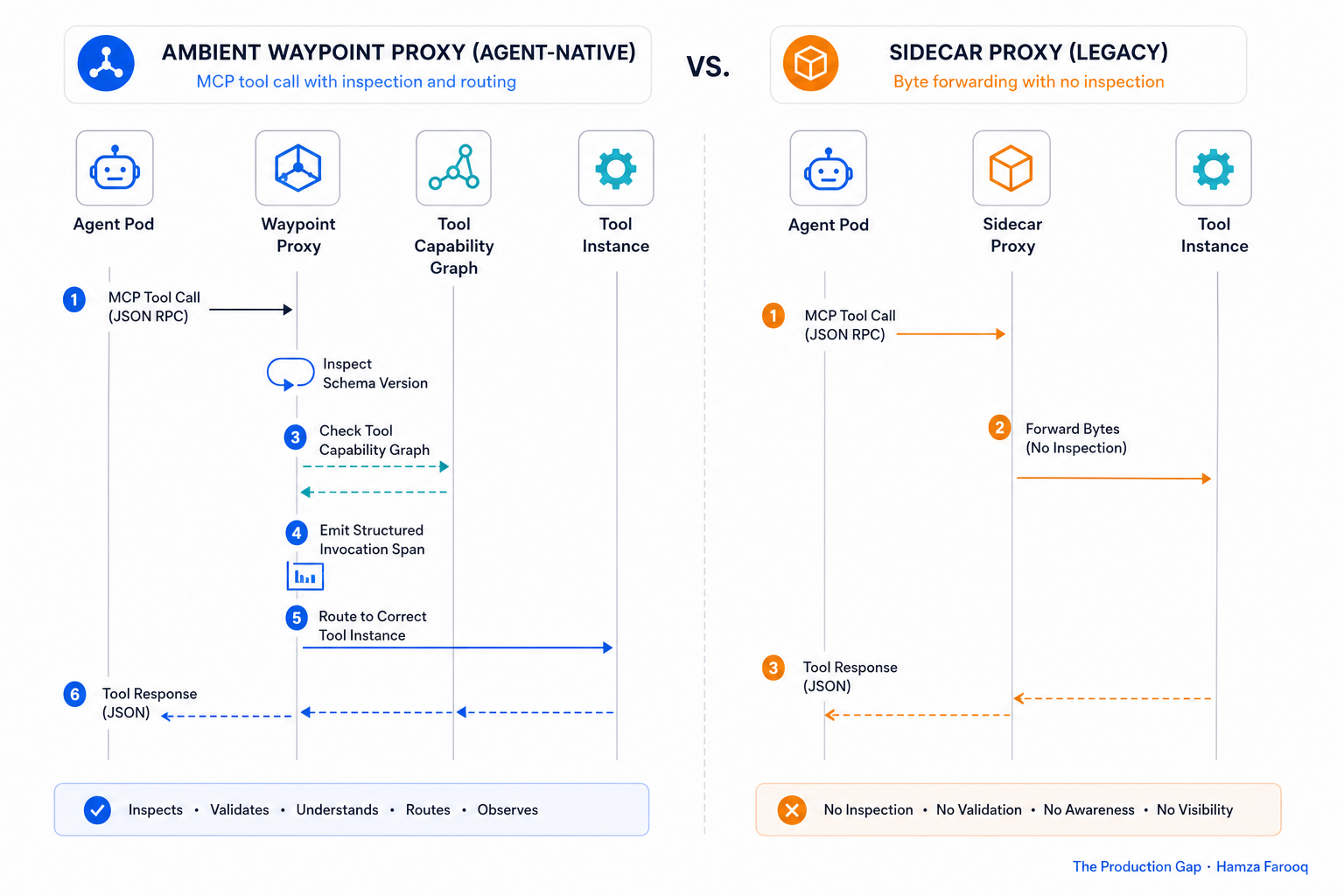
Schema-aware routing means the mesh reads a tool's declared input/output schema and matches each call to an instance satisfying the contract at the correct schema version. An agent calls search_documents expecting schema v3; the mesh inspects the MCP envelope, checks the capability graph, routes to the v3-capable instance, and rejects calls targeting v2, without the agent knowing which pod served it.
Call-level observability addresses a gap in standard mesh telemetry. Solo.io's agentgateway waypoint layers AI-native telemetry on top of the request rates, latencies, and connection metrics that standard Istio already provides, extending visibility down to individual tool invocations rather than aggregated service-level metrics. This requires a different control plane data model and cannot be bolted onto standard Envoy configuration.
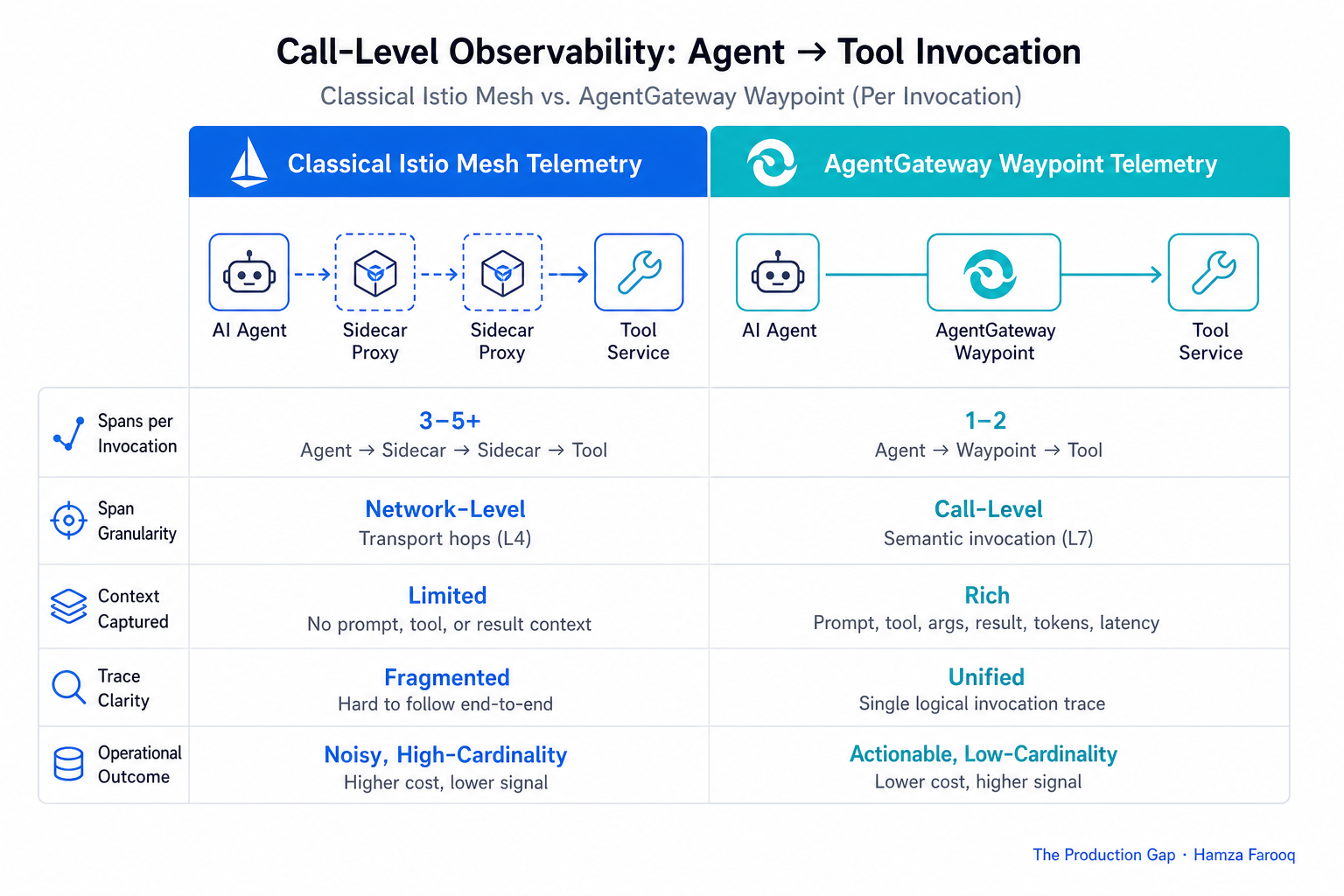
How do classical and agent-native meshes compare on capability?
The table below is the clearest way to see where the sidecar model stops and where agent-native architecture begins. Two rows decide the purchasing question in this guide's framework.
Table 1: Classical vs. Agent-Native Mesh Capability Matrix (as of Q2 2025)
| Capability | Classical Istio / Envoy Sidecar | Agent-Native Mesh (e.g., agentgateway, Agent Router Enterprise) |
|---|---|---|
| Routing model | Network endpoint (URL, host, method) | Tool capability contract + schema version |
| Protocol awareness | HTTP/gRPC/TCP | MCP-native + HTTP/gRPC |
| Rate limiting granularity | Per-service, per-route | Per-tool, per-calling-agent-identity |
| Observability unit | Request (aggregate metrics) | Tool invocation (structured span per call) |
| Schema registry | None | Native, control plane source of truth |
| Tool version enforcement | None, silent capability drift | Schema-version matching, mismatch rejection |
| Deployment model | Per-pod sidecar | Shared waypoint proxy (ambient mesh) |
| Existing Istio compatibility | N/A | agentgateway: extends Istio; Agent Router: managed AI Gateway with MCP integration |
Tool version enforcement: None is the silent failure no rate limiter catches. A schema changes and every dependent agent consumes a malformed contract with no observable error signal. MCP protocol awareness is the second decisive row: a mesh that cannot parse MCP envelopes enforces policy on an opaque byte stream.
How do waypoint proxies replace sidecars for agent workloads?
Waypoint proxies replace per-pod sidecars by running a shared, namespace-scoped proxy that intercepts agent-to-tool traffic at the ambient mesh layer, eliminating per-pod overhead while gaining the semantic depth to inspect and enforce MCP tool-call contracts.
The waypoint proxy is the deployment vehicle. The schema registry as control plane source of truth is the architectural shift. Both are required, and neither is sufficient alone.
FAQ
What specific limitations does Envoy sidecar proxy have when handling agent-to-tool traffic?
Envoy routes by URL, host, and HTTP headers and has no model for tool capability contracts, schema versions, or MCP semantics, so it cannot detect version mismatches, enforce per-tool quotas, or emit per-invocation spans. The practical result, as this guide frames it, is silent capability drift that surfaces no circuit-breaker signal.
Can existing Istio deployments be extended to handle agentic workloads, or is a full replacement required?
Partial extension is viable: Solo.io's agentgateway waypoint adds AI-native telemetry and agent-aware routing on top of Istio without replacing it. Full schema-registry enforcement and native MCP integration require purpose-built components, as in Tetrate's Agent Router Enterprise.
How do you implement per-tool rate limiting when multiple agents share the same tool endpoint?
Per-tool rate limiting applies a quota at the individual tool call level rather than at the service endpoint level, using the calling agent's identity as the enforcement key. In the framework used in this guide, the waypoint proxy is the right enforcement point because it intercepts the MCP envelope before the tool pod receives the call, making agent identity and tool name available as policy dimensions simultaneously.
What does call-level observability look like in practice for agent workloads?
Call-level observability means each tool invocation produces its own structured record showing which agent called which tool, at what schema version, and whether the exchange succeeded, rather than surfacing only aggregated per-service request counts. Solo.io's agentgateway waypoint layers AI-native telemetry of this kind on top of standard Istio metrics, as described in the author synthesis above .
Conclusion
The sidecar problem is not latency. It is semantics. Sidecars are network proxies operating on bytes; agent-to-tool traffic is capability negotiation operating on schemas and contracts. The most consequential gap, in the framework used throughout this guide, is the absence of a schema registry as control plane source of truth and the silent capability drift that follows when tool schemas change with no enforcement layer in place.
Existing Istio teams should evaluate agentgateway waypoint. Greenfield teams should evaluate Agent Router Enterprise. Either way, the diagnostic question is the same: if you cannot answer which schema version an agent called and whether the tool fulfilled the contract for recent invocations, the gap this article describes is already active in your infrastructure.
A mesh reporting zero errors is not evidence agents are getting what they asked for. It is evidence the mesh does not know what they asked.
Learn from me
Forward Deployed Engineering Bootcamp for Full-Stack Developers, my Maven cohort. Build and ship complete AI products end to end, from React and Node.js frontends to deployed models with caching and observability. Join the next cohort →
Hire us
Traversaal.ai. We're a team of forward deployed engineers solving the toughest AI problems for Fortune 100 companies: document intelligence, agentic data platforms, and real-time web intelligence, deployed in production. Work with our team to deploy your next agentic ecosystem. Talk to Traversaal.ai →
Join us
Want to solve these problems with us? We're always looking for forward deployed engineers who want to ship production AI. jobs@traversaal.ai