Mainframe API Integration Wrapper: How the Agent-Wrapper Pattern Makes Legacy Systems Real-Time and Agent-Compatible
Mainframe API integration wrapper patterns explained: learn how agent-wrapper design handles CICS latency, idempotency, and legacy system failures.

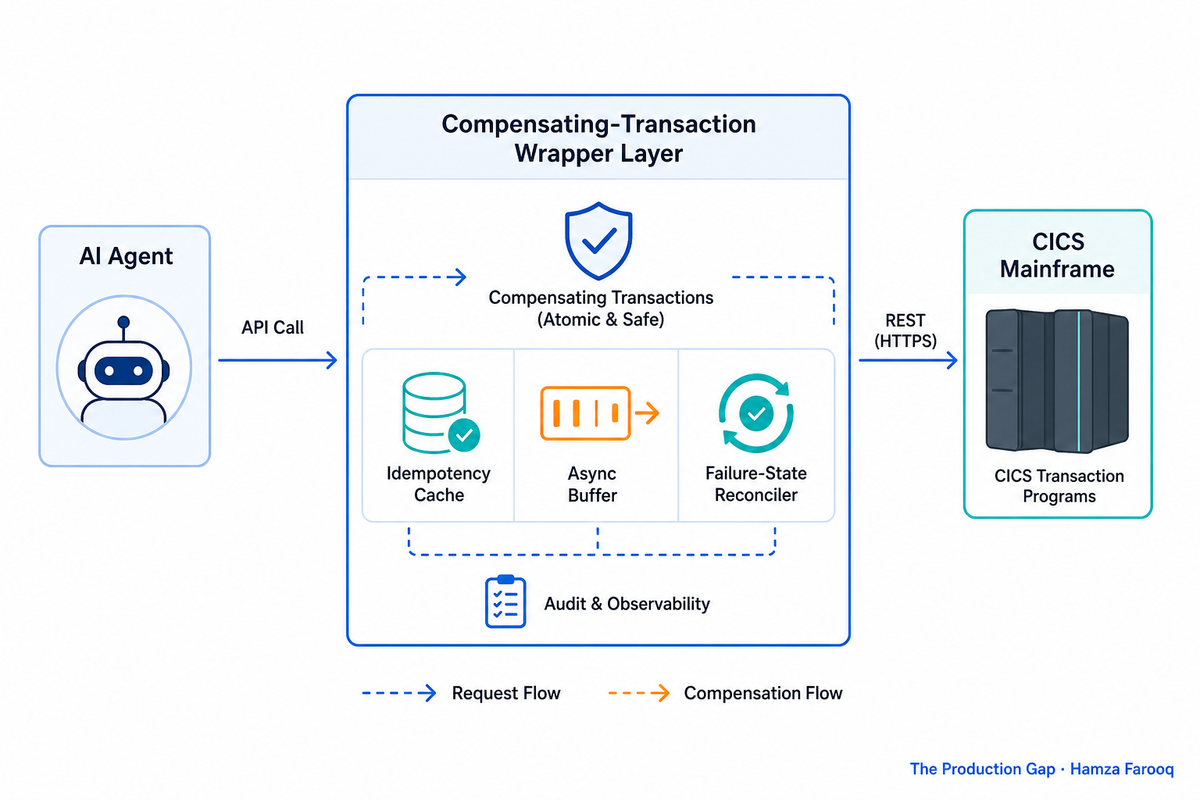
TL;DR: A mainframe API integration wrapper solves the incompatibility between batch-oriented legacy systems and real-time agent consumers by sitting between them as a translation layer that buffers latency mismatches, enforces idempotency, compensates for partial failures, and maps mainframe transaction boundaries to modern REST or event-driven contracts. The wrapper makes the mainframe appear instantaneous and stateless without touching the underlying system.
Key Takeaways
- Naive REST wrappers break at scale: A simple HTTP layer ignores transaction semantics and causes high failure rates under agent-driven load.
- Latency mismatch requires active buffering: The wrapper must return synthetic acknowledgments so agents do not time out.
- Partial failures need compensation logic: When a mainframe commits but the response is lost, the wrapper reconciles state, not the agent.
- Protocol translation goes deeper than format conversion: EBCDIC and copybook parsing is the surface; UOW boundary mapping is the structural work.
- Observability lives inside the wrapper: The wrapper must generate its own correlation IDs and failure-state logs because the mainframe cannot.
Why does a naive REST wrapper fail when an AI agent calls a mainframe?
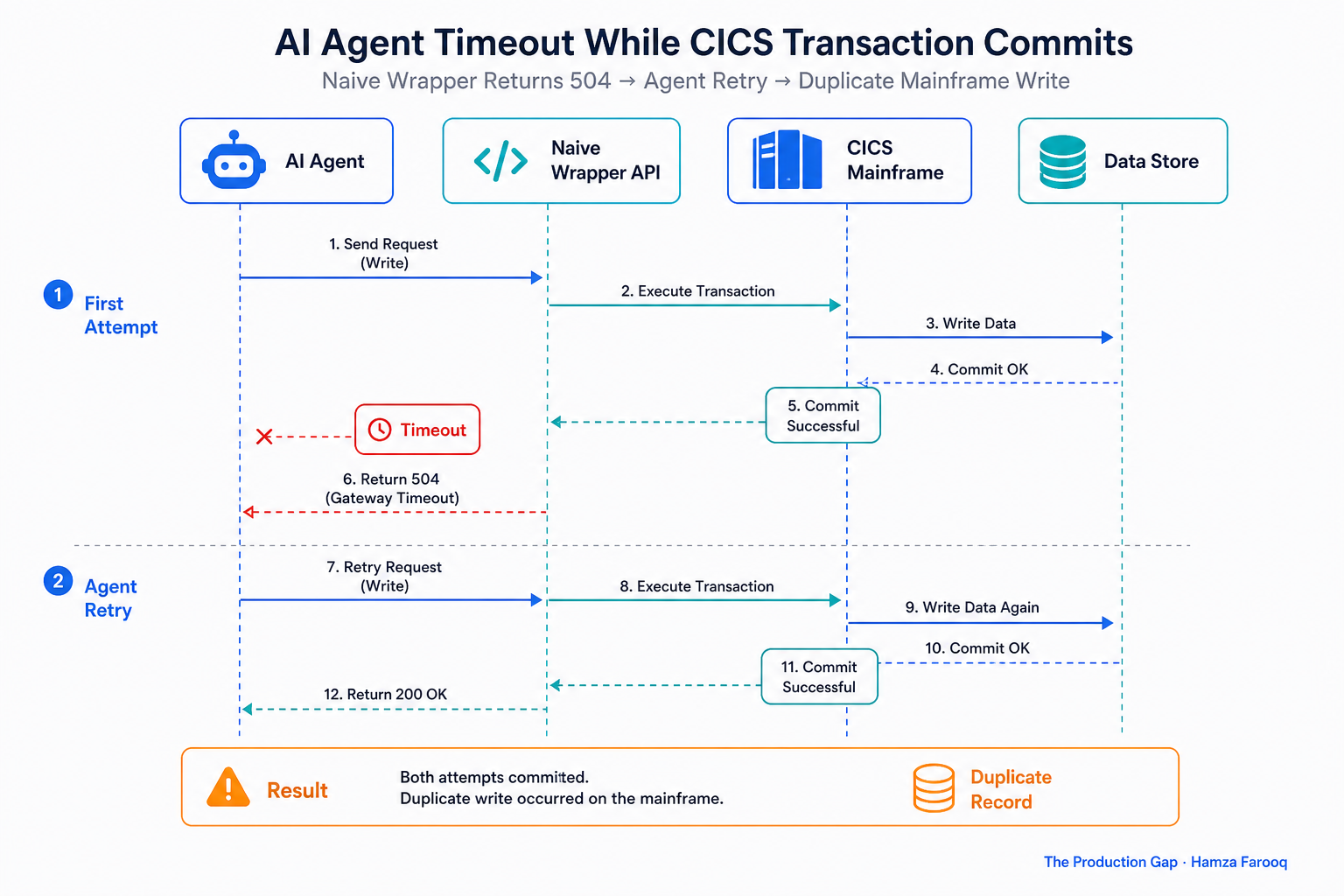
A naive REST wrapper fails because it exposes a protocol interface without owning the transaction semantics underneath it. Mainframes use unit-of-work (UOW) semantics (a transaction either fully commits or fully rolls back) and that outcome is not always communicated back up the stack. The wrapper receives silence, the agent receives a timeout, and the mainframe has already moved on.
Three failure modes follow. First, the agent times out while the mainframe has already committed. Second, the agent retries against a CICS program with no built-in idempotency key support. Third, the agent cannot determine whether the transaction committed at all. In a claim-adjudication scenario, if CICS response time exceeds the agent's timeout, the wrapper returns a 504, the agent retries, and the COBOL program may run twice, writing duplicate records.
An API gateway routes and authenticates. A wrapper owns failure semantics. As horizon.dev states, the right approach is to "wrap rather than replace, create intelligent API layers.
How should a wrapper handle latency mismatch, idempotency, and partial failure?
A correctly built wrapper handles latency mismatch through async buffering, enforces idempotency via fingerprint caching, and resolves partial failures through a reconciliation probe. The mainframe provides none of those mechanisms, the wrapper must supply all three.
Async buffering: When mainframe response time exceeds the agent's timeout, the wrapper accepts the request, emits a correlation-keyed message to IBM MQ, and immediately returns a synthetic 202 Accepted with a job token. The agent polls or receives a webhook when the mainframe responds. Superblocks confirms this architecture: "messaging brokers like IBM MQ serving as a complementary integration mechanism."
Idempotency enforcement: The wrapper fingerprints each inbound request using a hash of agent ID, payload, and intent token, then checks a cache such as Redis before allowing any CICS call. A committed status returns the cached response without touching the mainframe; an in-flight status returns a conflict response with a retry-after signal. Because CICS provides no native idempotency key support, this fingerprint cache is the only reliable mechanism for blocking duplicate commits.
Partial failure compensation: When the mainframe commits but the TCP connection drops before the response arrives, the wrapper holds an unknown state. It must run a reconciliation probe (a read-only, idempotent query to the mainframe or its audit log) to resolve actual commit state before returning anything to the agent.
Table 1: Agent-Wrapper Pattern vs. Naive REST Wrapper
| Failure Mode | Naive REST Wrapper | Agent-Wrapper Pattern |
|---|---|---|
| Mainframe response exceeds agent timeout | Returns 504; agent retries blindly | Returns 202 + token; async delivery via MQ |
| Agent retry on CICS with no idempotency support | Duplicate transaction committed | Fingerprint cache blocks replay; cached response returned |
| Mainframe commits, response lost | Agent holds unresolvable error | Reconciliation probe resolves commit state |
| CICS silent rollback | Wrapper returns 200 (incorrect) | Wrapper parses UOW status codes; returns structured error |
What does EBCDIC and copybook parsing require?
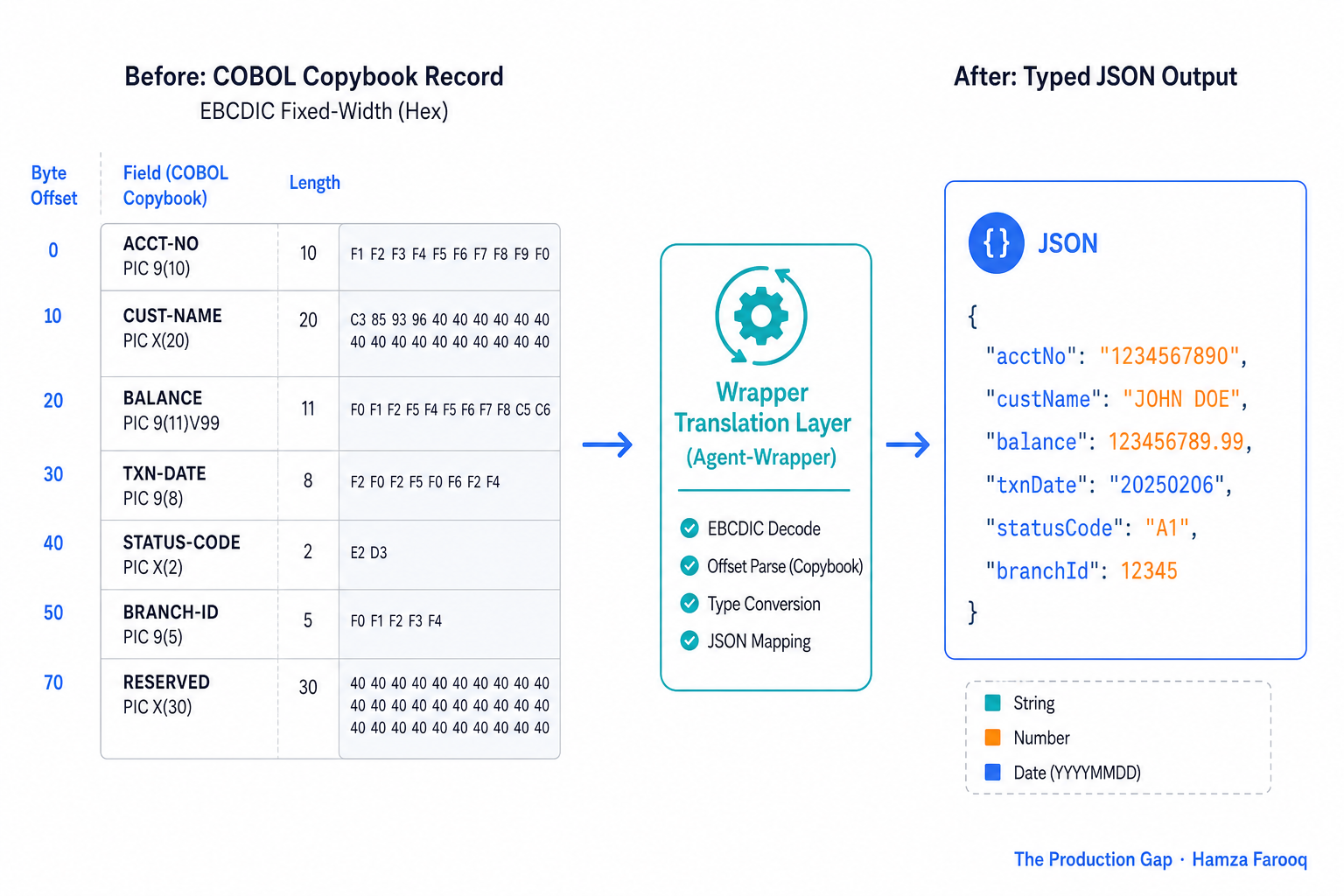
EBCDIC-to-UTF-8 conversion and fixed-width COBOL copybook parsing both require the wrapper to own the schema and deserialize each field by offset and type. COBOL copybooks define fixed-width, packed-decimal, and binary fields with no direct JSON equivalent, this is not a simple iconv call. As hicronsoftware notes, "API wrapping bridges new protocols and older architectures by translating modern requests into formats a COBOL mainframe can process." FDEs must own the copybook-to-schema mapping directly. Zowe can support this layer, though the copybook mapping itself remains the engineer's responsibility.Parsing correctly means the wrapper produces typed JSON that downstream agents can consume without further transformation.
How does the wrapper handle UOW boundary mapping?
UOW boundary mapping is where the wrapper defines the atomic contract agents consume, because a single agent API call may span multiple CICS programs in sequence. The wrapper must map those programs into one atomic, retriable API contract and surface a clear partial-completion status so a mid-saga failure does not leave state partially committed with no recovery path.
Beyond boundary mapping, the wrapper generates its own correlation IDs at request ingress, propagates them through every MQ message and CICS call, and writes structured logs capturing what was sent, received, and the UOW outcome. Microsoft's Azure mainframe extension architecture supports exactly this observability model. Without this layer, post-incident analysis is blind, the mainframe cannot supply correlation context to modern logging infrastructure.
Frequently Asked Questions
How does the agent-wrapper pattern differ from a standard API gateway? A gateway handles routing, authentication, and rate-limiting; an agent-wrapper also owns idempotency enforcement, async buffering, partial-failure compensation, and UOW boundary translation. A gateway that encounters a CICS timeout has nowhere to route the failure, a wrapper resolves it.
How do you handle a mainframe transaction that commits but returns no response before the agent times out? The wrapper runs a reconciliation probe (an idempotent read-only query to the mainframe or its audit log) resolves the pending state, and responds with a definitive outcome. Surfacing unknown to the agent is not acceptable; the agent has no mechanism to resolve it.
When should an FDE use IBM MQ instead of a synchronous REST-to-CICS call? Use IBM MQ when mainframe response time exceeds the agent's timeout budget or when reliable delivery and replay guarantees matter. Synchronous REST-to-CICS only works when response times are consistently below the timeout ceiling, a condition that must be verified, not assumed.
What is the correct way to enforce idempotency when CICS has no native idempotency key support? Fingerprint each request using a hash of agent ID, payload, and intent token, then store it with commit status in a cache before any CICS call. A committed status returns the cached response; an in-flight status returns a conflict signal with a retry-after value. This wrapper-side cache is the only reliable control point.
Conclusion
The wrapper that works in production is not a translation layer or thin middleware, it is a compensating-transaction engine that owns async buffering, idempotency caching, reconciliation probing, and observability. The mainframe will not provide any of those. The wrapper must. Audit your current mainframe-facing wrapper against those four mechanisms: whichever is missing is your most likely source of the next production incident. The mainframe is not the legacy problem. The wrapper that fails to absorb its complexity is.
Learn from me
Forward Deployed Engineering Bootcamp for Full-Stack Developers, my Maven cohort. Build and ship complete AI products end to end, from React and Node.js frontends to deployed models with caching and observability. Join the next cohort →
Hire us
Traversaal.ai. We're a team of forward deployed engineers solving the toughest AI problems for Fortune 100 companies: document intelligence, agentic data platforms, and real-time web intelligence, deployed in production. Work with our team to deploy your next agentic ecosystem. Talk to Traversaal.ai →
Join us
Want to solve these problems with us? We're always looking for forward deployed engineers who want to ship production AI. jobs@traversaal.ai