Multi-Agent Orchestration Patterns: How to Choose Between Supervisor, Pipeline, and Swarm Architectures
Multi-agent orchestration patterns explained: learn when to use supervisor, pipeline, or swarm architectures to cut costs and build reliable AI systems.

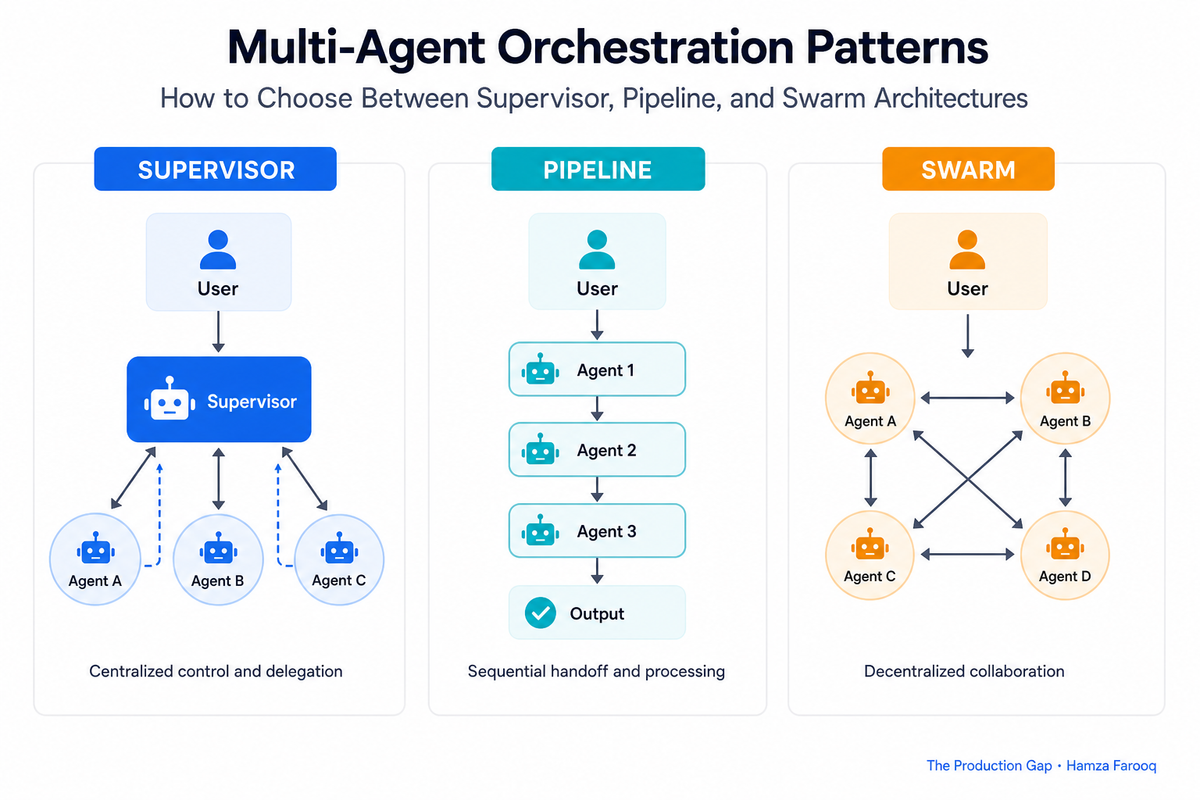
TL;DR: Use a supervisor when tasks require dynamic decision-making, a pipeline when work flows linearly through predictable stages, and a swarm when parallel agents outperform centralized control. Match the pattern to your task structure before writing any code.
You spun up three agents, wired them together, and watched costs balloon inside a week. The agents were not the problem. The architecture you picked without examining it was.
Key Takeaways
- Pattern choice shapes everything: The decision before you write code determines cost, reliability, and debuggability.
- Supervisor pattern owns complex decisions: Use it when tasks require dynamic routing or mid-flight judgment.
- Pipeline pattern fits predictable sequences: Fixed order, clean handoffs, lower operational complexity.
- Swarm pattern trades control for speed: Parallel agents finish broad tasks faster but risk duplicated work and compounding token costs.
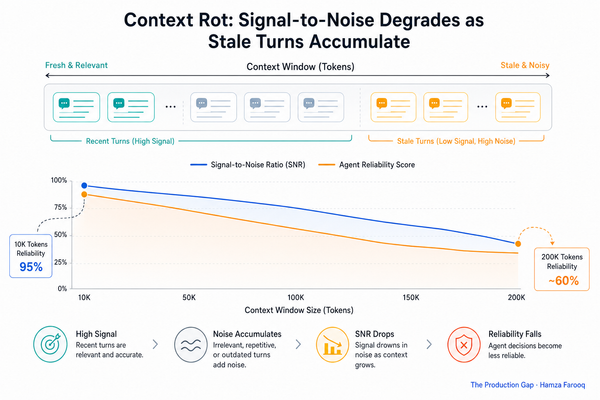
- Context fragmentation is the silent killer: Agents on incomplete shared state produce incoherent results.
- Hybrid architectures are valid: Combine patterns deliberately, with explicit boundaries between them.
Why does multi-agent orchestration pattern choice matter?
Choosing the wrong orchestration pattern is the most consequential architectural mistake you can make, because it determines cost, reliability, and debuggability before a single line of agent logic is written. Choosing the right orchestration pattern is the most consequential architectural decision in a multi-agent system. Most engineers adopt whatever pattern the tutorial used and face a costly rewrite after launch. Supervisor, pipeline, and swarm are not mutually exclusive, knowing how to combine them deliberately separates systems that hold up from systems that collapse under production load.
What is each orchestration pattern and what does it actually do?
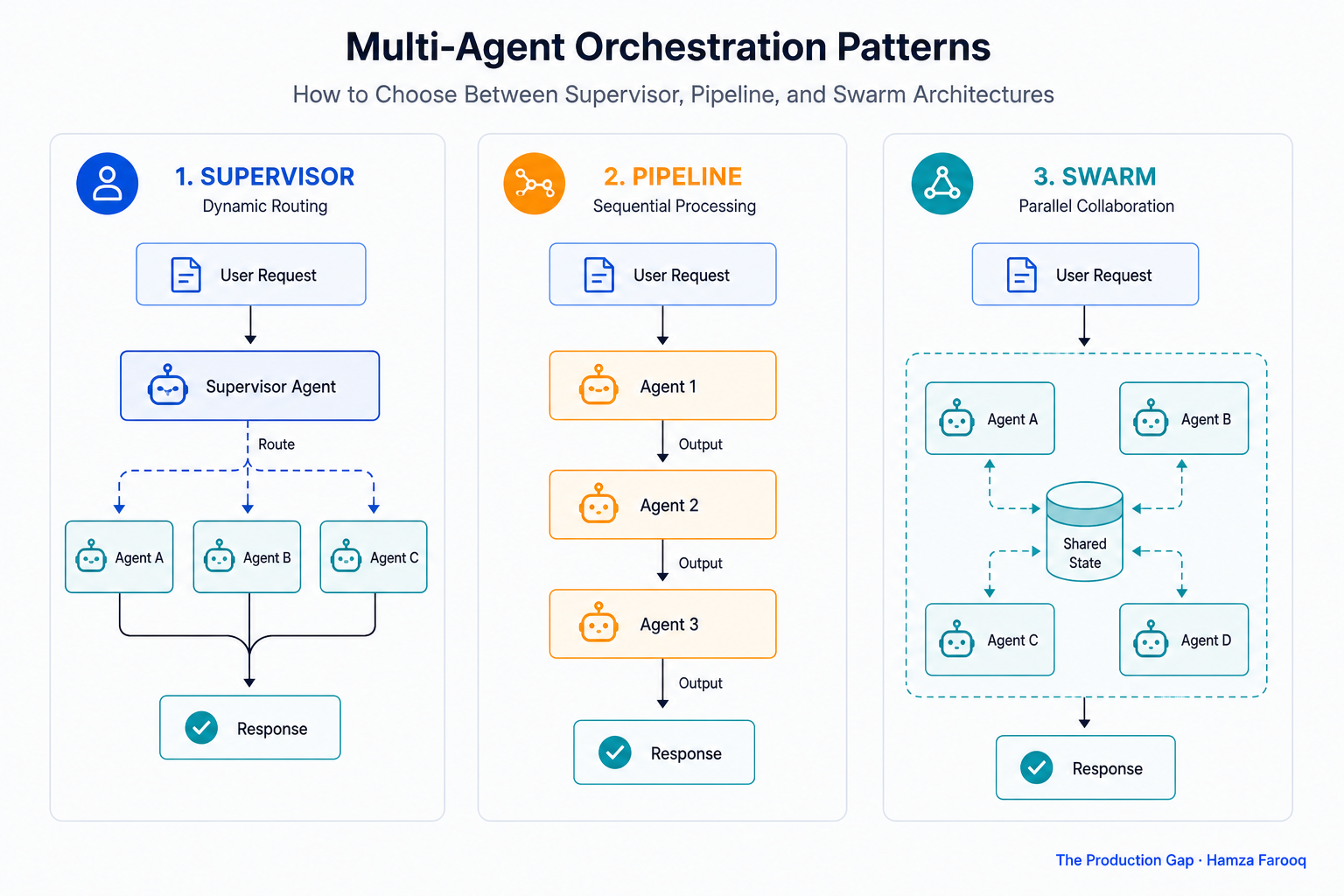
The supervisor pattern uses one central agent to route tasks dynamically; the pipeline pattern chains agents in a fixed sequence; the swarm pattern lets decentralized agents collaborate in parallel on shared state.
Supervisor pattern
A supervisor agent receives the top-level task, decides which specialized agents to invoke, routes outputs between them, and adapts the plan mid-flight when earlier results change what comes next. This suits tasks where the sequence of steps cannot be fully determined before runtime. The tradeoff: the supervisor becomes a single point of failure and a latency source when routing decisions require repeated inference calls.
Pipeline pattern
A pipeline chains agents in a fixed, predetermined order, each agent completes its step and hands output to the next. LangChain's framework taxonomy identifies subagents, skills, handoffs, and routers as building blocks that map directly onto how pipeline stages compose in practice. Pipelines suit document processing, content transformation, and any workflow where sequence is known before execution. A single failed step can halt the chain, so explicit fallback behavior at each stage is worth building in from the start.
Swarm pattern
Multiple agents operate in parallel, each tackling a slice of the problem autonomously and coordinating through shared state or message-passing. The Azure Architecture Center describes it directly: "multiple AI agents run simultaneously on the same task." This works best for genuinely parallelizable research or broad information gathering. Without tight coordination, agents duplicate work and context costs grow in ways that outpace speed gains.
Pick the task topology first, then select the pattern that fits it.
What tooling supports each pattern in practice?
Concrete framework choices make architectural intent explicit to every engineer who maintains the system. The following pairings reflect common usage:
Pipeline pattern: LangChain Expression Language (LCEL) composes chains declaratively, with explicit handoffs and fixed execution order that makes debugging straightforward.
Naming the framework at design time (not just in the README after the fact) makes it easier to reason about boundaries when patterns are nested.
What are the critical failure modes for each pattern, and how do you catch them early?
The three most dangerous failure modes are context fragmentation in swarms, cost growth from redundant context rehydration, and stalls or brittleness in supervisor-controlled pipelines. Identifying your dominant failure mode before writing the first agent is more valuable than any post-launch remediation.
Context fragmentation in swarm architectures
Context fragmentation happens when agents operate on different, incomplete versions of shared state because each carries its own conversation history rather than reading from a centralized store. The result is contradictory outputs not caught until human review. Centralizing agent state in a dedicated context store (where agents read and write shared state rather than maintaining independent histories) is the most reliable structural fix. Multi-agent is worth it only when your task decomposes cleanly and you can keep roles, state, and handoffs tight.
Cost growth from context rehydration
Cost growth is typically caused by re-injecting the full shared context into every agent prompt at every hop. Passing delta context (only what changed since the last hop) is the highest-leverage cost control in swarm design and should be a design constraint from day one, not a retrofit.
Stalls and pipeline brittleness
Supervisor stalls occur when an orchestrator waits on an agent that is itself waiting on an unresolved upstream output, creating a silent deadlock. In pipelines, a single failed step halts the chain unless fallback behavior is defined explicitly at each stage. Designing downstream agents to continue with degraded input prevents a common class of production incidents.
How do you choose the right pattern, or combine them?
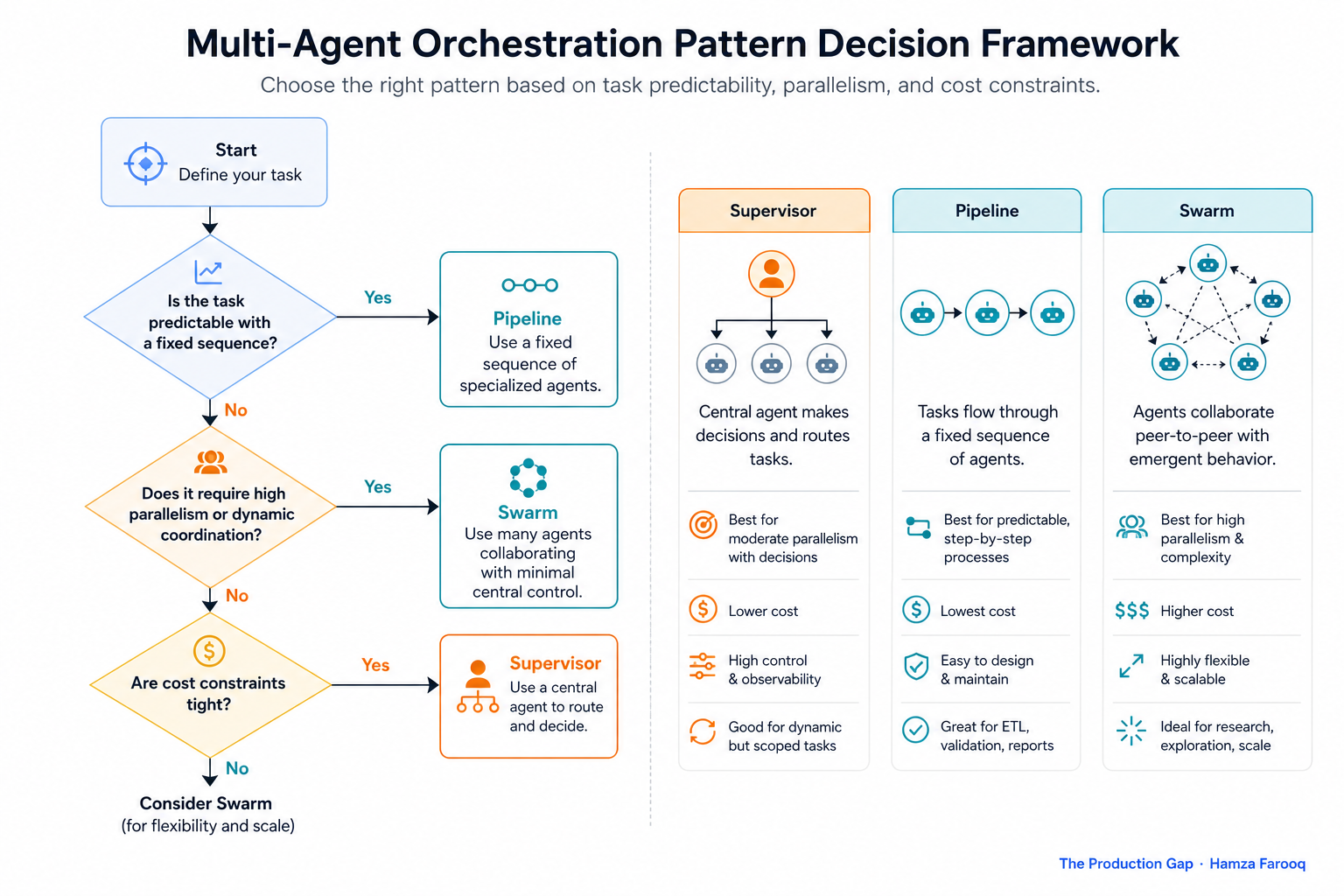
Choose a supervisor when tasks are unpredictable, a pipeline when order is fixed, and a swarm when subtasks are genuinely parallelizable. In production, nesting patterns is common and often the correct choice.
Table 1: Multi-Agent Pattern Selection Criteria
| Criterion | Supervisor | Pipeline | Swarm |
|---|---|---|---|
| Task graph known upfront? | No | Yes | Partially |
| Steps must run in sequence? | Sometimes | Always | No |
| Subtasks are independent? | No | No | Yes |
| Mid-task rerouting needed? | Yes | No | No |
| Relative cost risk | Medium | Lower | Higher |
| Debug complexity | Medium | Low | High |
The hybrid approach
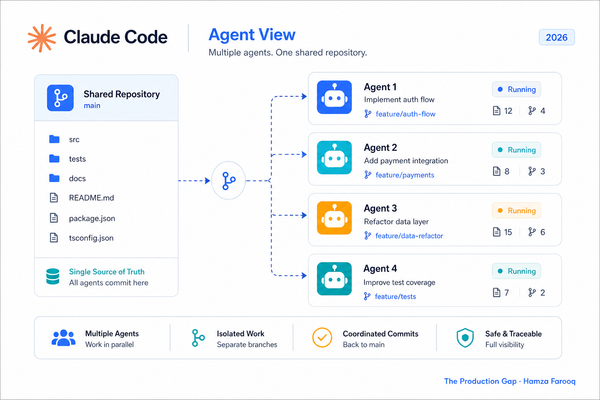
Production systems usually nest patterns. A common structure is a supervisor outer loop wrapping an inner pipeline for deterministic subtasks, with swarm bursts triggered only for parallelizable exploration. The architectural skill is knowing where to draw the boundary between patterns.
The single-agent escape hatch
If tasks cannot be decomposed cleanly and handoffs cannot be defined tightly, do not add agents. A single capable agent is always easier to debug than a poorly orchestrated multi-agent system.
Frequently Asked Questions
When should I use a supervisor pattern instead of a pipeline?
Use a supervisor when you cannot predict the task sequence before runtime and the workflow requires mid-execution rerouting or conditional branching. If every step is known in advance, a pipeline is easier to debug and carries lower operational complexity.
How does context fragmentation happen in multi-agent swarms?
Fragmentation occurs when agents carry independent conversation histories instead of reading from a centralized store, producing contradictory outputs. Externalizing state and passing only relevant deltas at each handoff addresses the root cause structurally.
What causes cost growth in swarm architectures?
Redundant context rehydration, re-injecting the full shared context into every agent prompt at every hop. Passing delta context is the direct fix and should be a design constraint from the start.
Can I combine multiple orchestration patterns in one system?
Yes, and it is common in production. A supervisor can delegate to an inner pipeline for deterministic steps, with swarm bursts reserved for parallelizable subtasks. Making the boundaries between patterns explicit in your design is what keeps hybrid systems maintainable.
Conclusion
Start with a pipeline: easiest to debug, lowest operational complexity, fastest path to proving value. Move to a supervisor only when routing genuinely requires dynamic judgment at runtime. Add swarm bursts only when a subtask is truly parallelizable and you have accounted for rehydration overhead. Get the orchestration pattern wrong and the whole system misbehaves in ways that are expensive to trace.
Draw your task graph before your next build session. Mark every decision point, every handoff, and every step that could run in parallel. The right pattern becomes apparent from the structure of the work, and if it does not, the task decomposition is not yet clean enough to justify adding agents.
Learn from me

Agent Engineering Bootcamp: Developers Edition, my Maven cohort. Advanced agentic RAG, multi-agent orchestration, memory, evals, and guardrails. Take agents from prototype to production. Join the next cohort →
Hire us
Traversaal.ai. We're a team of forward deployed engineers solving the toughest AI problems for Fortune 100 companies: document intelligence, agentic data platforms, and real-time web intelligence, deployed in production. Work with our team to deploy your next agentic ecosystem. Talk to Traversaal.ai →
Join us
Want to solve these problems with us? We're always looking for forward deployed engineers who want to ship production AI. jobs@traversaal.ai