Agentic AI in Supply Chain: How Autonomous Execution Delivers 3x ROI Beyond Traditional Automation
Agentic AI supply chain systems don't just recommend—they act. Learn how autonomous execution triples ROI and what guardrails you need before deploying.

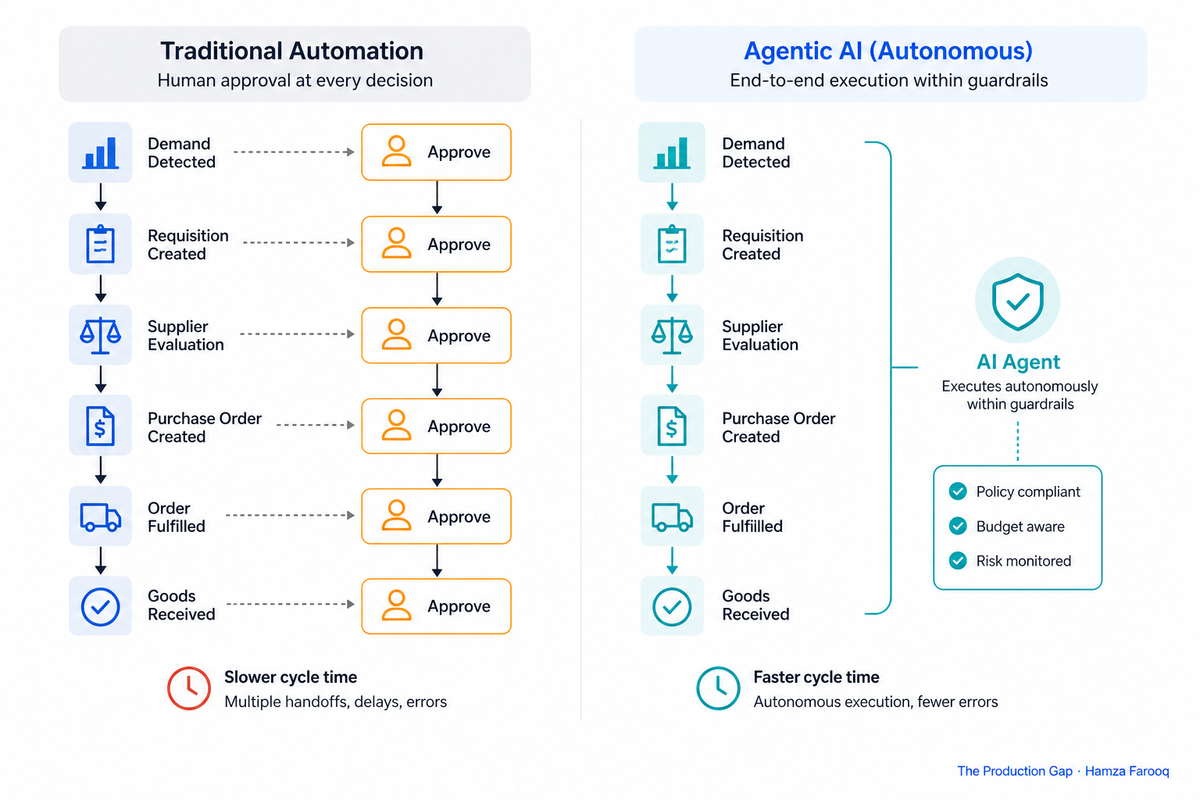
TL;DR: Agentic AI supply chain systems go beyond recommending actions to executing them autonomously within defined guardrails. Deployed correctly on high-volume, rules-bound processes, they eliminate human approval latency across thousands of daily decisions, producing meaningfully higher ROI than traditional automation. The limiting factor is not the technology; it is organizational readiness to govern autonomous decisions responsibly.
Key takeaways
- Agentic AI acts, not just advises: It independently executes decisions, issuing purchase orders, adjusting schedules, without waiting for human approval.
- The execution gap is real: Autonomous execution compounds returns through speed, lower labor overhead, and compressed exception cycles in ways rule-based automation cannot.
- SAP and AWS have already shipped production-ready tools: The early-mover window is open, but it won't stay that way.
- Guardrails are the real challenge: Define spending limits, risk thresholds, and escalation triggers before deployment, not after.
- Audit trails are non-negotiable: Every autonomous decision must be logged, explainable, and reconstructible for compliance and legal defensibility.
- Not every process is ready: Routine replenishment is a strong candidate today; complex negotiations and crisis response still need a human in the final seat.
What makes agentic AI fundamentally different from traditional supply chain automation?
Agentic AI is software that perceives its environment, selects from a range of possible actions, executes independently, and adapts based on outcomes, without requiring a human approval step between perception and action. That distinction separates it from every prior generation of supply chain automation.
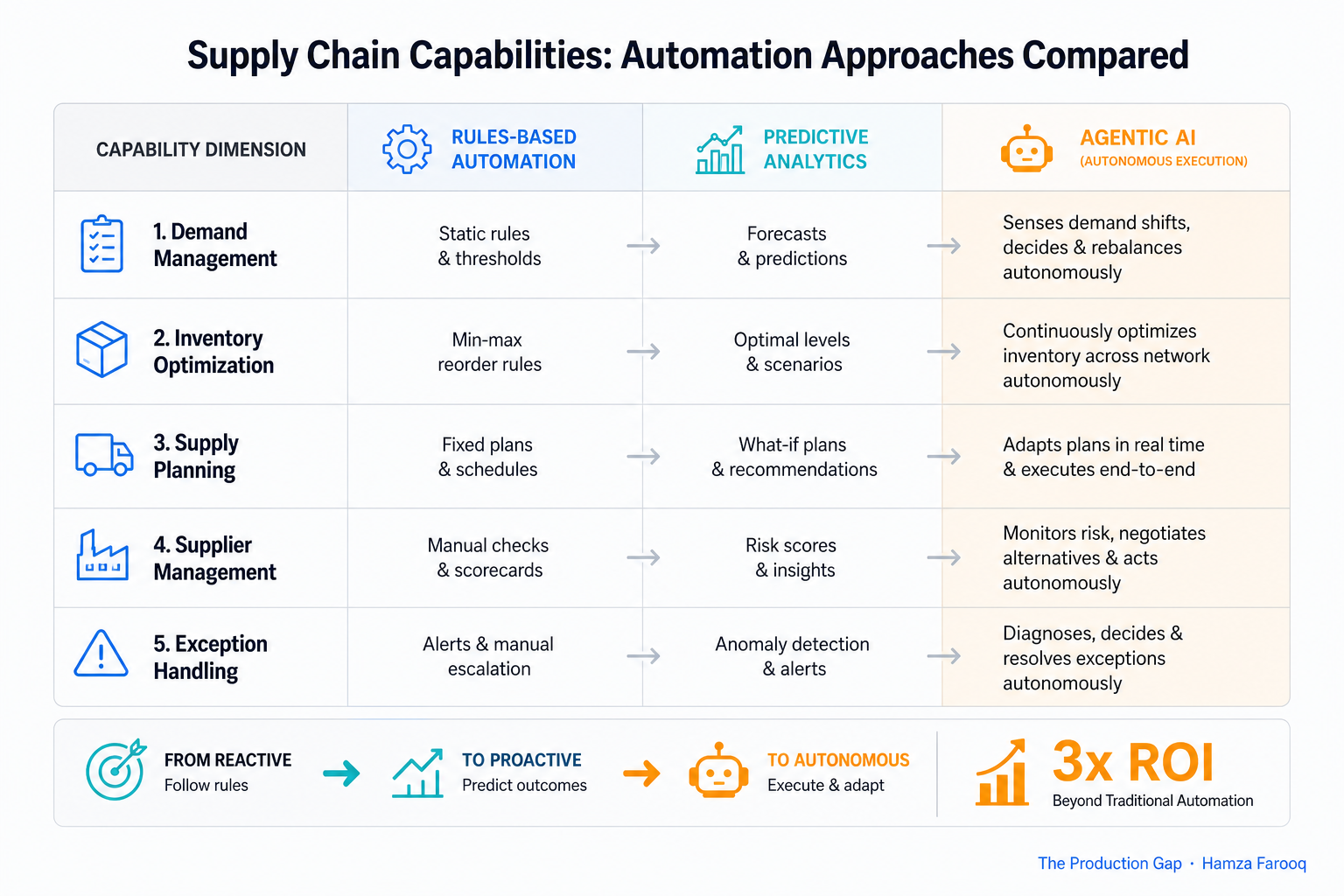
Traditional automation executes predefined rules. Predictive analytics surfaces recommendations. Agentic AI acts. A conventional system flags a stock-out risk and sends an alert. An agentic system detects the same signal, cross-checks supplier lead times, selects the optimal vendor, and issues the purchase order within a defined spending guardrail, no planner required. Supply Chain Management Review frames this precisely: the distinguishing value is "execution, not chat." An SSRN paper by Kee Chye Leo and Adrian Heng Tsai Tan treats autonomous multi-step exception resolution as a researchable framework, not a marketing claim.
SAP declared in June 2026 that agentic AI is rewriting the operating model, not upgrading it. The question is not whether autonomous agents work. It is whether your organization is governing them correctly before the decisions compound.
| Capability | Rules-based automation | Predictive analytics | Agentic AI |
|---|---|---|---|
| Executes actions autonomously | Yes (predefined only) | No | Yes (adaptive) |
| Adapts to new conditions | No | No | Yes |
| Requires human approval | Depends on rule | Always | Only above threshold |
| Handles multi-step exception chains | No | No | Yes |
| Generates audit trail | Partial | N/A | Yes, required |
Where does agentic AI deliver returns, and where does it still need a human?
Agentic AI delivers its strongest returns in high-volume, rules-bound processes like routine replenishment, carrier selection, and production schedule micro-adjustments, where speed and consistency compound across thousands of daily decisions.
Deloitte frames this as a current industrial transformation, not an emerging concept. EY agrees, framing agentic AI as actively reshaping global supply chain operations right now.
ROI is process-specific, not platform-specific. The table below maps where autonomous agents pay off and where they fall short. It is an author synthesis based on the sourced frameworks cited in this guide, not a measured benchmark from an external study.
The Autonomy Readiness Spectrum
| Process type | Autonomy readiness | Rationale |
|---|---|---|
| Routine replenishment orders | High, deploy now | High volume, clear rules, reversible |
| Carrier and lane selection | High, deploy now | Data-rich, fast feedback loops |
| Production schedule micro-adjustment | Medium, guardrails required | Downstream dependencies significant |
| Supplier qualification | Low, human in final seat | Relationship, legal, and reputational stakes |
| Crisis and disruption response | Low, human in final seat | Novel conditions, irreversible at scale |
How do you build guardrails that let agents act without creating unacceptable risk?
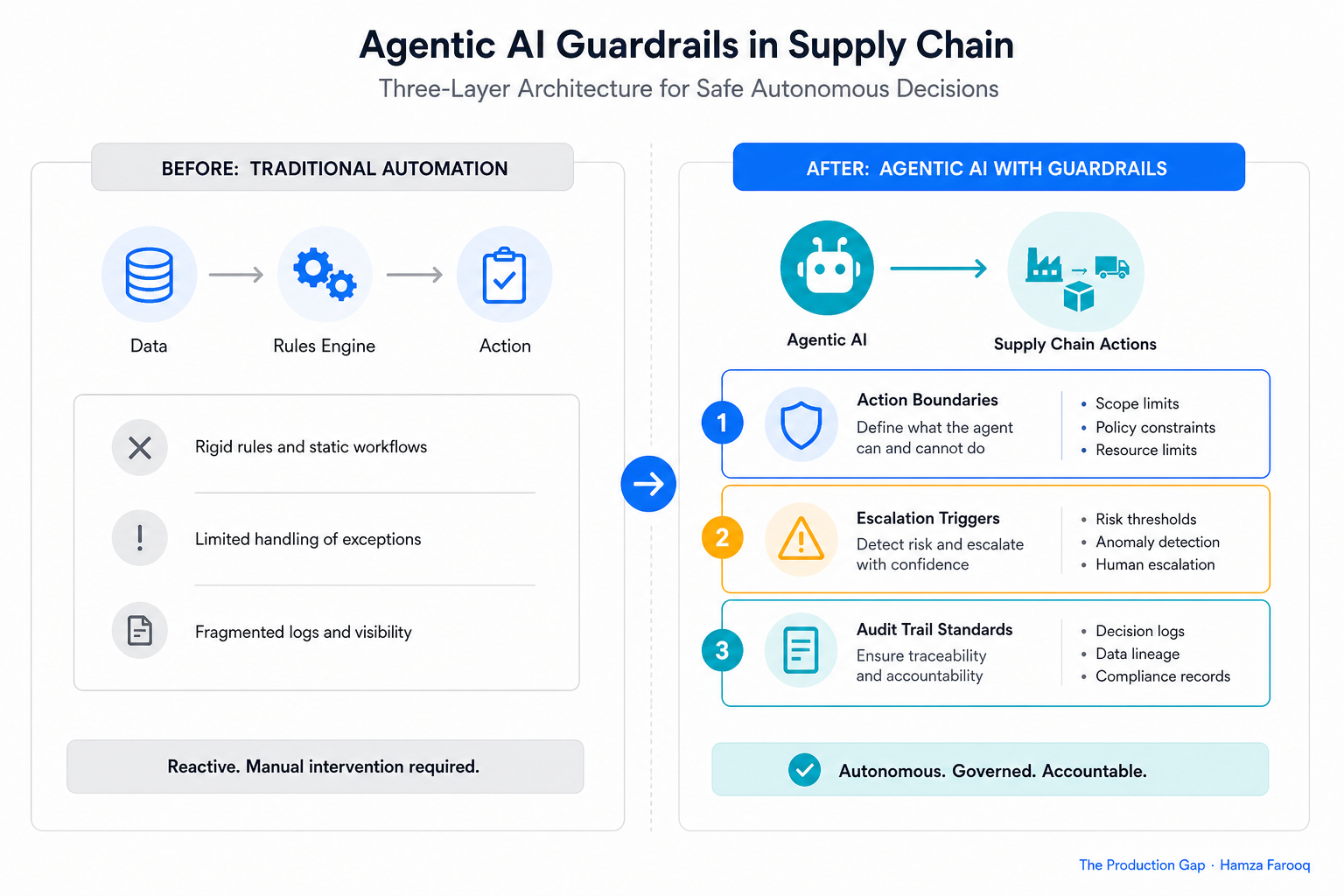
Effective guardrails define three things precisely: the threshold below which the agent acts autonomously, the conditions that trigger human escalation, and the audit trail standard that makes every autonomous decision reconstructible.
Action boundaries are hard limits baked into the agent's operating envelope. Any purchase order above a defined dollar threshold requires human confirmation; any deviation from the approved supplier list triggers automatic escalation. These parameters do not flex based on agent confidence.
Escalation triggers are conditions the agent must recognize as outside its authority: novel disruption signals, geopolitical risk flags, supplier financial distress indicators. The agent does not guess. It routes. Prediction Guard's practitioner framework provides concrete structure for these triggers.
Audit trail standards require every autonomous decision to log the data state that triggered it, alternatives considered, the guardrail threshold that authorized action, and the outcome. SAP's June 2026 analysis treats this as infrastructure, not an afterthought. AWS confirms the same infrastructure is now shippable at hyperscaler scale.
There is a risk few organizations design for: human expertise atrophy. As agents absorb routine exceptions, experienced planners can lose the institutional fluency to make those calls manually, not because the system failed, but because they stopped practicing. In the author's view, guardrail architecture must include a human skills continuity layer, covering deliberate rotation, exception shadowing, and scenario drills, or the organization becomes brittle the moment an agent goes offline.
FAQ
What is the difference between agentic AI and traditional supply chain automation? Traditional automation follows fixed rules and requires human approval to act outside them. Agentic AI perceives changing conditions, selects from multiple actions, and executes independently within guardrails. That is a different capability tier, not an incremental upgrade.
Which supply chain processes are ready for full autonomous execution right now? High-volume, rules-bound, reversible processes are ready today: routine replenishment, carrier selection, and production schedule micro-adjustments. Supplier qualification, contract negotiation, and crisis response still require a human in the final seat.
How should audit trails for autonomous supply chain AI decisions be structured? Log the data state that triggered each decision, alternatives considered, the guardrail threshold that authorized action, and the actual outcome. Without that structure, legal defensibility of AI-executed procurement is untenable.
What is the biggest underestimated risk of deploying agentic AI in supply chain operations? Human expertise atrophy. As agents absorb routine exceptions, planners stop practicing those decisions and can lose institutional fluency over time. A skills continuity program built before deployment is the insurance policy most guardrail architectures are missing.
Conclusion
This week, map your top five highest-volume exception types in procurement or planning. For each one, ask two questions: does this process sit on the "deploy now" tier of the Autonomy Readiness Spectrum, and does your team still know how to make that call manually without the system? The answer to the second question matters more than the first. Organizations that automate judgment without preserving it will move fast, right up until they cannot.
Learn from me
Agentic AI for Product Managers, my Maven cohort. Learn how to design, evaluate, and ship reliable AI systems: the technical fluency PMs need to lead agentic products, no engineering background required. Join the next cohort →
Hire us
Traversaal.ai. We're a team of forward deployed engineers solving the toughest AI problems for Fortune 100 companies: document intelligence, agentic data platforms, and real-time web intelligence, deployed in production. Work with our team to deploy your next agentic ecosystem. Talk to Traversaal.ai →
Join us
Want to solve these problems with us? We're always looking for forward deployed engineers who want to ship production AI. jobs@traversaal.ai