AI Agent Self-Improvement: Why Production Agents Keep Repeating the Same Failures (And How to Fix It)
AI agent self-improvement stalls when logs go nowhere. Learn how to close the feedback loop, extract failure patterns, and stop repeating costly mistakes.

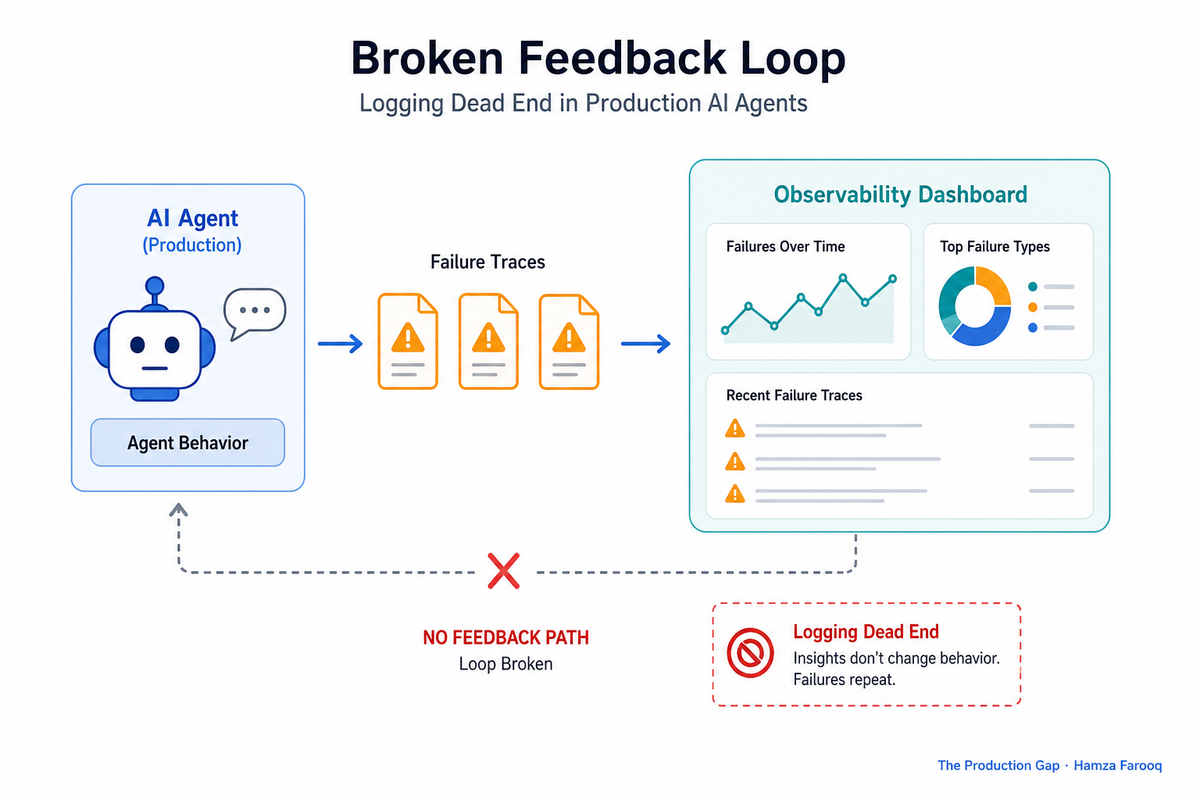
TL;DR: AI agent self-improvement stalls because most production systems log failures but never close the loop. Errors pile up in dashboards while prompts and tools stay frozen. Real fixes require four connected steps: structured failure logging, automated pattern extraction, prompt or tool updates triggered by those patterns, and regression testing to confirm improvement before redeployment.
Key Takeaways
- Logging alone breaks the loop: Capturing failures means nothing if no mechanism exists to change agent behavior next time.
- Traces are the raw material: Detailed records of every step in a failed run are the only reliable source for pinpointing where things went wrong.
- Pattern extraction is the missing step: Most teams never move from "we saw a failure" to "this failure type recurs under these specific conditions."
- Human approval gates keep updates safe: An agent modifying its own instructions without a human checkpoint risks breaking many things that previously worked.
- Benchmarks must validate the fix: After any update, a test suite must confirm the original failure is gone and nothing else broke.
- Fleet scale multiplies every unresolved flaw: One unfixed failure pattern across hundreds of concurrent instances stops being a minor bug and becomes an organization-wide problem.
Why do production AI agents keep repeating the same failures even when you are logging everything?
Production agents repeat failures because logging captures what went wrong but nothing in the system is wired to change agent behavior as a result.
An observability dashboard is a read-only artifact. A failed trajectory in LangSmith or Datadog does not feed itself back into the agent's prompts, tool definitions, or decision logic. The loop was never closed in the first place. When a service goes down, a pager fires because someone explicitly decided certain signals require a human response. Failed agent trajectories generate no equivalent alert and quietly pile up.
The missing piece is not a feedback algorithm. It is an assigned human responsibility paired with a trigger that forces a review cycle.
What does a complete AI agent self-improvement loop actually look like end to end?
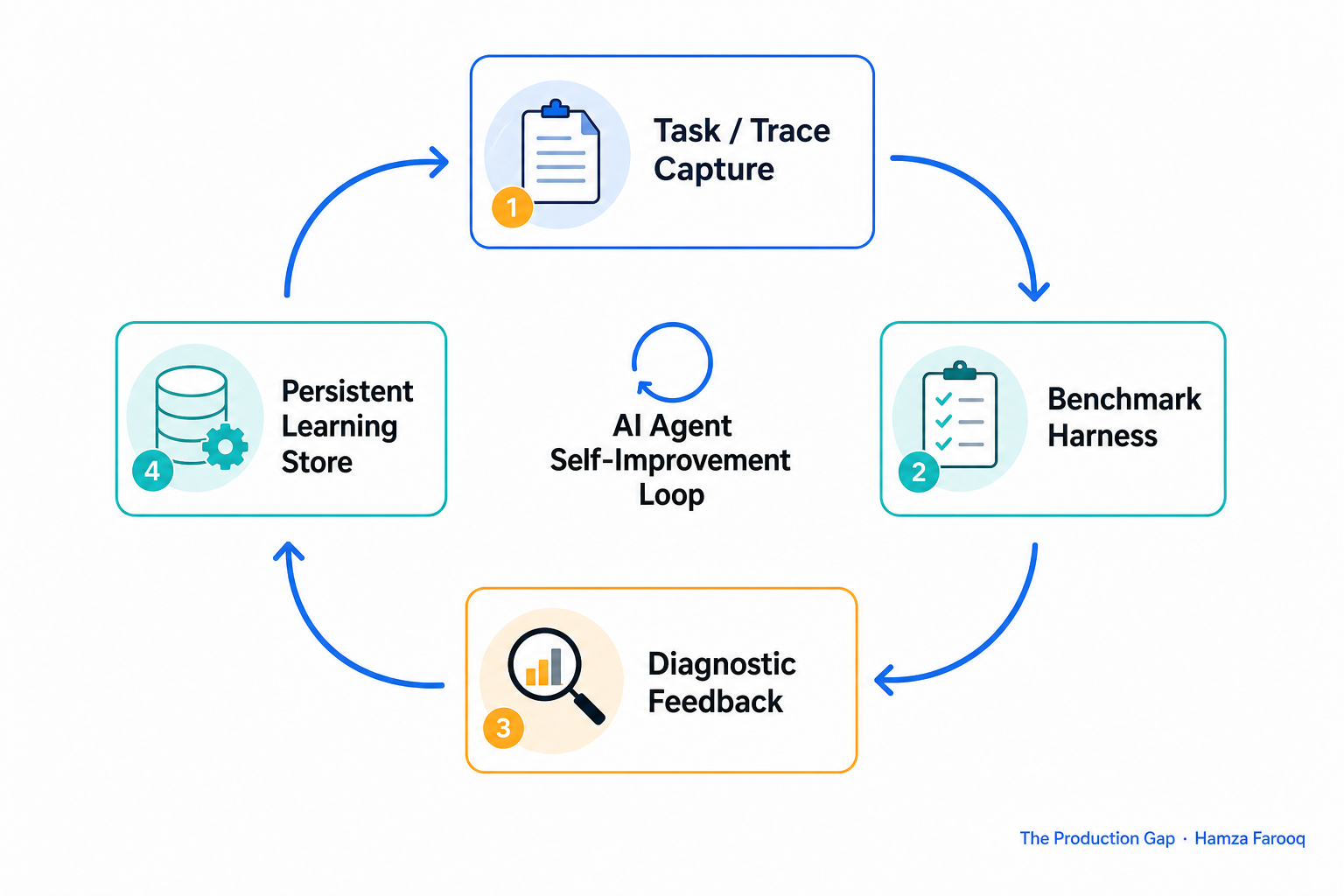
A complete self-improvement loop has exactly four components: task and trace capture, a benchmark harness, diagnostic feedback, and a persistent learning store. Most production systems have only the first one wired up correctly.
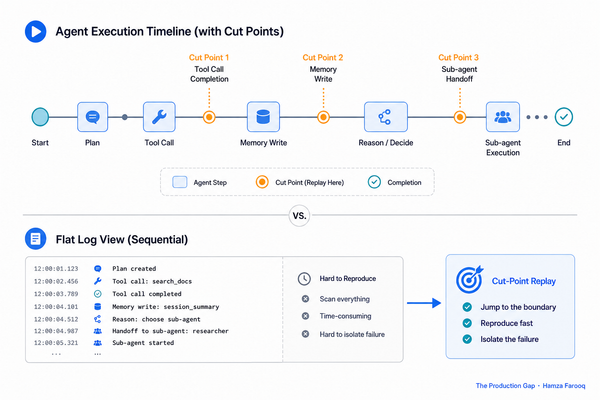
Task plus trace capture means every run is recorded as a structured trajectory: tool calls, LLM inputs and outputs, branching decisions, and final result. Build the corpus deliberately rather than waiting for production traffic to do it for you.
A benchmark harness is a deterministic test suite that re-runs after every update and scores each result pass or fail. Binary scoring is what separates a self-improving agent from one that merely has good observability.
Diagnostic feedback and pattern extraction is the step almost every team skips. Moving from "we saw a failure" to "this failure type recurs under these specific conditions" requires deliberate clustering of failed trajectories, through a secondary LLM call or scheduled human review. The output must be typed and actionable: not "the agent failed," but a description precise enough to map directly to a prompt or tool fix.
A persistent learning store is the accumulated record of known failure patterns, attempted fixes, and benchmark outcomes across deployment cycles. Without it, teams rediscover the same failure mode repeatedly because institutional knowledge from the previous fix was never written down.
The Four-Component Self-Improvement Audit
Author synthesis based on the framework used in this guide.
| Component | What Most Teams Have | What a Complete Loop Requires |
|---|---|---|
| Task and trace capture | Logs in observability dashboard | Structured trajectories, multi-run corpus |
| Benchmark harness | Ad-hoc manual testing | Deterministic, automated re-run suite |
| Diagnostic feedback | Failures noted, never clustered | Failure pattern classification and trigger |
| Persistent learning store | No cross-deployment memory | Versioned record of fixes and outcomes |
A system with three out of four components is not 75% of a self-improvement loop. It produces no self-improvement at all, because the loop does not close.
How do you safely let an AI agent update its own prompts or tools without introducing regressions?
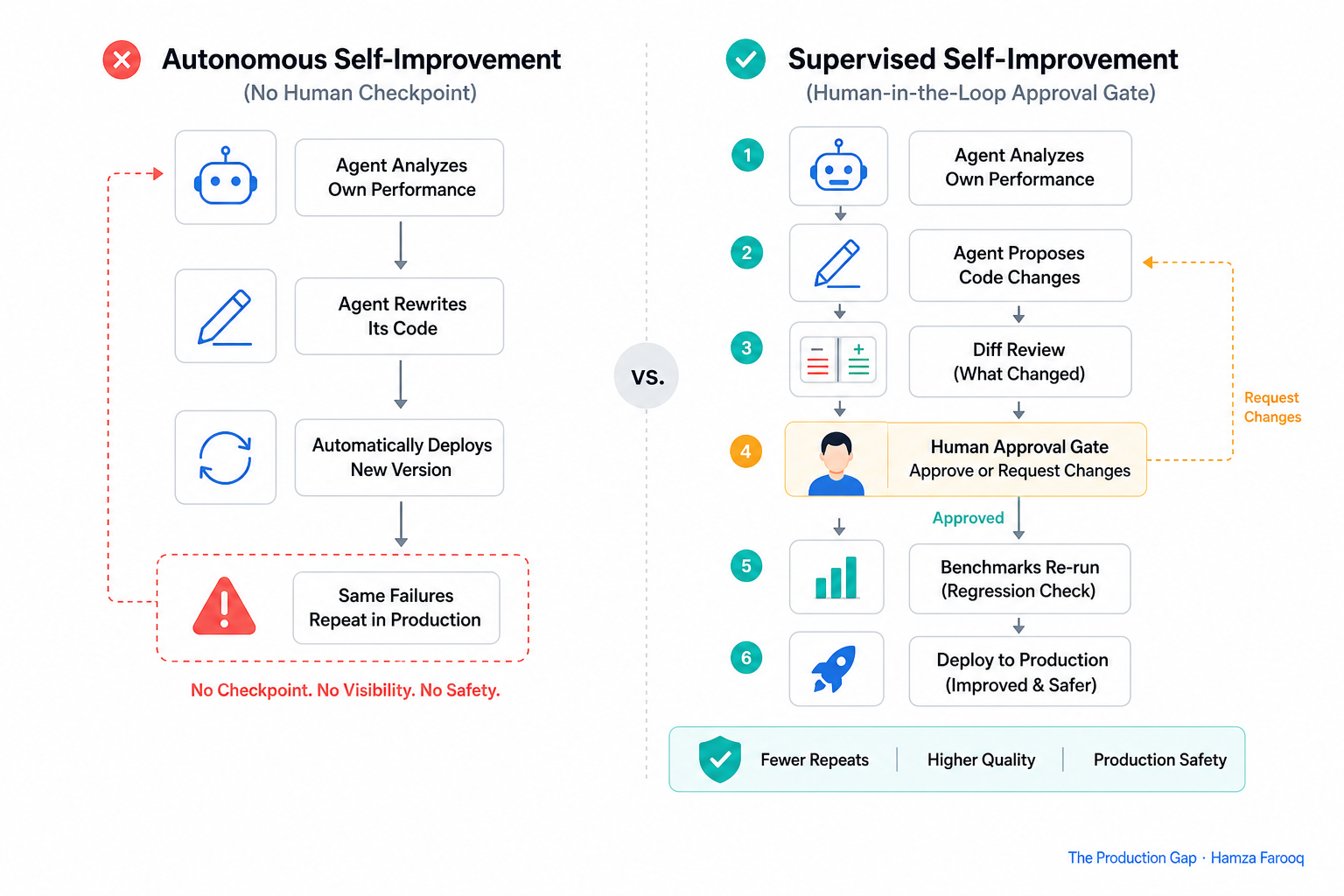
The safest approach is to require human approval on every proposed diff before it touches production, and to gate deployment on a full benchmark re-run.
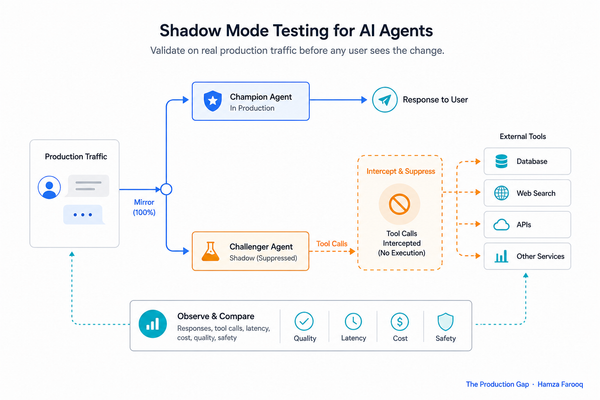
A human reviewer examines the proposed change as a diff, confirms it addresses the documented failure pattern, and approves or rejects it before anything reaches production. The benchmark harness then re-runs against the updated version. If the target failure is resolved and no previously passing tests now fail, the update is cleared for deployment. If either condition is not met, the cycle repeats. This two-gate structure, approval then benchmark, is what prevents a single bad update from propagating silently across an entire fleet.
Why do most teams stall at the logging step, and what forces them past it?
Three blockers explain the stall. First, no trigger condition: failures accumulate but nothing alerts an engineer to act on them. Second, no assigned owner: the agent's prompt logic falls between ML engineering and platform engineering, and neither team owns it as a living artifact. Third, no scheduled review ritual: no rotation, no time-box, no required output format.
In practice, teams tend to move past the stall after a high-profile failure escalates to leadership, or when the same failure produces visible business impact across many concurrent instances. The structural fix is a calendar invite, an assigned name, and a defined output format, followed by tooling to execute on whatever the review decides.
Frequently Asked Questions
What is AI agent self-improvement? AI agent self-improvement is a system where the agent's failures feed back into changes to its own behavior, through updated prompts, revised tool definitions, or modified decision logic, so it performs better on the same task next time, measured against a benchmark.
Why do AI agents repeat the same mistakes in production? The loop has an input (the trace) but no output wired back into agent behavior before the next run. Nothing is architecturally responsible for translating failure data into a behavior change before the agent runs again.
What is a benchmark harness for AI agents? A benchmark harness is a deterministic test suite that re-runs after any agent update and scores each result pass or fail, confirming a fix resolved the target failure without introducing regressions.
How do you extract failure patterns from AI agent traces at scale? In the author's experience, the most reliable approach is to cluster failed trajectories through a secondary LLM call or a scheduled human review session, producing a typed and actionable pattern description specific enough to map directly to a prompt or tool fix. The key discipline is requiring an output format that names the failure condition precisely rather than summarizing it loosely.
Conclusion
The AI agent self-improvement gap is an operational maturity problem. Teams built the logging and skipped the job that reads it.
All four components of the Four-Component Self-Improvement Audit must be connected and owned. Three out of four is not partial success. It is a loop that never fires. The concrete first step is to identify one recurring failure type in your existing traces, assign a named engineer to own it for the next sprint, define the benchmark test that would confirm it is fixed, and run the BerriAI diff, approval, and benchmark cycle once.
Your observability dashboard already contains the data. Building the review cadence around it is what turns that data into improvement.
Learn from me
Agent Engineering Bootcamp: Developers Edition, my Maven cohort. Advanced agentic RAG, multi-agent orchestration, memory, evals, and guardrails. Take agents from prototype to production. Join the next cohort →
Hire us
Traversaal.ai. We're a team of forward deployed engineers solving the toughest AI problems for Fortune 100 companies: document intelligence, agentic data platforms, and real-time web intelligence, deployed in production. Work with our team to deploy your next agentic ecosystem. Talk to Traversaal.ai →
Join us
Want to solve these problems with us? We're always looking for forward deployed engineers who want to ship production AI. jobs@traversaal.ai