AI ARR meaning: what does monday.com's $36 million AI ARR figure measure?
What monday.com's $36 million AI ARR definition includes and leaves out, and what a PM should ask before using a vendor's AI revenue claim in a business case.

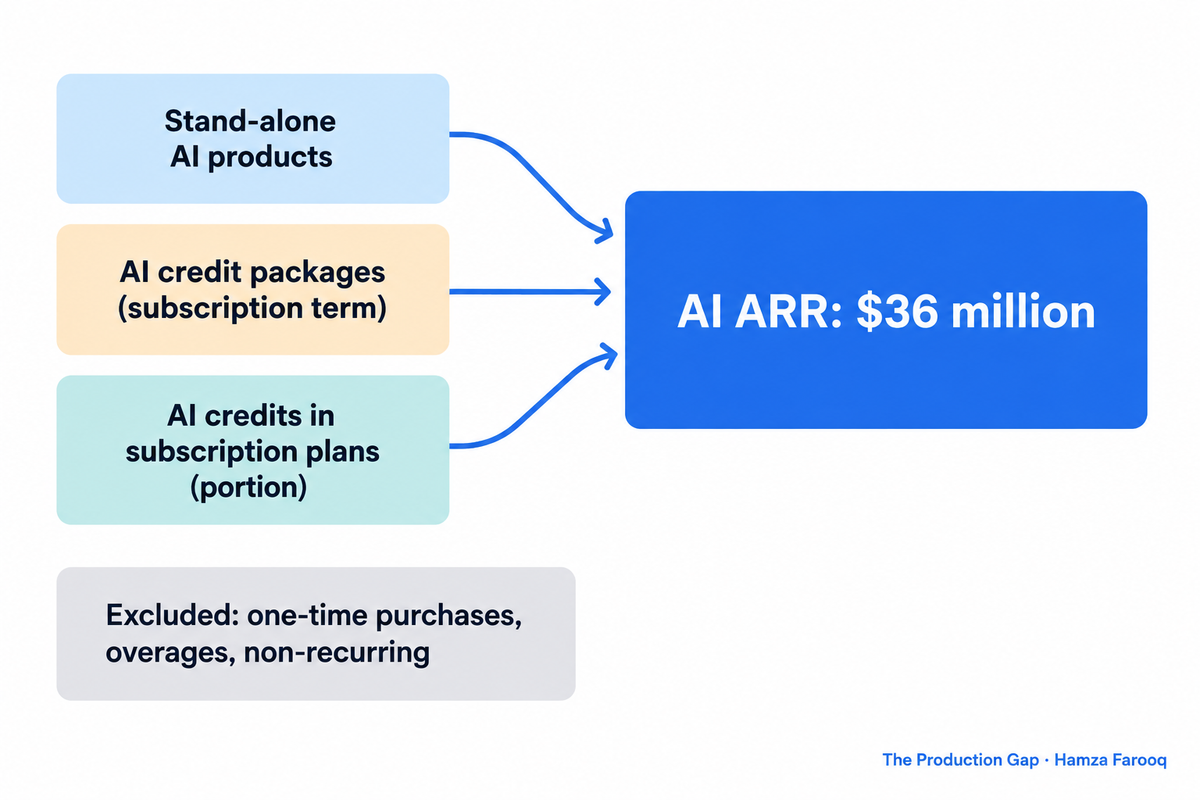
An AI ARR figure depends on how the company defines it, and the definition decides what the number can tell you. In its release dated November 9, 2026, monday.com reports $36 million in AI ARR. Its definition combines stand-alone AI products, AI credit packages and the AI-credit portion of subscription plans into one figure.
TL;DR: monday.com reports $36 million in AI ARR for the third quarter of 2026. By the company's own definition, the number combines stand-alone AI products, AI credit packages sold for a subscription term, and the portion of subscription plans attributable to included AI credits. One total cannot show how much each part contributes, so a buyer should treat it as a vendor claim and ask for the breakdown.
Key Takeaways
- One number, three parts: the company defines AI ARR as stand-alone AI products, AI credit packages and the portion of subscription plans attributable to included AI credits.
- Recurring only: the definition excludes one-time purchases, overages and amounts not contracted on a recurring basis.
- Adoption is a count: the release says monday agents passed 6 million interactions in less than two quarters, and the sentence does not define an interaction.
- Context in the same release: third-quarter revenue grew 19% year over year, and the fourth-quarter guide is approximately 14%.
- Start of a business case: a vendor's AI figure tells you what the vendor counts, and your own data does the rest.
What does monday.com's $36 million AI ARR include?
The company's release says AI ARR reached $36 million in Q3. The definition sits in the release's business key performance indicator section, where AI ARR is described as a component of ARR.
The definition has three parts. According to the SEC filing, AI ARR consists of stand-alone AI products, AI credit packages sold for a subscription term, and the portion of subscription plans attributable to included AI credits. The same definition excludes one-time purchases, overages and amounts not contracted on a recurring basis.
Two details matter for a reader. First, the third part is a portion of subscription plans, not whole plans. The release states a method for it: the portion is allocated based on the proportion of the list price of AI credits to the aggregate list prices of all products and AI credits in the arrangement, solely for calculating AI ARR. The release text I read does not state its dollar size. Second, a customer's one-off spend or overage charges would not appear in the figure.
What else did the release say about agents, growth and the AI-first shift?
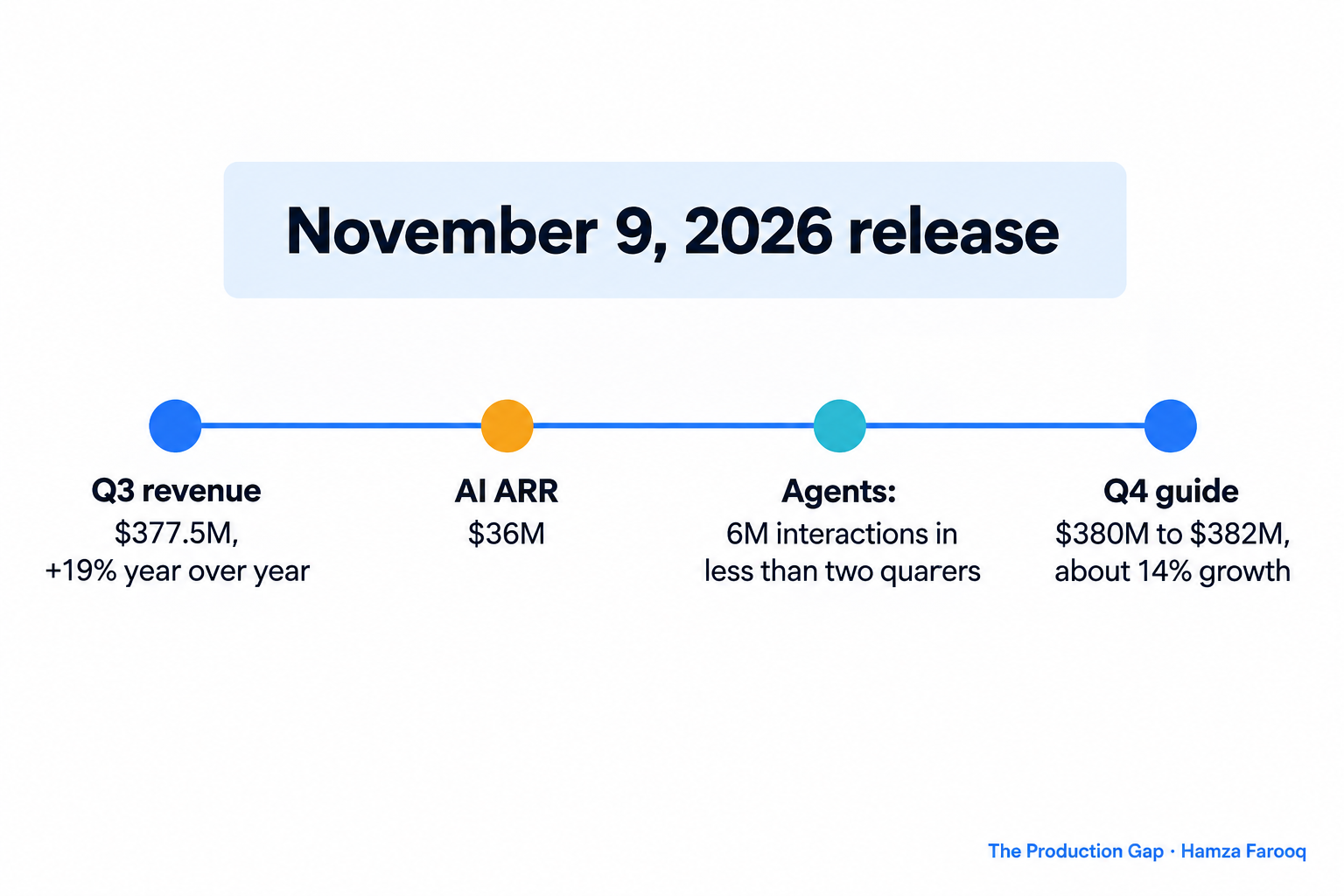
The release pairs the AI ARR figure with an adoption count: monday agents passed 6 million interactions in less than two quarters. A republished copy of the release carries the same bullet, which reads "AI ARR reached $36 million in Q3; monday agents passed 6 million interactions in less than two quarters."
That sentence gives a count and a time window. It does not define an interaction, so it does not say how many customers or users produced the 6 million.
The same document reports other figures. Revenue was $377.5 million, an increase of 19% year over year, and net dollar retention was 108%. For the fourth quarter, the company expects total revenue of $380 million to $382 million, representing year-over-year growth of approximately 14%.
On the AI-first shift, the release says the company took significant steps this quarter to become an AI-first company. The CEO commentary adds that an initiative of this scope introduces near-term operational headwinds. I could not confirm from the document whether the guidance reflects those headwinds, so this article does not link them.
How should a buyer read a vendor's AI revenue claim?
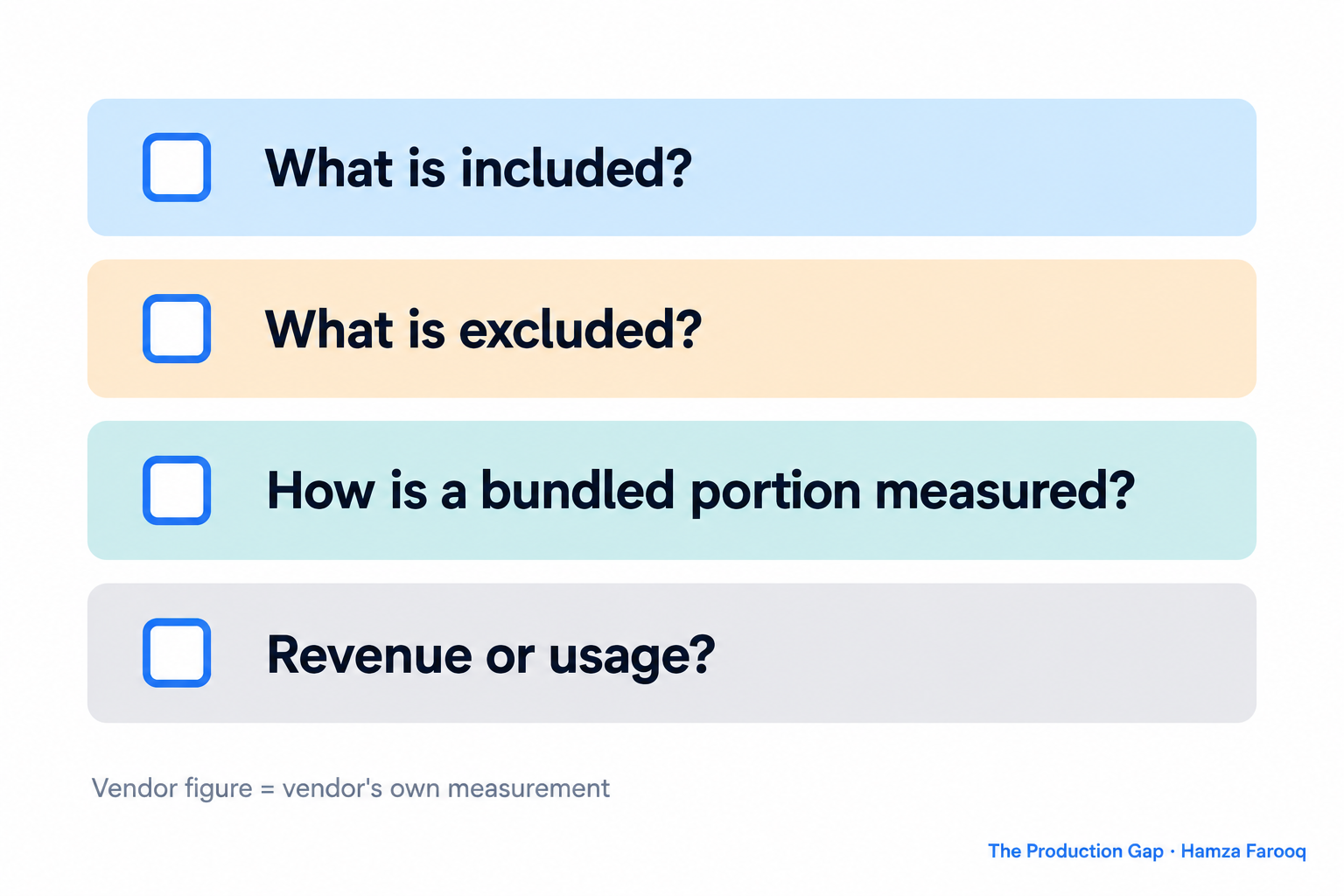
A buyer should read an AI revenue claim as a definition first and a number second. The same $36 million would read differently if it came from stand-alone products or from credits bundled into plans. The table applies that reading to each component the company names.
| Component in the definition | What the definition says | What the total alone leaves open |
|---|---|---|
| Stand-alone AI products | Included in AI ARR | How much of the total they supply |
| AI credit packages | Sold for a subscription term | How many customers buy them |
| AI credits in subscription plans | The portion of plans attributable to included AI credits, allocated by list-price proportion | How large the allocated portion is in dollars |
| One-time purchases and overages | Excluded | Not applicable, the definition leaves them out |
Keep revenue and usage claims apart as well. The release defines AI ARR as the annualized value of its AI offerings, and it gives an interactions count without defining it. Neither tells you whether a given customer got value from the product.
What can a PM do with this figure in an AI business case?
A PM can use the figure to ask better questions, not as a benchmark for their own return. The figure is the company's annualized value of its AI offerings under its own definition, which differs from what customers gained. Your business case depends on your costs, your users and your workflows.
Start with the definition of the metric you are shown, then match it to your decision. If you are deciding whether to buy AI credits, the credit components are relevant. If you are judging a vendor's direction, its growth figures and its own words about the AI-first shift are relevant, and the release has both. If you are sizing your own AI product, neither replaces pilot data.
Finally, record what you could not verify. The release text I read gives no breakdown among the three components, no total ARR to compare against and no definition of an interaction. Write those gaps into the business case so a vendor's headline does not become an assumption.
Frequently Asked Questions
What is AI ARR?
monday.com's release defines AI ARR as the annualized value of its AI offerings, a component of ARR covering the three parts above. Other companies may define it differently, so read each one's definition.
Does monday.com's $36 million AI ARR include one-time purchases?
No. The definition excludes one-time purchases, overages and amounts not contracted on a recurring basis.
Does 6 million agent interactions mean 6 million customers?
The release does not say so. It states that monday agents passed 6 million interactions in less than two quarters, and the sentence gives no definition of an interaction or a customer count. Treat it as an activity figure only.
Should I use a vendor's AI ARR in my own business case?
Use it as evidence of what the vendor counts and sells, and ground your own case in your costs and pilot results. The number reflects the vendor's own definition of annualized AI value, which differs from the return a buyer can expect.
Conclusion
monday.com reports $36 million in AI ARR, and its own definition shows what sits inside that total: stand-alone AI products, AI credit packages and the AI-credit portion of subscription plans. Read the definition before the number, ask for the breakdown, and keep usage counts separate from revenue claims. Then build your AI business case from your own data.
Learn from me

Agentic AI for Product Managers, my Maven cohort. Learn how to design, evaluate, and ship reliable AI systems: the technical fluency PMs need to lead agentic products, no engineering background required. Join the next cohort →
Hire us
Traversaal.ai. We're a team of forward deployed engineers solving the toughest AI problems for Fortune 100 companies: document intelligence, agentic data platforms, and real-time web intelligence, deployed in production. Work with our team to deploy your next agentic ecosystem. Talk to Traversaal.ai →
Join us
Want to solve these problems with us? We're always looking for forward deployed engineers who want to ship production AI. jobs@traversaal.ai