Andrew Ng's AI Engineering Skills Map: What 10,000 Job Postings Mean for Hiring and Role Design in 2026
Andrew Ng AI engineering skills, mapped. Learn the two-tier framework hiring managers need to write better job descriptions and build smarter role ladders in 2026.

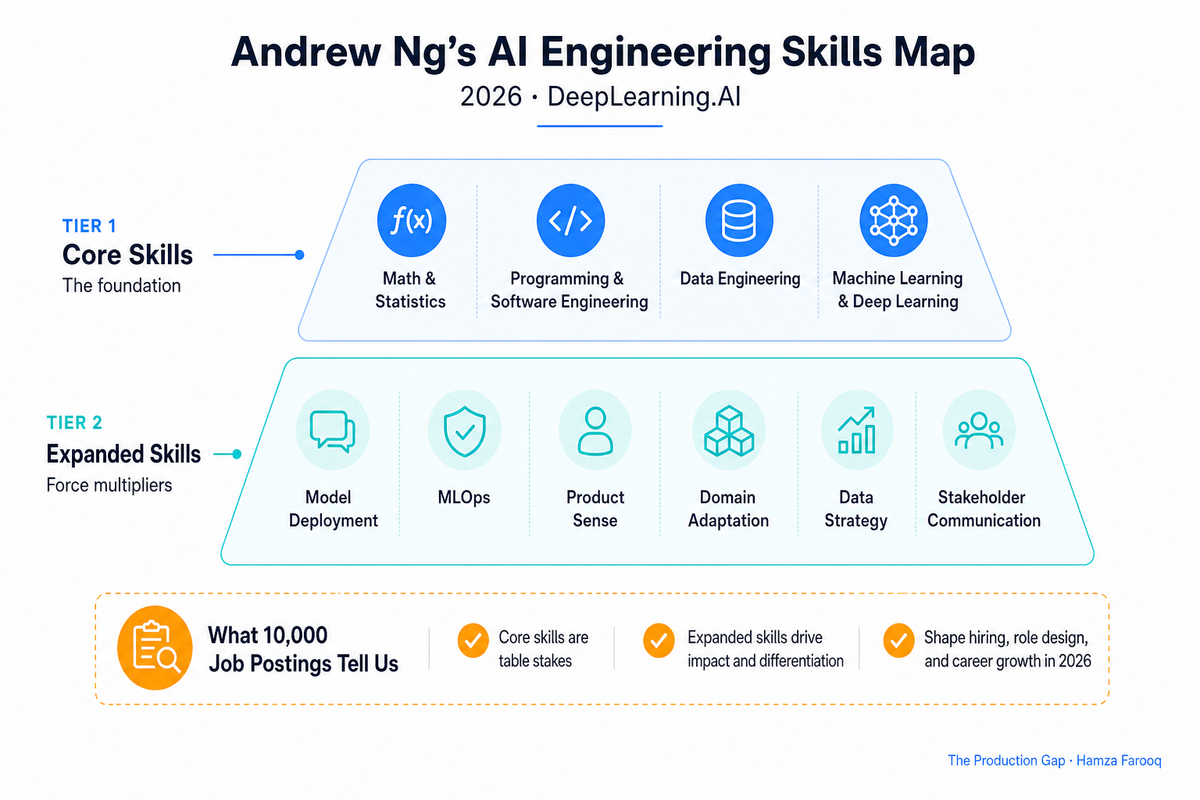
TL;DR: Andrew Ng's AI Engineering Skills Map, published in August 2026, organizes AI engineering into four core skills every engineer must hold and six expanded skills that define seniority and shipping capacity. Prompt engineering is repositioned as a subcomponent of the core tier, not a standalone career track. Hiring managers should use this two-tier hierarchy to write tiered job descriptions, design staged interview screens, and build role ladders that reflect what AI engineers actually need to ship.
Key takeaways
- The map names four core skills as the universal baseline for every AI engineer before specialization begins, with prompt engineering embedded as a subcomponent within that tier rather than a standalone track.
- Six expanded skills define who actually ships. This second tier is where seniority and output separate from prototype-stage work.
- Prompt engineering lost standalone status. It is now one technique within a broader set of LLM interaction capabilities, not a self-sufficient function or career specialty.
- Job descriptions need a rewrite. Listing prompt engineering alongside RAG pipeline design as co-equal bullets misrepresents both skills and their relative weight in the hierarchy.
- Role ladders should reflect the two-tier structure. The map draws a principled line between entry-level AI engineering and senior-level expanded-skill ownership.
- Interview stages map directly onto the tiers. Screen core skills early; assess expanded skills at the onsite.
Introduction
Andrew Ng's AI Engineering Skills Map is a credibility-backed corrective to years of improvised role definitions . Forbes framed the stakes directly: these are the skills that decide which teams ship efficiently (. Most coverage stops at the taxonomy. The organizational consequences run deeper.
What does the AI Engineering Skills Map actually say?
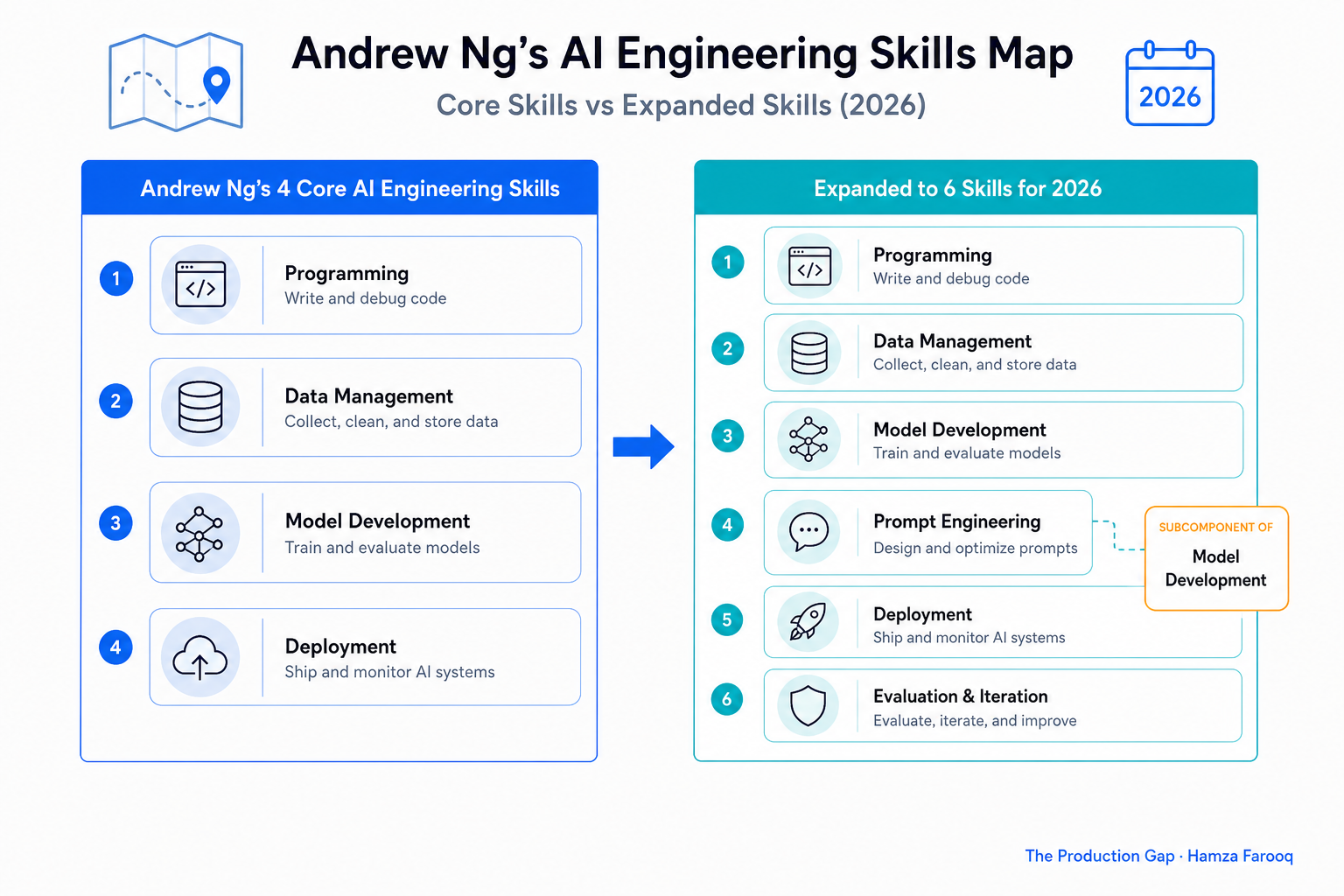
The map organizes AI engineering into a two-tier hierarchy: four core skills every AI engineer must hold, and six expanded skills that separate teams that ship from teams stuck at prototypes.
The four core skills are the baseline, not the differentiator. According to the framework, these are the competencies every AI engineer is expected to hold before specialization begins, with prompt engineering sitting as a subcomponent within that core tier rather than a standalone entry. Read the full authoritative list of both the four core skills and six expanded skills at DeepLearning.AI.
The six expanded skills represent the second tier, which Ng added as an expansion of the original four-skill framework. This tier is where seniority is decided and where team shipping capacity is determined.
Prompt engineering's placement is the structural fact everything else depends on. It sits inside the core tier as a technique within LLM interaction, not a standalone discipline. This is a deliberate architectural decision in the framework, not an oversight.
Why did Ng reposition prompt engineering, and why does it matter now?
Ng reclassified prompt engineering as a subcomponent rather than a standalone skill tier, and that reclassification has direct consequences for roles that were designed around it . The map treats prompting as one technique within a broader set of LLM interaction capabilities, not a self-sufficient function or career specialty.
The practical implication, as the framework used in this guide presents it, is that roles built entirely around prompt engineering now sit awkwardly against a published two-tier hierarchy. Leaders who hired into those roles before this map existed have three options worth considering: reclassify the individuals into the new hierarchy if they hold core AI engineering skills; reframe the function as a specialized AI interaction or UX role if that genuinely fits the work; or acknowledge the role was mis-scoped and restructure accordingly. The map does not make that call, but it makes ignoring the question harder to defend.
How should hiring managers rewrite job descriptions using the Skills Map?
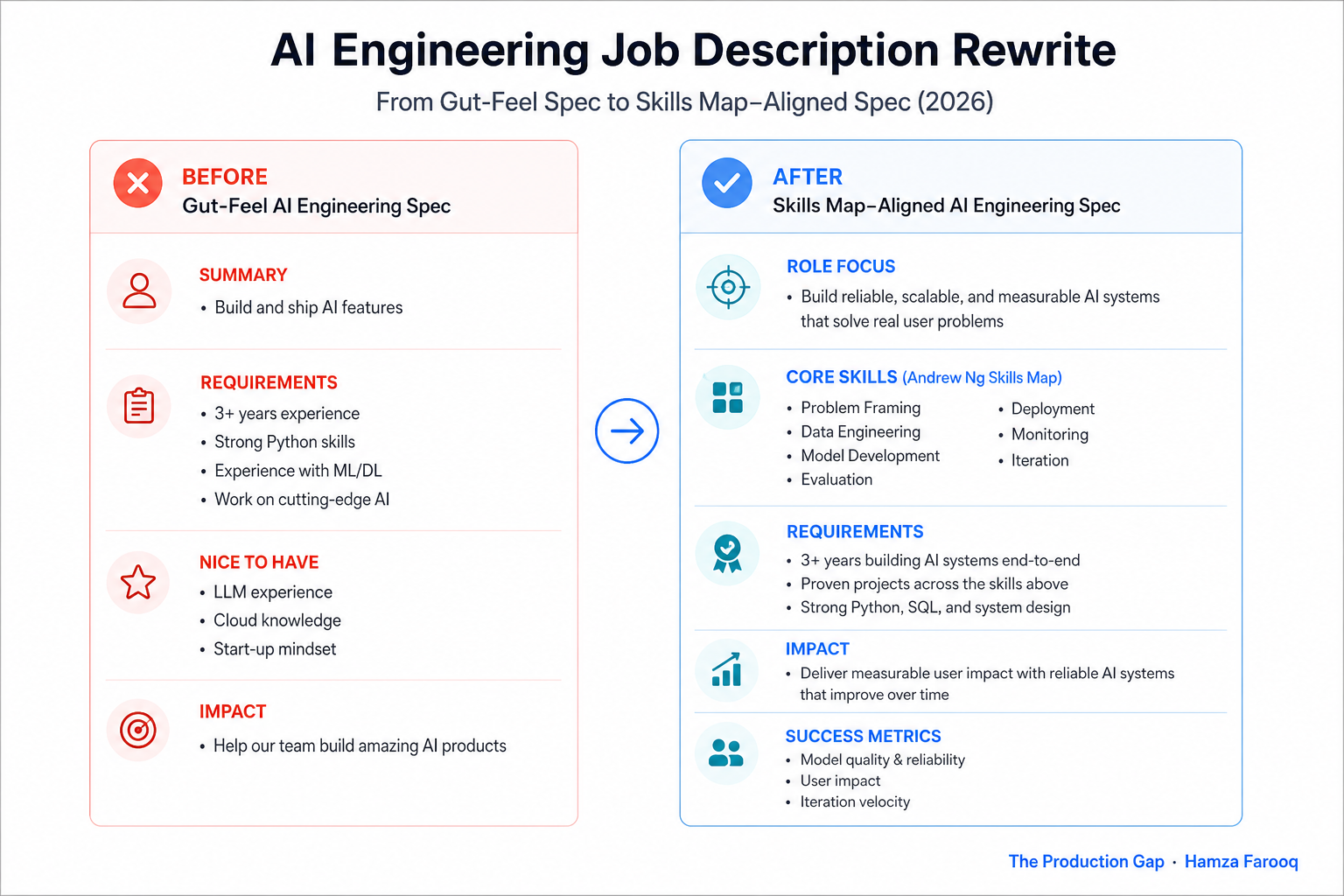
The most practical application of the framework is to list the four core skills as non-negotiable baseline requirements for every candidate, then specify which of the six expanded skills the role demands based on where your team sits on the build-to-ship spectrum. This approach, which the framework used in this guide calls tiered scoping, replaces gut-feel bulleted lists with a principled hierarchy.
Table 1: Skills Map-Aligned vs. Gut-Feel AI Engineering Job Requirements
| Skill area | Gut-feel spec (pre-map) | Skills Map-aligned spec | Tier |
|---|---|---|---|
| Prompt engineering | Listed as primary skill | Subcomponent of LLM interaction | Core |
| RAG pipeline design | Absent or buried | Required for senior roles | Expanded |
| Model evaluation | Missing entirely | Non-negotiable for product roles | Core |
| Fine-tuning | Vague "ML experience" | Specific: PEFT, LoRA, instruction tuning | Expanded |
| AI system orchestration | Not mentioned | Differentiator for high-shipping teams | Expanded |
| LLM deployment | Generic "deployment experience" | Specific: latency, cost, observability tradeoffs | Expanded |
Interview design follows naturally from this table. Screen core skills at the phone or technical screen stage and assess expanded skills at the onsite. This staged approach reduces the recurring mismatch where a candidate writes excellent prompts but cannot design an evaluation framework or build a RAG pipeline.
Leveling signal, as a practical rule of thumb: Mid-level AI engineers hold solid core skills and are developing one or two expanded skills. Senior AI engineers are fluent across multiple expanded skills and own architecture decisions.
What does the Skills Map mean for role ladders and team topology?
Core-skill proficiency defines the floor for any AI engineering title. Expanded-skill mastery defines seniority. The absence of expanded skills is what structurally distinguishes an AI engineer from a role that probably should not carry that title.
A practical role ladder based on this framework:
- Associate AI Engineer: Holds core skills and is actively developing expanded ones.
- AI Engineer: Owns core skills and is fluent in two or more expanded capabilities.
- Senior AI Engineer: Owns the full stack and drives architecture decisions across the expanded tier.
The "Prompt Engineer" decision follows the same logic described above: reclassify, reframe, or restructure. The framework does not render a verdict, but it does make the status quo harder to justify.
Frequently asked questions
What is Andrew Ng's AI Engineering Skills Map? Andrew Ng's AI Engineering Skills Map is a two-tier competency framework, published in August 2026, that identifies four core skills every AI engineer must hold as a baseline and six expanded skills that distinguish teams that ship from those that stall at prototypes. Prompt engineering is included as a subcomponent of the core tier rather than a standalone skill category.
Why did Andrew Ng reposition prompt engineering in the 2026 Skills Map? The map places prompt engineering as a subcomponent of LLM interaction within the core tier rather than a standalone career track. This reflects a view, as stated in the framework, that prompting is one technique within a broader skill set and not a self-sufficient discipline that justifies its own role tier.
How should I use Ng's Skills Map to write AI engineering job descriptions? List the four core skills as baseline requirements for every candidate, then specify which of the six expanded skills the role demands based on where your team sits on the build-to-ship spectrum. Use the tier distinction to separate screening stages: core skills at the early technical screen, expanded skills at the onsite.
What should engineering leaders do if they hired "Prompt Engineers" before this map existed? Evaluate whether the individual holds core AI engineering skills and, if so, reclassify them into the new ladder. If the actual work is closer to AI interaction design or UX, reframe the role accordingly. If the role was mis-scoped, restructure. The framework used in this guide does not prescribe a single path, but it gives leaders a principled basis for making the decision.
Conclusion
Ng's map is being read primarily as a skills taxonomy. The more consequential reading is organizational: roles built around a single technique now sit awkwardly against a two-tier hierarchy that a credible, public framework has made the reference point for the field as of August 2026.
The map did not create that misalignment. It made it visible and harder to ignore.
Your next three steps: Pull three current AI engineering job descriptions and score each requirement against the four core skills and six expanded skills. Identify which roles lack a clear tier placement.
Learn from me

Agentic AI for Product Managers, my Maven cohort. Learn how to design, evaluate, and ship reliable AI systems: the technical fluency PMs need to lead agentic products, no engineering background required. Join the next cohort →
Hire us
Traversaal.ai. We're a team of forward deployed engineers solving the toughest AI problems for Fortune 100 companies: document intelligence, agentic data platforms, and real-time web intelligence, deployed in production. Work with our team to deploy your next agentic ecosystem. Talk to Traversaal.ai →
Join us
Want to solve these problems with us? We're always looking for forward deployed engineers who want to ship production AI. jobs@traversaal.ai