AI Agent Workforce Planning: How to Build a Product Roadmap When Agents Are a Labor Category
AI agent workforce planning done right: treat agents as headcount, not software. Build roadmaps with real capacity, cost structures, and task ownership.

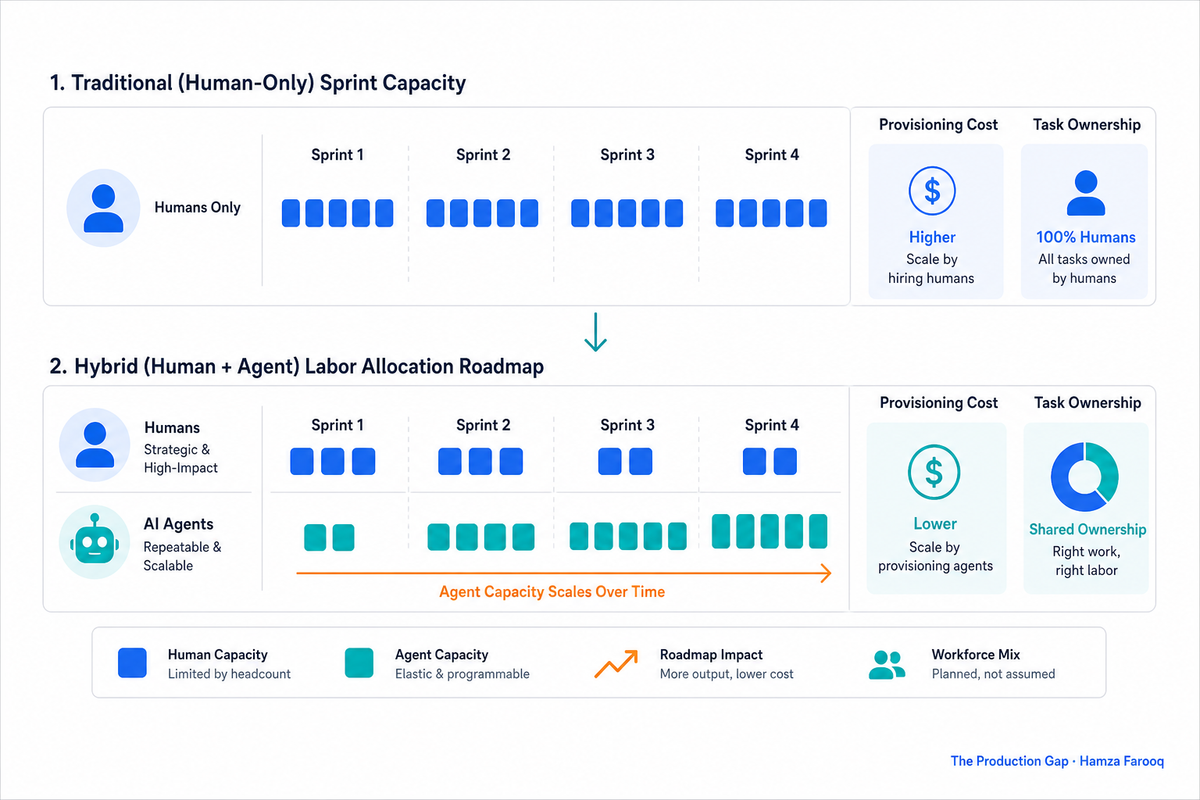
TL;DR: AI agent workforce planning requires treating agents as allocatable labor units on your product roadmap, not as software tools or infrastructure spend. Assign agents defined task ownership, headcount-equivalent cost structures, and governance policies just as you would human roles. This shift lets product leaders plan agent capacity, measure output, and make build-versus-buy decisions with the same rigor applied to any other workforce category.
Key Takeaways
- Agents are a labor category, not a tool: Plan, budget, and track them like a hire.
- Roadmaps must model agent capacity: Human-only sprint and OKR structures break without explicit agent allocation.
- Agent labor needs its own budget line: Alongside salaries, not buried in software spend.
- Task ownership requires deliberate governance: Without it, accountability gaps form fast.
- Model dependency is a roadmap risk: Deprecation mid-cycle equals losing a key team member.
- HR and finance must update their processes: Hybrid planning only works when both recognize agent labor as a distinct input.
Why does treating AI agents as software spend break your product roadmap?
Treating AI agents as software spend misclassifies a labor allocation decision as a procurement decision, pulling it out of the planning structures where capacity actually gets managed: sprints, headcount ratios, OKR ownership. When an agent absorbs a workflow previously owned by an FTE, that is a labor event. It changes task ownership, throughput ceilings, and accountability structure.
Workforce planning with AI agents adapts the traditional planning cycle to treat agent labor as a distinct input. KPMG reinforces that effective planning integrates human and digital workers into a unified model. The failure is structural, reclassifying the decision type fixes it; adding an AI budget line does not.
How do you size and allocate AI agent capacity the same way you would headcount?
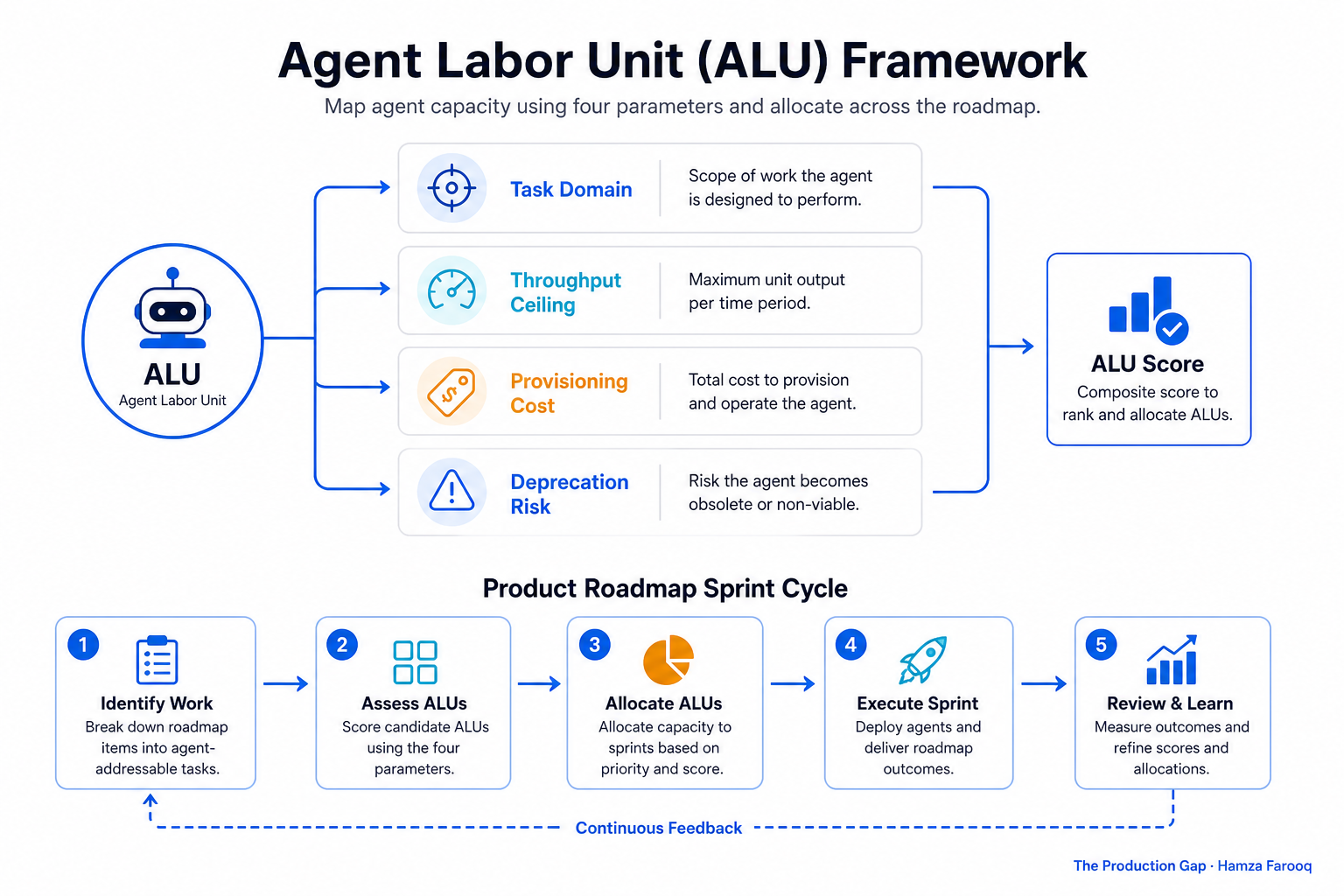
You size agent capacity like headcount (by mapping task ownership, estimating throughput, pricing provisioning cost, and assigning accountability) with the difference that agent units scale horizontally without hiring lag. The Agent Labor Unit (ALU), the framework used in this guide, is the planning primitive that makes this possible.
It has four parameters:
- Task domain: the bounded workflow the agent owns
- Throughput ceiling: volume sustained before quality degrades or escalation triggers
- Provisioning cost: inference plus integration and oversight overhead, per quarter
- Deprecation risk: exposure rating for upstream model changes
Roadmap capacity becomes ALUs plus FTE-weeks, allocated against a unified task map.
Table 1: Human FTE vs. Agent Labor Unit (ALU), Planning Dimensions Compared
| Planning Dimension | Human FTE Model | Agent Labor Unit (ALU) Model |
|---|---|---|
| Capacity unit | Engineer-week | Task throughput / time period |
| Provisioning timeline | Sequential hiring process | Days to weeks |
| Cost category | Salary + benefits (OpEx) | Inference + integration (OpEx) |
| Accountability structure | Role owner | Workflow owner + oversight lead |
| Deprecation risk | Attrition / resignation | Model change / vendor discontinuation |
| Scaling mechanism | Sequential hiring | Horizontal instance provisioning |
As shown in Table 1, the ALU model mirrors the Full-Time Equivalent (FTE) model across every planning dimension while substituting agent-specific variables for human-specific ones. A QA automation agent assigned to regression testing has a defined task domain, a throughput ceiling measured in test cycles per sprint, a monthly inference cost, and a model dependency flag. That is an ALU, and in this guide's framework it should be planned like a hire. Workday describes AI agents as systems that reason, plan, and act autonomously within human-defined parameters, exactly the profile that requires workforce-style planning. Deloitte documents that agentic AI can automate scheduling and forecast labor needs in real time, but only when the planning architecture treats agents as a labor input in the first place.
What governance model decides which workflows go to agents versus humans?
Workflow assignment requires a standing decision authority (not a one-time audit) that runs every task through three gates before any agent gets provisioned. The ALU Governance Gate Framework, an original methodology used in this guide, defines those gates as follows. Skipping any gate tends to produce accountability gaps that surface only after deployment.
The ALU Governance Gate Framework
Gate 1, Accountability Tolerance: Does regulatory, legal, or reputational risk require a named human? If yes, the task stays human-owned regardless of agent capability.
Gate 2, Error Reversibility: If the agent produces a wrong output, can you catch and correct it before it causes downstream damage? Low-reversibility tasks require a human in the loop even when agents do the execution.
Gate 3, Oversight Cost Ratio: Does the human oversight required to govern the agent cost more than the agent saves? If so, the task is not agent-ready yet.
A customer-facing pricing recommendation workflow fails Gate 1 at most regulated financial institutions, not because agents cannot execute it, but because a named human must be accountable for the output. That constraint belongs in the roadmap before a single agent is provisioned. PwC notes that AI agents are reshaping workforce strategy faster than anticipated, which makes governance a strategic roadmap input rather than something you sort out after deployment.
How must HR and finance change their processes to support hybrid workforce planning?
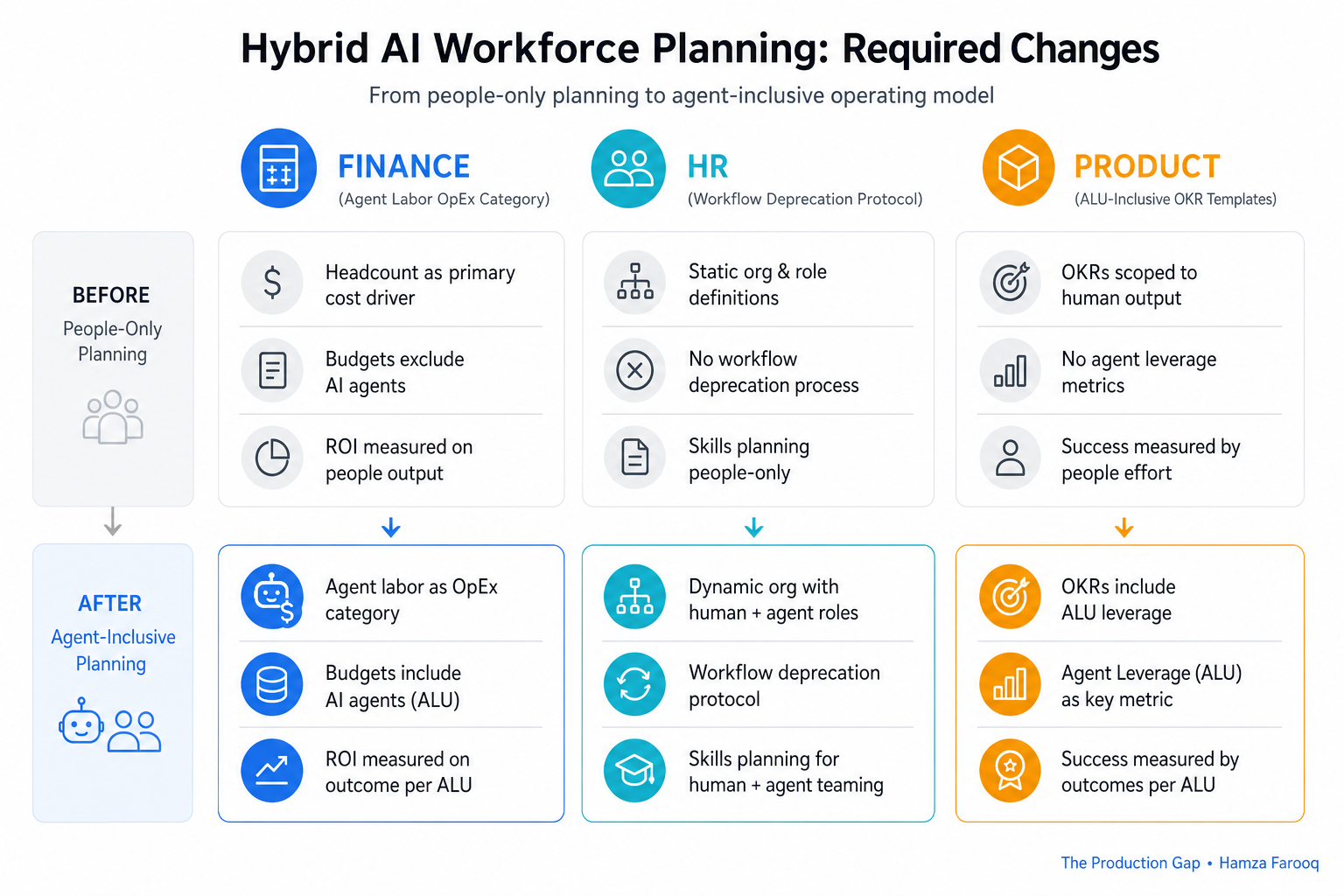
HR and finance must restructure approval workflows, budget categories, and reporting systems to recognize AI agents as a distinct, plannable labor input. As long as agents are booked as software, headcount models stay miscalibrated and roadmap decisions get made on false data.
Based on the planning logic above , three changes are worth prioritising:
- Finance: Create a dedicated "agent labor" Operation Expense (OpEx) category, separate from software licensing, with reporting granularity that matches contractor spend, cost per workflow, per quarter, per business unit.
- HR: Build a workflow deprecation protocol, a formal process by which a task previously assigned to an FTE is officially transferred to an ALU within a planning cycle, with headcount reallocation documented.
- Product: Update OKR and sprint templates to include ALU capacity alongside FTE capacity so roadmap commitments reflect total labor, not just human labor.
Deloitte documents that agentic AI can generate autonomous scheduling plans and continuously evaluate labor constraints in real time, capabilities that only translate into roadmap value when finance and HR systems are structured to receive and act on that output.
Frequently Asked Questions
What is AI agent workforce planning? AI agent workforce planning is the discipline of incorporating AI agents as a distinct labor category into forecasting, capacity planning, and task ownership assignment, requiring updates to budget categories, sprint templates, and OKR structures, not just an added AI spend line.
How do you account for model deprecation risk in a product roadmap? Model deprecation risk in a product roadmap should be treated like key-person dependency: flag agent workflows with a deprecation risk rating in the ALU framework and assign a contingency owner who can absorb the task if the model changes mid-cycle.
Should AI agent costs appear in headcount budgets or software budgets? AI agent costs belong in a dedicated OpEx category modeled on contractor spend rather than software licensing, because the decisions they drive are workforce decisions, not procurement decisions. This is a practical rule of thumb from the framework used in this guide, not an established accounting standard.
What happens to OKRs when agents absorb tasks previously assigned to FTEs? OKRs must reanchor to outcomes when agents absorb tasks previously held by FTEs: the FTE owner's role shifts to governing output quality and holding accountability the agent cannot hold, otherwise the over-authorization problem simply recreates itself.
Conclusion
Most product leaders are heading into planning cycles with templates built for human-only teams. That produces over-hiring into roles agents already cover, under-investment in agent-native capabilities, and accountability gaps where no governance exists.
Addressing this takes three parallel moves: reclassify agents as a labor category in finance, build a workflow deprecation protocol in HR, and adopt the ALU framework in product planning so agent capacity is visible alongside FTE capacity before any roadmap commitment is made.
In your next roadmap review, add one column to your capacity table: ALU count. If you cannot fill it in, you have found the gap.
Learn from me
Agentic AI for Product Managers, my Maven cohort. Learn how to design, evaluate, and ship reliable AI systems: the technical fluency PMs need to lead agentic products, no engineering background required. Join the next cohort →
Hire us
Traversaal.ai. We're a team of forward deployed engineers solving the toughest AI problems for Fortune 100 companies: document intelligence, agentic data platforms, and real-time web intelligence, deployed in production. Work with our team to deploy your next agentic ecosystem. Talk to Traversaal.ai →
Join us
Want to solve these problems with us? We're always looking for forward deployed engineers who want to ship production AI. jobs@traversaal.ai