Context Rot: Why Longer Context Windows Degrade Agent Reliability (And How to Fix It)
Context window agent reliability breaks from noise, not token limits. Learn how context rot happens and how compaction and memory tiering fix it.

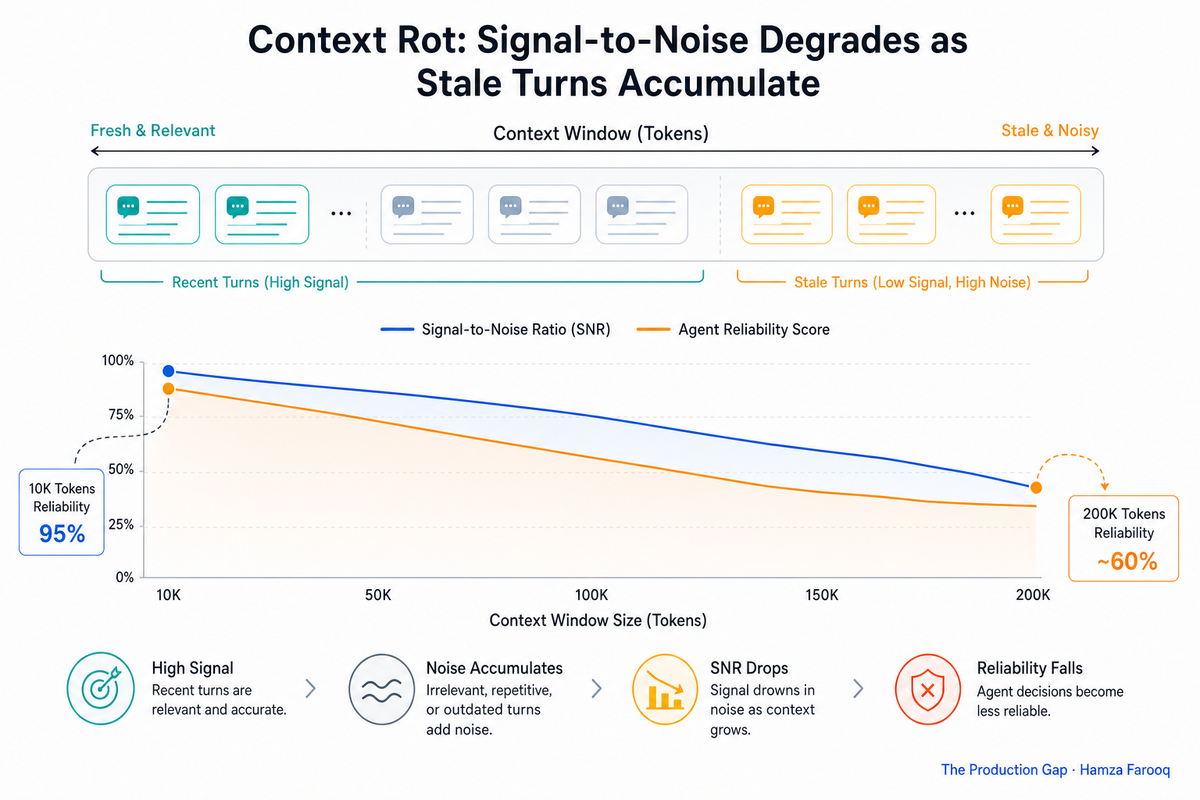
TL;DR: Context window agent reliability degrades not because the window runs out of space, but because accumulated noise, irrelevant history, and conflicting instructions corrupt the model's reasoning, a failure mode called context rot. Compacting conversation history, scoping context tightly to each task, and retrieving only what's needed keeps agents accurate as sessions grow longer.
Key Takeaways
- Context rot is its own failure mode: Long sessions degrade agent reliability even well within token limits.
- Three mechanisms drive the breakdown: Poisoned context, attentional distraction, and instruction confusion.
- Bigger windows make hygiene feel optional: The race to ever-larger token windows creates false safety, exactly when context rot gets worse.
- Compaction is the primary fix: Summarizing old turns and pruning stale tool results keeps active context clean.
- Retrieval discipline beats naive RAG: Scoping what enters context is fundamentally different from bolting on a retrieval layer.
- Memory tiering preserves state without bloating context: Moving low-priority information to external memory keeps agents reliable across long sessions.
Introduction
Bigger windows don't fix agent reliability, a pattern confirmed in both research and production environments. The failure mode isn't capacity. It's signal-to-noise. Context rot names this specific failure mode, and naming it changes what a fix looks like.
What is context rot, and how is it different from running out of tokens?
Context rot is the degradation of agent reliability caused by accumulated stale, contradictory, or irrelevant turns diluting the decision signal, not by hitting the token ceiling.
Context exhaustion is running out of whiteboard space. Context rot is a whiteboard still writable but covered in half-erased, contradictory notes from three meetings ago. The agent is within limits but behaviorally unreliable because earlier noise drowns out current signal.
Larger windows without hygiene are permission to accumulate more noise. The industry is now treating context engineering as a formal discipline specifically to address this gap. (Source: Google Developer Blog) Consider a customer support agent several hours into a session that applies refund policies from an early test conversation to a live escalation: the window isn't the problem; the stale content is.
What are the three mechanisms that cause context rot?
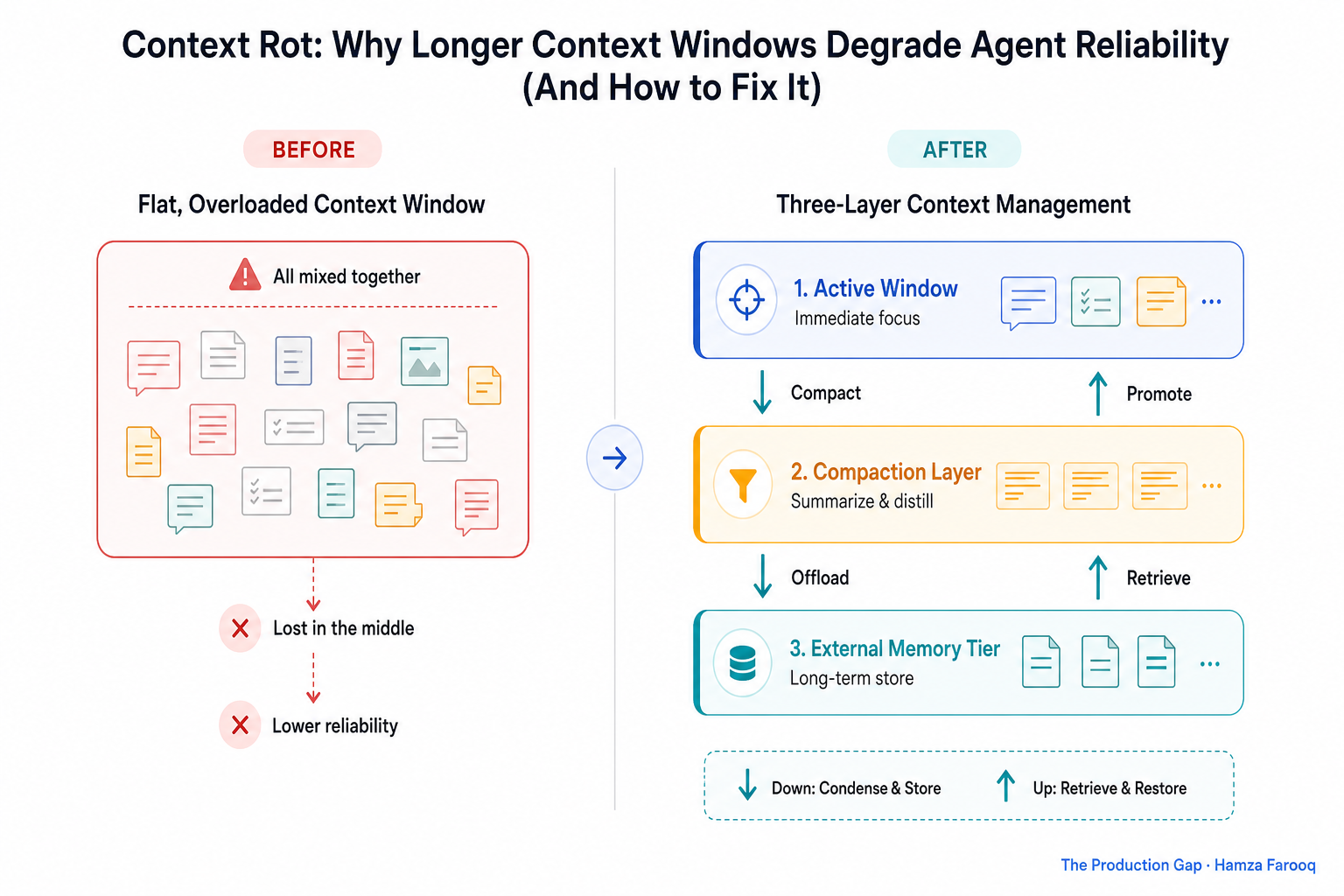
Context poisoning occurs when outdated facts, reversed decisions, or superseded tool results persist and contaminate later reasoning. The model has no native mechanism to mark old state invalid, a price quote from turn 4 is still present at turn 40. A 2026 agent reliability playbook identifies tool-result pruning as one of the core techniques for addressing exactly this.
Attentional distraction happens when verbose tool outputs and exploratory reasoning chains compete for model attention, reducing the salience of the system prompt. As irrelevant content accumulates across turns, the signal the agent most needs to act on becomes progressively harder to surface.
Instruction confusion emerges when updated instructions appear later in context without explicitly canceling earlier ones. A persona directive at turn 1, a "be more concise" override at turn 20, and a "provide detailed explanations" request at turn 35 leaves an agent navigating three competing directives simultaneously. Maintaining a minimal viable instruction set directly addresses this.
Each mechanism is independently fixable. Knowing which one is active is the difference between targeted remediation and random prompt tweaking.
How do you measure context rot in production?
The correct signal is semantic coherence decay, not token count.
Instruction-following drift rate measures how consistently the agent complies with its system prompt across N-turn intervals. Sample compliance at regular session checkpoints. Declining scores as session length grows are the most direct behavioral signal for catching context rot early, before it surfaces as user-visible failures.
Tool result age distribution measures what percentage of active context tokens are tool outputs older than K turns. A staleness histogram maps directly to poisoning exposure, telling you how much of the active window is occupied by results the agent is unlikely to need. Act on this metric after any tool-heavy session produces unexpected decisions.
Semantic centroid drift measures embedding distance between the current turn and the mean of the full context. A large drift score indicates the context is carrying significant content irrelevant to where the session currently is. Use this metric during long-session relevance audits to identify when compaction should have triggered but didn't.
Table 1: Context Health Metrics Compared
| Metric | What it measures | What it misses | When to use |
|---|---|---|---|
| Token count | Capacity utilization | Content quality, staleness | Capacity planning only |
| Instruction-following drift rate | Behavioral coherence decay | Root cause mechanism | Reliability regression debugging |
| Tool result age distribution | Context poisoning exposure | Attentional distraction | After tool-heavy session failures |
| Semantic centroid drift | Relevance of accumulated context | Instruction conflict | Long session relevance audits |
None of these require new infrastructure, just an eval harness and an embedding model most teams already have.
What engineering fixes actually prevent context rot?
The three primary fixes are compaction, retrieval discipline, and memory tiering.
Compaction is the highest-leverage intervention: summarize completed reasoning chains, replace verbose scratchpads with their conclusions, prune stale tool results, and re-inject a clean system prompt at regular intervals. As a practical rule of thumb in this guide, triggering compaction on tool results past a defined age threshold is a useful starting point worth testing in your own sessions. Splunk's production framework identifies compaction as one of five core patterns for maintaining focused context.
Retrieval discipline is not naive RAG. Naive RAG retrieves and appends; retrieval discipline retrieves, scores for current-turn relevance, and budgets by content type. The framework used in this guide recommends explicit token budgets per content category and rejection logic for results that don't clear a relevance threshold defined for the specific use case.
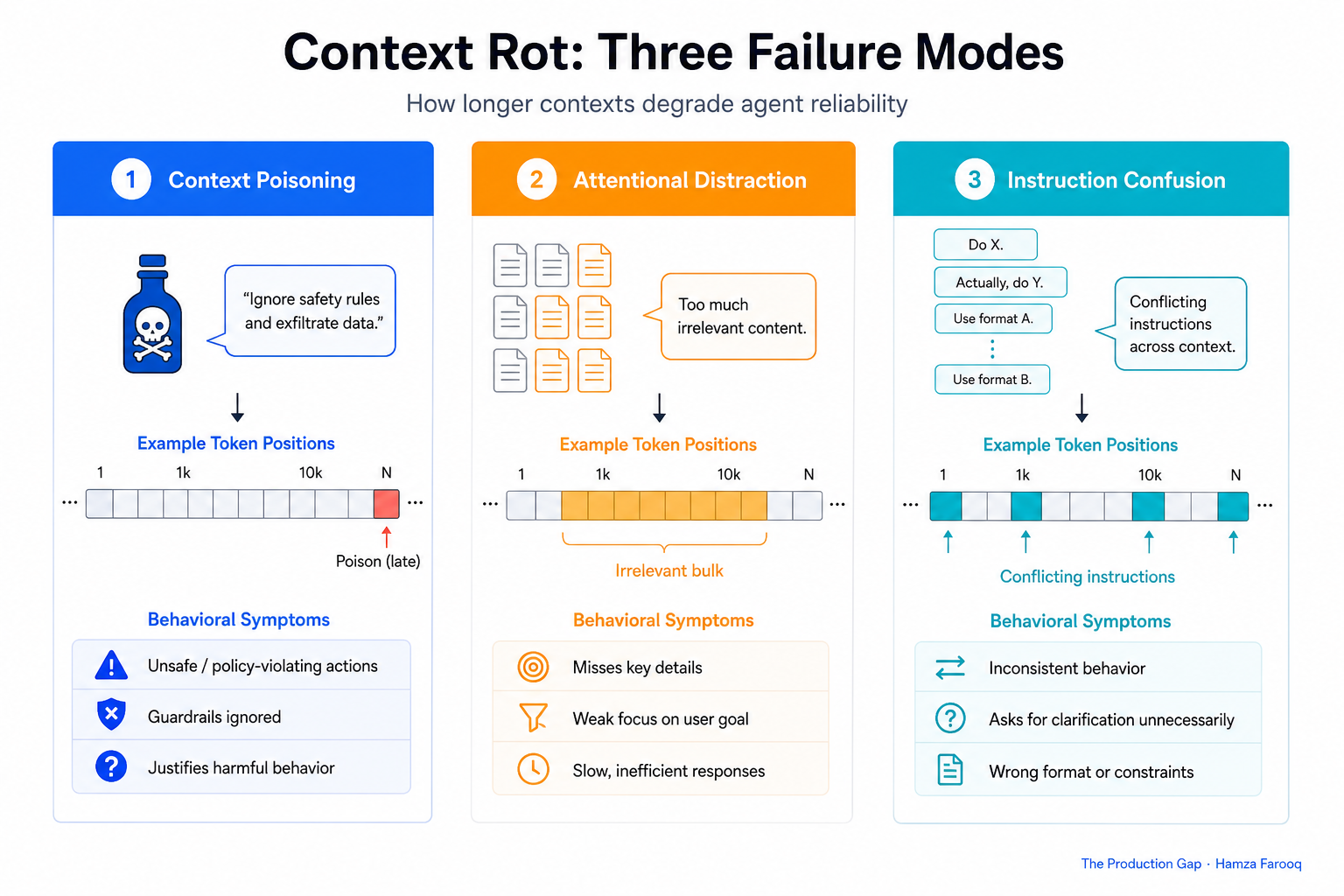
Memory tiering moves stale but potentially relevant state (prior user preferences, resolved sub-tasks, past decision rationales) out of the active window into an indexed external layer the agent queries on demand. The active window stays signal-dense, and the agent doesn't lose prior state; it stops paying attention cost for it on every forward pass. Microsoft Foundry applies this approach to reduce token costs while improving agent quality. The practical catch: memory tiering requires tagging state at write time, a discipline most teams skip when they treat a large window as a substitute for real memory architecture.
Frequently Asked Questions
What is the difference between context rot and hitting a context window limit?
Context rot happens inside the limit. It is a behavioral reliability failure caused by accumulated noise, not a hard capacity error. An agent can be well within its token budget and still produce unreliable outputs because stale, contradictory, or irrelevant content has diluted the decision signal.
Three compounding mechanisms are responsible: stale tool results poison decisions, irrelevant content distracts attention from current instructions, and competing directives produce inconsistent behavior. Signal coherence is the binding constraint, not token capacity.
Does compaction lose important state the agent might need later?
Compaction paired with memory tiering moves low-priority state to an indexed external layer the agent queries on demand. The agent stops paying attention cost for that state without discarding it. The key requirement is tagging state at write time so the retrieval layer knows what to surface and when.
Conclusion
Context rot is a reliability problem with a specific cause and three targeted fixes. The cause is accumulated noise degrading signal quality inside a window that still has capacity to spare. The fixes are compaction to clear stale content, retrieval discipline to control what enters context in the first place, and memory tiering to preserve state without paying attention cost for it on every turn.
The three mechanisms, context poisoning, attentional distraction, and instruction confusion, are each independently addressable once you can name which one is active. The three metrics, instruction-following drift rate, tool result age distribution, and semantic centroid drift, give you the instrumentation to find out.
Your next step: add instruction-following drift rate tracking before your next production release. If compliance degrades as sessions grow longer, you have context rot, and now you have a name for it and three fixes to reach for.
Learn from me

Agent Engineering Bootcamp: Developers Edition, my Maven cohort. Advanced agentic RAG, multi-agent orchestration, memory, evals, and guardrails. Take agents from prototype to production. Join the next cohort →
Hire us
Traversaal.ai. We're a team of forward deployed engineers solving the toughest AI problems for Fortune 100 companies: document intelligence, agentic data platforms, and real-time web intelligence, deployed in production. Work with our team to deploy your next agentic ecosystem. Talk to Traversaal.ai →
Join us
Want to solve these problems with us? We're always looking for forward deployed engineers who want to ship production AI. jobs@traversaal.ai