Beacon Handoff: The Open-Source Tool for Coding Agent Session Portability Across Any Tool
Coding agent session portability finally has a solution. Learn how Beacon handoff serializes and transfers sessions across Cursor, Copilot, and Claude Code.

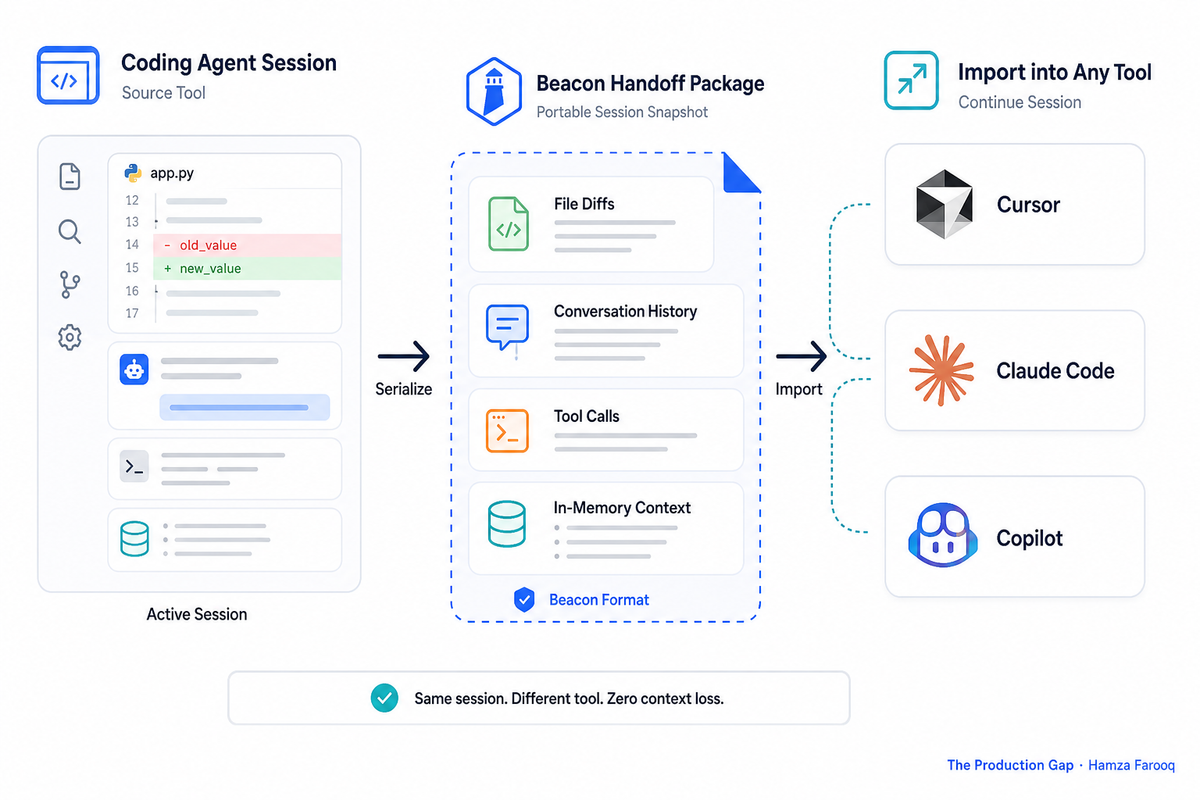
TL;DR: Beacon handoff is an open-source tool designed to serialize an active coding agent session into a portable format that a supported receiving agent can import and resume. It targets four components: file diffs, conversation history, tool calls, and in-memory context. It does not capture runtime state, tool-native memory, or the implicit decision trail. If cross-tool session switching is already costing your team time, Beacon is the most direct available option while a broader industry standard remains absent.
Key Takeaways
- Beacon handoff fills a real gap: No built-in mechanism exists to move a session between coding agents. Beacon packages session state into a portable format any supported tool can import.
- Serialization targets four components: File diffs, conversation history, tool calls, and in-memory context are the four components Beacon is designed to transfer (author synthesis from the three-layer framework used in this guide).
- Multi-agent workflows raised the stakes: Teams now run tools like Cursor, Copilot, and Claude Code alongside each other, making cross-tool switching a practical daily concern rather than an edge case.
- Portability is still imperfect: Runtime state, tool-specific memory, and the implicit decision trail do not cross the boundary regardless of the handoff method used.
- Point solution, not a standard: Beacon fills a gap that a proper industry-wide protocol should eventually cover. No standardized cross-vendor handoff protocol currently exists.
- Adoption is a timing call: If lost session context is already costing your team time, adopt now alongside deliberate reasoning-log practices. Otherwise, waiting for a more mature standard is a reasonable choice.
What is Beacon handoff and what does it actually serialize when you export a coding agent session?
Beacon handoff is an open-source tool that serializes an active coding agent session into a portable package a supported receiving agent can import and resume from. It targets four core components: file diffs, conversation history, tool calls, and in-memory context.
File diffs capture the changes made during the session alongside the conversational context explaining why those changes were made. Conversation history is the full turn-by-turn dialogue and the most human-readable part of any export. Tool calls cover external invocations such as terminal commands, file reads, and search queries, so the receiving agent does not repeat mechanical steps already completed. In-memory context represents the agent's working model at the moment of export: files loaded, symbols indexed, and constraints held in the active context window.
Why is cross-tool coding agent session portability suddenly urgent?
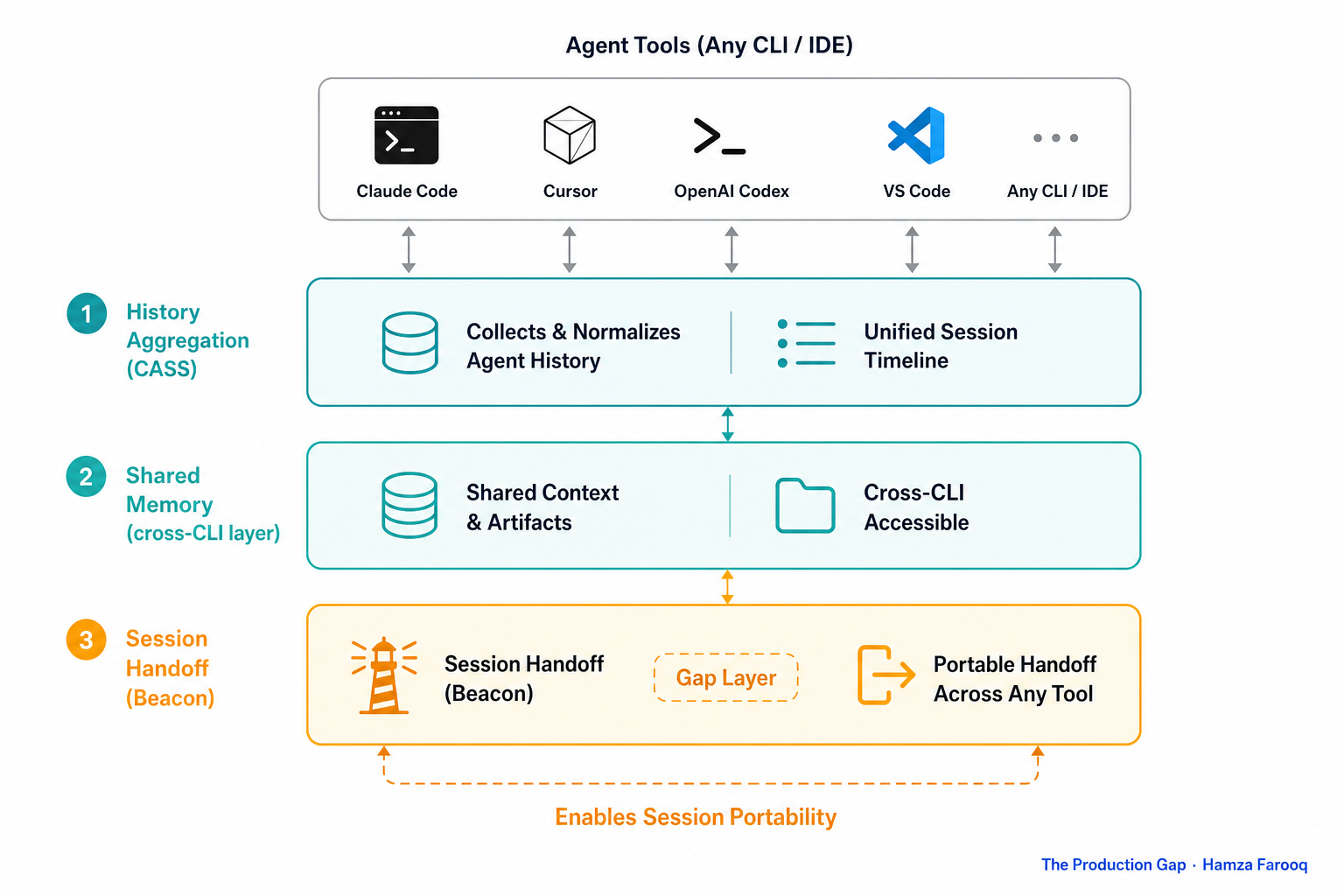
- History aggregation: Search past sessions across agents (addressed by CASS)
- Shared memory: Concurrent shared context across live agents (addressed by cross-CLI layers)
- Session handoff: Move an active, in-progress session to a different tool (addressed by Beacon)
CASS aggregates sessions from 11 agents, which is useful for search but is not a handoff tool. The cross-CLI shared-memory layer for Claude, Codex, Grok, and others handles concurrent shared context, not live session transfer. Beacon targets layer three, which existing tools largely leave unaddressed.
The Three-Layer Model of Multi-Agent Session Management (framework used in this guide)
| Tool or Layer | What it handles | What it does not handle |
|---|---|---|
| CASS | Indexing and searching past sessions across 11 agents | Transferring an active session to a new tool |
| Cross-CLI shared memory | Shared context across Claude, Codex, and Grok simultaneously | Moving a session mid-task to a different CLI |
| GitHub Copilot session unification | Consistent state within the Copilot ecosystem | Cross-vendor handoff to Cursor, Claude Code, or others |
| Beacon handoff | Serializing and transferring an active session across tools | Agent-native runtime state, tool-specific memory, reasoning logs |
What can Beacon handoff not transfer, and what does that cost your team?
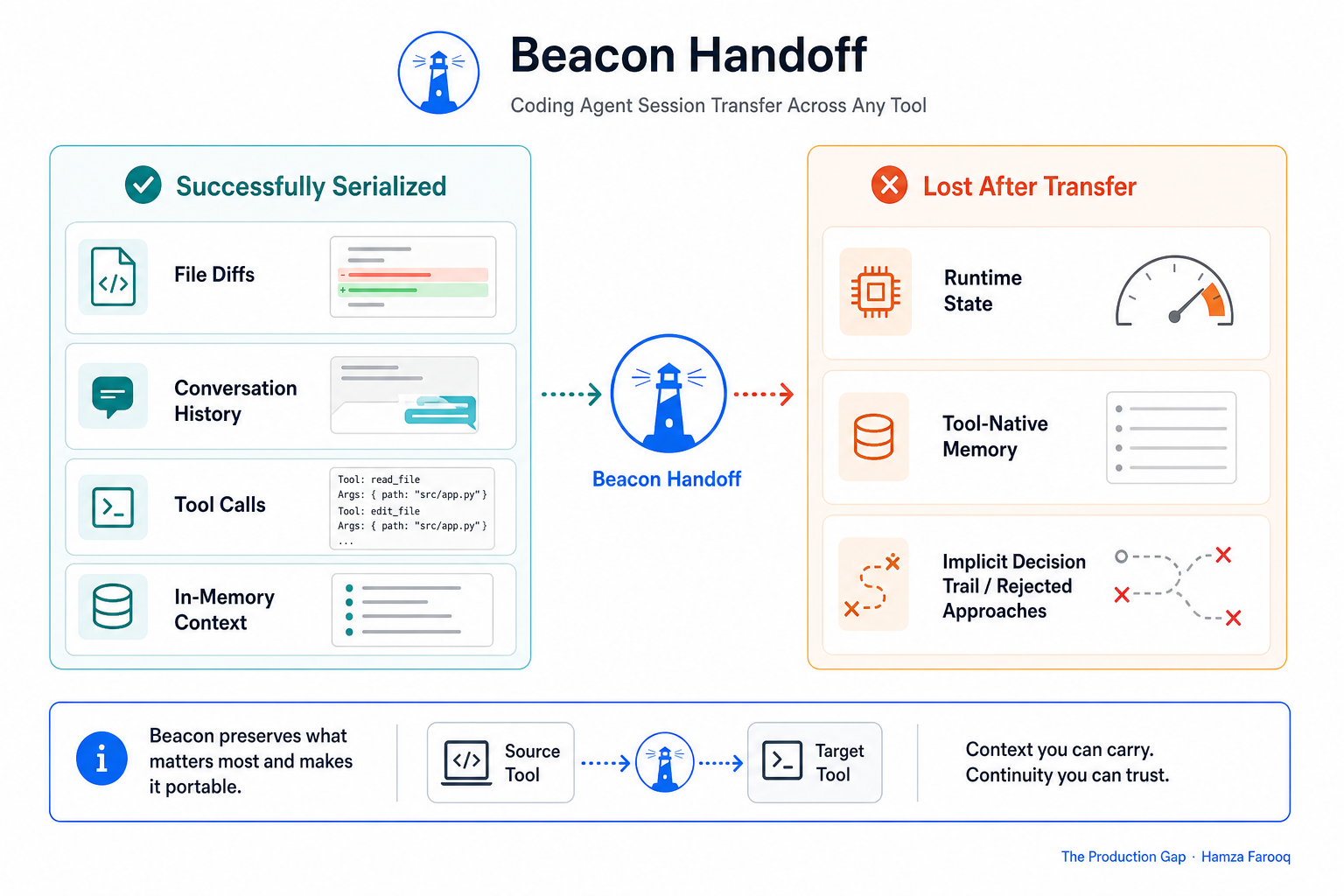
Even with Beacon handoff, switching coding agents mid-session will still lose runtime state, tool-specific memory, and most expensively the implicit decision trail: rejected approaches and half-formed constraints that shaped the session but never made it into a file or tool call.
Runtime state includes active terminal processes, in-flight tool calls, and loaded model state. Beacon exports what ran, not the running process itself. Tool-specific memory presents a separate problem: indexes, embeddings, and project context files are structures the receiving agent has to rebuild from scratch. OpenScout's checklist is direct about this point, confirming that what survives a transfer is consistently shorter than teams expect.
The epistemological gap is the more expensive loss. The code changes are in git. What is not recorded anywhere is why a particular approach was rejected, why a service boundary sits where it does, or what offhand constraint was mentioned that the agent quietly incorporated. That reasoning lives in the context window, not in any artifact. A handoff tool can serialize artifacts. It cannot serialize reasoning.
Frequently asked questions
What exactly does Beacon handoff serialize when it exports a coding agent session? Beacon handoff serializes four components: file diffs, conversation history, tool calls, and in-memory context. Runtime state, tool-native memory, and the implicit decision trail are not designed to travel with it. OpenScout's agent portability checklist illustrates the consistent gap between what teams expect to carry over and what actually does.
How does Beacon handoff differ from shared-memory layers like CASS or cross-CLI session managers? Beacon handoff differs from CASS and cross-CLI layers in that it is designed specifically to move an in-progress session to a different tool entirely, which neither of the other solutions addresses. CASS aggregates and searches past session history across 11 agents but does not transfer active sessions. Cross-CLI layers give agents concurrent shared context across tools running simultaneously but do not move a session mid-task. Beacon targets that distinct third layer.
What is still lost when you resume a session in a different tool even with Beacon handoff? The biggest loss is the implicit decision trail: rejected approaches and reasoning that shaped the session but was never written into a file or tool call. The code changes survive in git. The reasoning behind the choices does not survive in any artifact. Closing that gap requires deliberate reasoning-log capture at each session checkpoint, a practice that sits outside what any current handoff tool provides automatically.
Conclusion
Beacon handoff addresses the mechanical layer of cross-tool coding agent session portability by serializing the four components it is designed to transfer. The implicit decision trail, the reasoning, the rejections, and the constraints that quietly shaped a session, is what costs teams the most time when switching tools, and no current tool captures it automatically.
A practical rule of thumb from this guide: pair Beacon with deliberate reasoning-log capture at each checkpoint. A structured note of rejected approaches and implicit constraints, held within your agent control plane, closes the gap that serialization alone cannot. If cross-tool switching is already eating meaningful time, Beacon is worth adopting now alongside that habit. If switching is occasional, waiting for a more mature protocol is a reasonable call.
The context you lose when you switch coding agents is mostly the context you never wrote down.
References
Learn from me
Claude Code in Practice, my Maven cohort. Master Claude Code from fundamentals to advanced orchestration: skills, subagents, hooks, MCP, and production automation. Join the next cohort →
Hire us
Traversaal.ai. We're a team of forward deployed engineers solving the toughest AI problems for Fortune 100 companies: document intelligence, agentic data platforms, and real-time web intelligence, deployed in production. Work with our team to deploy your next agentic ecosystem. Talk to Traversaal.ai →
Join us
Want to solve these problems with us? We're always looking for forward deployed engineers who want to ship production AI. jobs@traversaal.ai