Churn Prediction AI Automation: How Agentic Systems Turn Risk Scores into Retention Actions
Churn prediction AI automation uses agentic systems to act on risk scores instantly—learn how to cut action latency and boost customer retention.

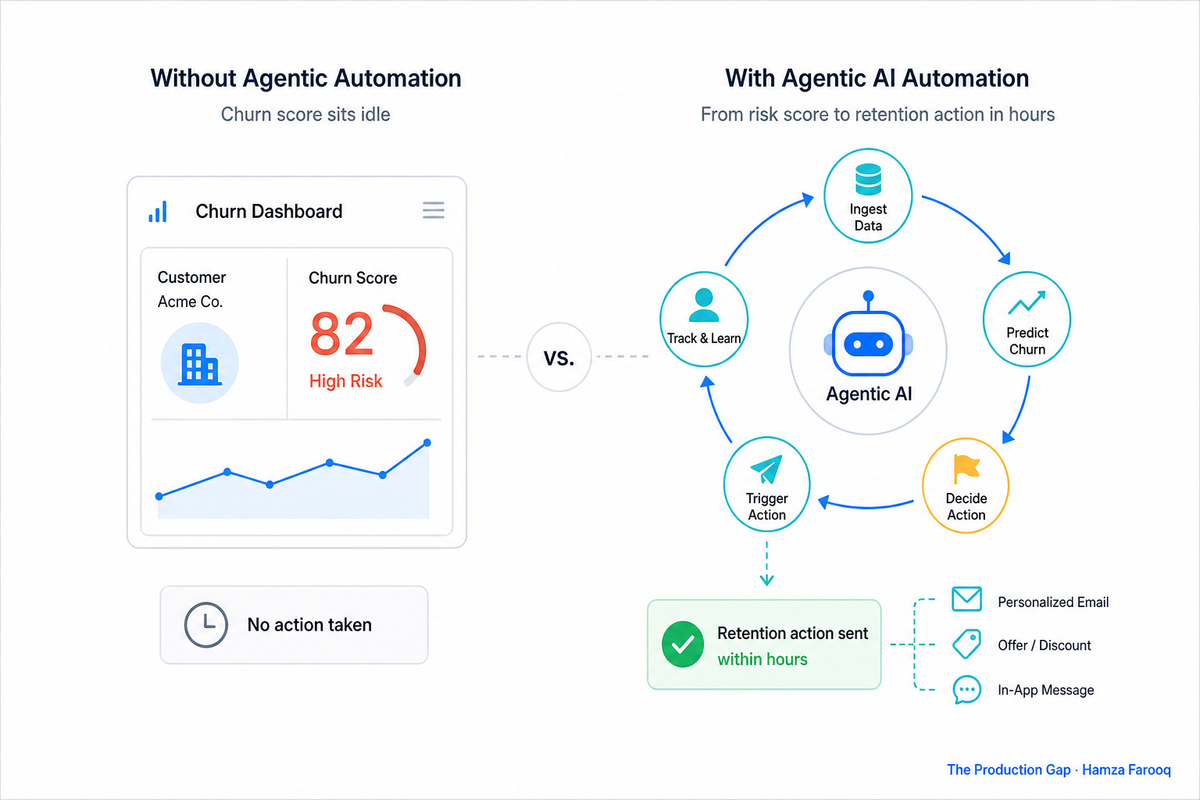
TL;DR: Churn prediction AI automation moves beyond generating risk scores by deploying agentic systems that autonomously diagnose why customers are at risk, craft segment-level retention narratives, and trigger or recommend specific next-best-actions without waiting for human intervention. In telecom and SaaS contexts, these systems close the gap between knowing a customer might leave and actually doing something about it. As of 2026, this orchestration layer is the primary competitive differentiator in retention, not predictive accuracy.
Key Takeaways
- Churn scores alone are not enough: A risk flag means nothing if no one acts on it in time.
- Agentic AI closes the action gap: These systems investigate why a customer is leaving and trigger a personalized response without waiting for a human.
- Root-cause analysis changes the playbook: Address the specific driver (billing friction, low usage, missed onboarding), not a generic discount.
- Telecom and SaaS churn have different warning signs: Subscriber churn shows up in usage drops and support spikes; SaaS risk surfaces in shrinking seat activity and skipped check-ins.
- Speed is now the competitive edge: The race is who can shrink the time between a risk signal and tailored outreach to nearly zero.
- Agents work inside your existing tools: No stack replacement required; agentic systems plug into CRMs and CS platforms already in use.
What Is Churn Prediction AI Automation?
The competitive gap now is not predictive accuracy. It is action latency: the hours or days between a risk score appearing and anyone doing something about it. Agentic churn systems exist specifically to close that gap.
Why Does a High-Accuracy Churn Model Still Fail to Prevent Churn?
A team with a strong model but a multi-day response lag is competing against a team with a slightly weaker model and an agentic loop that acts the same day. The faster team retains more customers. In the framework used in this guide, predictive accuracy is no longer the primary lever. Intervention speed is.
What Behavioral Signals Are Most Predictive of Churn, and Do They Differ Between Telecom and SaaS?
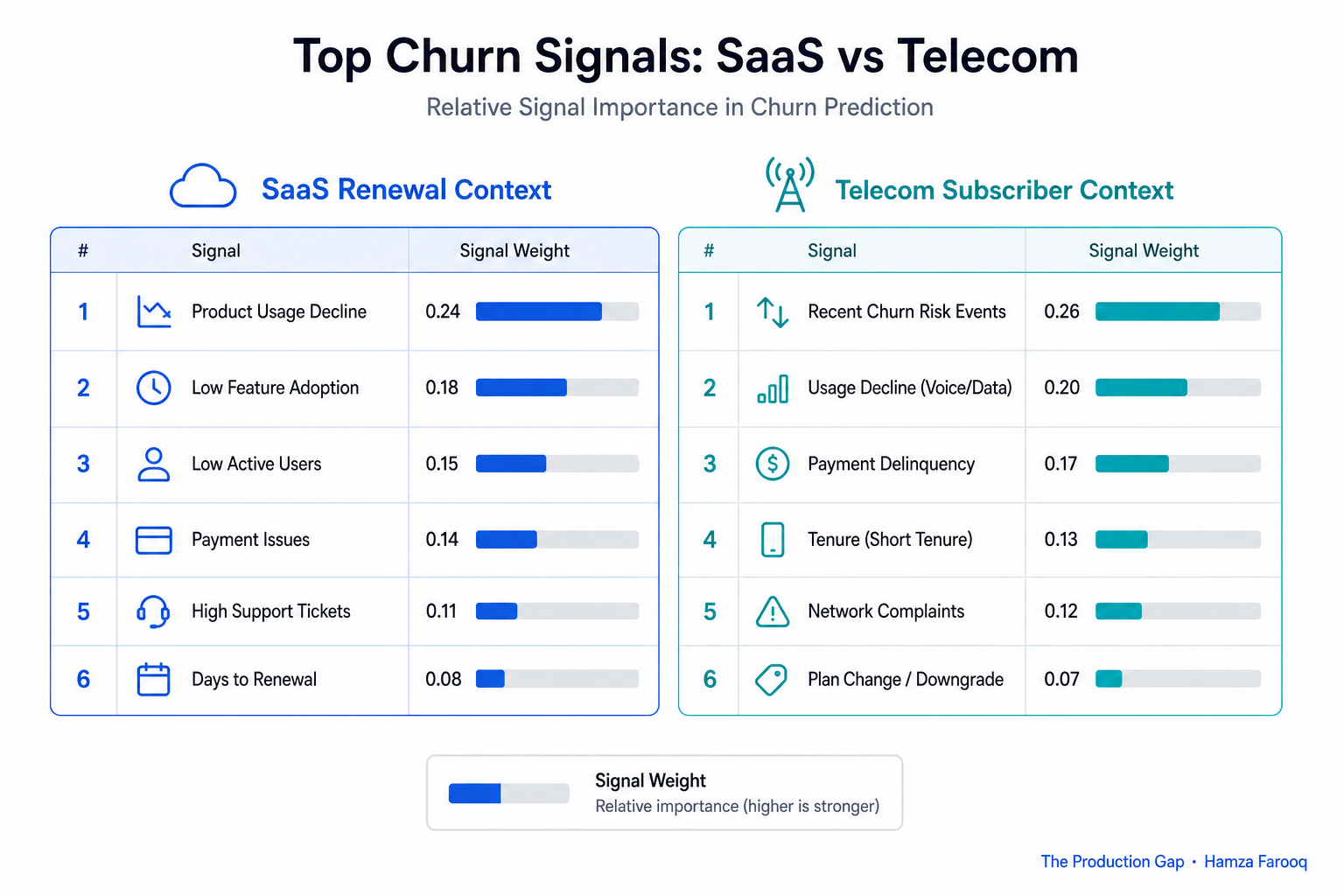
The most predictive SaaS churn signals are declining seat activity, skipped executive check-ins, and shrinking feature adoption. Telecom subscriber churn is better predicted by dropped data usage, support ticket spikes, and plan downgrade inquiries.
Conflating these leads to wrong interventions. Churn prediction software uses machine learning and behavioral data to identify at-risk customers, but the signals that matter are vertical-specific. An AI-based churn prediction model studied specifically for telecommunications shows that telecom patterns require their own feature engineering; borrowing a SaaS model wholesale will not produce reliable results in a subscriber context.
Table 1: Churn Signal Comparison, SaaS vs. Telecom (as of 2026)
| Signal Category | SaaS Renewal Risk | Telecom Subscriber Risk |
|---|---|---|
| Usage pattern | Seat activity drop over 60 days | Data/voice usage drop over 30 days |
| Support behavior | Unresolved tickets, silence after complaints | Spike in billing/coverage contacts |
| Engagement events | Skipped QBR, ignored CSM outreach | Plan downgrade inquiry, competitor mention |
| Billing signal | Payment delays, downgrade request | Early termination inquiry |
| Relationship signal | Champion departure, org restructure | Household plan cancellation pattern |
A SaaS team applying telecom signal weights would likely mis-prioritize their entire outreach queue. The combination of signals that matters in one vertical does not map cleanly onto the other.
How Does an Agentic AI System Translate a Churn Score into a Specific Retention Action Without Human Intervention?
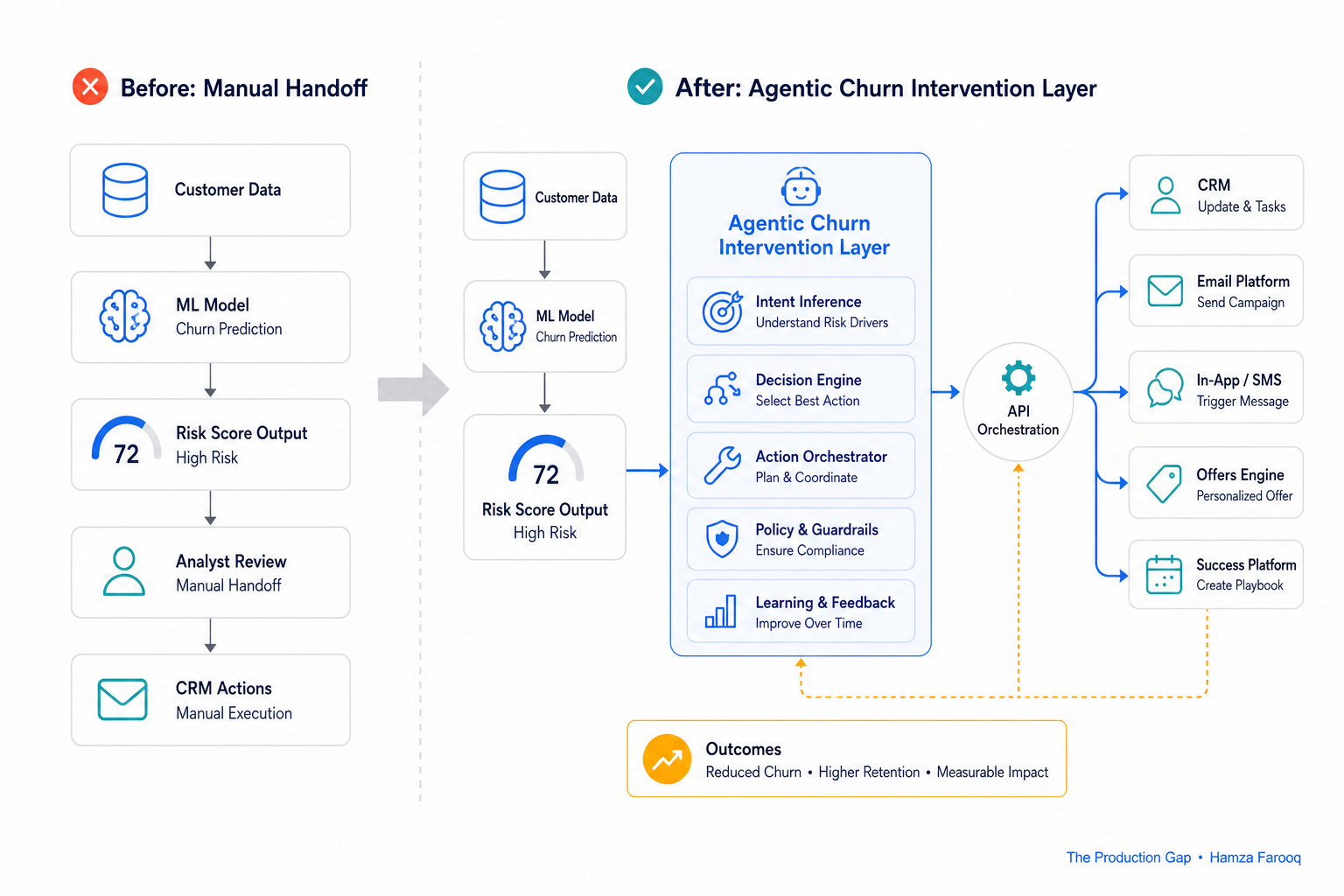
An agentic AI churn system translates a risk score into a retention action by running an automated root-cause analysis loop that pulls CRM history, usage logs, and support data, then executes a next-best-action through existing CS or CRM tooling.
The Score, Narrate, and Act (SNA) Loop Explained
The architecture runs in three steps. This is the framework used in this guide, referred to here as the Score, Narrate, and Act (SNA) loop:
- Score intake: The ML model fires a churn probability above threshold. Machine learning identifies trends within customer data to automate prediction of at-risk customers, and that is the loop's entry point.
- Root-cause narration: The agent pulls CRM activity, product usage logs, support ticket history, and billing records simultaneously. It clusters the signals into a root-cause category (for example, adoption stall, billing friction, or champion departure) and generates a plain-language narrative summary for the account.
- Next-best-action execution: The agent matches the root-cause cluster to a predefined playbook and either acts autonomously (sends a personalized email, schedules a CSM task, fires a Slack alert) or surfaces a ranked recommendation for human approval, depending on account tier. UiPath AI Center demonstrates this pattern using Tabular Data TPOT Classification within an end-to-end automation workflow.
The agent's job is not to predict churn. The model already did that. The agent explains why and acts immediately.
How Do You Integrate Agentic Churn Intervention into Your Existing CRM Without Rebuilding the Stack?
Agentic churn intervention integrates into existing CRM and CS platforms through API-based orchestration layers that listen for score threshold events, pull account context, and push actions back into the same systems your team already uses.
The integration pattern is additive, not destructive:
- Trigger layer: A webhook or scheduled API call from your existing churn model fires when a score crosses threshold. Gainsight's AI capabilities already support this pattern, making it a natural anchor point.
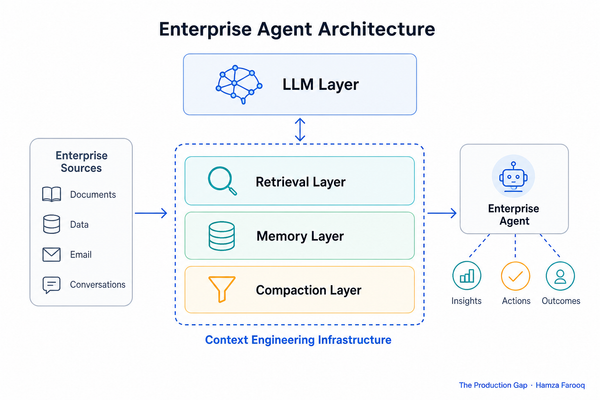
- Agent orchestration layer: A lightweight agent built on LLM-based reasoning and tool-calling pulls context from CRM, product analytics, and support APIs simultaneously.
- Action layer: The agent writes back to tools your team already uses: creates a Gainsight CTA, logs a Salesforce task, sends a Slack message to the CSM, or fires a personalized email through existing marketing automation.
One practical guardrail worth setting early, and a core recommendation in this guide, is to define a human-in-the-loop threshold by account ARR. Agents act autonomously below a certain ARR floor and route a ranked recommendation for human approval above it. No new stack is required, only an orchestration layer that listens to your existing model and acts through your existing tools.
Frequently Asked Questions
What is the difference between a churn prediction model and an agentic churn prevention system? A churn prediction model produces a risk probability score. An agentic system investigates why the score is elevated, generates a root-cause narrative, and triggers a personalized retention action without waiting for human review.
How much does intervention speed actually affect retention outcomes? This is author synthesis based on the framework in this guide: the faster a risk signal is investigated and acted on, the more options remain available before a customer disengages. Agentic workflows compress the gap between score and outreach, and that window is precisely where retention decisions are made or lost. No peer-reviewed benchmark is cited here; the logic is structural.
What data sources does an agentic churn system need to run root-cause analysis? At minimum: product usage logs, CRM records including last contact date and champion history, support ticket volume and resolution status, and billing data showing payment history and plan changes.
Can agentic churn systems work for both high-volume low-ACV and low-volume enterprise accounts? Yes, but the action tier should differ. Agents act fully autonomously for low-ACV accounts where manual intervention does not scale, and surface a prioritized recommendation to the CSM or AE for high-ACV enterprise accounts.
Conclusion
The teams building an edge have connected the Score, Narrate, and Act loop: an agentic layer that investigates why a customer is at risk, generates a root-cause narrative, and fires a personalized intervention through existing tools without waiting for someone to log in and act.
A practical starting point: pick one at-risk segment, map its three most common root-cause clusters, and define the next-best-action playbook for each. Automate that loop before revisiting the model itself.
Your churn model is not your problem. Your action latency is. Fix that first.
Learn from me
Agentic AI for Product Managers, my Maven cohort. Learn how to design, evaluate, and ship reliable AI systems: the technical fluency PMs need to lead agentic products, no engineering background required. Join the next cohort →
Hire us
Traversaal.ai. We're a team of forward deployed engineers solving the toughest AI problems for Fortune 100 companies: document intelligence, agentic data platforms, and real-time web intelligence, deployed in production. Work with our team to deploy your next agentic ecosystem. Talk to Traversaal.ai →
Join us
Want to solve these problems with us? We're always looking for forward deployed engineers who want to ship production AI. jobs@traversaal.ai