Why 98% of Enterprises Pilot AI Agents but Only 18% Scale Them: The Unstructured Data Readiness Gap
Enterprise AI scaling challenges start with messy data, not bad models. Learn why pilots succeed but production fails—and how to close the readiness gap.

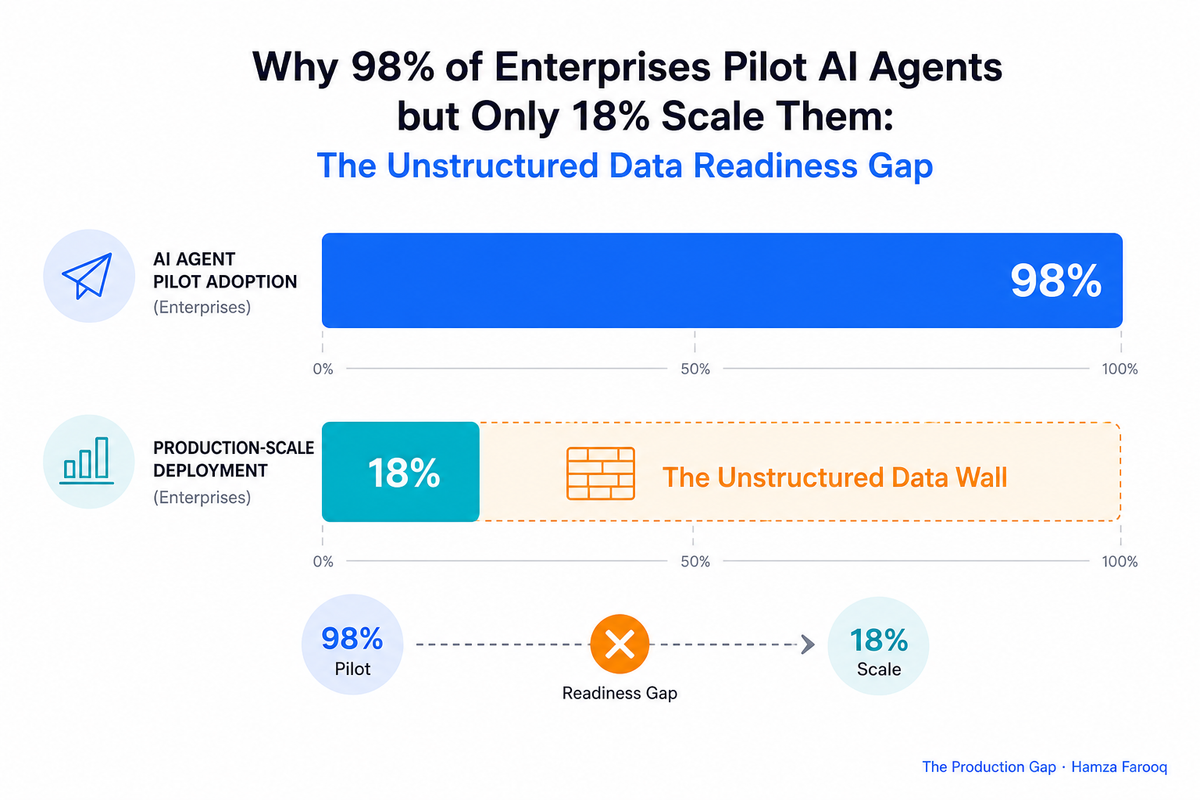
TL;DR: Enterprise AI scaling challenges stem primarily from unstructured data infrastructure failures, not model or integration shortcomings. Most enterprises cannot scale AI agents because their documents, emails, and knowledge bases lack the structure, metadata, and retrieval quality agents need to operate reliably. Pilots succeed in controlled conditions with clean inputs; production breaks when agents hit the messy, inconsistent data reality at scale.
Key Takeaways
- Most large enterprises run AI agent pilots; far fewer reach full production.
- The bottleneck is not the model. It is whether enterprise content can be found and retrieved at agent runtime.
- Accessibility beats accuracy: clean data buried in unmapped file stores is functionally nonexistent to an agent.
- Storage decisions made years before AI agents existed now directly determine agent performance.
- Pilot warning signs are reliable predictors of scale failure, and they appear early.
- Pilots without a clear production path drain internal credibility and budget momentum.
Why are enterprise AI agents stuck at the pilot stage?
Most enterprises have an AI agent running somewhere. Almost none have one running everywhere it needs to. That gap is not a model problem. It is a storage architecture problem that AI adoption exposed.
The result is a condition practitioners call "AI pilot purgatory": stalled budgets, exhausted executive patience, and months of sunk investment with no production ROI. This article gives Field Delivery Engineers the diagnostic language to name the real constraint before the program collapses.
Why do enterprise AI pilots succeed but production deployments fail?
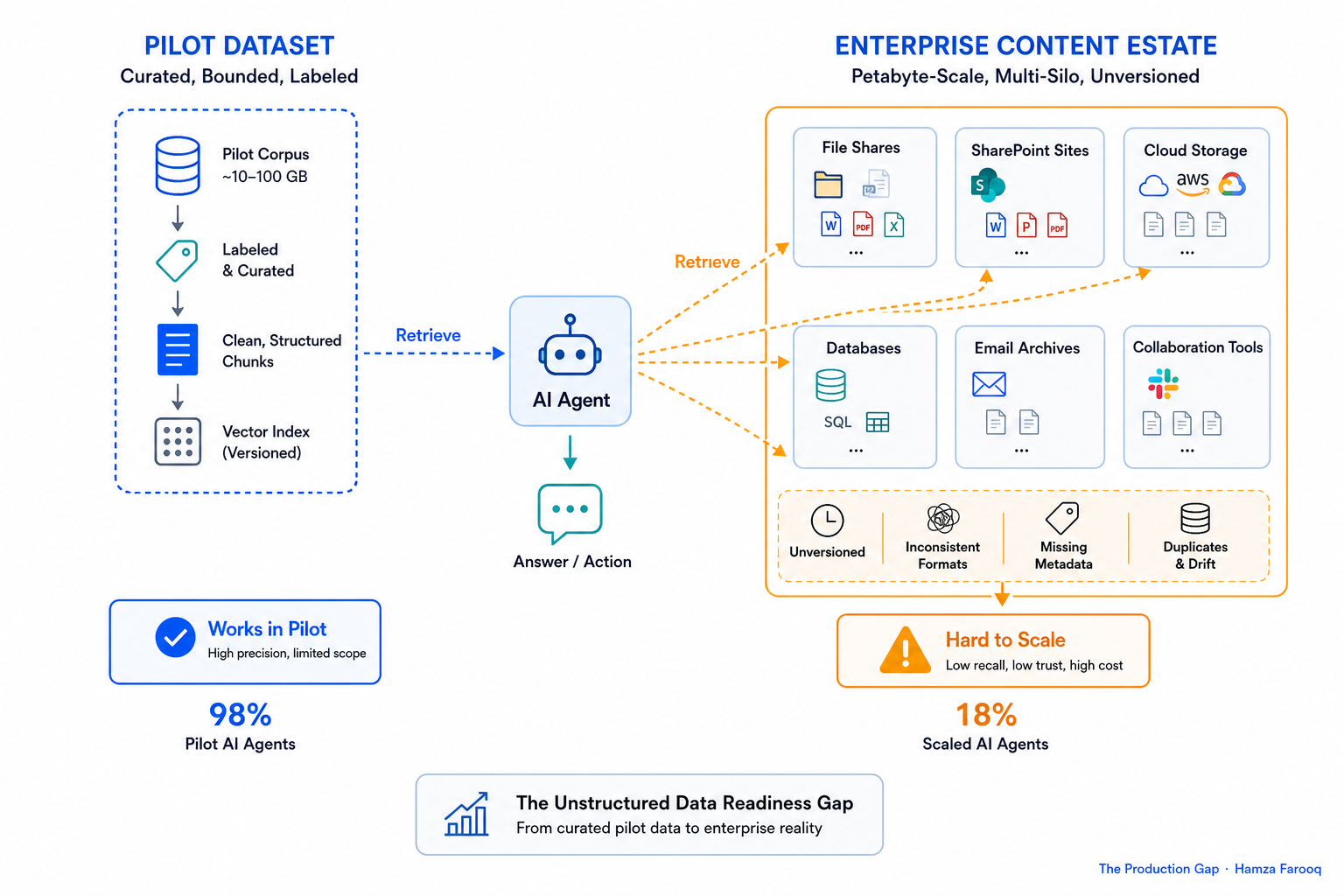
Enterprise AI pilots succeed because they run on curated, bounded datasets that bear no resemblance to the unstructured content estate an agent encounters in full production.
Pilots are built to win. Data is hand-selected, schemas are clean, retrieval paths are short. When the same agent hits the full enterprise content estate (SharePoint sprawl, legacy file shares, disconnected object stores, decade-old PDFs with no metadata) retrieval collapses. Not because the model degraded, but because the content was never addressable.
Agents depend on runtime discoverability. A document that cannot be consistently located, versioned, and retrieved at inference time is functionally nonexistent, regardless of how accurate its contents are. The pilot proved the curated subset worked, not that production was ready. FDEs must make that distinction explicit before the "pilot succeeded" narrative forecloses the infrastructure conversation.
Why does data accessibility matter more than data quality for AI agent scaling?
Data accessibility, meaning whether an agent can reliably discover and retrieve content at runtime, is a more binding constraint on production deployment than data accuracy or completeness.
The operative distinction, as used in this guide:
- Data quality: Is the content correct, complete, and consistent?
- Data accessibility: Can the agent find, version, and retrieve the content at the moment it needs it?
Content that is 100% accurate but buried in an unmapped file share is inaccessible and worthless to an agent at inference time. No prompt engineering or model fine-tuning recovers content the retrieval layer cannot surface.
A practical rule of thumb: before any production timeline is proposed, score the client's content estate across three dimensions: can it be found, versioned, and retrieved consistently at runtime? The reframe that matters is shifting the client conversation from "Is your data clean?" to "Can your agent find your data when it matters?"
What storage and content infrastructure separates enterprises successfully scaling AI agents from those still piloting?
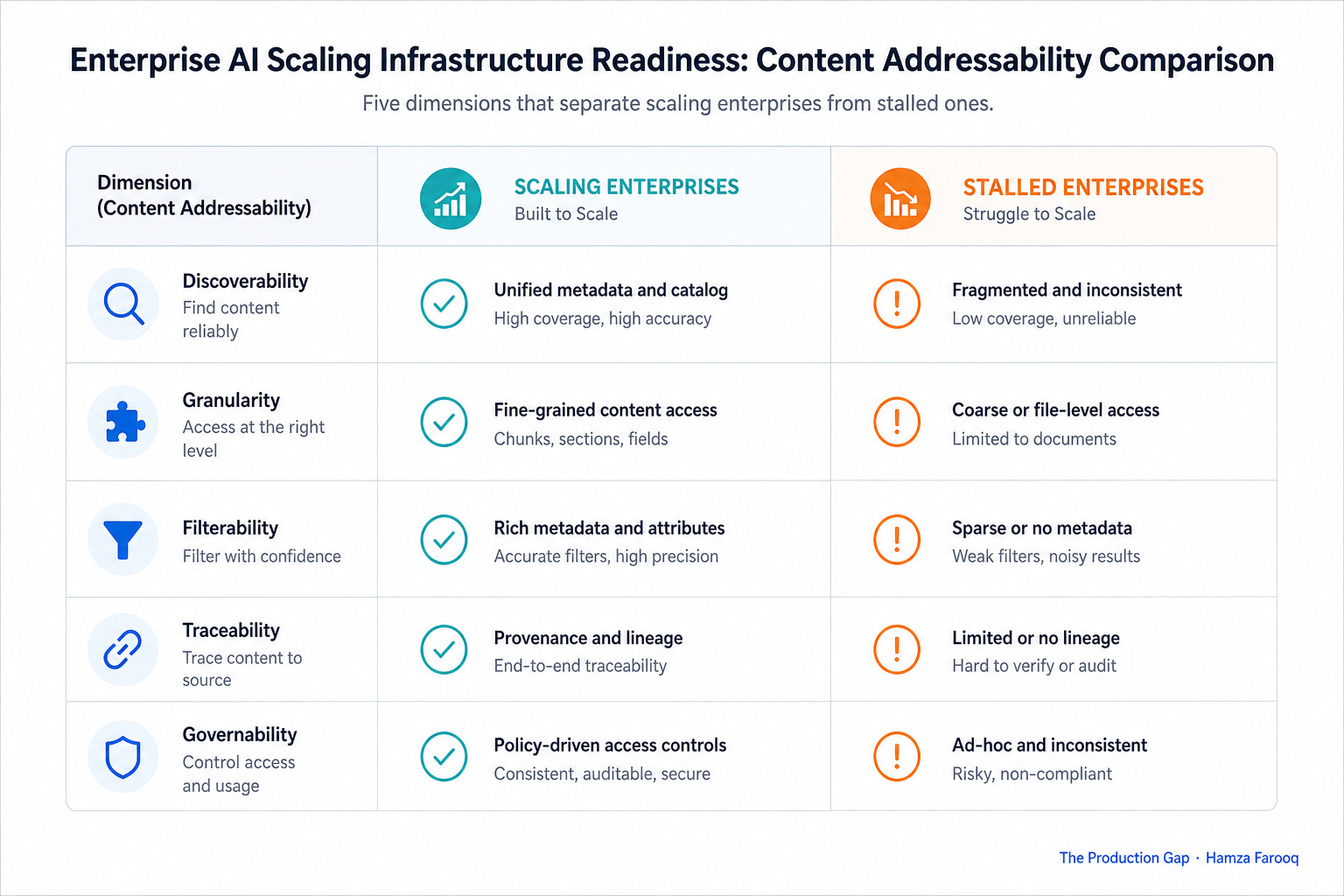
Enterprises successfully scaling AI agents share one structural characteristic: their file infrastructure made unstructured content addressable at petabyte scale before the AI project began.
Those that scale did not find better models. They inherited or deliberately built storage architecture that solved runtime discoverability before any AI initiative started. The following table, labeled here as The AI Agent Scaling Readiness Checklist, can be used as a discovery checklist in every client engagement:
The AI Agent Scaling Readiness Checklist
| Infrastructure characteristic | Scaling enterprises | Stalled enterprises |
|---|---|---|
| Unified namespace across storage silos | Present | Fragmented by system or region |
| Consistent metadata schema for unstructured files | Enforced at ingest | Ad hoc or absent |
| Versioning and audit trail at file level | Native | Manual or nonexistent |
| Petabyte-scale indexing accessible to agents | API-addressable | Human-search-only |
| Data governance applied to unstructured content | Extends to file stores | Structured data only |
Storage decisions made years ago now directly determine agent performance today. Multiple "no" answers across this checklist signal a pre-condition requiring remediation before production deployment is viable. Closing these gaps also requires clear ownership across data engineering, MLOps, governance, and AI integration roles. BairesDev’s guide to assembling an AI team provides a useful breakdown of the capabilities enterprises need as they move from pilot to production.
What are the early warning signs during an AI pilot that unstructured data will block scale?
The most reliable early warning signs appear during the pilot itself, in how the agent struggles to find content, not process it.
FDEs have a diagnostic window during the pilot that closes once the "pilot succeeded" narrative locks in. The following five signals, drawn from the framework used in this guide, should be captured before that happens.
- Retrieval inconsistency at modest file volume. Same query, same corpus, different results across runs. This instability will amplify into complete retrieval failure at petabyte-scale volume.
- Pilot dataset required significant manual curation. If the data team spent a disproportionate share of pilot effort selecting or restructuring source files, that effort does not scale.
- Performance degrades when scope expands slightly. Adding one additional department's file share causes a measurable retrieval quality drop.
- No metadata governance exists for target content. Files lack consistent naming, ownership records, or version history. Runtime discoverability will fail under production load.
Three or more of these signals means the conversation needs to shift to infrastructure remediation before any production timeline is proposed.
Frequently Asked Questions
How do you assess whether an enterprise's unstructured data estate is ready to support AI agent production deployment? Test whether the agent can consistently find, version, and retrieve content at runtime across the full target corpus, not just the curated pilot subset. If retrieval degrades when scope expands beyond the pilot boundary, remediation must precede any deployment timeline.
What is "AI pilot purgatory" and why does it happen? "AI pilot purgatory" describes enterprises trapped in extended pilot investment without production ROI. It happens when the gap between curated pilot data and the real content estate is never diagnosed and no infrastructure remediation plan exists.
Why does data accessibility matter more than data accuracy for AI agents at scale? An agent cannot use content it cannot find. Accurate data in unindexed file stores is functionally nonexistent at runtime, and no model fine-tuning recovers content the retrieval layer cannot surface.
What storage infrastructure characteristics separate enterprises that successfully scale AI agents from those that stall? Unified namespace, enforced metadata schemas, native file versioning, petabyte-scale API-addressable indexing, and unstructured data governance. Enterprises that built these before their AI programs began are the ones scaling today.
Conclusion
The pilot-to-production gap is not an AI problem. It is a storage architecture problem that AI agents exposed. The right question is not which model to select. It is whether this enterprise's unstructured content can be found, versioned, and retrieved at runtime, at petabyte scale, by an agent that was never designed with this file estate in mind.
Next step: Test the client's primary unstructured content stores against the AI Agent Scaling Readiness Checklist above before any production timeline is proposed. Multiple "no" answers is a remediation conversation, not a deployment conversation.
The enterprises scaling AI agents today did not get better models. They built better foundations.
Learn from me
Forward Deployed Engineering Bootcamp for Full-Stack Developers, my Maven cohort. Build and ship complete AI products end to end, from React and Node.js frontends to deployed models with caching and observability. Join the next cohort →
Hire us
Traversaal.ai. We're a team of forward deployed engineers solving the toughest AI problems for Fortune 100 companies: document intelligence, agentic data platforms, and real-time web intelligence, deployed in production. Work with our team to deploy your next agentic ecosystem. Talk to Traversaal.ai →
Join us
Want to solve these problems with us? We're always looking for forward deployed engineers who want to ship production AI. jobs@traversaal.ai