Forward Deployed Engineer Skills: A Self-Assessment and Learning Path for Every Core FDE Competency
Forward deployed engineer skills decoded: self-assess RAG prototyping, demo craft, and stakeholder translation, then close gaps with targeted learning paths.

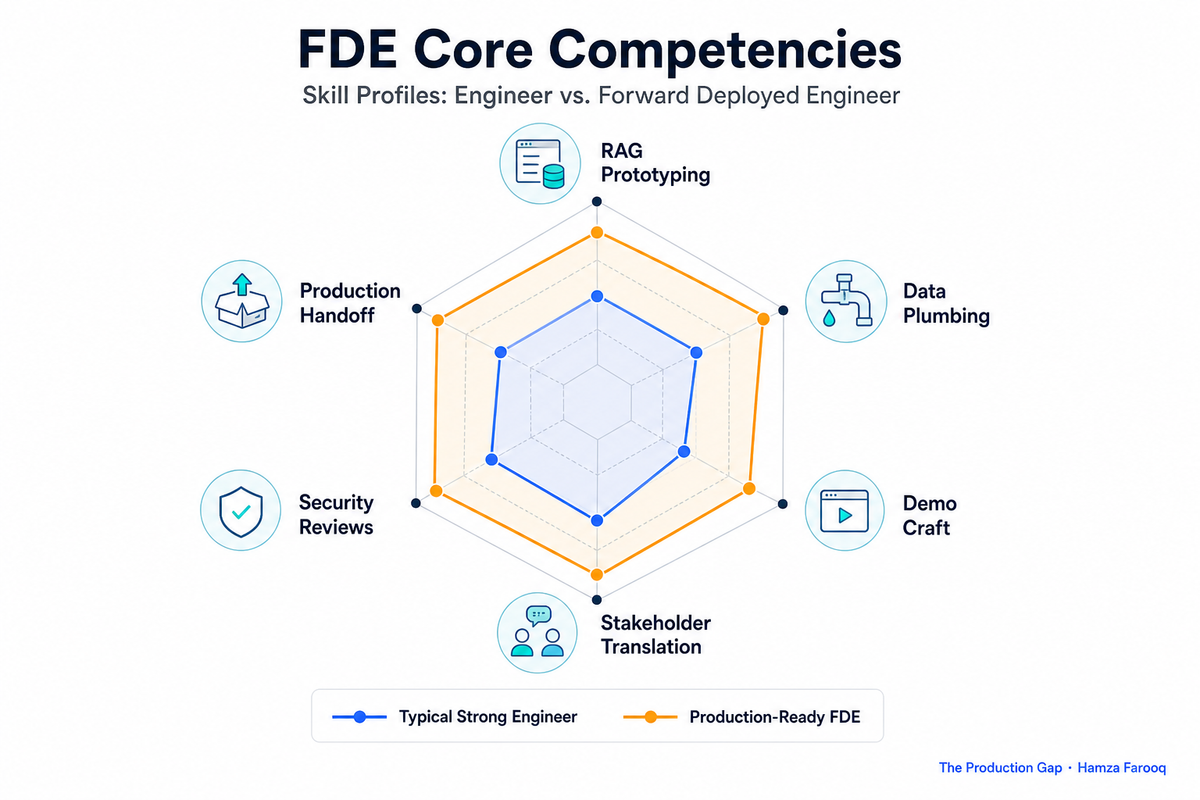
TL;DR: Forward deployed engineer skills span six core competencies: RAG prototyping, data plumbing, demo craft, stakeholder translation, security reviews, and production handoff. Use this guide to self-assess each area and close specific gaps with targeted resources.
Key Takeaways
- FDE differs from solutions engineering: FDEs write and ship real code on customer infrastructure; solutions engineers primarily demo and advise.
- Data plumbing is the hidden bottleneck: Engagements stall on connecting messy enterprise data, not on the AI model.
- Demo craft is an engineering discipline: A compelling proof-of-concept survives unpredictable customer data, not clean sample inputs.
- Stakeholder translation is learnable: Converting a VP's vague goal into a precise spec can be studied and practiced deliberately.
- Security reviews are a first-class deliverable: Enterprise deals live or die on your ability to answer SOC 2, data residency, and access control questions on the spot.
- Production handoff determines lasting impact: A clean handoff with documentation and an enabled internal champion separates a successful engagement from a forgotten pilot.
What Is a Forward Deployed Engineer?
A forward deployed engineer embeds directly with customers, ships production-quality code on customer infrastructure, and bridges the gap between an enterprise client's real environment and a working AI solution. The combination of engineering depth and customer-facing judgment is harder to find than either skill alone.
FDE roles appear at senior and staff levels across AI-native companies. The shortage is not about coding ability. The forward deployed engineer career path rewards engineers who can execute all six competencies simultaneously: RAG prototyping, data plumbing, demo craft, stakeholder translation, security reviews, and production handoff.
FDE vs. Solutions Engineer: Key Differences
| Dimension | Forward Deployed Engineer | Solutions Engineer |
|---|---|---|
| Primary output | Shipped code on customer infrastructure | Demo, advice, and use-case guidance |
| Codebase ownership | Writes and owns production-quality code | Configures or demonstrates existing product |
| Customer engagement depth | Embedded; works inside customer environment | Advisory; pre-sales or post-sales support |
| Technical floor | Full-stack plus data engineering and AI/ML depth | Product and integration knowledge |
| Security and compliance role | Treats SOC 2 and data residency as engineering deliverables | Escalates to a dedicated security team |
| Engagement end state | Hands off a maintained, documented codebase | Closes the sales cycle or resolves a support case |
What Are the Core Technical Skills a Forward Deployed Engineer Actually Needs?
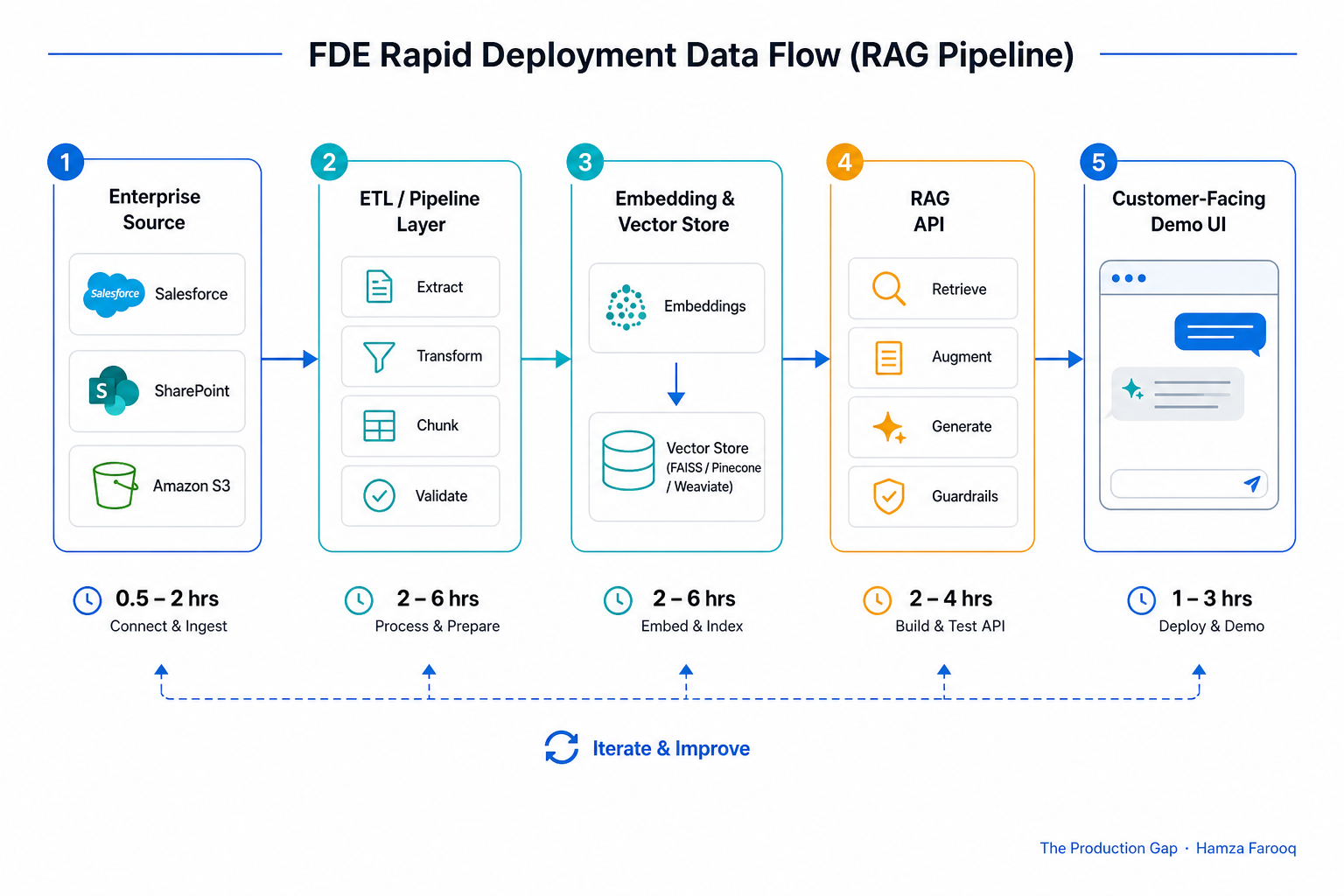
RAG prototyping is the starting point. An FDE must stand up a working retrieval-augmented generation pipeline against a customer's existing document store (SharePoint, Confluence, S3) early in an engagement. The skill is not knowing how RAG works in theory, it is knowing which chunking strategy holds up on messy PDFs when a stakeholder demo is imminent.
Data plumbing is where timelines blow up. When a customer says "our data is in Salesforce," what that means in practice is: Salesforce, then a custom ETL, then chunked embeddings, then a vector store the customer has never provisioned. Your ceiling as an FDE is set by your ability to chain unfamiliar enterprise data sources under pressure, not by your ability to fine-tune a model.
Self-assessment question: Can you build and deploy a working RAG pipeline against a novel data source (no clean schema documentation) under significant time pressure?
Learning path: LangChain and LlamaIndex docs for RAG architecture; dbt fundamentals for transformation logic; Airbyte connector docs for source integration.
What Is the Difference Between Demo Craft and Just Building a Prototype?
Demo craft is the discipline of building a proof-of-concept that survives real customer data and a live audience, a distinct skill from prototyping against clean sample inputs.
Strong demo craft has three components:
- Data hardening. Run your demo against the ugliest slice of the customer's real data before any live session.
- Graceful failure paths. When the LLM returns an unexpected response, the UI must not break visibly.
- Narrative anchoring. Every demo action maps to a business outcome, not a feature.
Stakeholder translation lives inside demo craft. Forward deployed engineering requires communication, listening, and empathy as core skills. Turning a VP's vague goal into a scoped, demonstrable spec (and translating results back into business language after the demo) is a skill you can practice deliberately.
Self-assessment question: Have you run your demo against a dataset you had never seen, with a stakeholder in the room, and recovered gracefully from an unexpected output?
Learning path: Study enterprise sales demo recordings for pacing and recovery. Read The Mom Test before any scoping conversation.
How Do FDEs Handle Enterprise Security Reviews and Production Handoff?
FDEs treat SOC 2 compliance, data residency, and access control documentation as engineering deliverables, not procurement paperwork to hand off to someone else.
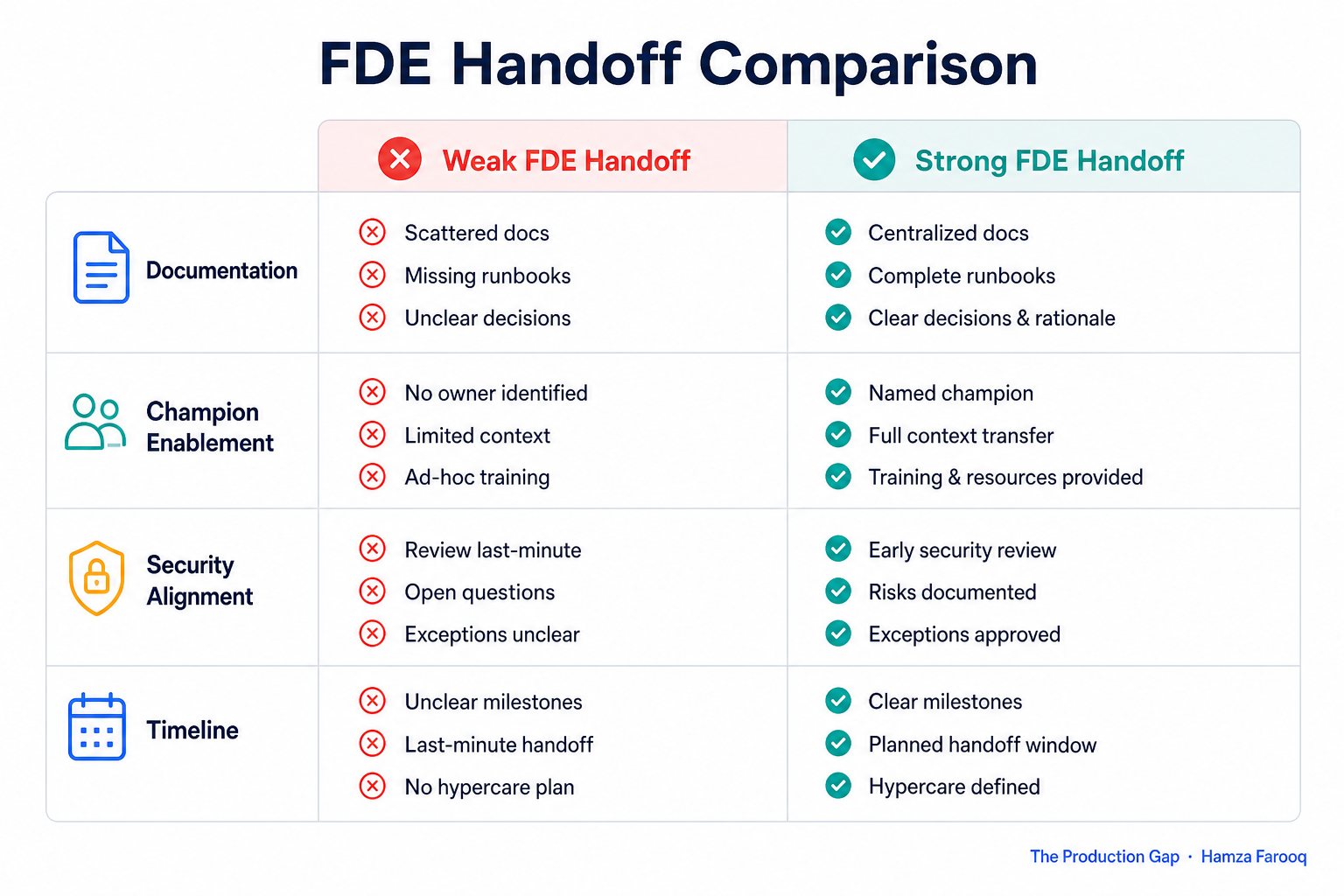
The FDE role requires a rare combination of elite engineering, customer-facing skills, and AI/ML depth. That combination is most exposed at the transition from prototype to production. A clean handoff has three components:
- Documentation: Architecture decision records (ADRs), a runbook, and an annotated codebase the customer's team can maintain independently.
- Internal champion enablement: A thorough walkthrough with real ownership transfer beats a Confluence page nobody reads.
- Security posture alignment: The handoff package explicitly maps prototype security decisions to the customer's compliance framework, in writing.
| Handoff Component | Weak FDE Execution | Strong FDE Execution |
|---|---|---|
| Documentation | README with setup steps | ADR + runbook + annotated code |
| Champion enablement | "Call us if it breaks" | Thorough walkthrough with ownership transfer |
| Security alignment | Verbal confirmation | Written data flow diagram mapped to compliance controls |
| Timeline | Assembled after the deal closes | Begins at engagement kickoff |
Self-assessment question: Could a customer's senior engineer maintain your prototype six months after you leave, without ever calling you?
Learning path: Study the C4 model for architecture documentation. Complete a SOC 2 fundamentals course so security review questions do not catch you unprepared.
FDE Self-Assessment: 6 Diagnostic Questions
Rate yourself 1 to 5 on each. Your lowest score is where the next engagement is most likely to stall.
- Can you build and deploy a working RAG pipeline against a novel data source with no clean schema documentation, under significant time pressure?
- Can you chain multiple unfamiliar enterprise data sources (Snowflake, a legacy Oracle DB, and a REST API) into a coherent pipeline within a constrained timeline?
- Have you run your demo against a dataset you had never seen, with a stakeholder present, and recovered gracefully from an unexpected model output?
- Can you translate a VP's vague goal into a scoped, demonstrable spec, then translate results back into business language after the demo?
- Can you answer SOC 2, data residency, and access control questions on the spot, without escalating to a separate security team?
- Could a customer's senior engineer maintain your prototype six months after you leave, without ever contacting you?
Frequently Asked Questions
What is the difference between a forward deployed engineer and a solutions engineer? A forward deployed engineer writes and ships production-quality code directly on customer infrastructure; a solutions engineer demos existing product capabilities and advises on use cases. The comparison table above summarizes the differences across six practical dimensions.
What does a successful production handoff look like after an FDE engagement? A successful handoff includes ADRs, a runbook, an annotated codebase, a written security posture document, and a trained internal champion, assembled throughout the engagement, not after the deal closes.
How do FDEs handle enterprise security and compliance requirements on customer sites? FDEs treat SOC 2, data residency, and access control documentation as engineering deliverables, speaking to data flow, VPC boundaries, and access control models with the same fluency they bring to the technical architecture.
How do forward deployed engineers build demos that survive real customer data? FDEs test against the ugliest slice of actual customer data before any live session, build graceful failure paths for unexpected model outputs, and anchor every demo action to a business outcome rather than a technical feature.
Conclusion
The six FDE competencies form a chain, and the weakest one sets your ceiling. For most engineers moving into FDE roles, the weak link is not the prototype, it is everything that happens after the demo succeeds.
FDE roles are consistently posted at senior and staff levels because the bar across all six competencies is simultaneously high. Use the diagnostic questions to find your floor, then commit to one deliberate practice rep: build a demo against an unfamiliar dataset, write an ADR for an existing project, or complete a SOC 2 fundamentals module. One rep beats a reading list.
The FDE who closes deals is not the fastest coder in the room. They are the one who leaves every customer environment cleaner than they found it.
Learn from me
Forward Deployed Engineering Bootcamp for Full-Stack Developers, my Maven cohort. Build and ship complete AI products end to end, from React and Node.js frontends to deployed models with caching and observability. Join the next cohort →
Hire us
Traversaal.ai. We're a team of forward deployed engineers solving the toughest AI problems for Fortune 100 companies: document intelligence, agentic data platforms, and real-time web intelligence, deployed in production. Work with our team to deploy your next agentic ecosystem. Talk to Traversaal.ai →
Join us
Want to solve these problems with us? We're always looking for forward deployed engineers who want to ship production AI. jobs@traversaal.ai