What Is a Forward Deployed Engineer? The AI Role Bridging the Gap Between Models and Production
Forward deployed engineer AI roles close the pilot-to-production gap. Learn what FDEs do, who's hiring, and why this career path is exploding in 2026.

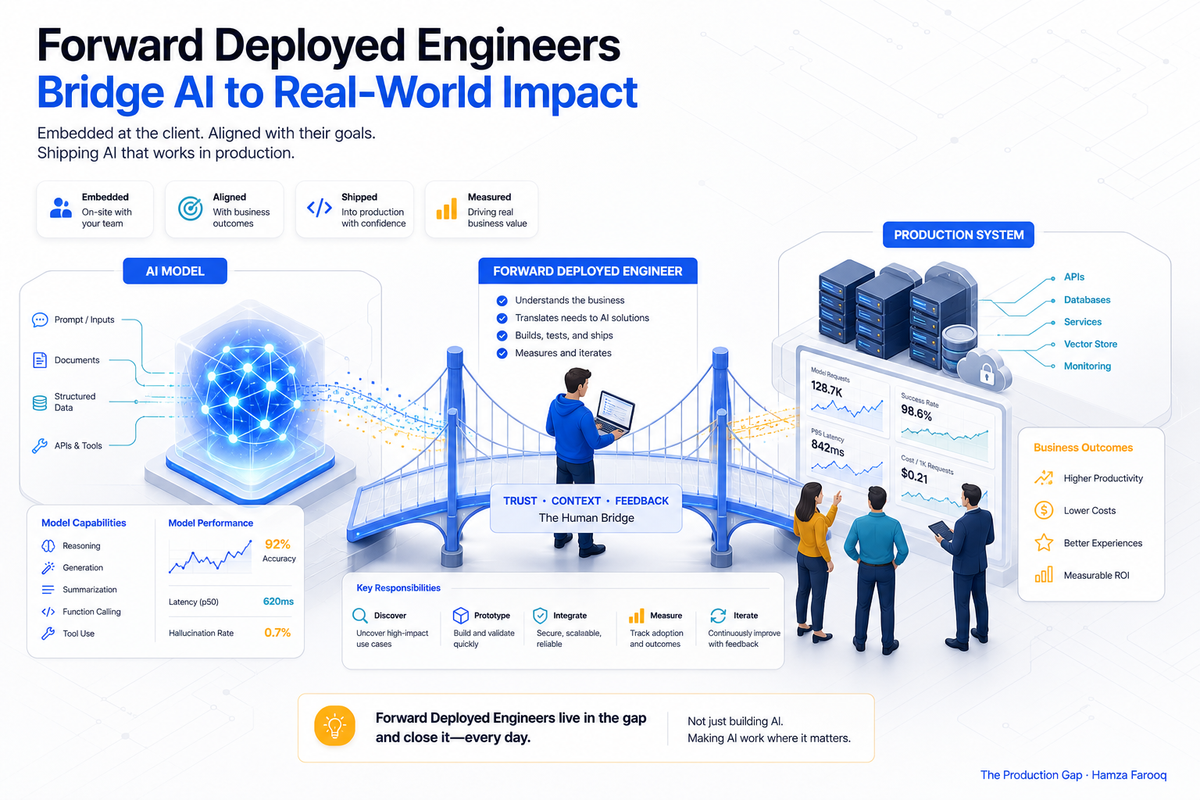
TL;DR: A forward deployed engineer in AI is a technical generalist who embeds directly with enterprise customers to translate production constraints, messy data, and business logic into working AI systems-closing the gap between a model that performs in a lab and one that actually ships. Unlike ML engineers who optimize models or software engineers who build products, FDEs own the full integration layer where research meets reality.
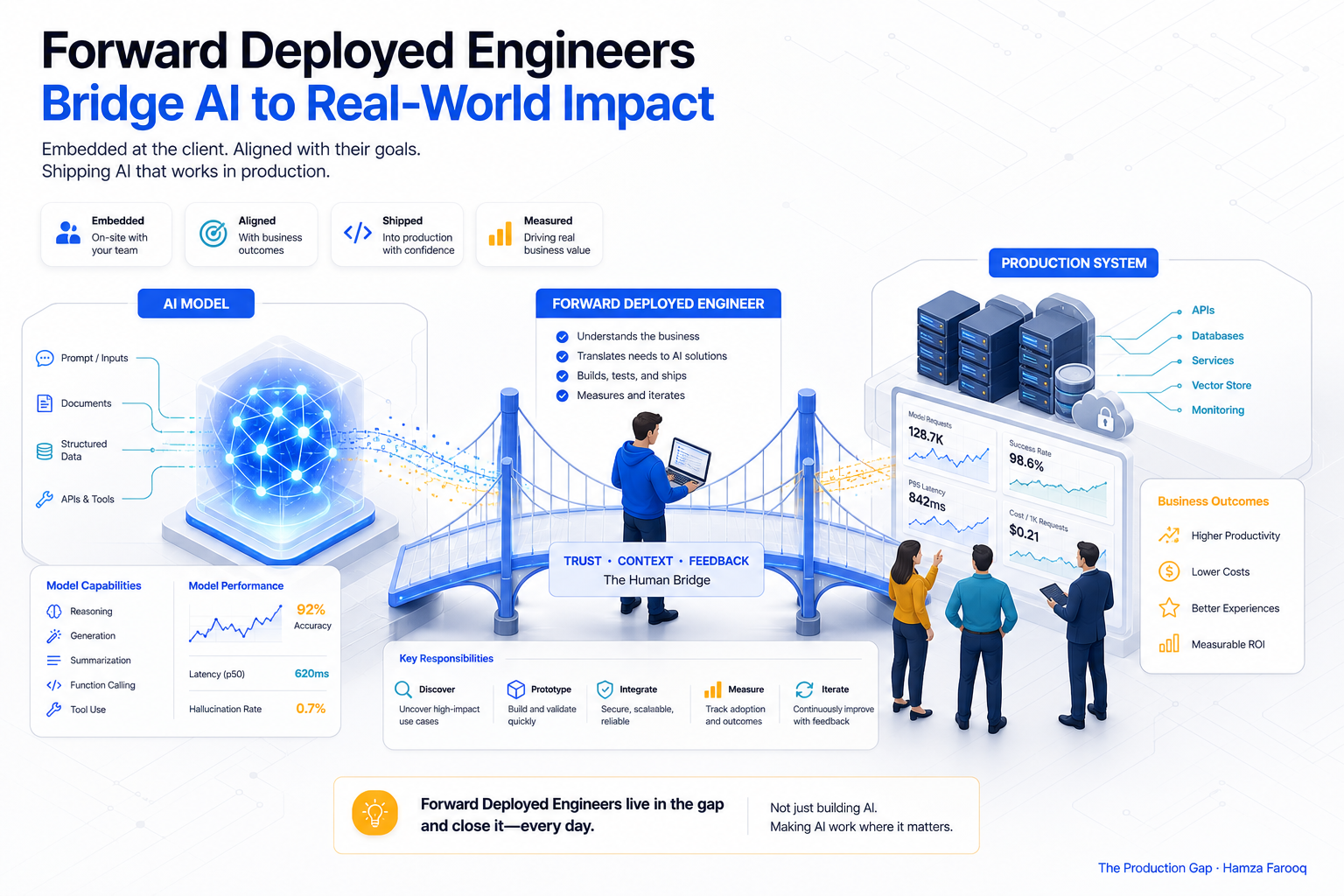
Key Takeaways
FDEs live at the customer site, They embed directly with customers to make AI work inside real business environments.
The pilot-to-production gap is the problem, Fewer than 1 in 3 large companies have scaled AI pilots, and that failure is exactly the gap FDEs close.
FDE is not ML engineering or consulting, The role blends hands-on coding, customer problem-solving, and systems integration in a way no single traditional title covers.
AWS's $1 billion bet changes the calculation, Selling AI tools is no longer enough; someone has to make them land.
Palantir wrote the original playbook, Companies like Palantir, Scale AI, and Anduril ran this model for years before the industry caught up.
The role is a career crossroads, not a dead end, FDE builds rare technical depth and business fluency that opens doors to founding, product leadership, or senior engineering.
Introduction
Fewer than 30% of large enterprises have successfully scaled AI pilots into production, according to McKinsey's State of AI 2025 report. That 70% failure rate is not a model quality problem, it is an ownership problem. Nobody sits inside the customer's environment accountable for the gap between "this demo looked great" and "this runs reliably in our infrastructure." Forward Deployed Engineers are the structural answer, and in 2026, AWS put a billion dollars behind that premise.
What does a forward deployed engineer actually do?
A Forward Deployed Engineer embeds directly inside a customer's organization to own AI implementation end to end, from environment setup to production deployment to the organizational change management that makes adoption stick.
The day-to-day makes the role concrete. Monday means debugging an LLM pipeline against a legacy Oracle database nobody fully documented. Tuesday is explaining to a CISO why a vector database needs specific network permissions. Wednesday is writing the production code that fixes Tuesday's conversation. Thursday is training the customer's team to maintain what was just built.
The accountability structure is what separates FDE from every adjacent role
An FDE is not there to advise, they are there to build, inside the customer's systems, under the customer's constraints. The defining characteristic is production ownership: the FDE is responsible for whether the system runs, not just whether the recommendation was sound. Consultants leave before go-live. Solutions engineers hand off after the sale. FDEs stay until the thing works.
Palantir operationalized this model earlier than almost anyone. Their Forward Deployed Engineer titles, established during government contracts in the early 2010s, embedded a technical owner inside the mission environment with authority to build and instructions not to leave until the system was woven into the customer's workflows. Scale AI's enterprise teams operate on the same logic, placing engineers directly inside customer data environments to own fine-tuning pipelines a remote team could never safely run.

FDE vs. ML engineer vs. solutions engineer, where each role stops
| Dimension | ML Engineer | Solutions Engineer | Forward Deployed Engineer |
|---|---|---|---|
| Primary location | Vendor HQ | Vendor HQ / sales cycle | Customer site |
| Output | Trained models, pipelines | Demos, technical proposals | Running production systems |
| Customer contact | Rare | High (pre-sale) | Constant (post-sale) |
| Writes production code? | Yes | Rarely | Yes, inside customer infra |
| Accountable for uptime? | No | No | Yes |
| Role ends when? | Model ships | Contract signs | System is self-sustaining |
ML engineers build the model, FDEs make it work in your building
An ML engineer optimizes training pipelines and ships model artifacts in a controlled environment. Their success metric is model quality, not whether a Fortune 500 customer's IT firewall will let the system through. When their model hits an enterprise air-gapped data center, their job is done. The FDE's job starts there.
Solutions engineers sell the capability, FDEs deliver it
A solutions engineer builds sandboxed demos and handles deep technical questions through the sales cycle, but their accountability ends at contract signature. The FDE inherits exactly what the sandboxed demo never had to touch: real data, real security, real legacy systems. That inheritance is where most enterprise AI deployments have historically broken down.
Why AWS invested $1 billion in forward deployed engineering
AWS's $1 billion commitment in 2026 reflects a hard-won lesson: AI-as-a-service does not deploy itself. The world's largest cloud provider is not spending that money on better documentation, it is spending it on humans embedded at customer sites because that is what closes the last mile.
The 'deploy and hope' model is broken for enterprise AI
SaaS products can survive self-serve because the integration surface is bounded: an API key, a webhook, a configuration screen. Enterprise AI touches proprietary data, regulated workflows, and legacy systems built before the cloud existed. AWS's position is that selling Bedrock and SageMaker without FDE support leaves the majority of enterprise value unrealized, because customers cannot operationalize the capability without on-site engineering help. That is a services problem, not a product problem.
Palantir, Anduril, and Scale AI are the proof of concept the rest of the industry spent a decade dismissing as "too services-heavy" and is now racing to replicate. These companies are not outliers, they are the template.
How agent harnesses like Claude Code and Codex are changing the FDE role
Agent harnesses like Claude Code and OpenAI's Codex are reshaping what a single forward deployed engineer can ship. Work that used to take weeks, wiring integrations, writing glue code, and debugging against unfamiliar systems, increasingly starts with an agent doing the first pass inside the customer's codebase while the engineer directs and verifies. AWS's own FDE unit is explicitly agentic-first, compressing engagements from months to roughly 45 days. The harness does not replace the FDE, it raises the ceiling on how much one embedded engineer can deliver.
Is FDE a real engineering career?
Forward Deployed Engineering is a distinct engineering discipline, not rebranded consulting, and the difference shows up in what practitioners build after they leave.
FDEs who spend two to four years in the role accumulate something genuinely hard to get elsewhere: production AI systems shipped inside a dozen different enterprise environments, a dozen security regimes navigated, a dozen legacy integration failures debugged. Former Palantir FDEs have gone on to found AI infrastructure startups and step into CTO roles specifically because they have seen where enterprise deployment breaks down and built the judgment to avoid it.
The recurring LinkedIn debate about whether FDE is "real engineering" reflects a bias toward HQ-centric development that the production AI crisis is now directly challenging. If the metric is working systems in production inside real enterprises, FDEs have a stronger claim than most engineers who have never left their own company's codebase.
FAQ
What is a Forward Deployed Engineer in AI? An FDE embeds at a customer site to own end-to-end AI implementation, integration, security compliance, and internal team handoff. Unlike a consultant, they write production code and are accountable for whether the system runs.
How is FDE different from a solutions engineer? Solutions engineers operate in the pre-sales cycle and exit at contract signature. FDEs take over after the contract is signed and own the implementation inside the customer's actual environment, with no exit until the system is in production.
Why do AI companies need Forward Deployed Engineers? Enterprise AI fails to reach production at scale because the gap between a working demo and a running production system requires someone embedded in the customer environment with the authority to build, not just advise. FDEs fill that specific ownership gap.
Learn from me
Forward Deployed Engineering Bootcamp for Full-Stack Developers, my Maven cohort. Build and ship complete AI products end to end, from React and Node.js frontends to deployed models with caching and observability. Join the next cohort →
Work with me
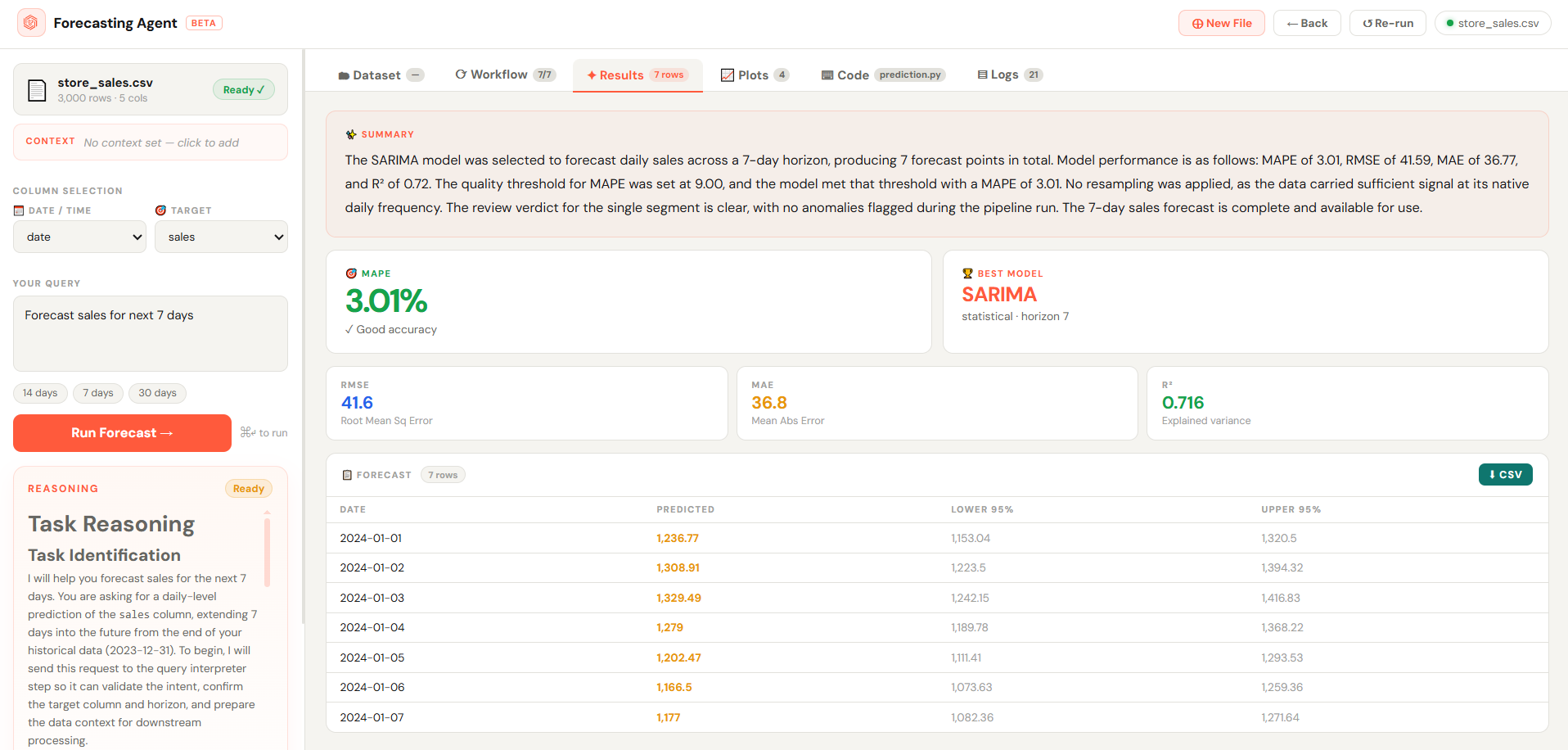
Traversaal.ai, We help companies stand up Forward Deployed Engineering for production AI. Hire us for your next AI deployment or business problem. Get in touch →