Build vs Buy AI: A Decision Framework for Enterprise AI Agents
Build vs buy AI? Learn which path protects your competitive edge, controls TCO, and scales enterprise AI agents without costly surprises.

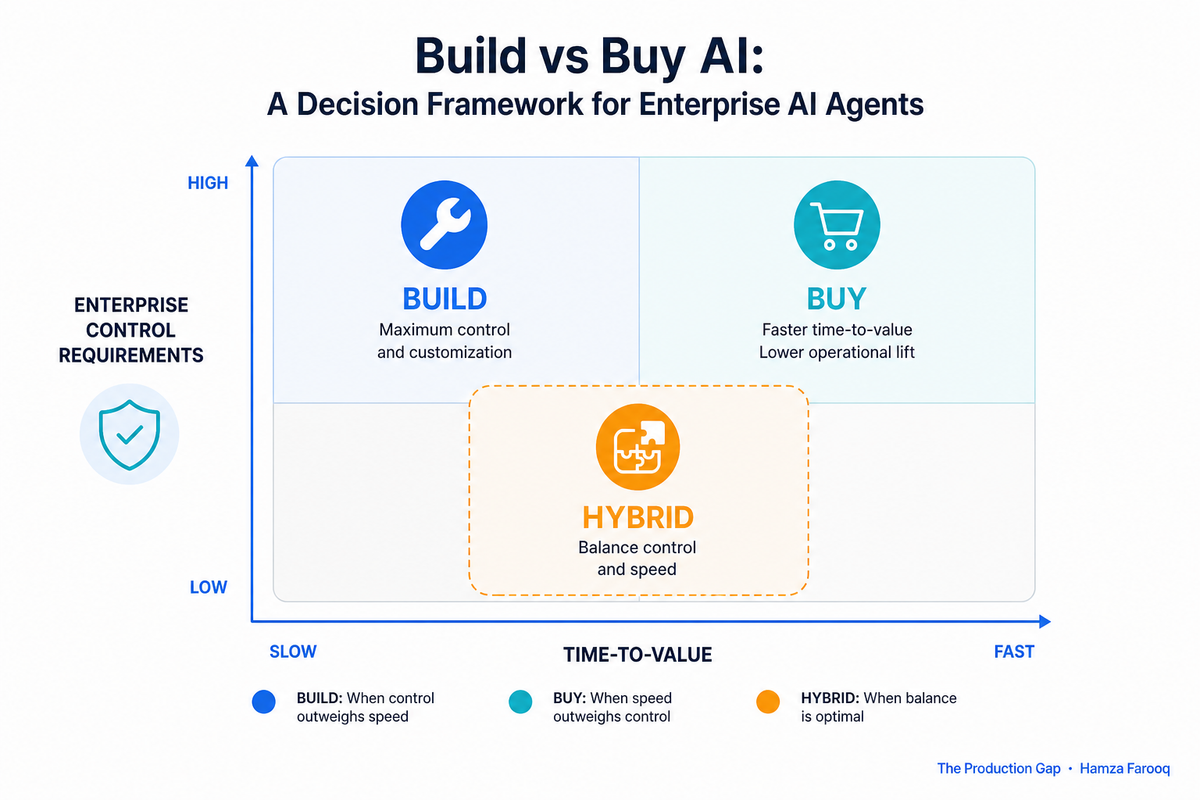
TL;DR: The build vs buy AI decision hinges on whether AI is core to your competitive advantage or just operational infrastructure. Build when the capability differentiates your product or requires proprietary data and workflows. Buy or use a hybrid model when speed, cost, and proven functionality outweigh the strategic value of owning the underlying system.
Key Takeaways
- Inference costs changed the math: The drop in model pricing makes custom builds far more financially viable.
- Differentiation determines the right path: If AI touches your core product or trains on proprietary data, building preserves a competitive edge vendors cannot replicate.
- Governance has board-level stakes now: Data leakage and runaway costs have pushed this decision into legal, compliance, and risk committees.
- The hybrid FDE model splits ownership smartly: Control your orchestration logic while renting model infrastructure, flexibility without the full build burden.
- Speed-to-value often favors vendors early: Vendor platforms compress deployment timelines when time-to-market outweighs long-term customization needs.
- Total Cost of Ownership (TCO) rarely matches sticker price: Maintenance, retraining, observability tooling, and talent are routinely underestimated on both sides.
A Fortune 500 company spent 14 months customizing a vendor AI agent platform, then discovered their "buy" decision had quietly become a build, without the IP to show for it.
Foundation model inference costs dropped roughly 95% in two years, rewriting build economics overnight. Agentic failures, data leakage, runaway API costs, hallucinated tool calls, have pushed this into board-level risk committees. The build vs buy AI question isn't binary. Enterprises winning with enterprise AI agents in 2026 identified which layer of the stack they actually needed to own, and protected it regardless of what vendors did underneath.
What are the real hidden costs of building custom AI agents in-house?
Inference is cheap now. The surrounding infrastructure is not. ML engineers capable of shipping production-grade agentic systems command $250,000-$500,000+ fully loaded in 2026 , so a three-person agent team clears $1M annually before a single API call. Hallucinations, runaway tool calls, and cross-agent data leakage require purpose-built tracing and cost guardrails, tools like LangSmith and Arize help, but internal builds need custom instrumentation layered on top. Budget a recurring 20–30% of initial build cost annually for maintenance, and expect security and compliance overhead to surface mid-project if it wasn't scoped upfront.
The Fortune 500 company thought they were buying. Fourteen months later, they had a de facto internal build with none of the IP, the trap custom AI development only avoids when you go in with clear eyes about what it actually costs.
When does proprietary data or core product differentiation make building the obvious choice?
Build when the agent's value comes directly from proprietary data, unique workflows, or capabilities that would hand a competitor an advantage if they ran on the same vendor platform. A fintech that trains agents on a decade of internal credit decision data loses that advantage on Salesforce Agentforce, model weights and fine-tuning artifacts stay inside the vendor's infrastructure. When the agent is the product, vendor abstraction layers add latency, feature constraints, and a roadmap controlled by someone else's product team. In healthcare, defense, or EU-regulated industries, data sovereignty requirements can make building a legal obligation rather than a preference.
The clearer signal for buying: internal-only, off-the-shelf use cases (IT helpdesk, HR FAQ, document summarization) where speed and vendor reliability matter more than marginal customization. One question cuts through most of the debate: "Is the AI differentiation we're building something a vendor could commoditize in 12 months?" If yes, buy. If no, build.
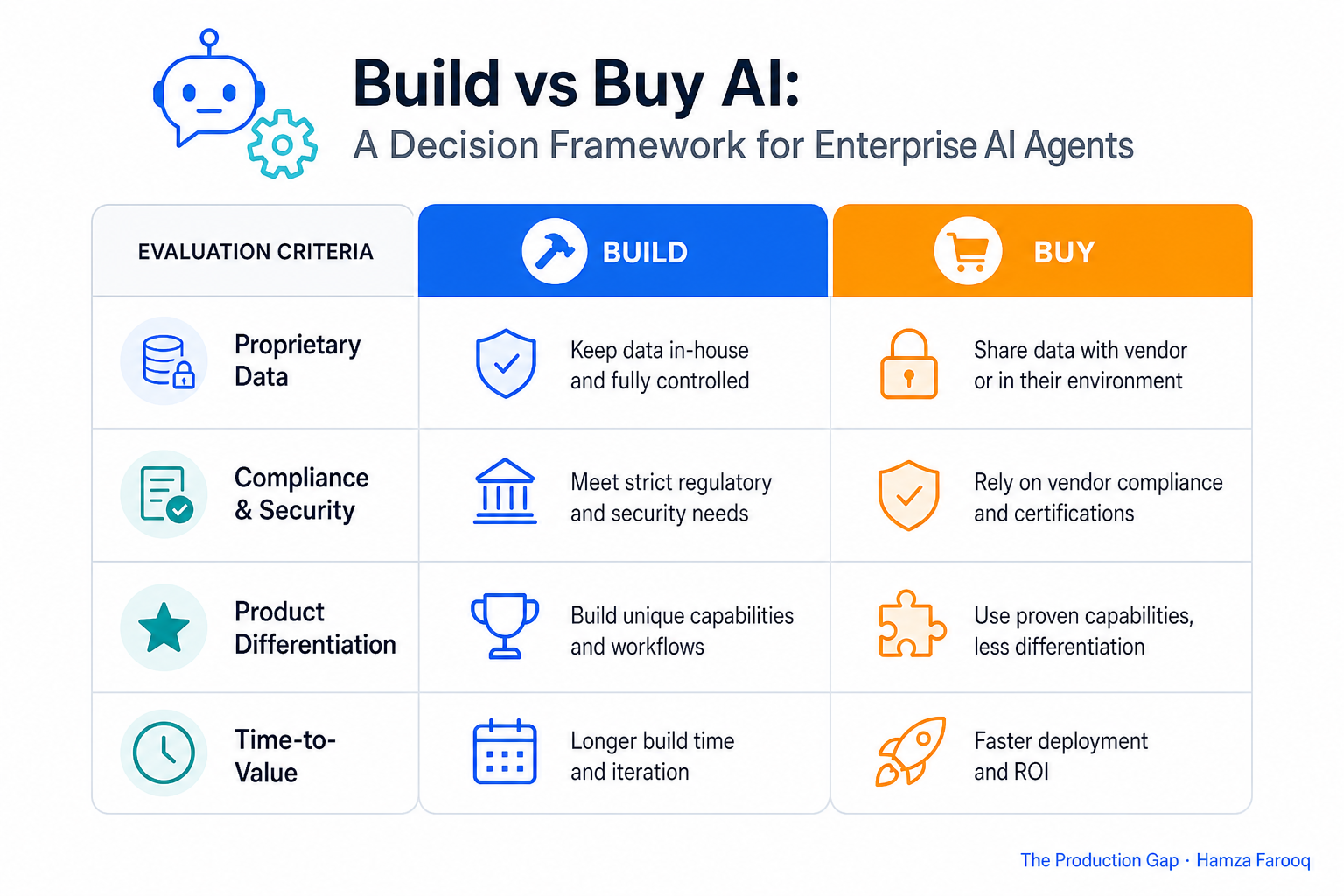
| Evaluation Criterion | Build | Buy | Hybrid FDE |
|---|---|---|---|
| Proprietary data as core moat | ✅ Strong fit | ❌ IP stays with vendor | ✅ Own context layer |
| Time-to-first-deployment | ❌ 6–18 months | ✅ Weeks to months | ⚠️ 3–6 months |
| Data sovereignty / compliance | ✅ Full control | ⚠️ Vendor-dependent | ✅ Configurable |
| Long-term customization | ✅ Unlimited | ❌ Platform-constrained | ✅ Orchestration-level |
| Inference cost at scale | ⚠️ Variable | ⚠️ Vendor markup | ✅ Direct model pricing |
| Talent requirement | ❌ High | ✅ Low | ⚠️ Moderate |
| Vendor lock-in risk | ✅ None | ❌ High | ✅ Low |
What is the hybrid FDE model and which enterprises should use it?
The hybrid Foundational Development Environment gives enterprises ownership of the orchestration layer and agent memory while renting inference and tooling from vendors. What the enterprise owns in FDE: the AI orchestration layer (LangGraph, AutoGen, or a custom DAG), agent memory and context stores, tool routing logic, and observability instrumentation. Owning orchestration means swapping inference providers (OpenAI today, Anthropic tomorrow, a cheaper open-weight model next year) without touching any business logic.
What the enterprise rents in FDE: foundation model inference, pre-built tool connectors, and vendor-managed RAG pipelines. With inference costs down roughly 95% in 2026, renting inference makes financial sense even at enterprise scale.
The trap FDE avoids: buying a platform, customizing it heavily over 12–18 months, and finding that every customization is platform-native and non-portable. A healthcare enterprise using FDE owns agent orchestration and patient-context memory in HIPAA-compliant infrastructure while calling Anthropic's Claude API for inference, swapping to a cheaper model next quarter means updating an endpoint, not rebuilding a clinical workflow. FDE reframes the question from "build or buy?" to "which layer do you need to own to retain competitive leverage in 24 months?"
How do you evaluate vendor AI agent platforms for enterprise production readiness?
Five criteria separate production-ready vendor platforms from polished demos: multi-agent orchestration capability, observability and cost controls, data isolation guarantees, SLA commitments for agentic workloads, and customization depth without vendor dependency.
Multi-agent orchestration maturity is still a real gap as of mid-2026. Microsoft Copilot Studio handles simple sequential flows, but complex parallel or stateful architectures frequently need LangGraph or AutoGen underneath, require documented production deployments, not demo videos. Observability and cost guardrails became critical after the 2025–2026 wave of runaway API cost incidents; token-level cost tracking, agent step tracing, and automated circuit breakers belong in any vendor contract.
Data isolation in multi-tenant platforms is the specific risk that elevated this decision to board committees. Require SOC 2 Type II documentation and a written data boundary architecture, verbal assurance during a sales call carries no weight. Agentic SLAs must cover task completion rates, tool call latency, and failure mode behavior, not just uptime; most major vendors hadn't published agentic-specific SLAs, which means contract negotiations are where those commitments either get locked in or vanish.
Customization ceilings deserve the same scrutiny: map your 24-month agent roadmap against the platform's documented limits before signing. "Enterprise-ready" is a marketing claim, these five criteria are what turn a vendor demo into a real production evaluation.
Frequently Asked Questions
What is the main difference between building and buying an AI agent platform?
Building means your organization owns the code, data pipelines, and architecture outright; buying means operating within a vendor's constraints. The critical distinction isn't upfront cost, it's where competitive leverage lives in 24 months.
How do you calculate total cost of ownership for a custom-built AI agent?
Sum inference costs, fully loaded engineering talent ($250K–$500K+ per senior ML engineer annually), observability tooling, and annual maintenance at 20–30% of initial build cost, a three-person production team commonly exceeds $1.5M annually before security and compliance engineering.
When does vendor lock-in become a strategic liability for AI agent infrastructure?
When 12–18 months of platform-native customization has created business logic that can't be extracted or ported. If swapping your inference endpoint requires rebuilding workflows, the lock-in is already done.
Which enterprises are best suited for the hybrid FDE model?
Enterprises with regulated data environments, proprietary workflow logic, or multi-agent complexity that exceeds vendor ceilings, healthcare, financial services, defense contractors, and product companies with customer-facing AI are the strongest candidates.
The layer you own is the one that compounds
Own the orchestration. Own the memory. Rent the inference. If AI touches your core product or proprietary data, build or adopt FDE. If AI supports internal operations and speed matters more than customization, buy, but negotiate data portability and customization limits into the contract before signing.
The vendors competing for your AI budget are betting you won't ask where your orchestration logic lives in two years.
Learn from me
Agentic AI for Product Managers, my Maven cohort. Learn how to design, evaluate, and ship reliable AI systems: the technical fluency PMs need to lead agentic products, no engineering background required. Join the next cohort →
Hire us
Traversaal.ai. We're a team of forward deployed engineers solving the toughest AI problems for Fortune 100 companies: document intelligence, agentic data platforms, and real-time web intelligence, deployed in production. Work with our team to deploy your next agentic ecosystem. Talk to Traversaal.ai →
Join us
Want to solve these problems with us? We're always looking for forward deployed engineers who want to ship production AI. jobs@traversaal.ai