Knowledge Transfer Verification: Why the Client Engineer Must Run the Runbook Live Before You Leave
Knowledge transfer verification means watching your client run the runbook live—not just handing it over. Close real gaps before you leave.

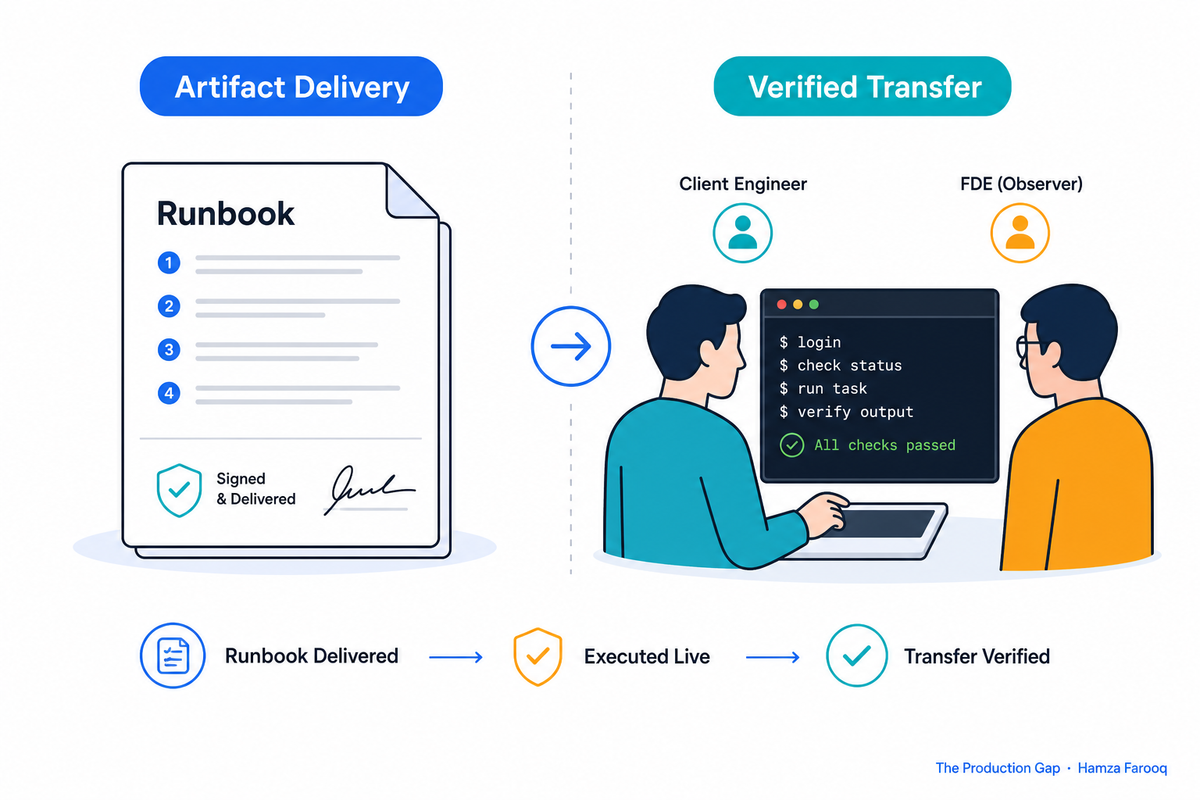
TL;DR: Knowledge transfer verification requires the client engineer to execute the runbook live, with the outgoing FDE present, before the engagement closes. A document proves a process was written down, not that it was understood. Silent gaps in tacit knowledge only surface when someone unfamiliar attempts the steps under observation. Witnessed live execution is the only method that reliably exposes what needs clarification while there is still time to clarify it.
Key Takeaways
- Documents prove delivery, not understanding: Handing over a runbook confirms an artifact exists, not that the client engineer can operate without you.
- Tacit knowledge lives in the person, not the page: Judgment calls, error interpretations, and environmental quirks never make it into even the most detailed written procedure.
- Live execution is the only real verification: Having the client engineer run the runbook while you watch surfaces gaps no document review can catch.
- Three phases cover the full session: Pre-execution briefing, live solo execution, and structured debrief form the complete witnessed-execution framework used in this guide.
- Sign-off means they ran it, not just read it: Knowledge transfer is not operationally complete until the client engineer has executed the procedure independently and you witnessed it.
Why does a completed runbook document not prove the client engineer can operate the system?
Standard templates make this worse. The University of Iowa's Knowledge Transfer Document captures roles, responsibilities, and processes, what to do, not whether the recipient can actually do it. These templates are built to confirm documentation, not capability.
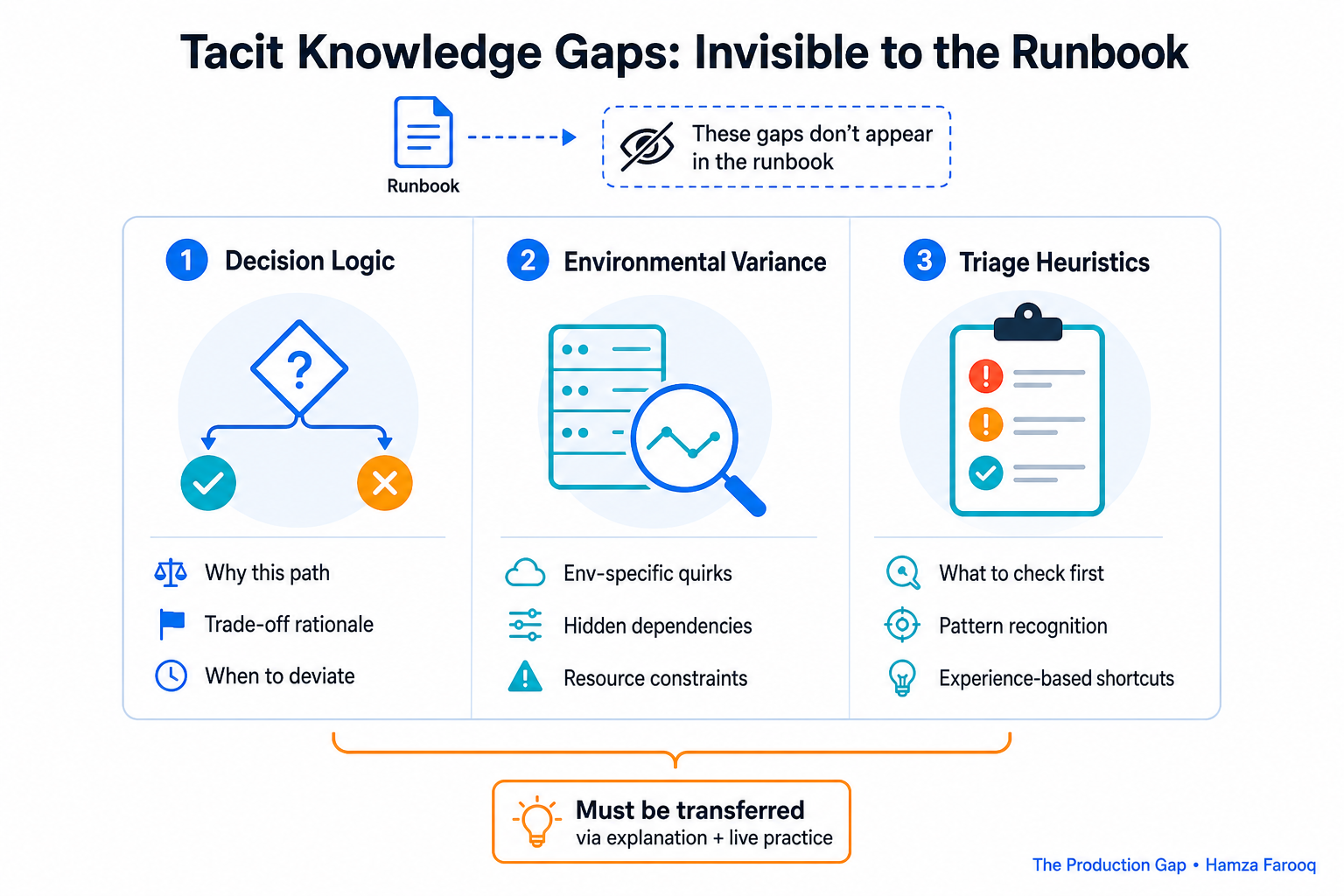
The deeper problem is tacit knowledge. A runbook can say "restart the ingestion service if throughput drops below threshold," but it cannot tell the client engineer whether a warning on their screen right now is a throughput warning or a network partition. That distinction gets learned through debugging, not written down in prose.
Some gap categories are invisible to any document: decision logic under ambiguous outputs (what to do when the system's response is valid but unexpected), environment-specific variance (quirks the FDE absorbed through months debugging this client's configuration), and triage heuristics (prioritization logic the FDE never articulated because it felt obvious). These are the gaps that generate after-hours tickets. Treat the runbook as a prerequisite, not a deliverable.
What is the difference between a handoff checklist and knowledge transfer verification?
A handoff checklist confirms artifacts were delivered; knowledge transfer verification confirms a human being can use those artifacts to operate independently, and only one actually protects you when something breaks after hours.
The Forbes Business Council is direct: verifying knowledge transfer requires "a process-based methodology that tracks skills and not courses." Checking a checklist tracks artifact delivery. Witnessing live execution tracks operational skill.
Table 1: Handoff Checklist vs. Live Runbook Verification, Six Dimensions
| Dimension | Handoff checklist | Live runbook verification |
|---|---|---|
| What it confirms | Artifacts were delivered | Capability was transferred |
| Who performs it | FDE checks off items | Client engineer executes live |
| Gap type surfaced | Missing documents | Missing comprehension |
| Risk it addresses | Incomplete delivery | Operational blindness |
| When it's complete | Both parties sign | FDE witnesses full execution |
| Legal/contractual weight | Delivery proof | Operational readiness proof |
If your offboarding ends at the checklist, you have confirmed paperwork, not competence.
How should an FDE structure a witnessed live runbook execution session?
Phase 1: Pre-execution briefing (FDE speaks last). The client engineer explains what the runbook does in their own words before touching the keyboard. Listen for missed dependencies, wrong sequencing assumptions, and terms the client engineer skips rather than defines. Catching these gaps before execution begins is less disruptive than catching them mid-procedure.
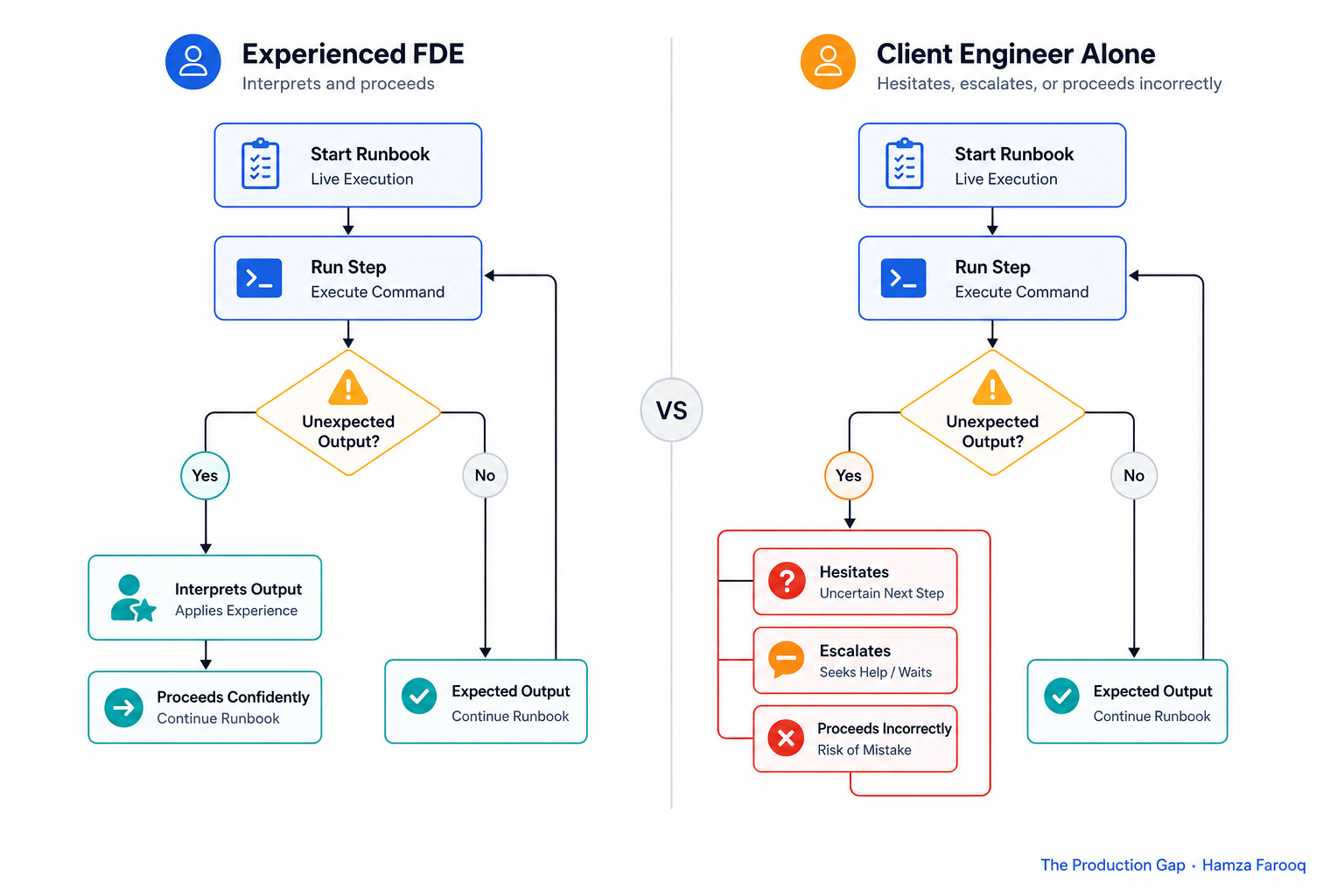
Phase 2: Live solo execution (client engineer drives, FDE observes silently). The client engineer runs the runbook against a live or staging environment. The FDE does not intervene unless a production-breaking action is imminent. The critical failure mode surfaces here: the client engineer follows every step correctly, then hits an unexpected output, a non-fatal warning, an ambiguous status code, and pauses. That pause is the data. It reveals procedural compliance without operational judgment, and no document review will catch it.
Phase 3: Structured debrief (name every deviation). The FDE walks through every hesitation and undocumented judgment call from the execution phase. Each one gets logged, and anything the runbook cannot explain becomes an amendment before the FDE leaves. Every pause is a tacit knowledge artifact that needs to be extracted before departure.
What gap types only surface during live execution and never in a document review?
Gap 1: Unexpected output interpretation. The runbook says "confirm service is healthy." The client engineer runs the command and gets a response within bounds but visually different from the screenshot. Do they proceed or escalate? The document cannot answer. This is procedural compliance without operational judgment, a failure mode that typically surfaces in post-mortems rather than in pre-departure reviews.
Gap 2: Environment-specific variance. The FDE absorbed this client's quirks, a latency spike at peak hours, a config flag set differently than the vendor default, as background noise over months. They are not background noise to the client engineer encountering them alone at midnight.
Gap 3: Undocumented branching logic. Most runbooks are written for the happy path. When execution hits a branch point (restart now or wait for self-recovery?) the document is silent. Research into knowledge transfer frameworks confirms that transfer success requires active validation, not assumed comprehension from materials delivery.
If a live session surfaces zero hesitations, treat that as a signal worth examining: either the system is genuinely simple, or the execution conditions were not representative enough to surface real gaps.
Frequently Asked Questions
How do you verify that a knowledge transfer actually worked and not just that documents were delivered? Have the client engineer execute the runbook live while the FDE observes without intervening. Verification is complete when the client engineer can execute every step, interpret outputs, and explain every judgment call without prompting.
What types of knowledge gaps does a runbook document fail to capture? Three: unexpected output interpretation, environment-specific variance, and undocumented branching logic. All three only surface during live execution.
When is a knowledge transfer operationally complete in an enterprise engagement? When the client engineer has executed the procedure independently, the FDE has witnessed it, and all deviations have been documented and resolved, not when artifacts are delivered and signed off.
How is a live runbook verification session different from a handoff checklist? A checklist confirms artifacts were delivered; a verification session confirms the receiving engineer can use them to operate without support. One is a delivery record; the other is capability proof.
Conclusion
The handoff document creates a sense of closure that neither party has actually earned. The three-phase witnessed execution framework used in this guide closes the gap: the pre-execution briefing surfaces comprehension failures before they become execution failures; live solo execution reveals procedural compliance without operational judgment; the structured debrief converts every hesitation into a documented amendment before the FDE walks out the door.
Your engagement is not complete when the document is signed. It is complete when the client engineer has shown you, in real time, that they can operate without you.
Before your next offboarding session: schedule a witnessed execution block in the final week, not the final day, so debrief findings can still be acted on.
Learn from me
Forward Deployed Engineering Bootcamp for Full-Stack Developers, my Maven cohort. Build and ship complete AI products end to end, from React and Node.js frontends to deployed models with caching and observability. Join the next cohort →
Hire us
Traversaal.ai. We're a team of forward deployed engineers solving the toughest AI problems for Fortune 100 companies: document intelligence, agentic data platforms, and real-time web intelligence, deployed in production. Work with our team to deploy your next agentic ecosystem. Talk to Traversaal.ai →
Join us
Want to solve these problems with us? We're always looking for forward deployed engineers who want to ship production AI. jobs@traversaal.ai