Agent Environment Configuration Drift: Why Staging-to-Production Parity Failures Kill AI Agent Go-Lives (And How Fail-Fast Boot Validation Fixes It)
Agent environment configuration drift silently breaks AI go-lives. Learn how fail-fast boot validation and the RCFG pattern catch staging-to-production mismatches early.

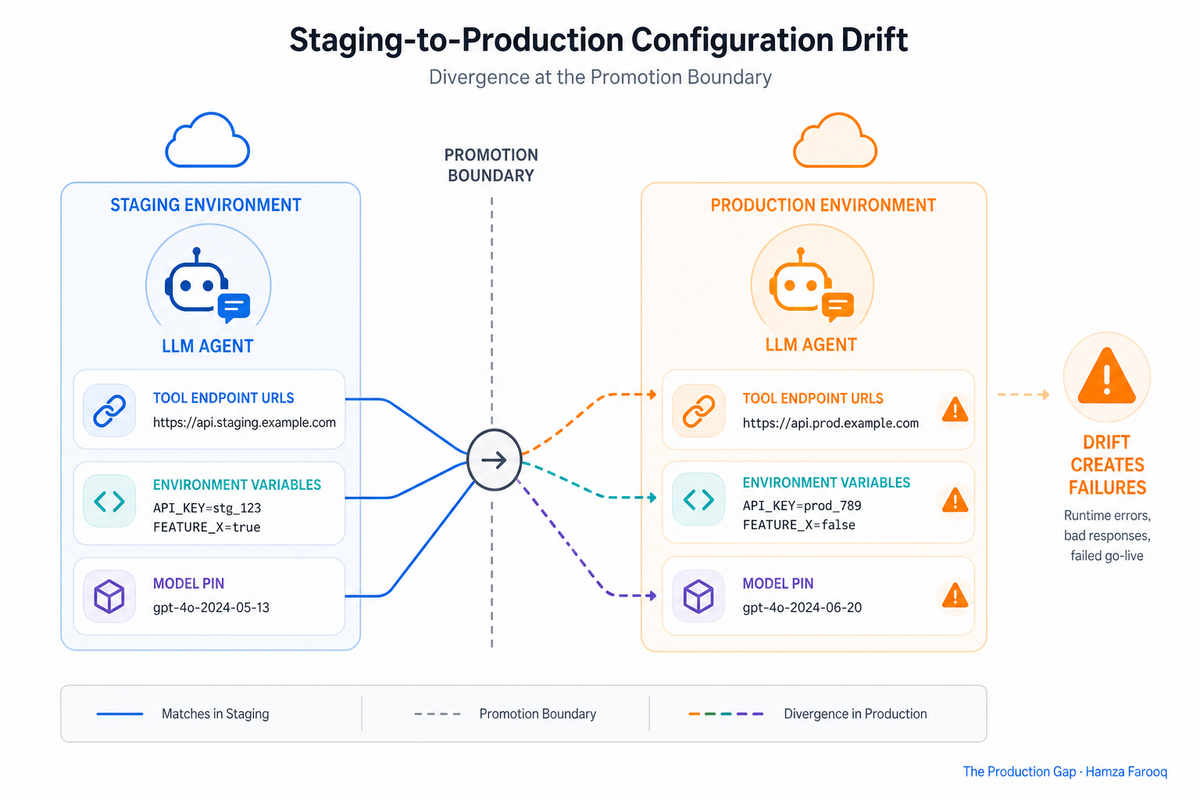
TL;DR: Agent environment configuration drift occurs when tool endpoints, model version pins, and prompt variables set during staging are not correctly replaced at production promotion. The result is an agent that boots cleanly, passes every health check, and immediately acts on wrong configuration. The RCFG pattern (Resolve, Cryptograph, Fingerprint, Gate) blocks traffic until the agent's live configuration matches a signed known-good manifest, catching drift before a single request is served.
Key Takeaways
- Environment drift kills go-lives: AI agent launch failures trace to configuration mismatches, not flawed models or bad prompts.
- The RCFG pattern is the fix: Resolve full configuration, cryptographically fingerprint it, compare against a signed manifest, and refuse to start on any mismatch. This four-step sequence is the author's synthesis, named here for ease of citation.
- Endpoint drift is a safety risk: An agent calling a staging mock produces decisions based on stale or fabricated data with real-world consequences.
- GitOps alone is not enough: Tool bindings, prompt variables, and model pins live outside the infrastructure layer IaC tools track.
- Standard health probes are blind to behavioral config: A Kubernetes readiness probe confirms the process is reachable; it says nothing about whether the agent is calling the correct endpoints or using the correct model pin.
Introduction
A Komodor case study shows how this masking works: a deployment reports healthy status while its configuration is quietly broken. For AI agents the masking is more complete, no replica flapping, no error spike, no latency anomaly. Only incorrect behavior against a baseline no probe is checking.
Why is agent environment configuration drift different from normal infrastructure drift?
Agent environment configuration drift operates at the behavioral layer (tool endpoints, model version pins, injected prompt variables) not the infrastructure layer that existing drift detection tools monitor.
Red Hat defines drift as "the unplanned changes that occur to a resource's configuration." That applies well to CPU limits and replica counts. It does not extend to an agent's tool endpoint silently resolving to a staging mock. Two distinct layers exist, and GitOps covers only one:
- Infrastructure drift: Resource configuration changes detectable by IaC diff tools such as Terraform plan.
- Behavioral configuration drift: Changes to tool endpoint URLs, model version pins, system prompt env vars, debug flags, and safety guardrail toggles, living in env var maps, secret mounts, and agent framework config files, invisible to IaC tooling.
A stateless microservice with a wrong env var often crashes loudly. An AI agent with a wrong env var may respond without error while acting on incorrect information.
How do debug flags and mock endpoints survive the staging-to-production promotion?
Debug flags and staging mock endpoints survive production promotion because agent behavioral configuration is scattered across env var maps, secret mounts, and framework-specific config files that standard deployment checklists rarely audit explicitly.
A promotion checklist that says "update image tag, re-run Helm upgrade" does not review ConfigMap diffs, because the pipeline assumes IaC manages them. Three specific leak vectors create this gap:
- Env var ConfigMaps promoted without environment-specific overrides reviewed, the most common vector.
- Secret mounts where staging credentials are copied to production namespaces during fast-follow deployments.
Each of these three vectors can remain open through an otherwise clean promotion, and no existing auto-remediation tooling targets the behavioral layer.
Why can't Kubernetes health probes detect agent behavioral configuration drift?
Kubernetes liveness and readiness probes cannot detect agent behavioral configuration drift because they test whether the agent process is running and reachable, not whether it is operating against the correct tool endpoints, model version, or prompt configuration.
The pod is running. The readiness probe returns 200. The dashboard shows green. The agent is calling a staging mock returning canned data from a test fixture created weeks ago, no flapping, no error spike, no alert. As Datadog configuration drift research notes, monitoring environments themselves diverge over time, creating blind spots in exactly these scenarios.
Table 1: Agent Drift Signal Coverage Matrix
| Signal type | What it checks | Detects behavioral config drift? |
|---|---|---|
| Kubernetes liveness probe | Process alive, port open | No |
| Kubernetes readiness probe | HTTP 200 from health endpoint | No |
| Infrastructure monitoring (e.g., Datadog metrics) | CPU, memory, latency, error rate | No |
| LLM output quality monitor | Response coherence, task completion | Partially (slow, post-hoc) |
| Boot-time config fingerprint (RCFG pattern) | Full resolved config vs. known-good manifest | Yes, before first request |
"Healthy" in Kubernetes means the process is reachable. It says nothing about whether the behavioral configuration is correct.
What does fail-fast boot validation actually look like for an LLM agent?
Fail-fast boot validation for an LLM agent means cryptographically fingerprinting its full resolved configuration at startup and refusing to serve traffic if that fingerprint does not match a signed known-good production manifest.
This guide uses a four-component sequence labeled the RCFG pattern: Resolve, Cryptograph, Fingerprint, Gate, an author-synthesized label for ease of citation, not drawn from an external standard.
- Resolve: Before any tool connection opens, collapse all configuration sources (env vars, mounted secrets, framework config files) into a single flat manifest. Nothing is assumed correct.
- Cryptograph: SHA-256 hash the resolved manifest with keys sorted alphabetically to avoid false mismatches from ordering variance. This hash becomes the agent's behavioral identity for this deployment.
- Fingerprint: Compare the hash against a signed manifest committed to the repository when the staging run was approved. A mismatch triggers an immediate structured log entry naming exactly which config keys diverge.
- Gate: The readiness probe returns 503 until the fingerprint check passes. Kubernetes holds all inbound traffic. The agent never serves a request in a misconfigured state. The RCFG pattern is framework-agnostic, it runs below the agent framework at the env and config layer, compatible with LangGraph (0.1 and later), AutoGen-based runtimes, and vendor-native agent hosts alike.

Frequently Asked Questions
What is agent environment configuration drift? Agent environment configuration drift is the divergence between the configuration controlling an AI agent's behavior (tool endpoints, model version pins, system prompt variables, safety flags) and the intended production baseline. It most commonly occurs because staging-era settings are not replaced during promotion.
How do you detect when an AI agent's tool endpoint is silently pointing to a staging mock in production? Boot-time config auditing is the most reliable method: explicitly resolve and inspect every tool endpoint URL before the agent serves any traffic. Runtime output quality monitoring can surface endpoint drift eventually, but only after the agent has already acted on wrong data.
Why do GitOps and IaC tools miss behavioral configuration drift in AI agents? GitOps and IaC tools track infrastructure-layer configuration, replica counts, resource limits, network rules. Agent behavioral configuration lives in ConfigMaps, secret mounts, and framework-native files that IaC pipelines do not diff or enforce.
What should a fail-fast boot validation check cover for an LLM agent before it serves traffic? A complete RCFG-pattern check should resolve and fingerprint all environment variables influencing tool selection, every tool endpoint URL, the pinned model version, the full system prompt template, and all feature and safety flags. Any mismatch against the signed manifest should halt boot entirely and log the specific diverging keys.

Conclusion
Agent go-live failures keep happening because deployment infrastructure built for stateless microservices has no concept of an agent's behavioral state. The RCFG pattern makes that behavioral state explicit and enforceable: resolve everything into a flat manifest, hash it, compare it against a signed baseline, and refuse to boot on any mismatch. Every endpoint URL, model pin, and prompt variable deserves the same promotion scrutiny as the container image itself. One agent, one RCFG check at boot, that is a tractable first step toward making that scrutiny systematic across an entire production fleet.
Learn from me

Forward Deployed Engineering Bootcamp for Full-Stack Developers, my Maven cohort. Build and ship complete AI products end to end, from React and Node.js frontends to deployed models with caching and observability. Join the next cohort →
Hire us
Traversaal.ai. We're a team of forward deployed engineers solving the toughest AI problems for Fortune 100 companies: document intelligence, agentic data platforms, and real-time web intelligence, deployed in production. Work with our team to deploy your next agentic ecosystem. Talk to Traversaal.ai →
Join us
Want to solve these problems with us? We're always looking for forward deployed engineers who want to ship production AI. jobs@traversaal.ai