Agent Name Service (ANS): what DNS-anchored agent identity verifies and what it leaves to you
The Linux Foundation launched Agent Name Service on 10 Nov 2026. See how ANS ties AI agent identity to DNS and certificates, and which checks still fall to you.

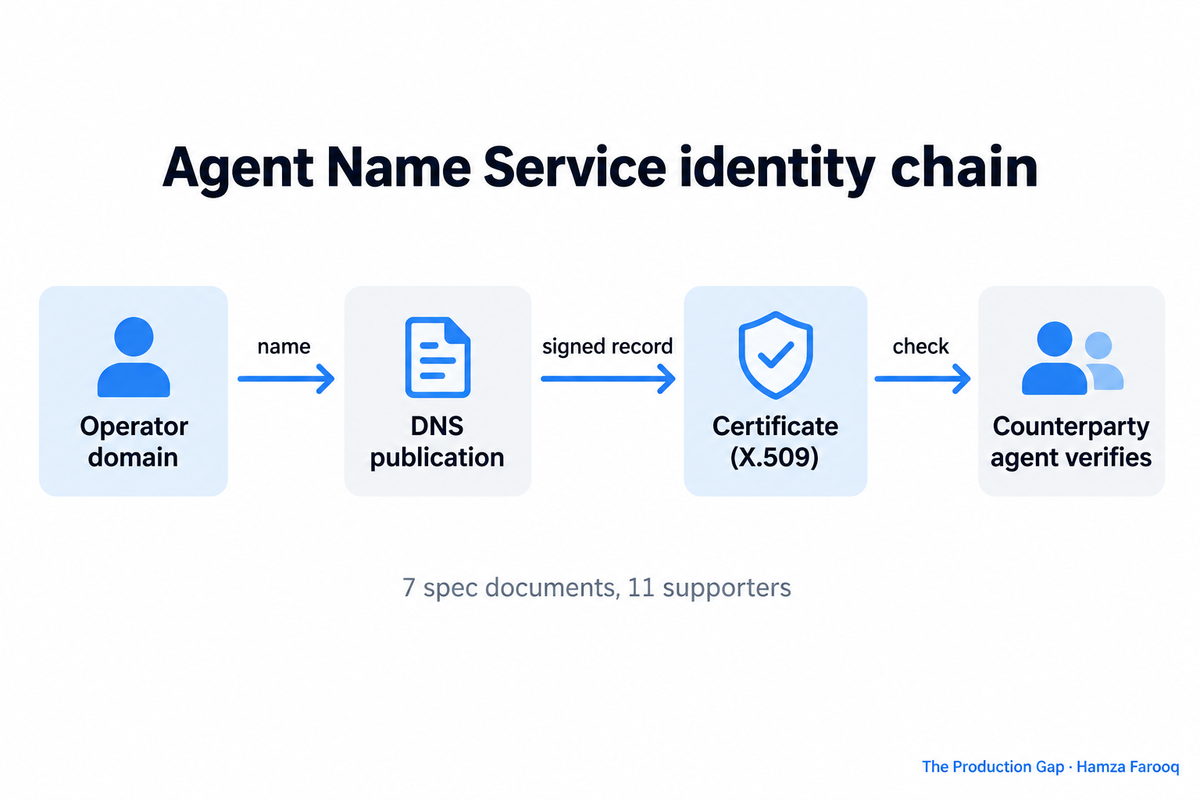
Agent Name Service (ANS) is an open standard that ties an AI agent's identity to a domain name, published through DNS and checked with certificates. The Linux Foundation announced it as a project on 10 November 2026 at KubeCon + CloudNativeCon North America, with a seven-document specification and 11 supporting organizations. The release describes identity, verification and discovery, and lists no authorization document.
TL;DR: Agent Name Service binds an agent to a domain its operator controls, publishes the identity through DNS, and lets other agents verify it with certificates and signed records. That proves who stands behind an agent. The release's topic list includes no authorization, and the Cloud Security Alliance says DNS attacks become more consequential when agents trust DNS programmatically.
Key Takeaways
- Launch facts: The Linux Foundation announced ANS on 10 November 2026, with seven specification documents and 11 supporters.
- What it proves: Which organization an agent belongs to, using a domain name as the anchor.
- What it skips: The topics the release lists for the seven documents include no authorization.
- Main risk: The Cloud Security Alliance argues classic DNS attacks become more consequential when agents make trust decisions at scale.
- Your move: Pair ANS with IAM, gateways and a fail-closed policy for unsigned DNS zones.
What did the Linux Foundation actually launch?
The Linux Foundation launched ANS as an open standard for identity, verification and discovery of AI agents, built on DNS. Agents are named and registered, their identities are published through DNS, and others can verify them and monitor the records for unauthorized changes.
The seven documents cover domain-anchored naming, registration and versioning, DNS publication, public log auditing, integrity monitoring, and agent-to-agent authentication. A technical steering committee will govern the spec. Supporters include Cisco, Cloudflare, DigiCert, GoDaddy, Infoblox, Salesforce and OWASP.
Adoption evidence is thin so far. Cloud Native Now reports that AGNTCY's Agent Directory Service, another Linux Foundation project, supports verification of ANS identities. The same piece describes no independent evaluation, and intent to launch was announced in June.
How does ANS tie an agent's identity to DNS and certificates?
ANS binds a versioned agent name to a domain the operator controls. The Cloud Security Alliance (CSA) describes resolution as a directory lookup against an Agent Registry rather than a chain of ordinary DNS queries.
In that design, each registered agent receives a key pair and an X.509 certificate from a certificate authority. The client checks the registry's signature over the endpoint data and runs a revocation check. Answers carry a time-to-live, with a recommended default of 300 seconds. The trust anchor is the certificate authority that issues the registry's own certificate.
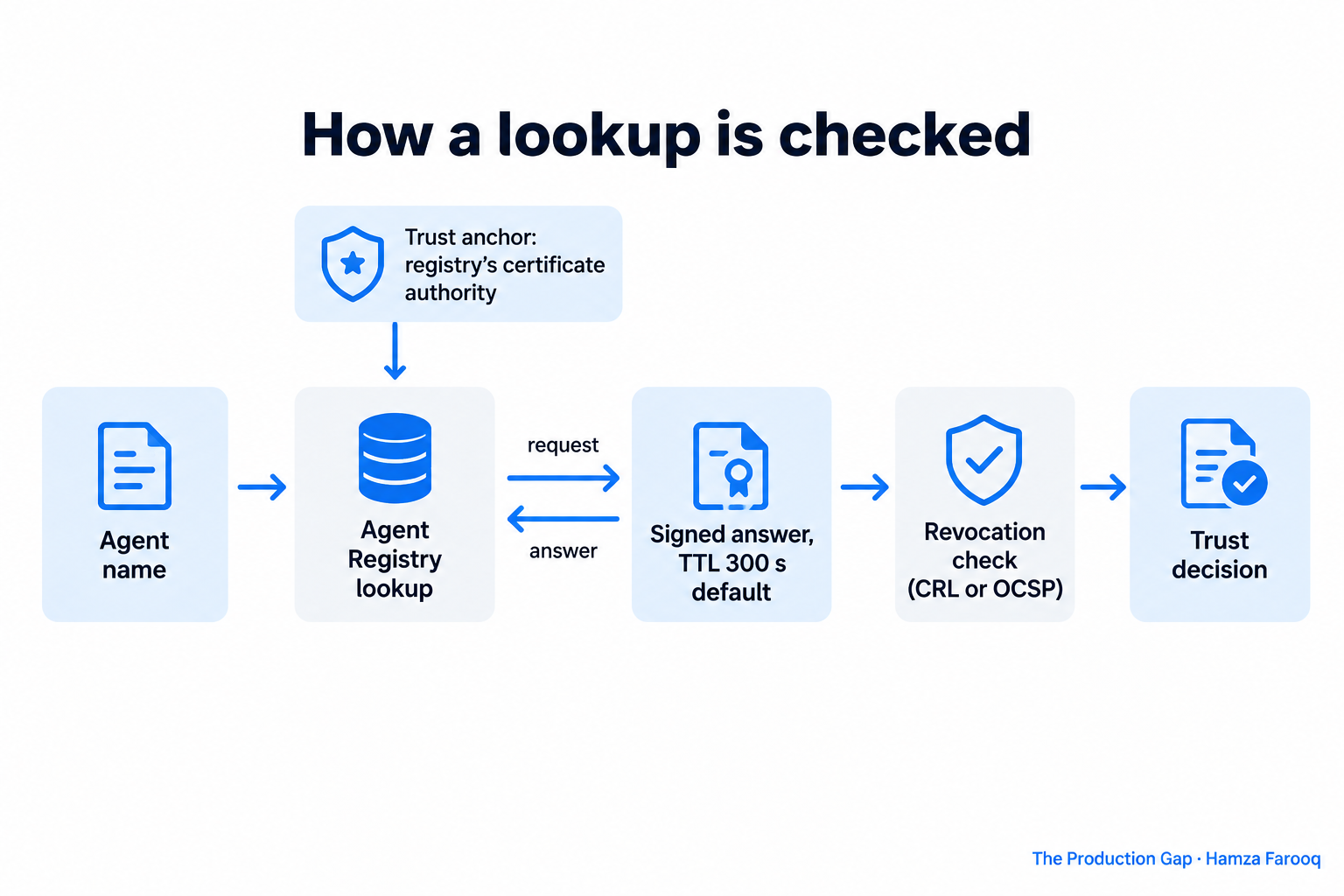
One caveat applies to the details. CSA states that the concrete DNS record encoding and the DNSSEC deployment profile were not yet specified in the primary sources it reviewed. Read the seven documents before you plan an implementation, because this article draws on the release, the CSA analysis, InfoWorld and Cloud Native Now, not the spec text.
What does ANS verify, and what does it leave to you?
The release describes provenance checks: which domain owner stands behind an agent and whether its records are authentic and unchanged. It lists no document on authorization or behavior, so those stay with you. The table maps each question a counterparty asks to what ANS provides and what you still own.
| Question you ask | What ANS provides | What you still own |
|---|---|---|
| Who runs this agent? | A name tied to a domain the operator controls, published through DNS | Checking the domain is the one you expected |
| Is the record real and current? | Signed records, certificate checks, integrity monitoring | Revocation timing and a policy for unsigned DNS zones |
| What may it do? | No authorization topic in the release's list | IAM, scopes, approval rules |
| Is it behaving safely? | Nothing in the release's stated scope | Gateways, logging, human review |
June coverage described a broader goal. InfoWorld reports the Foundation saying ANS should let systems verify who an agent represents, what permissions it has, and whether its code stays authentic. The final release lists no permissions document, so do not rely on ANS for authorization until a spec says how.
Why does the Cloud Security Alliance say DNS attacks matter more with agent identity?
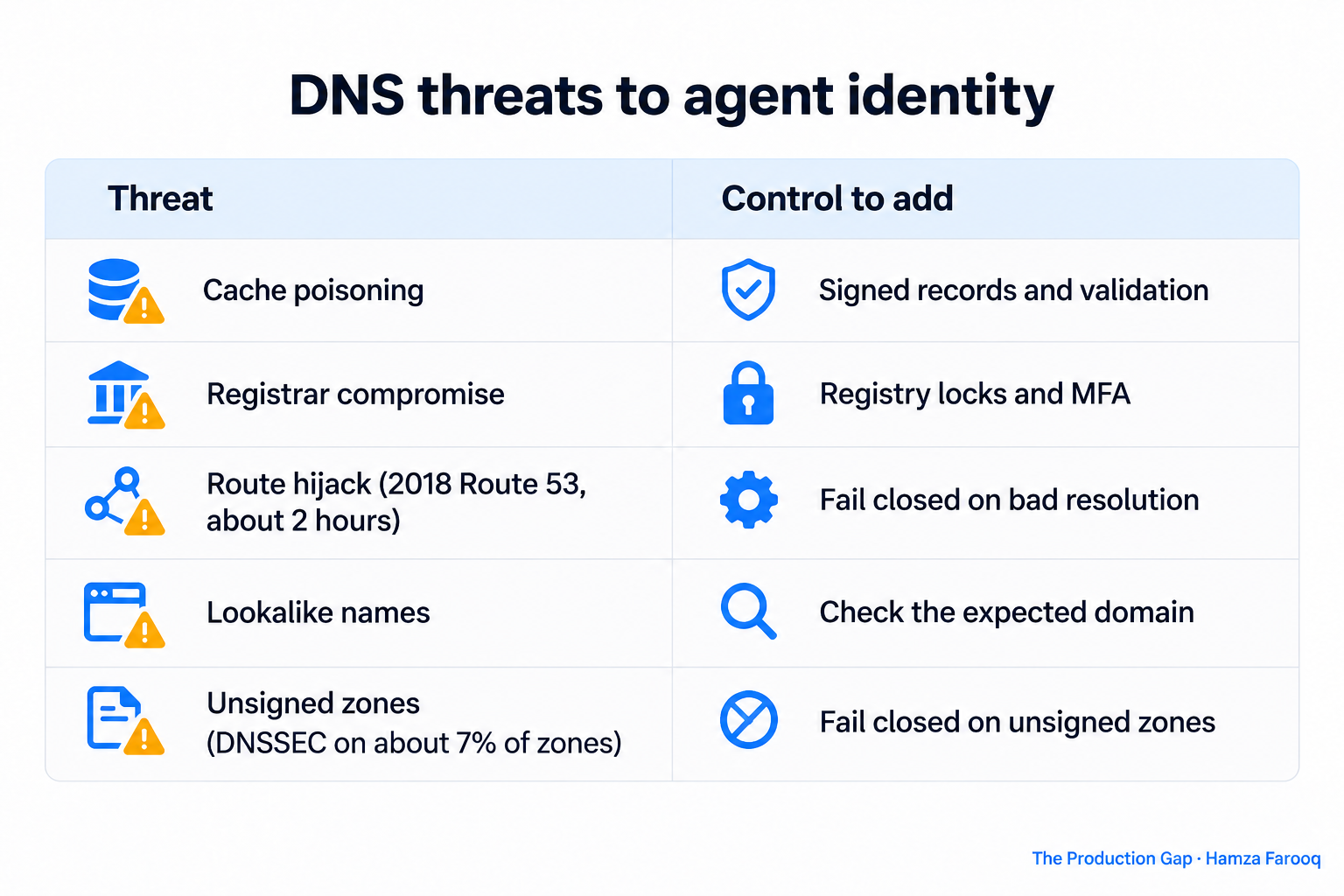
The Cloud Security Alliance argues that classic DNS attacks matter more once software, not people, decides whom to trust. Its analysis says the attacks become more consequential because automated agents make trust decisions programmatically and at scale.
Its threats include cache poisoning and response spoofing, and registrar compromise, which would let an adversary re-point an agent's identity records. A 2018 BGP hijack of Amazon Route 53 redirected DNS resolution to a malicious server for roughly two hours.
The DNSSEC number is the sharpest. CSA says DNSSEC is cryptographically signed on only about seven percent of zones. Its key question is whether ANS mandates signing and validation and fails closed when a name resolves through an unsigned zone.
Analysts quoted by InfoWorld add cautions. Forrester's Charlie Dai told InfoWorld that DNS was not originally designed for high-assurance identity. Gartner's Jaishiv Prakash advises adding IAM, workload identity, AI gateways and API security controls, and says overlap with DNS-AID and AGNTCY is expected at this stage; InfoWorld says the Foundation hosts both. He suggests waiting for clearer interoperability guidance before treating any one initiative as strategic infrastructure.
What should a team building agents do now?
Use ANS as an identity input and keep your own controls in front of every agent action. Inventory the agents that call outside your boundary and the domains you would register for them. Decide what happens when a counterparty's name resolves through an unsigned zone, and default to fail closed. Keep authorization in your IAM and gateway layer, scoped per agent, so a verified identity never implies permission. Log each identity check so a hijack leaves a trail.
If you publish agents, treat your registrar account as production infrastructure, with multi-factor sign-in and registry locks where offered. If you only consume agents, test verification on a low-risk workflow first.
Frequently Asked Questions
What is Agent Name Service (ANS)?
ANS is an open standard for identity, verification and discovery of AI agents, built on DNS. The Linux Foundation announced it as a project on 10 November 2026. Agents are registered and published through DNS so others can verify who runs them.
Does ANS replace OAuth or other agent authentication?
No. The topics the release lists for its seven documents include no authorization, and I did not read the spec text. You still need IAM and policy to decide what a verified agent may do.
Is DNS secure enough to anchor agent identity?
Not on its own. The Cloud Security Alliance says DNSSEC signs only about seven percent of zones and asks whether ANS mandates signing and fails closed on unsigned zones. It also lists risks such as registrar compromise.
Who supports ANS?
The release names 11 organizations, including Cisco, Cloudflare, DigiCert, GoDaddy, Infoblox, Salesforce and OWASP. They are announced supporters, and I could not verify how deeply any of them has deployed it.
Conclusion
ANS gives agents a verifiable answer to "who is behind you?", using a domain you already own. It is early, and the release lists no permissions document. Adopt it for identity, require signed DNS, and keep authorization in the systems you already trust.
Learn from me

Agent Engineering Bootcamp: Developers Edition, my Maven cohort. Advanced agentic RAG, multi-agent orchestration, memory, evals, and guardrails. Take agents from prototype to production. Join the next cohort →
Hire us
Traversaal.ai. We're a team of forward deployed engineers solving the toughest AI problems for Fortune 100 companies: document intelligence, agentic data platforms, and real-time web intelligence, deployed in production. Work with our team to deploy your next agentic ecosystem. Talk to Traversaal.ai →
Join us
Want to solve these problems with us? We're always looking for forward deployed engineers who want to ship production AI. jobs@traversaal.ai